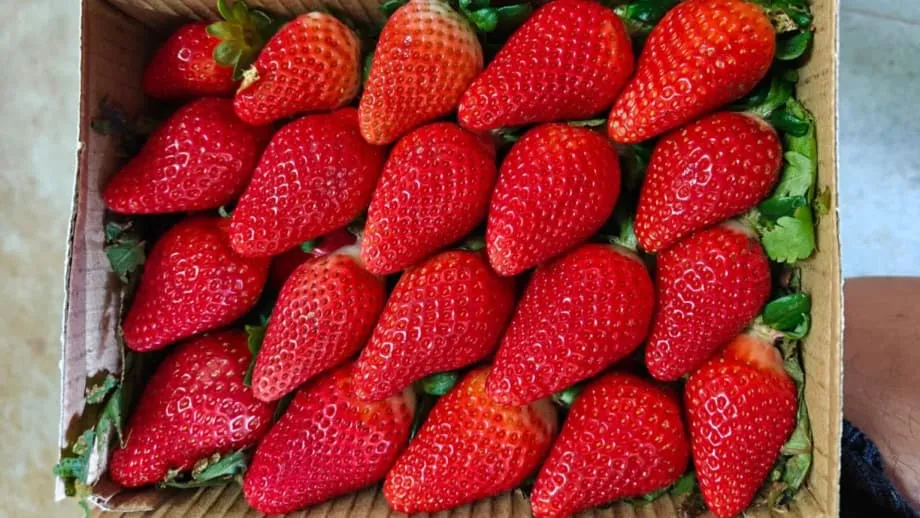
A Strawberry Heartland With an Imported Foundation
Mahabaleshwar produces about 85 percent of India's strawberries, yet the plants behind this crop still depend on varieties developed abroad. As of August 5, 2026, India has no domestically developed strawberry variety. Scientists are working toward one, while farmers are using protected growing systems, weather forecasts and direct sales to manage the risks they face today.
Contents
- A Strawberry Heartland With an Imported Foundation
- The Cost of Starting Again Each Season
- How Foreign Mother Plants Reach Indian Fields
- A Local Variety Is a Long Project
- Punjab Adds Another Route to Breeding
- Protected Growing Extends the Season
- Weather Towers and Vertical Growing Change Farm Decisions
- A Small Farm Finds Another Way to Sell
- Overseas Breeding and a Growing Market
- Key Points
The mountainous region in western India sits above 1,000 metres. Its elevation provides a cool growing window from November to March, while light soil that drains well suits the delicate plants. These conditions have made Mahabaleshwar the centre of a crop that ranks among the most profitable horticultural options in western India.
Thousands of small farms depend on strawberry cultivation. Their income, however, rests on more than favourable soil and cool weather. Sudden heavy rain can destroy an entire field, and growers must keep investing in replacement plants. Foreign breeding programmes supply the genetic foundation, while local farmers carry the immediate cost and weather risk.
India's response has several parts: developing a variety suited to local conditions, improving growing advice, protecting plants from weather and helping farmers sell their harvest more directly. Each addresses a different part of the same problem. A new cultivar, meaning a cultivated plant variety, is a long project; growers need ways to keep their farms productive while that work continues.
The Cost of Starting Again Each Season
Sheetal Danavle and her husband operate a farm covering three acres, with half the land devoted to strawberries. They replace their strawberry plants each season at a cost of around $2,500. A good harvest can double that investment, but bad weather makes the outcome a gamble.
The replacement bill gives a concrete measure of the pressure on a small farm. Money goes into planting before the family knows how the season will turn out. Heavy rain can then undo the work across the field, leaving the investment exposed to conditions the growers cannot control.
Danavle's experience also shows why technology alone is not a simple answer. She has tried hydroponics, returned to open fields after a cyclone and developed another source of opportunity through social media. Her choices reflect the need to balance growing methods with the cost of recovering when a season goes wrong.
How Foreign Mother Plants Reach Indian Fields
India imports strawberry mother plants mainly from California, Florida, Italy and Spain. These plants provide the starting material that nurseries multiply for farmers. Overseas breeders take 10 to 15 years to develop leading varieties and hold patents on them.
Nelson Sequeira of Tara Farms Fresh describes a process that begins with certified mother plants arriving under quarantine. Nurseries then multiply them into daughter plants for sale to growers. Under advanced conditions, one mother plant can produce 20 to 40 runners, the growth through which the plants are multiplied.
Nursery technology makes that multiplication possible on a substantial scale. Plants grow in industrial pipes cut in half and filled with coco-peat, a growing material made from coconut husks. Precise drip irrigation supplies water, while fogging systems help maintain the small growing environments around the plants, known as microclimates.
These systems improve the way planting material is produced locally, but their starting genetics still come from abroad. India can multiply imported varieties using sophisticated equipment while continuing to depend on overseas breeding for the mother plants.
A Local Variety Is a Long Project
Scientists at Mahatma Phule Krishi Vidyapeeth are working with the Bhabha Atomic Research Centre to develop India's first climate-resilient strawberry cultivar. Their aim is a plant that can handle local heatwaves while producing fruit that is both large and firm.
The programme applies low doses of gamma irradiation to plant tissues as part of the breeding process. Its goal brings together qualities that matter at different stages of production: tolerance of local growing conditions and the size and firmness of the harvested fruit.
Dr Darshan Shashank Kadam says results may take 10 to 15 years. No specific release date has been given. The timescale is comparable to the 10 to 15 years that overseas breeders take to create leading varieties, making domestic breeding a sustained effort rather than an immediate replacement for imports.
Mahatma Phule Krishi Vidyapeeth's team is also helping growers with decisions they can use now. It supplies updated planting schedules and fertiliser guidance tailored to Mahabaleshwar's conditions. That work connects the longer breeding programme with the practical demands of each growing season.
Punjab Adds Another Route to Breeding
Punjab Agricultural University has secured funding through the QUAD initiative for work using image-based phenotyping and multi-omic tools. Strawberries are among the crops included in the programme, which seeks faster genetic gains for resilient varieties.
Image-based phenotyping uses images to assess observable plant traits. Multi-omic tools examine several kinds of biological information together. In this programme, the methods are intended to help researchers advance breeding toward plants better able to cope with difficult conditions.
The Punjab initiative and the work involving Mahatma Phule Krishi Vidyapeeth and the Bhabha Atomic Research Centre use different approaches toward a shared goal: stronger crop varieties. For strawberry growers, the immediate position remains unchanged. A domestic cultivar is still under development, while imported varieties support current production.
Protected Growing Extends the Season
Ketan Yashwant Sodha of Berry Fresh Agrotech moved toward hydroponics and polyhouses after repeated rain damage during peak growing months. His early hydroponic trials failed, but lessons from those attempts eventually led to success.
Hydroponics gives growers a way to manage water and nutrients through a controlled growing system. Polyhouses provide a protected growing space. At Berry Fresh Agrotech, semi-open polyhouses now allow production throughout the year, extending cultivation beyond Mahabaleshwar's usual cool window from November to March.
Sodha's team is testing 19 varieties, including rare Japanese types and a line from the Netherlands. It limits water to 75 millilitres per plant each day to concentrate sugars and aromas. Regular tests of leaves and petioles, the stalks connecting leaves to the plant, guide nutrient delivery.
The combination makes production a closely managed process. Variety testing, water limits and plant testing all contribute to decisions about how the crop is grown. Sodha's experience also shows that reaching this stage involved failed trials before the system worked successfully.
Berry Fresh Agrotech plans to expand to a site covering five acres with 200,000 plants. At that planned scale, the figures work out to 40,000 plants per acre. Standard operating procedures and farm manuals have already been prepared for investors, setting out how the operation is intended to run.
Weather Towers and Vertical Growing Change Farm Decisions
Krishan Bhilare recalls American strawberry varieties arriving in 1992. His farmer network now uses data from four weather towers to forecast rain and adjust spraying schedules. Farmer producer groups are adopting weather towers and artificial intelligence as tools for managing cultivation.
The practical value lies in timing. Rain forecasts help growers decide when to spray, turning weather information into a decision about work in the field. The towers address an immediate production risk, while breeding programmes address the longer task of developing plants suited to local conditions.
Vertical growing tackles a different constraint: the amount of land available. Towers with five layers of coco-peat substrate increase plant density fivefold on the same area. Instead of placing every plant at one level, growers use several levels of growing space.
The weather and vertical systems serve separate purposes. One helps organise farm operations around expected rain; the other allows more plants to occupy the same land. Both show how organised groups are changing cultivation while the crop continues to rely on imported genetics.
A Small Farm Finds Another Way to Sell
Danavle tried hydroponics in 2017 and achieved full success with organic production and reduced labour. A cyclone destroyed the setup that same year. She returned to open-field cultivation, illustrating the financial exposure that remains when a small farmer invests in new equipment.
Danavle then added social media outreach to her farming work. Her videos invite visitors to pick strawberries directly at the farm. Selling directly reduces the role of intermediaries and boosts income, giving her another way to improve the business without relying solely on a different growing system.
She now combines traditional cultivation with influencer activities. Her experience connects several stages in the region's changing strawberry economy, from imported varieties to experiments with protected production and new sales channels.
Key dates in that development include:
- 1992: American strawberry varieties arrived, according to Krishan Bhilare's recollection.
- 2017: Danavle successfully tried hydroponics before a cyclone destroyed the setup that year.
- August 5, 2026: Domestic breeding remains underway, while growers use imported plants, protected systems and direct sales.
Overseas Breeding and a Growing Market
Singapore-based Singrow provides an international parallel. It has developed a climate-resilient strawberry through genomics and precision methods. The variety achieves high Brix levels without fungicides and supports production throughout the year under controlled conditions. Brix is a measure used to describe sugar concentration.
Singrow's work brings together several aims also visible in India's efforts: resilience, fruit quality and control over the growing season. Indian researchers are pursuing local heat tolerance, while protected cultivation businesses are testing varieties and managing water and nutrients to improve production.
The wider plant breeding market is projected to grow from $18.8 billion in 2025 to $62.8 billion by 2035, with a compound annual growth rate of 12.8 percent. The projected total for 2035 is more than three times the 2025 figure. Demand for fruit and vegetable varieties adapted to climate conditions is driving investment across Asia.
Broader breeding trends place increasing attention on stable yields and tolerance of stress in fruit and vegetable crops. For Mahabaleshwar's thousands of small farms, those aims connect directly to the need for a dependable harvest. Local genetics, protected cultivation, timely weather information and direct selling address different parts of that need, with domestic breeding still years from its expected results.
Key Points
- Mahabaleshwar produces about 85 percent of India's strawberries, with a cool growing window from November to March.
- India has no domestically developed strawberry variety and imports mother plants mainly from the United States, Italy and Spain.
- Mahatma Phule Krishi Vidyapeeth and the Bhabha Atomic Research Centre are pursuing a local cultivar, with results expected to take 10 to 15 years.
- Punjab Agricultural University has QUAD funding for breeding tools applied to strawberries and other crops.
- Berry Fresh Agrotech tests 19 varieties and plans a site covering five acres with 200,000 plants.
- Four weather towers help Krishan Bhilare's network plan spraying, while vertical systems increase plant density fivefold.
- Sheetal Danavle combines open-field farming with social media and direct sales after losing a hydroponic setup to a cyclone in 2017.
- The global plant breeding market is projected to reach $62.8 billion by 2035, up from $18.8 billion in 2025.