A new chapter for Assam tea
India has entered the commercial matcha market, with the first locally produced batch sold at the Guwahati Tea Auction Centre in Assam on July 3, 2026. The tea came from Chota Tingrai Tea Estate in Tinsukia district, where a family owned operation has spent years adapting Japanese methods and machinery to Assam’s native tea plants.
- A new chapter for Assam tea
- Why matcha is different from ordinary green tea
- How Japanese expertise was adapted to Assam
- Matcha assamica seeks its own identity
- A growing market at home and abroad
- Why diversification matters to India’s tea estates
- Quality and authenticity will shape the next phase
- Key Points
The first lot consisted of five kilograms and sold for Rs 3,000 per kilogram through auctioneer J Thomas & Co. Pvt Ltd. Guwahati based Sheosons Chai Co. bought the batch. Current auction prices for the estate’s matcha are reported at between Rs 3,000 and Rs 3,800 per kilogram.
The sale marks a major change for a state known around the world for strong black tea. It also gives India a domestic source for a product that has recently become popular in cafes, bakeries and wellness businesses. Matcha lattes, desserts and other food products have spread across Indian cities, where most supplies previously came from East Asia.
Assam Chief Minister Himanta Biswa Sarma described the launch as a new stage in the state’s tea history and linked the project to India’s long collaboration with Japan. The production milestone comes as Indian tea estates face rising costs, ageing bushes, unstable weather and pressure from cheaper imports.
Why matcha is different from ordinary green tea
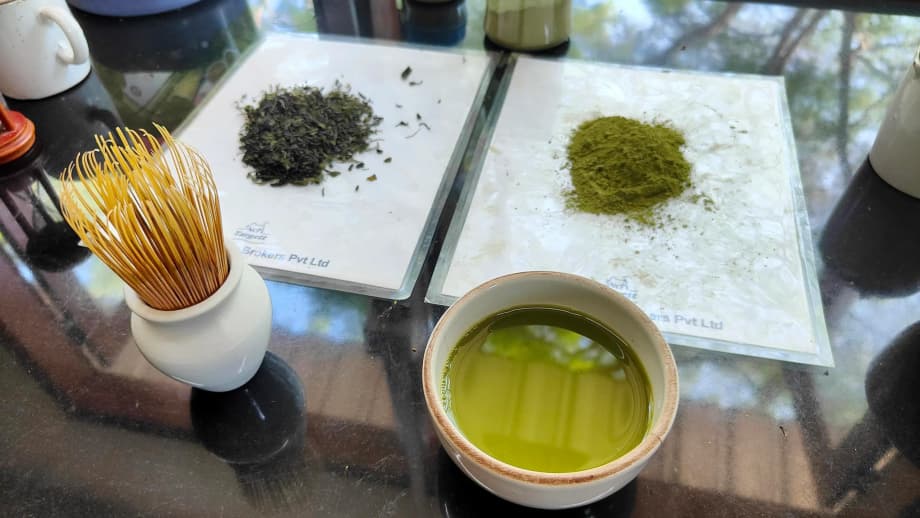
Matcha is a finely ground green tea powder. With regular green tea, hot water extracts compounds from the leaves, which are then discarded. Matcha is whisked directly into water, so the drinker consumes the whole leaf.
That difference makes the production process more exacting. In Japan, bushes are commonly covered for several weeks before harvest, limiting sunlight and encouraging higher levels of chlorophyll and L theanine. This helps create matcha’s vivid green colour, smooth texture and savoury taste, often described as umami.
After harvesting, the leaves are steamed to stop oxidation. Stems and veins are removed, leaving a material known as tencha. The tencha is dried and ground into a very fine powder, traditionally using slow stone mills. The finished tea is then whisked into hot water or used in drinks, confectionery and cooked foods.
Because the entire leaf is consumed, bitterness and processing defects are more obvious than they are in a brewed tea. Mrigendra Jalan, whose family owns Chota Tingrai, explained why controlling the flavour was central to the project.
Matcha is the only form of tea where you are ingesting the entire leaf, so you can’t have something that is too bitter.
Assam’s native Camellia sinensis assamica is valued for the bold taste it brings to black tea. That strength, however, can become harsh when the leaf is powdered and consumed whole. The estate therefore had to find a cultivar and processing method that could retain colour and useful compounds while softening the tea’s astringency.
How Japanese expertise was adapted to Assam
Chota Tingrai’s matcha project grew from a decade long partnership involving Japanese tea manufacturers, agronomists, equipment suppliers and tea specialists. The estate installed a fully automated Japanese style factory, with machinery designed for the local tea crop. Kawasaki Kiko, a Japanese tea machinery company, was among the partners involved in the technical work.
Masanori Yanagawa, a Japanese tea consultant and certified tea instructor, worked with the Jalan family for more than three years. The partnership began with green tea production and reached its first experimental matcha batch in 2017. That trial showed that matcha could be made from an Indian tea variety rather than from the small leaf Japanese plants traditionally associated with the drink.
The estate selected Tinali 17 for commercial production because of its high polyphenol and amino acid content, along with its strong green colour. Reports also identify TV9 as one of the indigenous Assam varieties used in the wider matcha programme.
Fresh leaves are steamed and then passed through several drying cycles in gas powered dryers. Each cycle uses a lower temperature while the leaves are rolled. The process is designed to remove moisture gradually and reduce the loss of colour, antioxidants and other natural compounds. The dried tencha is cooled before being milled in small batches for more than 12 hours to produce the final powder.
The estate also tested Yabukita, one of Japan’s best known tea varieties. It did not perform well in Assam’s hot conditions and was less resistant to local pests than native plants. The experience reinforced the value of working with Assam’s own tea genetics instead of attempting to copy Japanese cultivation in a different climate.
Matcha assamica seeks its own identity
Chota Tingrai is calling its product Matcha assamica rather than presenting it as a substitute for Japanese matcha. The distinction reflects differences in plant type, soil, climate and cultivation methods. Japanese matcha is often made from Camellia sinensis sinensis, a small leaf plant grown in cooler regions. Assamica is a larger leaf variety suited to Assam’s warm, low altitude tea gardens.
Those differences produce a different cup. Mrityunjay Jalan, the estate’s fourth generation owner, said Japanese matcha often has a strong umami character and pronounced grassy notes. The Assam product retains vegetal flavours but is described as less astringent, with a sweeter aftertaste.
Jalan believes that profile could attract consumers who are curious about matcha but find traditional versions too intense. He sees the tea as a possible first step for new drinkers before they move to stronger grades.
It can be an entryway for people to start drinking a lighter variety of matcha and then maybe move on to a stronger grade of matcha.
For Japanese tea professionals involved in the project, the product has a separate place in the market. Yanagawa said matcha made from Japanese varieties and Japanese cultivation methods cannot be reproduced exactly in Assam. He also said matcha style green tea products made elsewhere could meet demand if they deliver consistent quality and the characteristics consumers expect from powdered green tea.
That approach gives the Assam product room to develop its own reputation. Rather than competing directly with ceremonial Japanese matcha, Matcha assamica could be aimed at lattes, iced beverages, ice cream, cakes and other culinary uses where a robust flavour can work well.
A growing market at home and abroad
Matcha’s popularity has expanded far beyond Japanese tea ceremonies. Cafes now use it in hot and cold drinks, while food companies add it to doughnuts, chocolates, biscuits and health products. In India, the powder has appeared in ladoos, dosas and other products that combine a global trend with familiar local foods.
Indian demand is projected in the supplied industry reporting to reach about US$167 million by 2030. Global demand has also grown faster than production in traditional supply centres, creating shortages and higher prices. Japan remains the leading producer and consumer, while China, Vietnam, Taiwan and South Korea are also important sources.
Chota Tingrai’s first commercial output is modest. The estate produced about 250 kilograms of matcha during 2026 and plans to reach between 200 and 300 kilograms a month. Its gardens produce roughly three million kilograms of tea each year, including about 130,000 kilograms of green tea. Matcha is still a small part of that business, yet its price and market attention make it attractive.
The estate has identified the United States, Europe and West Asia as possible export markets. Other major matcha import destinations include Canada, the United Kingdom, Germany, Australia, Singapore and South Korea. Domestic cafes and food manufacturers may provide an earlier customer base while production volumes and quality controls develop.
Why diversification matters to India’s tea estates
India has a tea history stretching back more than two centuries, yet black tea remains the centre of its production and exports. Assam’s conventional output includes orthodox tea and CTC tea, a method in which leaves are crushed, torn and rolled into small pieces for strong brews.
That business faces several pressures. Labour and energy costs are rising, many tea bushes are ageing, yields have fallen in some gardens and extreme weather is becoming more frequent. Auction prices have often failed to keep pace with expenses, while cheaper imported tea adds competition.
Speciality teas can provide an alternative because they are sold on flavour, origin and processing rather than volume alone. Assam and neighbouring Manipur already have producers making fermented and raw teas inspired by Pu’er styles. Darjeeling estates have experimented with Yabukita, combining Japanese plant genetics with Indian growing conditions.
The Jalan family spent more than US$1 million on its green tea and matcha factory, which has a reported processing capacity of about 800 kilograms a day. That is a large investment for a product whose commercial record began with a five kilogram auction lot. The business case depends on building repeat orders, maintaining consistent quality and persuading buyers that Indian matcha deserves a place beside established Japanese products.
For tea workers and growers, successful diversification could create demand for different skills, equipment and leaf standards. It could also encourage estates to invest in processing rather than selling most of their harvest as a bulk commodity. Those gains will depend on careful planning, since matcha production requires precise timing, specialised machinery and strict quality checks.
Quality and authenticity will shape the next phase
The first auction has proved that Assam can make and sell commercial matcha. It has not yet proved that the product can be produced at scale with the same colour, taste and texture from one batch to the next. Consistency will be central to export contracts and to the confidence of cafe chains and food manufacturers.
Growers must also manage the tension between tradition and innovation. Japanese matcha has a long cultural history, with established grades, preparation methods and regional identities. Assam’s product will need to be transparent about its plant variety and production process while building a distinct Indian identity.
That distinction may become an advantage. A smoother, less bitter powder could work well in milk based drinks and recipes, while Assam’s strong tea heritage can give the product a clear origin story. The combination of local cultivars, Japanese equipment and Indian processing conditions creates a category that is related to matcha without claiming to be identical to the Japanese original.
The Guwahati auction has given that category its first public commercial price and its first buyer. The next test will come from repeat sales, consumer response and the estate’s ability to reach its monthly production target. If those steps succeed, other Indian tea gardens may begin testing their own matcha style products.
Key Points
- Chota Tingrai Tea Estate in Assam produced India’s first commercial matcha batch.
- A five kilogram lot sold at the Guwahati Tea Auction Centre for Rs 3,000 per kilogram.
- Guwahati based Sheosons Chai Co. bought the first commercial lot.
- The tea uses indigenous Assam varieties, including Tinali 17, with Japanese processing equipment and technical support.
- The estate brands the product Matcha assamica to distinguish it from traditional Japanese matcha.
- Production is expected to reach between 200 and 300 kilograms a month.
- The project gives India a new speciality tea product as its industry faces rising costs and pressure on black tea prices.