The Ocean Obstacle: When Fishing Fleets Become Floating Barriers
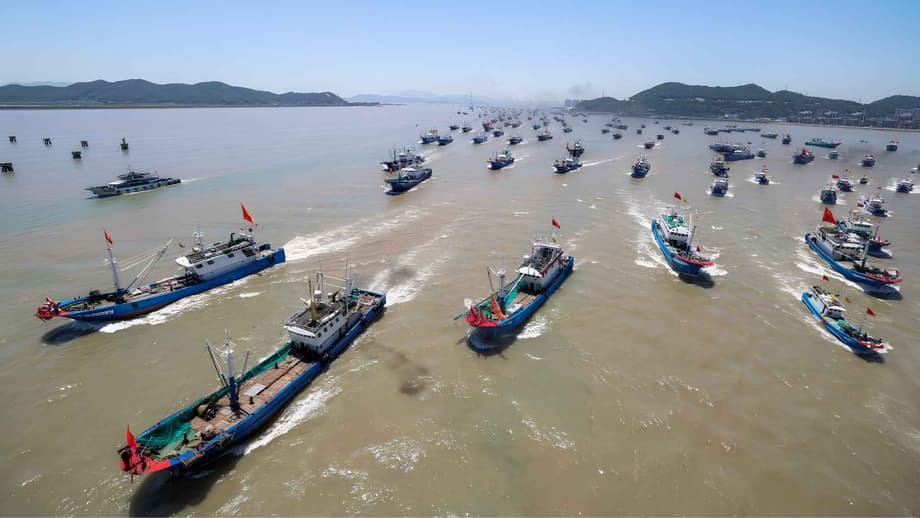
On January 11, vessel tracking screens across the East China Sea displayed an unusual pattern. Approximately 1,400 Chinese fishing vessels gathered in a formation stretching more than 200 miles, creating a floating barrier across one of the most sensitive waterways in Asia. Commercial captains faced a sudden choice: bypass the area entirely or zigzag through a congested corridor where a single collision could trigger an international incident. This was not a one time anomaly. Two weeks earlier, on Christmas Day, roughly 2,000 Chinese fishing boats arranged themselves into two parallel lines spanning about 290 miles in an inverted L shape that dominated the same contested waters. An American congressional commission later described these mobilizations as a new gray zone threat, noting that such formations could reveal a potential tactic for a future blockade or invasion scenario involving Taiwan. To nearby ships, the pattern was not merely a strange blip on a screen. It was a traffic jam spread across open water, where one wrong move could mean disaster.
- The Ocean Obstacle: When Fishing Fleets Become Floating Barriers
- Beijing Explanation and the Limits of Tracking Data
- Inside the Gray Zone: Where Civilian and Military Lines Blur
- Pressure Points From Taiwan to the South China Sea
- The Global Reach of Dark Fleets and Distant Water Operations
- Environmental and Economic Costs Beneath the Surface
- Responses and the Challenge of Ambiguity
- Key Points
The bigger worry extends beyond pure military strategy. The East China Sea compresses fishing fleets, disputed borders, commercial routes, and stressed marine ecosystems into the same patch of ocean. A vessel that looks like a trawler on radar might serve purposes that have little to do with seafood. When hundreds of boats hold position in geometric alignment, they can slow movement, confuse radar screens, force detours, and make it harder for other ships to know who is simply fishing and who may be following orders. The formations stretched around 200 to 290 miles and involved thousands of vessels, presenting a practical navigation challenge that rippled through commercial shipping schedules.
Beijing Explanation and the Limits of Tracking Data
Chinese officials strongly reject the idea that the activity was military in nature. The Chinese Embassy in Washington stated that the East China Sea remains an important fishing area and that November through February marks the peak winter fishing season. Embassy spokesperson Liu Pengyu said the following regarding the concentration of boats.
It is therefore normal to see a high concentration of fishing boats operating at sea during this time.
Chinese state media has made similar arguments, pointing to fishing seasons, fish finding technology, and traditional grounds near Zhoushan as explanations for large groups of boats. This explanation does not settle the debate, but it serves as a reminder that the same patch of ocean can look very different depending on who is reading the data. Public vessel tracking data can reveal patterns, yet it does not prove the exact role or orders of every vessel at sea. The geometric precision and density of the Christmas Day and January 11 formations, however, have left many maritime analysts searching for alternative explanations beyond seasonal fishing.
Inside the Gray Zone: Where Civilian and Military Lines Blur
The term gray zone refers to the space between normal civilian activity and open military conflict. In maritime strategy, it allows a state to apply pressure, obstruct movement, and assert control without firing a shot or raising a naval ensign. Fishing vessels are particularly useful in this space because they combine legal protections under international maritime law with the ability to confuse radar operators and overwhelm coast guard resources. Under the International Regulations for Preventing Collisions at Sea, known as COLREGs, naval vessels face restrictions on interfering with boats actively engaged in fishing. Analysts note that China has used this legal framework to create maneuvering room for its fleets, a tactic some describe as lawfare.
The strategy rests on a broader architecture of power. China currently commands the largest navy in the world, the largest coast guard in the world, and what researchers call the largest maritime militia in the world. Officially labeled the People Armed Forces Maritime Militia, or PAFMM, this force is defined by Beijing as an armed mass organization composed of civilians who keep their regular jobs. It is considered both a component of the armed forces of China and an auxiliary reserve force of the PLA. Paramount leader Xi Jinping has personally championed the expansion of these maritime militia forces since declaring a maritime power strategy in 2012, visiting fishing villages in Hainan Province to underline the importance of protecting sovereign claims.
Analysts often describe the integration of the PLA Navy, China Coast Guard, and maritime militia as a three sea forces structure. In this model, civilian vessels form the outer ring of presence and friction, while coast guard and naval forces wait in reserve as escalation options. This layered approach makes it difficult for neighboring states to respond without appearing to overreact against civilian boats. Victor Cha, president of the Geopolitics and Foreign Policy Department at the Center for Strategic and International Studies, said China actions are carefully calibrated to strengthen regional control without triggering war.
Pressure Points From Taiwan to the South China Sea
Around Taiwan, the gray zone fleet has become a persistent instrument of pressure. Throughout 2025, Beijing increased the use of civilian and paramilitary vessels to probe the defenses of the island below the threshold of formal conflict. Large fleets of sand dredgers and fishing boats have repeatedly appeared near the Matsu islands, sometimes numbering in the hundreds and stretching the patrol capacity of the Taiwanese Coast Guard to its limit. After a fatal incident involving a Chinese speedboat near Kinmen in February 2024, Beijing intensified coast guard patrols and framed them as routine law enforcement, gradually normalizing a Chinese presence in waters long administered by Taiwan.
Critical infrastructure has also come under pressure. In early 2023, two undersea internet cables serving the Matsu islands were severed within days of each other, leaving residents with degraded connectivity for weeks. More recently, authorities in Taiwan detained the cargo ship Hong Tai 58 and prosecuted its captain for intentionally damaging a cable linking Taiwan to the Penghu Islands. While intent is not always provable, such incidents expose vulnerabilities in maritime digital infrastructure and demonstrate how commercial shipping networks can be used for strategic signaling.
The South China Sea has witnessed even more direct confrontations. Researchers have documented 270 specific incidents of harassment and assault by Chinese maritime militia vessels against regional states since 2012. In March 2021, more than 200 Chinese vessels anchored in a tight formation at Whitsun Reef inside the Philippine Exclusive Economic Zone, remaining stationary for weeks without casting nets. In 2014, Chinese Coast Guard personnel allegedly used axes and physical violence against Filipino resupply boats near Second Thomas Shoal, injuring a serviceman. In February 2026, a routine Philippine maritime patrol over Scarborough Shoal was met with 28 separate radio challenges from a PLA Navy vessel, followed by the appearance of a Chinese military jet. Jay Tarriela, spokesperson of the Philippine Coast Guard, disclosed the radio challenge incident, which signaled deliberate and calibrated messaging.
Indonesia has faced similar tests in the North Natuna Sea. A survey in March 2024 found that 73 percent of Indonesians perceive Chinese actions in the South China Sea as a threat. Despite economic ties worth over 135 billion dollars, Jakarta has seen repeated incursions by Chinese research vessels and coast guard ships, with Beijing increasingly asserting traditional fishing rights inside Indonesian waters. Chinese vessels also conducted prolonged seabed mapping activities and demanded that Indonesia halt drilling exercises in Natuna waters, reflecting a measured strategy aimed at encouraging tacit acceptance of what Beijing defines as its maritime rights.
The Global Reach of Dark Fleets and Distant Water Operations
The challenge is not confined to Asian waters. The distant water fishing fleet of China, the largest on earth, now operates across the Indian Ocean, the South Atlantic, and the Pacific. One estimate suggests that China controls more than 57,000 industrial fishing vessels and accounts for roughly 44 percent of all visible global fishing activity across more than 90 countries. These vessels frequently operate in clusters near the edges of foreign Exclusive Economic Zones, sometimes switching off their Automatic Identification System transponders to evade detection, a practice known as dark shipping.
In the Indian Ocean, Chinese trawlers have intensified activity around the maritime zones of India, including the Bay of Bengal, the Arabian Sea, and waters near the Andaman and Nicobar Islands. Indian naval monitoring has recorded surges in high risk vessels, illegal fishing incidents, and dual use operations, with trawlers shadowing military exercises and moving nocturnally through sensitive channels. In the South Atlantic, Argentina has observed roughly 200 Chinese squid fishing vessels operating near its waters, with the flotilla growing by nearly 50 percent over the last decade. Argentine and American officials have expressed suspicions that some vessels carry antennas inconsistent with fishing activities and may conduct unauthorized seabed mapping. Washington has helped Argentina improve maritime surveillance, including approving purchases of P3C Orion aircraft, to protect against illegal fishing and monitor foreign fleet behavior.
These fleets often patrol for months alongside refuelling ships, maneuvering with Chinese Coast Guard or PLAN warships trailing behind. In June 2025, the Philippine Coast Guard reported more than 50 Chinese maritime militia vessels swarming Rozul Reef within the Philippine Exclusive Economic Zone. Between 2021 and 2023, Ecuador tracked around 510 Chinese fishing boats operating near the Galapagos EEZ, with many vessels going dark simultaneously and raising alarms about intelligence gathering and ocean mapping.
Environmental and Economic Costs Beneath the Surface
Beneath the strategic calculations lies a living ecosystem under severe strain. Several studies suggest the East China Sea is already under heavy pressure from fishing and management challenges. A 2022 study in Frontiers in Marine Science said China introduced measures such as seasonal fishing moratoriums, zero growth policies, and minimum mesh sizes because of depleted fishery stocks. The same study found signs of slow ecosystem recovery, but warned that fishing pressure after seasonal closures still needs to be reduced. Another study, published in 2023, examined chub mackerel and conger in the East China Sea. Its conclusion was direct; both fishery populations were overfished and declining, which means management should become more conservative.
Large fleets also bring practical environmental concerns that extend beyond fish stocks. When hundreds or thousands of boats gather, hold position, and then disperse, they add engine noise, fuel use, collision risk, and extra pressure on waters that are already politically tense. A 2024 Marine Policy study found that Chinese gray zone actions in the East China Sea, Taiwan Strait, and South China Sea can affect fisheries by reducing fishing space and lowering catch volumes. For coastal communities, this is not an abstract issue. It can mean fewer safe places to work and fewer fish reaching docks. In Argentina, squid specialist Marcela Ivanovic stated that Chinese fleets are fishing savagely in the area, depleting stocks that local industries depend upon.
Chinese claims of responsible behavior stand in contrast to a documented pattern of deception and rule evasion. The Chinese state provides an estimated 7.2 billion dollars in subsidies to distant water fleets, including for fishing and oceanographic intelligence gathering. Workers on some vessels are tasked solely with enforcing blockades and using intimidation tactics rather than engaging in fishing. This convergence of commercial extraction and state coercion turns civilian vessels into instruments of gray zone power while depleting marine resources worldwide.
Responses and the Challenge of Ambiguity
Countering this strategy requires recognizing that the Chinese gray zone fleet is not merely a fisheries management issue but a deliberate instrument of statecraft. Improving maritime transparency should be a priority. Integrating satellite imagery, AIS tracking, and radar monitoring can help identify suspicious vessel behavior and patterns of coordinated activity. Taiwanese security partners should focus on protecting critical infrastructure, particularly subsea cables, by strengthening monitoring along cable routes and improving rapid repair capacity. Enhanced surveillance tools, operational cooperation, and legal frameworks for maritime enforcement would help Taiwan and other regional partners respond to large numbers of civilian vessels without escalating incidents into military confrontation.
The United States and regional allies have several diplomatic and operational options. Enhanced cooperation on fishing rights and enforcement of international law in territorial waters, including under the United Nations Convention on the Law of the Sea, remains essential. Sharing intelligence assets and using diplomatic back channels across the Indo Pacific can help counter maritime militia forces backed by Beijing without direct confrontation. Identifying the bases and ports where maritime militias stage operations, along with their commanders, could provide actionable intelligence for targeted sanctions and restrictions. Strengthening the coast guards of partner nations supports law enforcement and deterrence as China seeks to exploit security gaps. Joint patrols, such as those conducted by Japan, France, and the United Kingdom, increase naval deployments around Indo Pacific flashpoints and demonstrate collective resolve.
Some analysts suggest that a graduated diplomatic warning system could be established. In a wartime scenario, Beijing must be put on notice that fishing vessels acting as extensions of the PLAN will be treated as such following repeated warnings to disperse. By issuing repeated warnings and allowing time for withdrawal, the Chinese Communist Party cannot hide behind COLREGs and risks confrontation if vessels persist in mock blocking maneuvers. Having demonstrated a willingness to disregard international law while selectively weaponizing it, seaborne tactics by China carry risks of direct confrontation should a Taiwan contingency or comparable flashpoint materialize.
Key Points
- Approximately 1,400 Chinese fishing vessels formed a 200 mile barrier in the East China Sea on January 11, following a Christmas Day formation of 2,000 boats that stretched 290 miles in an inverted L shape.
- An American congressional commission described the mobilizations as a potential gray zone tactic that could be used in a future blockade or invasion scenario involving Taiwan.
- China maintains the world largest navy, coast guard, and maritime militia, using a three sea forces structure that layers civilian vessels, coast guard ships, and naval assets to create ambiguity.
- Researchers have documented 270 incidents of harassment and assault by Chinese maritime militia vessels in the South China Sea since 2012, with pressure tactics expanding around Taiwan and Indonesia.
- The Chinese distant water fishing fleet operates globally across the Indian Ocean, South Atlantic, and Pacific, with vessels frequently switching off tracking transponders in a practice known as dark shipping.
- Environmental studies indicate the East China Sea is overfished and declining, while gray zone activities reduce fishing space and lower catch volumes for coastal communities.