PLA Mouthpiece Warns Tokyo Is Hiding Offensive Weapons Behind Defensive Claims
The PLA has accused Japan of taking a dangerous gamble with its plan to deploy satellite aided drones to southwestern islands near Taiwan. In a commentary published Sunday, the PLA Daily said Tokyo maintained that it was building a multilayered coastal defense system, but the equipment carried a distinct offensive nature. While called a shield, it is in reality a spear, the newspaper stated. The remarks represent some of the strongest language from Beijing since Tokyo accelerated its military buildup across the Ryukyu chain, a string of more than 55 islands stretching toward Taiwan. Chinese military officials contend that the combination of long range drones, standoff missiles, and cruise missiles gives Japan the ability to strike deep inside Chinese territory while keeping its own forces out of immediate danger.
- PLA Mouthpiece Warns Tokyo Is Hiding Offensive Weapons Behind Defensive Claims
- The Arsenal Behind the Accusations
- Yonaguni Island Becomes the Front Line
- Allied Exercises and U.S. Force Posture
- Beijing Expands Retaliation Beyond the Military Sphere
- A Historic Shift in Japanese Security Policy
- The Endgame for Tokyo and Beijing
- Key Points
The commentary arrives as Japanese Prime Minister Sanae Takaichi has pushed to revise national security policy and expand the role of the Self Defense Forces. It also follows repeated Chinese drone flights between Yonaguni Island and Taiwan, which have prompted Japanese fighter scrambles in recent months. The tension over the southwestern islands sits at the center of a worsening rivalry that now mixes military posturing with economic retaliation and diplomatic threats.
The Arsenal Behind the Accusations
Japan intends to acquire unmanned aerial systems with a range exceeding 1,000 kilometers, or roughly 620 miles. These drones would operate alongside the Type 25 surface to ship missile and the Tomahawk cruise missile, creating a layered strike complex capable of hitting maritime and land targets across the East China Sea from Japanese soil. The Type 25, developed domestically for the Ground Self Defense Force, can reach approximately 1,500 kilometers, bringing ports and airfields on the Chinese mainland within range. Separately, Japan plans to purchase 400 Tomahawk cruise missiles from the United States, each with a range of about 1,600 kilometers, allowing naval vessels to attack targets far inland without sailing into close range enemy fire.
In southwestern Japan, the upgraded Type 12 land to ship missile is also entering service. Developed by Mitsubishi Heavy Industries, the extended range model can travel about 1,000 kilometers, a fivefold increase over the original 200 kilometer variant. Launchers arrived at Camp Kengun in Kumamoto Prefecture in early March in a secretive nighttime operation that drew protests from local residents, who complained that the prefecture had never been notified. The missiles are expected to be operational by the end of March, with further deployment planned at Camp Fuji in Shizuoka later this year. Japan has deployed PAC 3 interceptors and midrange surface to air missiles on Okinawa, Ishigaki, and Miyako islands, forming an arc of missile coverage along the first island chain.
Yonaguni Island Becomes the Front Line
Yonaguni Island, located roughly 110 kilometers east of Taiwan, sits at the western edge of Japanese territory. On a clear day, observers there can see the Taiwanese coastline. The island has become an increasingly busy hub for Japanese and American forces, and Tokyo now plans to deploy surface to air missiles there by March 2031. Defense Minister Shinjiro Koizumi announced the timetable during a visit to the island, saying the systems would intercept aircraft and ballistic missiles threatening the area. The planned deployment marks the first time officials have committed to a firm deadline for placing air defenses on Yonaguni.
The island has already hosted U.S. Marines who established a forward arming and refueling point, known as a FARP, in late 2024 and again in 2025. This temporary facility extends the range of helicopter patrols and could serve as a staging ground for mobile anti ship batteries in a crisis. In November 2025, Japanese fighters scrambled to intercept a suspected Chinese surveillance drone flying between Yonaguni and Taiwan, one of several such incidents that have underscored the strategic value of the island. The Japan Air Self Defense Force Southwest Air Defense sector now monitors the channel closely, releasing flight path maps after each incursion to document foreign activity.
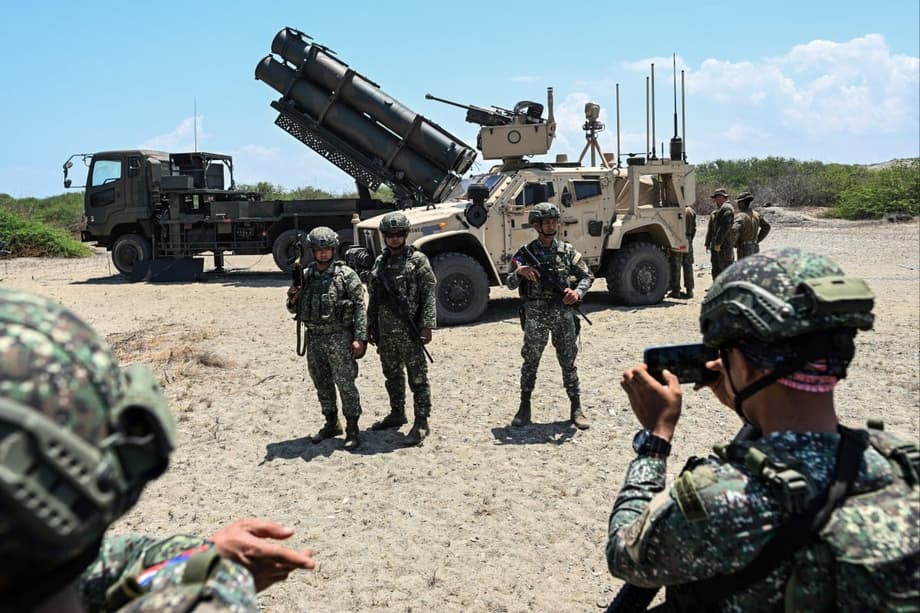
Analysts say the island is ideally positioned to block Chinese naval access to the western Pacific through the Miyako Strait, a key route for the PLA Navy. Marine Corps doctrine calls for staging troops inside an adversary weapons engagement zone before any conflict, and Yonaguni offers a foothold just 67 miles from Taiwan. Weapons such as the NMESIS anti ship system, armed with Naval Strike Missiles, have been discussed as future candidates for the island, though moving them there during a live crisis would face severe challenges given the extensive missile and air capabilities of the PLA.
Allied Exercises and U.S. Force Posture
The United States has reinforced the region through deployments and joint drills designed to tighten coordination along the first island chain. In April 2025, the U.S. military announced it would send MQ 4C Triton surveillance drones to Kadena Air Base on Okinawa to monitor Chinese drone activity in the same waters. More recently, about 300 troops from the Japan Ground Self Defense Force and roughly 20 members of the U.S. Marine Corps 12th Marine Littoral Regiment conducted drills across Miyako, Ishigaki, and Yonaguni islands from May 17 to 22. The exercises included command post training on Miyako, shore based anti ship missile logistics on Ishigaki, and unmanned reconnaissance flights using the Scan Eagle 2 drone on Yonaguni.
The 12th Marine Littoral Regiment specializes in Expeditionary Advanced Base Operations, a concept that relies on small, mobile teams to establish missile and sensor nodes on outlying islands. The drills also featured the first joint coordination center staffed by Japanese and American personnel on Miyako Island during a Ground Component Command exercise. U.S. Forces Korea Commander Gen. Xavier Brunson recently proposed a kill web integrating American, Japanese, South Korean, and Philippine forces into a single operational network spanning the first island chain. The idea was tested during the Balikatan exercise in the Philippines, which simulated blocking Chinese naval passage through the Luzon Strait. The Nansei Islands drills are viewed as the northern anchor of that same network.
The growing American footprint has not gone unnoticed in Beijing. The Chinese Ministry of Defense has accused the allies of accelerating the weaponization and militarization of space and fueling an arms race. Washington recently approved a 700 million dollar sale of NASAMS air defense systems to Taiwan and a 330 million dollar deal for aircraft parts, adding to the layers of deterrence Beijing views as encirclement.
Beijing Expands Retaliation Beyond the Military Sphere
China has responded to the military buildup with measures that extend well beyond naval patrols and drone overflights. After Prime Minister Takaichi suggested in late 2025 that Japan would likely become militarily involved if China attacked Taiwan, Beijing discouraged its citizens from traveling to Japan, restricted exports to 40 Japanese entities linked to remilitarization, and withdrew giant pandas from the Ueno Zoo in Tokyo, a long standing symbol of bilateral friendship. Chinese visitors contribute roughly 11 billion dollars annually to the economy of Japan, making the travel warning a pointed economic signal. The Commerce Ministry placed 20 firms on an export control list and added another 20 to a watchlist, drawing a sharp reaction from Tokyo, which called the steps deplorable.
Bilaterally, trade remains a powerful constraint on both sides. China has been the largest trading partner of Japan since 2005, with two way commerce hitting 322 billion dollars in 2024. Japan imports about 43 billion dollars more from China than it exports, creating a dependency that Beijing appears willing to exploit. Geopolitical analyst Arnaud Bertrand, who specializes in China, argued that Japan faces a fundamental contradiction as it deepens its military posture. He said the economic interdependence between the two nations makes an arms race unsustainable for Tokyo.
Japan cannot simultaneously militarize against China and maintain the economic relationship that its prosperity depends on. At some point, Tokyo will have to choose, and Beijing is trying to make that choice become as obvious as possible.
Chinese military pressure has also intensified near Japanese waters. The PLA Navy Liaoning Carrier Strike Group sailed between Yonaguni and Iriomote Island in September 2024, and high altitude surveillance drones now pass regularly through the channel separating Yonaguni from Taiwan. Each sortie triggers fighter scrambles from the Japan Air Self Defense Force and feeds a cycle of action and reaction that both sides use to justify further spending.
A Historic Shift in Japanese Security Policy
The current buildup rests on policy changes that began more than a decade ago. In 2014, the Abe government controversially reinterpreted the pacifist constitution to allow limited collective self defense, expanding the role of Japanese forces beyond strict territorial protection. That reinterpretation opened the door to closer cooperation with the United States and set in motion the deployments now taking shape across the Ryukyu chain. Analysts note that each step was presented as modest and defensive. Coastal surveillance arrived on Yonaguni in 2016, missiles reached Ishigaki in 2023, electronic warfare units followed, and long range drones and standoff weapons are completing the shift.
Prime Minister Takaichi has gone further than her predecessors by explicitly linking Japanese military preparations to a possible Taiwan conflict. During parliamentary remarks last November, she raised the possibility of military involvement in a Taiwan contingency, a sharp departure from longstanding ambiguity on the issue. The comments came shortly after the 80th anniversary of the end of Japanese colonial rule over Taiwan, adding historical sensitivity for Beijing. The Chinese Foreign Ministry condemned the remarks and demanded that Japan fully repent for its war crimes and stop playing with fire on the Taiwan question.
Einar Tangen, a senior fellow at the Centre for International Governance Innovation, warned that Japanese missile deployment plans are not isolated moves. He said the timetable is deliberately aligned with the diplomatic calendar of Prime Minister Takaichi.
The decision of Japan represents a calculated escalation that will increase regional tensions. These actions are not occurring in a vacuum. They are timed to strengthen the hand of Prime Minister Sanae Takaichi ahead of a visit to Washington.
Tangen noted that the timing strengthens the negotiating position of Takaichi ahead of visits to Washington, where President Donald Trump has pressed allies to increase defense spending and shoulder more regional security responsibilities. The Japanese cabinet approved a record defense budget exceeding nine trillion yen, roughly 58 billion dollars, with plans to double spending to 2 percent of gross domestic product. The budget carves out 100 billion yen for a framework called SHIELD, which will deploy massive numbers of unmanned aerial, surface, and underwater systems by March 2028.
The Endgame for Tokyo and Beijing
The accelerated timetable of Japan suggests a sense of urgency in Tokyo. Officials moved up the Type 12 missile deployment by one year, and the defense minister has set firm deadlines for Yonaguni air defenses. Analysts say Tokyo perceives a closing window for establishing forward positions before Chinese capabilities grow too formidable to challenge. The Type 03 Chu SAM surface to air missiles planned for Yonaguni are defensive in nature, Koizumi insists, designed to protect the island rather than attack other countries. Yet the line between defense and offense has blurred as ranges extend and platforms multiply. A shield capable of intercepting missiles over the East China Sea also provides coverage for strike aircraft and missiles operating from the same bases.
For Beijing, Taiwan remains what officials call the core of core interests. It is the one issue on which there is genuine consensus across Chinese society, government, and military, according to analyst Bertrand. The explicit positioning of Japan as a party to any Taiwan conflict, combined with weapons that can reach the Chinese mainland, touches on historical grievances and territorial claims that neither side appears willing to compromise. The result is a security dilemma in which each defensive move by one power looks like an offensive threat to the other, driving both to arm faster than diplomacy can keep pace.
As both nations prepare for a range of scenarios around Taiwan, the southwestern islands have transformed from a quiet periphery into one of the most heavily militarized corridors in Asia. Whether the buildup prevents conflict or makes it more likely depends on decisions still to be made in Tokyo, Beijing, and Washington. For now, the drones, missiles, and joint exercises signal that neither side intends to step back.
Key Points
- The PLA Daily accused Japan of disguising offensive military capabilities as defensive coastal shields, calling drone and missile plans a dangerous gamble.
- Japan is deploying long range drones, upgraded Type 12 missiles, Type 25 standoff weapons, and 400 Tomahawk cruise missiles that can strike targets deep inside China.
- Surface to air missiles are scheduled for Yonaguni Island, roughly 110 kilometers east of Taiwan, by March 2031, alongside expanded joint exercises involving Japanese and American forces.
- Prime Minister Sanae Takaichi has linked Japanese military preparedness to a possible Taiwan contingency, breaking with decades of ambiguity.
- China has retaliated through export restrictions, travel warnings, repeated naval patrols, and drone flights near Japanese territory.
- Japan approved a record defense budget approaching 2 percent of GDP, funding unmanned systems under the SHIELD framework and accelerating missile deployment schedules.