A Capital Transformed by Sound and Light
SEOUL turned into a living museum of pop culture this spring as BTS launched an ambitious month-long citywide initiative that drew visitors from across the globe. The project, titled “BTS The City: Arirang Seoul,” converted major landmarks into immersive fan experiences between March 20 and April 19, creating a spectacle that blurred the lines between concert tour and cultural festival. The event marked the release of the group’s fifth full album, “Arirang,” and served as the launchpad for their world tour of the same name.
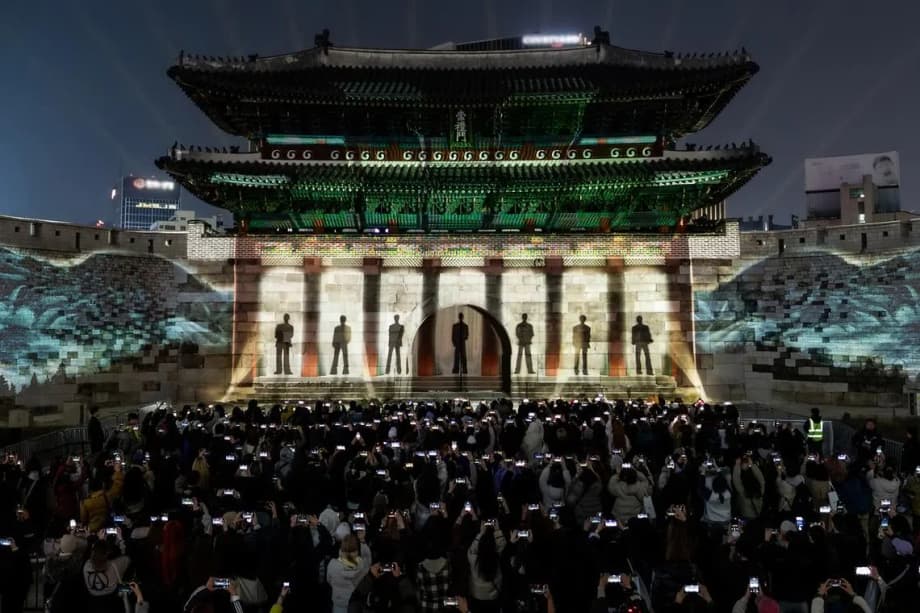
Music label Big Hit Music, operated by HYBE, reported staggering international participation throughout the project. At Sungnyemun, a 14th-century gate that stands as one of Seoul’s most treasured historic landmarks, approximately 73 percent of visitors to the media facade installation were foreign nationals. The trend was even more pronounced at Dongdaemun Design Plaza, where an interactive space called Army Madang attracted a crowd that was more than 86 percent international.
The installation at Dongdaemun featured participatory programs that highlighted Korean culture alongside BTS themes. Visitors designed fan merchandise and contributed to a large-scale logo installation constructed from balls inscribed with lyrics. These activities transformed passive tourism into active cultural exchange, allowing fans to engage with both the music and traditional Korean creative practices.
The citywide activation extended beyond static installations. Seoul City Tour Tiger Bus reported a 20 percent increase in ridership during the project period, driven by a special BTS-themed tour that connected key locations including Gwanghwamun, Namdaemun Market, HYBE Headquarters in Yongsan, Dongdaemun Design Plaza, and Gyeongbokgung Palace. Large-scale digital billboards, drone light shows, and music-themed illuminations at Banpo Bridge and N Seoul Tower created a cohesive visual narrative across the metropolitan area.
The Ministry of Culture, Sports and Tourism confirmed that South Korea welcomed a record 2.06 million foreign visitors in March alone, with first-quarter arrivals reaching 4.76 million, a 23 percent increase from the previous year. This marked the highest quarterly figure on record. Chinese visitors led the surge with 1.45 million arrivals, up 29 percent year-over-year, followed by Japanese tourists at 940,915, representing a 20.2 percent increase. Visitors from Taiwan rose 37.7 percent to 544,503. Foreign credit card spending reached 3.21 trillion won ($2.18 billion) during the first quarter, up 23 percent from the previous year, according to ministry data.
Retailers Ride the Wave of Purple
The economic stimulus extended deep into Seoul’s retail sector. Department stores in the Myeongdong shopping district anticipated massive crowds ahead of the group’s March 21 performance at Gwanghwamun Square, launching targeted marketing campaigns to capture the influx of international fans.
Lotte Department Store executed a “Welcome Lights” project from March 19 to 22, bathing the exterior of its flagship store and the nearby Avenuel luxury building in purple, the official color associated with BTS and their global fanbase known as ARMY. The illumination ran daily from 6 p.m. to 10 p.m., creating a nighttime attraction designed specifically for visiting fans. The retailer also hosted a “K-Wave Shopping Week” from March 19 to 29, offering foreign customers Lotte gift certificates worth 7 percent of their purchases along with Korean-themed souvenirs. The flagship store opened a dedicated “K-GIFT” section featuring items such as kimchi from Lotte Hotel and expanded K-food options, while increasing safety personnel by more than 50 percent to manage crowds.
Shinsegae Department Store partnered directly with HYBE to open a pop-up shop at its Heritage Museum space starting March 20, selling the new album and official light sticks. The company’s Myeongdong branch hosted a “K-Love Festival” targeting international customers, while Shinsegae Duty Free created a “K-WAVE Zone” featuring BTS-themed magazines, magnets, puzzles, and plush toys. Collaborative products included a “Super Tuna Edition” gift set featuring member Jin and kombucha drinks packaged with the TinyTan character brand.
The retail strategy produced measurable financial results. Shares of Lotte Shopping closed at 98,200 won per share, up 4.58 percent, while Shinsegae rose 3.48 percent to 342,000 won on expectations of increased foreign spending. Yu Jung-hyun, an analyst at Daishin Securities, recommended an overweight view on the retail sector, projecting that inbound visitor numbers would reach fresh record highs as global fans traveled to Korea for concert dates.
Global Travel Demand Spikes
The announcement of BTS’s return generated immediate ripple effects in global travel markets. According to Hotels.com, international searches for trips to Seoul jumped 155 percent within 48 hours of the tour announcement on January 14 compared with the previous week. Interest in Busan, which will host concerts in June, surged by 2,375 percent.
Demand proved particularly strong across Asia. Travel searches for Busan from Japan, Hong Kong, and Taiwan rose by several thousand percent, while domestic interest also climbed sharply, with searches for trips to Seoul up 190 percent and Busan soaring 3,855 percent. The overseas response reached as far as Brazil, where news-focused radio station BandNews FM highlighted BTS’s October concert in Sao Paulo as a major national story. Data from local transport platform ClickBus showed that searches for bus tickets to the city jumped more than 600-fold following the announcement.
The travel boom reflected more than casual curiosity. The 82-date world tour spanning 34 cities represents one of the largest global entertainment events of the year. Analysts at NH Investment & Securities project the tour could generate up to 4 trillion won in total economic impact, including direct revenue and secondary consumer spending. Billboard analysis initially estimated tour revenues at nearly 740 million pounds, though subsequent projections suggest the figure could grow substantially higher.
The Historic Gwanghwamun Concert
The comeback reached its crescendo on March 21 with a free concert at Gwanghwamun Square, a historic plaza that sits directly in front of Gyeongbokgung Palace, the main royal residence of the Joseon Dynasty. The location carries deep symbolic weight, anchored by statues of Admiral Yi Sun-sin and King Sejong along an axis that runs through central Seoul. Once a traffic corridor, the space was reconfigured into a pedestrian plaza in 2022 to function as a major civic gathering place.
Staging the concert at this site placed a global cultural event in front of Korea’s most recognizable historic landmark, linking contemporary pop culture with the country’s political and royal heritage. The concert, which was also streamed on Netflix, transformed the 1,200-meter footprint of the square into a controlled venue with layered security barriers and segmented viewing zones.
Lee Benson, a photojournalist from Milwaukee Independent, documented the transformation of Gwanghwamun Square from public space to concert venue over six days. He described the final result as a space that existed in parallel versions depending on one’s vantage point.
From the ground at Gwanghwamun Square, the experience was shaped by barriers, distance, and constant negotiation for position. Back home, the same performance arrived as a complete broadcast, uninterrupted and fully framed. The difference was not just visual, but experiential.
Lee Hwa Jeong, a researcher at NH Investment & Securities, explained the broader economic pattern to Reuters regarding how performances by artists with global fandoms generate economic activity beyond ticket sales.
Performances by artists with a global fandom like BTS do not end with ticket sales but drive tourism consumption throughout the entire city.
This proved true in Goyang, where foreign card transactions in the area rose 807 percent from April 6 to 12 compared with the previous week, while overall spending increased by 231 percent. Spending at convenience stores rose by 1,069 percent, at cafes by 1,109 percent, restaurants by 600 percent, and retail purchases by 629 percent. Hana Card tracked spending patterns of 30,000 foreign nationals who purchased tickets for BTS concerts in Goyang on April 9, 11, and 12, finding that this group spent approximately 55.5 billion won in South Korea between January 1 and April 12. The average expenditure per visitor reached 1.85 million won.
Safety Measures and Crowd Management
The massive gatherings required extensive security coordination, particularly in light of the 2022 Halloween crowd crush in Itaewon that resulted in 159 deaths. South Korean authorities treated the BTS events with heightened caution, implementing layered barriers and controlled entry points to prevent dangerous concentrations of people.
At Gwanghwamun Square, police presence increased substantially throughout the preparation period. The U.S. Embassy in Seoul issued a Security Alert on March 21 warning that the event might draw upwards of 250,000 spectators, resulting in enhanced security, road closures, and impacts to public transportation. The Republic of Korea classified the event as increasing the risk of a Mass Gathering Crowd Disaster, implementing a caution-level crisis alert.
Entry points were sealed around the concert’s perimeter before zones reached capacity, a measure that restricted attendance to approximately 50,000 people rather than the anticipated 250,000. While this prevented potential safety incidents, it also meant many fans were disenfranchised from attending despite traveling long distances. The design created a layered crowd with staggered sections to prevent tight concentrations, though some fans expressed frustration at visibility obstructions from media cameras and barriers.
Secondary Economic Ripples
The economic impact extended to small businesses and digital platforms. Woowa Brothers, operator of the food delivery app Baemin, launched a support program for 100 small cafes in Jongno-gu and Jung-gu, supplying ingredients for a limited-edition drink called “The City Arirang Red Ade.” The company provided omija syrup for approximately 20,000 drinks along with packaging materials and promotional support.
Results were immediate and dramatic. Daily average pick-up orders at participating cafes surged by about 1,000 percent, while average daily pick-up sales rose 430 percent. Cafe owners reported that the campaign drew tourists who visited specifically to photograph the promotional materials, creating additional foot traffic beyond the immediate beverage sales.
The phenomenon also drove interest in BTS-related pilgrimage sites. Fans visited locations linked to the group’s early career, including the former headquarters of BigHit Music and Hakdong Park in Gangnam, where members spent time as trainees. Commercial tours emerged to cater to this demand, offering guided itineraries through places the group frequented during their training era.
Cultural Significance of Arirang
The album and tour title, “Arirang,” carry profound cultural resonance. Arirang is a traditional Korean folk song with roots stretching back centuries, often described as an unofficial national anthem associated with separation, longing, resilience, and identity. The version most widely recognized internationally was recorded in 1896 when seven Korean students studying at Howard University in Washington DC were captured on wax-cylinder phonograph equipment by American ethnologist Alice Cunningham Fletcher. This recording, documented in a newspaper article titled “Seven Koreans at Howard,” introduced the melody to global audiences and placed it within a global archive of cultural preservation.
By invoking Arirang for their comeback, BTS drew on this deeper history, connecting modern global performance to a song long associated with the Korean experience itself. The album represents the group’s first full-length project since pausing group activities in 2022 to complete mandatory military service, a hiatus during which members pursued individual solo careers.
Future Destinations and Economic Projections
The Seoul project serves as merely the opening chapter of a global rollout. Upcoming editions of “The City” project are planned for Las Vegas in the United States from May 20 to May 31 and Busan in South Korea from June 5 to June 21. These events will replicate the immersive landmark transformation model that proved successful in Seoul.
Analysts predict the economic effects will continue to compound as the world tour progresses. With 82 shows across 34 regions remaining and projections of ticket sales reaching 2.7 trillion won, the direct revenue represents only a fraction of the total impact. When including secondary spending on accommodations, dining, transportation, and retail, the total economic injection could reach unprecedented levels for a musical act.
The South Korean government has taken notice of this cultural-economic nexus. In the Ministry of Culture, Sports and Tourism’s 2025 National Image Survey, BTS ranked first among Koreans seen as having the most positive influence on the country’s international reputation, with member Jungkook placing sixth overall as the highest-ranked solo artist from the group. This recognition highlights the group’s role as unofficial cultural ambassadors whose commercial activities align with national economic interests.
Key Points
- BTS’s month-long “BTS The City: Arirang Seoul” project ran from March 20 to April 19, transforming landmarks into immersive fan experiences
- South Korea recorded record tourism numbers in March with 2.06 million foreign visitors, up 23 percent in the first quarter to 4.76 million total
- Foreign visitors comprised 73 percent of attendees at Sungnyemun installations and 86 percent at Dongdaemun Design Plaza’s Army Madang space
- Approximately 30,000 foreign concert attendees spent 55.5 billion won between January and April, averaging 1.85 million won per person
- Retailers including Lotte and Shinsegae reported stock price increases and expanded foreign customer sales through targeted BTS-themed campaigns
- The 82-date world tour spanning 34 cities is projected to generate up to 4 trillion won in total economic impact including secondary spending
- Upcoming “The City” project editions are scheduled for Las Vegas (May 20-31) and Busan (June 5-21)