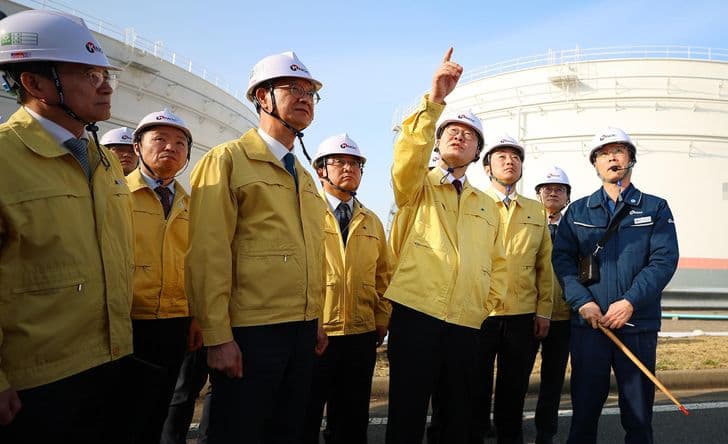
Northeast Asia Emerges as Critical Oil Storage Hub
Major oil-producing nations across the Middle East are increasingly viewing South Korea as a strategic offshore storage location amid the prolonged closure of the Strait of Hormuz. Yang Gi-uk, who leads the industrial resource security office at the Ministry of Trade, Industry and Energy, revealed Tuesday that numerous countries beyond the United Arab Emirates have initiated discussions about utilizing Korean facilities. The interest reflects a fundamental reassessment of energy logistics as traditional export routes through the Persian Gulf face unprecedented disruption.
Yang noted that Saudi Arabia, Kuwait, and other Gulf producers recognize that storing crude outside the strait allows them to reduce export risks while maintaining supply flexibility. These countries rely on crude exports for large portions of their national economies, making the current blockade particularly damaging. By positioning barrels in advance in Northeast Asian facilities, exporters can circumvent the maritime chokepoint that normally handles the majority of their shipments to Asian markets.
The development marks a major shift in regional energy architecture. Traditionally, Middle Eastern producers maintained storage facilities within their own territories or in consumer nations through direct sales contracts. The current crisis has prompted a hybrid model where producers retain ownership of crude stored in external facilities, effectively creating floating reserves that remain accessible regardless of shipping lane disruptions. Yang emphasized that specific names of additional countries seeking storage agreements will be disclosed at appropriate diplomatic intervals, though he confirmed active negotiations are underway with multiple parties.
The Hormuz Blockade Threatens Global Supply Chains
The effective closure of the Strait of Hormuz has created cascading effects across international energy markets that extend far beyond the immediate region. This narrow maritime passage normally handles approximately 78 percent of Middle Eastern crude exports bound for China, Japan, South Korea, and Taiwan. With traffic ground to a halt amid military conflict involving Iran and retaliatory strikes, major exporters face severe economic pressure that threatens their fiscal stability.
There will be flight cancellations soon if oil supplies are not restored in coming weeks. Europe has maybe 6 weeks or so of jet fuel left.
International Energy Agency Executive Director Fatih Birol issued stark warnings regarding the downstream effects of the disruption. In comments published this week, Birol stated that Europe faces approximately six weeks of jet fuel remaining before commercial aviation operations face severe constraints. He predicted imminent flight cancellations between European cities if oil supplies are not restored in coming weeks. The impact will include higher petrol prices, elevated gas prices, and increased electricity costs across affected regions.
Asian economies occupy the primary lines of this crisis according to Birol, who identified Japan, Korea, India, China, Pakistan, and Bangladesh as particularly exposed markets. The disruption has already forced South Korea to implement emergency measures including alternating day license plate systems for public vehicles and parking restrictions to reduce domestic consumption. President Lee Jae Myung has instructed his government to treat prolonged disruption in global energy markets as a given condition, ordering strengthened emergency response systems and rapid deployment of supplementary budget resources.
Seoul Secures Emergency Supplies Through Strategic Diplomacy
Presidential Chief of Staff Kang Hoon-sik recently completed an intensive four-nation diplomatic tour through Kazakhstan, Oman, Saudi Arabia, and Qatar designed to secure alternative supply routes that bypass the blocked strait entirely. The delegation returned with concrete commitments for 273 million barrels of crude oil and 2.1 million tons of naphtha scheduled for delivery through year-end. These volumes represent substantial security buffers, with the crude alone covering more than three months of normal economic operation based on South Korea’s 2025 consumption baseline.
Saudi Arabia emerged as the primary supplier during this emergency diplomacy, agreeing to ship 50 million barrels of previously allocated crude through alternative Red Sea ports during April and May. From June through December, the Kingdom committed to prioritize allocation and shipment of an additional 200 million barrels specifically to Korean companies. Kang emphasized that these arrangements involve import prices based on market rates rather than emergency premiums, noting that crude and naphtha have become commodities that cannot be obtained even with money in the current disrupted market.
The diplomatic initiative also addressed immediate logistical crises. Kang secured active cooperation from Oman for the safe passage of 26 Korean vessels previously stranded near the conflict zone, meeting with Deputy Prime Minister for Economic Affairs Theyazin bin Haitham Al Said. In Qatar, which was added to the itinerary unexpectedly, Kang received assurances that Korea remains a top priority for uninterrupted liquefied natural gas supply contracts despite regional tensions. Foreign Minister Cho Hyun confirmed that safety information regarding these vessels has been shared with Gulf Cooperation Council countries and the United States to secure safety assurances, while ruling out any compensation payments to Iran for passage rights.
Beyond securing new supplies, the government is managing existing strategic reserves through innovative swap arrangements with domestic refiners. Under this program, Korea National Oil Corporation lends strategic reserves to SK Energy, GS Caltex, HD Hyundai Oilbank, and S-Oil, with 32 million barrels requested and 17 million allocated for April delivery. Six contracts totaling 8.38 million barrels are already being delivered, with an additional 8 million barrels expected to be contracted within the month.
Inside the International Joint Stockpiling Program
South Korea operates a sophisticated international joint stockpiling program that transforms its domestic storage infrastructure into a revenue-generating strategic asset while enhancing national energy security. Through government operated Korea National Oil Corporation, the country maintains nine oil storage facilities nationwide, including underground tanks and the world’s single largest oil storage base, with combined current capacity of approximately 140 million barrels. The government is reviewing plans to expand this capacity by an additional 20 million barrels through designs funded by recent supplementary budget allocations.
The program mechanics offer mutual benefits for both host and participant nations. Foreign producers lease idle storage capacity, generating rental income for Korea while granting Seoul preferential purchasing rights during supply emergencies. Abu Dhabi National Oil Company currently stores 4 million barrels under this framework, while Kuwait Export Crude maintains similar volumes. Yang explained that although these foreign-owned volumes are not officially counted as part of South Korea’s strategic reserves, they effectively expand domestic stockpiles since domestic refiners maintain active demand for the crude.
This arrangement has proven particularly valuable during current negotiations for alternative supplies. Yang noted that when securing replacement volumes from Middle Eastern partners, the offer of storage facilities helped discussions. The UAE case demonstrates this dynamic, where existing joint stockpiling agreements appear to have streamlined the process of securing replacement cargoes during the crisis. The government has also extended credit ceilings of up to $3 billion to KNOC, backed by the Export-Import Bank of Korea and the Korea Development Bank, to support timely crude imports and maintain liquidity during the emergency.
The stockpiling strategy extends beyond immediate crisis management. Industry officials view these arrangements as foundational to extended supply chain restructuring. By establishing permanent storage partnerships with major producers, South Korea creates structural incentives for exporters to prioritize Korean market access during future disruptions. The current crisis has accelerated interest from producers who previously relied exclusively on domestic storage or direct shipment models, potentially establishing Korea as a permanent regional hub for Gulf crude reserves.
Regional Powers Reassess Energy Security Strategies
The Hormuz crisis has exposed varying levels of vulnerability across East Asian economies while prompting broader strategic reassessments regarding energy security architecture. Unlike Japan, which maintains robust import coverage of approximately 150 days, or Taiwan with statutory mandates requiring 90 days of consumption coverage, South Korea has historically operated with tighter margins. However, current government-controlled reserves now provide 210 days of supply according to official reports, with the international joint stockpiling program adding further practical buffer capacity.
China presents a contrasting case that highlights the geopolitical dimensions of the crisis. The People’s Republic of China holds approximately 1.2 billion barrels in onshore stockpiles according to Kpler data, providing roughly 108 days of import cover. Combined with substantial domestic production of 4.3 million barrels daily and pipeline imports from Russia and Central Asia, Beijing appears advantageously placed to weather supply disruptions compared to regional rivals. Atlantic Council analysis suggests that while an oil crisis brings real economic pain to China, it might empower Beijing relative to competitors like Japan, South Korea, and Taiwan.
The crisis has accelerated discussions about alternative energy infrastructure across the region. In Southeast Asia, policymakers are reviving previously inactive proposals for the ASEAN Power Grid, which would create cross-border electricity integration to reduce dependence on fossil fuel imports from unstable regions. Dr. Mirza Huda of ODI Global argued during recent discussions in Hanoi that regional grid integration would allow nations to depend on neighbors for energy security rather than remaining hostage to distant geopolitical conflicts. The 43rd ASEAN Ministers on Energy Meeting identified subsea power cables as key building blocks for this integration, with projects like the Brunei Darussalam-Indonesia-Malaysia-Philippines Power Integration Project combining overland and subsea connections.
Energy transition advocates argue that current volatility strengthens the case for electrification and renewable deployment. South Korea’s energy ministry announced revised seasonal and time of use electricity pricing systems designed to shift industrial demand away from evening peak hours toward midday when solar generation peaks. Weekend discounts for electric vehicle charging began April 18, while large industrial users face new rate structures from April 16. These measures aim to reduce oil-derived electricity demand while supporting domestic renewable generation capacity.
The crisis also highlights the growing importance of supply chain security for clean technology manufacturing. China maintains dominant positions in solar panel production, battery materials processing, and electric vehicle supply chains, giving it structural advantages in the energy transition regardless of oil market volatility. However, analysts note that the United States, Europe, South Korea, and Japan retain competitive strengths in advanced semiconductors, software systems, and high-end clean technology innovation, suggesting a distributed rather than monopolized transition trajectory.
What to Know
- Major Middle Eastern oil producers including Saudi Arabia, the UAE, and Kuwait have initiated discussions with South Korea regarding the use of domestic oil storage facilities as the Strait of Hormuz remains closed.
- South Korea secured commitments for 273 million barrels of crude oil and 2.1 million tons of naphtha through year-end via diplomatic efforts led by Presidential Chief of Staff Kang Hoon-sik.
- The International Energy Agency warns that Europe faces approximately six weeks of jet fuel reserves remaining, with potential flight cancellations imminent if supplies are not restored.
- South Korea currently maintains approximately 140 million barrels of storage capacity with plans to expand by 20 million barrels, while government-controlled reserves provide 210 days of supply coverage.
- Under international joint stockpiling agreements, foreign producers lease Korean storage facilities while granting Seoul preferential purchasing rights during supply emergencies.
- China holds approximately 1.2 billion barrels in strategic reserves, leaving it advantageously placed compared to other Asian economies dependent on Middle Eastern imports.
- The crisis has renewed regional interest in alternative energy infrastructure including the ASEAN Power Grid and accelerated domestic energy conservation measures in South Korea.