A Record-Breaking Year Sets the Stage
The Japanese anime industry shattered financial records in 2024, reaching a total market value of 3.8407 trillion yen (approximately $25.1 billion) according to the Association of Japanese Animations (AJA). This figure represents a 14.8% increase from the previous year, marking the second-highest annual growth rate on record behind only 2019. The driving force behind this surge came from beyond Japan’s borders, as overseas revenues climbed 26% year-over-year to reach 2.1702 trillion yen ($14.1 billion), while the domestic market saw modest growth of 2.8% at 1.6705 trillion yen.
This milestone marks the third consecutive year that international sales have exceeded domestic earnings, a trend that first emerged during the 2020 pandemic when streaming platforms accelerated global distribution. The 2024 data confirms a fundamental shift in the industry’s economic center of gravity, with foreign markets now accounting for roughly 56% of total revenue. Kazuko Ishikawa, chair of the AJA and president of Nippon Animation, described anime as having evolved into a core pillar of Japan’s cultural and economic exports during a presentation at the Tokyo International Film Festival Content Market (TIFFCOM).
The 6 Trillion Yen Ambition
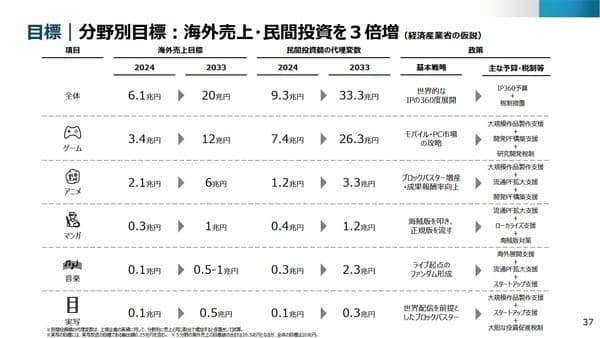
Building on this momentum, Japan’s Ministry of Economy, Trade and Industry (METI) unveiled an ambitious roadmap during its 18th Entertainment and Creative Industrial Policy Seminar on March 27. The government aims to expand the overseas anime market to 6 trillion yen (approximately $37 billion) by 2033, effectively tripling the current figure in less than a decade. This target forms part of a broader national strategy to grow Japan’s total creative industry exports from roughly 6.1 trillion yen in 2024 to 20 trillion yen ($125 billion) by 2033.
The mathematics of this goal reveal both the confidence and the challenge facing Japanese policymakers. To reach 6 trillion yen, the anime industry must maintain a compound growth rate that would see the overseas market expand by 186% over the next eight years. The timeline is particularly aggressive given that the market has already experienced rapid expansion, growing from 1.4592 trillion yen in 2022 to the current 2.1702 trillion yen in 2024, nearly doubling in just two years. Sustaining this velocity through 2033 will require structural changes to how anime is produced, distributed, and monetized globally.
Masahiko Hasegawa, editor-in-chief of the AJA report, emphasized the widening gap between domestic and international markets.
The overseas market now far exceeds local revenues, and the gap will only widen. Growth today includes bundled contracts that span theatrical, streaming, merchandising, and event rights, not just content distribution.
From VHS Imports to Global Streaming Dominance
The evolution of anime’s global reach represents one of the most dramatic transformations in entertainment history. For international fans who grew up in the 1990s, accessing Japanese animation required dedication, involving the hunt for rare VHS tapes at specialty shops or fan club trades. Today, streaming platforms deliver subtitled and dubbed content to 200 global markets within hours of Japanese broadcast, with nearly half of all overseas revenue flowing through these digital distribution channels.
The pandemic era served as an inflection point. When lockdowns began in 2020, platforms like Netflix, Crunchyroll, and Amazon Prime Video aggressively acquired anime libraries, introducing the medium to mainstream audiences who had previously never encountered it. This accessibility created a self-reinforcing cycle: as subscriber numbers grew in North America, Europe, and Asia, production budgets increased, visual quality improved, and the genre shed its niche status. The International Otaku Events Association now tracks 160 anime-related events across 50 countries, ranging from massive conventions like Anime Expo in Los Angeles to smaller gatherings in emerging markets.
Megumi Onouchi, AJA committee member and CEO of HumanMedia, addressed industry professionals at TIFFCOM with an optimistic assessment of this trajectory.
Overseas revenue is now climbing high and has not yet reached the peak. We’re seeing a rise in international events across the globe, and the numbers are increasing.
Government Strategy: Blockbusters, Platforms, and Workforce Reform
To achieve the 6 trillion yen target, METI has outlined a three-pronged strategy focusing on blockbuster production, distribution infrastructure, and workforce development. The government plans to allocate substantial budget increases to support these initiatives, with funding for the anime industry rising from under 20 billion yen in fiscal year 2024 to 58.9 billion yen in fiscal year 2026. METI itself will control 35.5 billion yen of this total, representing a 60% share that signals a shift toward treating cultural content as an economic priority rather than merely an artistic concern.
The “blockbuster” emphasis draws inspiration from recent theatrical successes, including the Demon Slayer franchise, which became the first Japanese film to surpass 100 billion yen at the global box office with its 2025 release Demon Slayer: Kimetsu no Yaiba the Movie: Infinity Castle. However, this focus on high-budget, mass-appeal productions raises concerns within the creative community about potential homogenization of content. Critics note that anime’s international appeal has historically stemmed from its willingness to explore unconventional narratives and artistic styles that differ from Western animation norms.
Concurrent with the blockbuster push, METI launched the IP360 support program, which provides grants of up to 10 million yen (approximately $62,500) to independent developers. These funds cover pre-production through localization and overseas promotion, aiming to diversify the pipeline beyond established studios. The program also emphasizes improving working conditions and raising performance-based pay rates for animators, addressing an industry reputation for exploitative labor practices that has deterred new talent.
The Human Resource Crisis
Behind the impressive revenue figures lies a severe workforce shortage that threatens the industry’s ability to scale production to meet global demand. Industry estimates suggest Japan needs approximately 30,000 additional animators to sustain current output levels, let alone expand to meet the 2033 targets. Current working conditions at many studios involve long hours, low wages, and contract-based employment that offers little security or benefits.
Major corporations are responding with infrastructure investments designed to consolidate talent and improve working environments. Entertainment conglomerate Kadokawa announced plans to establish “Studio One Base,” a production hub inside Tokyo’s Sunshine City complex in Ikebukuro that will consolidate six affiliated animation studios under one roof. The facility, scheduled to open in autumn 2026, aims to improve collaboration between teams while creating what the company describes as “an environment where creators can focus on creating.”
Tsuyoshi Kikuchi, Kadokawa’s Executive Officer and Chief Studio Officer, explained the philosophy behind this consolidation.
By renewing the image of anime production sites, improving studio functions to raise productivity, and improving the treatment of creators, we will strive to create a workplace that people can take pride in and a profession others will aspire to. By strengthening regional collaboration with Toshima Ward and Sunshine City, we will develop Ikebukuro into a ‘world-class anime city’ and establish global IP creation capabilities.
The 20 Trillion Yen Ecosystem
While anime commands the spotlight, the government’s 20 trillion yen target encompasses a broader ecosystem of creative industries. Video games represent the second pillar of this strategy, with METI setting a goal of expanding the overseas game market from 3.4 trillion yen to 12 trillion yen by 2033, a 253% increase. The strategy focuses particularly on capturing greater market share in mobile and PC gaming sectors, supported by tax incentives for research and development as well as AI-driven translation tools to accelerate localization.
Manga presents a different challenge, with targets rising from 300 billion yen to 1 trillion yen. Rather than focusing solely on production, the government strategy here emphasizes anti-piracy enforcement and authorized distribution. Japan plans to deepen cooperation with foreign authorities, particularly targeting counterfeit goods in markets like China, while supporting AI-assisted translation to speed up official releases. The government also plans to revitalize domestic bookstores, recognizing their role as incubators for intellectual property that frequently receives anime adaptations.
Together, anime and games account for 18 trillion yen of the 20 trillion yen goal, leaving music and live-action content to cover the remaining 2 trillion. These sectors face even steeper growth requirements, with music targeted to expand from 100 billion yen to between 500 billion and 1 trillion yen, representing 400% to 900% growth.
Feasibility and Creative Risks
Despite the optimistic projections, industry observers have raised questions about the feasibility of these targets. Japanese pop culture exports already enjoy established presence in major global markets, suggesting that further growth may face the law of diminishing returns. The video game industry in particular represents a mature market where Japanese companies compete against well-funded Western and Chinese competitors.
The emphasis on “blockbuster” productions carries inherent risks familiar to Hollywood and the AAA video game industry. Chasing mass-market appeal often leads to ballooning budgets, extended production schedules, and creative conservatism that prioritizes commercial safety over innovation. For a medium that has thrived internationally precisely because it offers alternatives to Western storytelling conventions, this approach could potentially undermine the unique qualities that attracted global audiences initially.
Additionally, the government’s projection relies heavily on continued growth in streaming revenue, which may stabilize as markets mature and competition intensifies. While anime tourism and merchandise sales offer secondary revenue streams, unlocking their full potential requires Japanese companies to establish direct overseas retail and event operations rather than relying on licensing fees.
The Bottom Line
- Japan’s overseas anime market reached a record 2.17 trillion yen ($14.1 billion) in 2024, representing 26% annual growth and surpassing domestic revenues for the third consecutive year.
- METI aims to triple this figure to 6 trillion yen ($37 billion) by 2033 as part of a broader 20 trillion yen creative industry export target.
- The strategy emphasizes blockbuster productions, expanded streaming distribution, and improved working conditions for animators, with government budgets increasing to 58.9 billion yen by 2026.
- Industry faces structural challenges including a shortage of 30,000 animators and historically poor labor conditions that threaten production capacity.
- Video games and manga join anime as priority sectors, with combined targets of 18 trillion yen representing 90% of the total creative industry goal.
- Private sector investments, including Kadokawa’s Studio One Base consolidation, align with government efforts to modernize production infrastructure and improve creator wages.