The Ritual at Kuala Krau
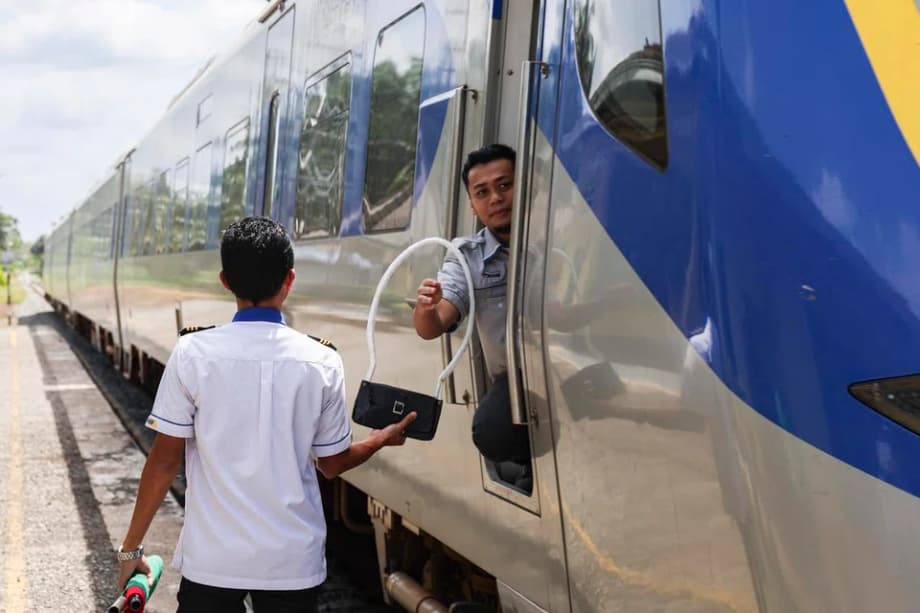
As dawn breaks over the dense rainforest of Pahang state, station master Mohd Akmal Jamal takes his position at the edge of a weathered platform. In his hands rests a leather pouch bearing a distinctive horseshoe shaped handle, its surface darkened by decades of use. Down the platform, his assistant raises an elbow in a gesture resembling a boxer stance. The morning train from Tumpat approaches slowly, and the driver leans out from the cockpit door. With practiced precision, the driver hooks a matching pouch onto the raised arm of the assistant, then extends his own elbow to receive the pouch from Mr Akmal as the locomotive continues its journey northward.
This elaborate choreography, performed at Kuala Krau railway station, represents one of the last surviving examples of colonial era railway safety procedures in Southeast Asia. The exchange, known locally as the cota system, has governed train movements along the eastern seaboard of the Malay Peninsula since 1885, long before electronic signalling or computerized track controls existed. While the majority of the world has transitioned to automated systems that rely on radio signals and sensors, this remote station maintains a tradition that demands human contact and physical proof of way.
The setting contributes to the timeless quality of the scene. Kuala Krau lies along the 526 kilometer route that stretches from Gemas in Negeri Sembilan to Tumpat in Kelantan, a line that cuts through some of the most remote terrain of the peninsula. Known among travelers as the Jungle Railway, the tracks pass alongside Taman Negara national park where dense vegetation presses against the rails and wildlife occasionally interrupts service. The humid air and morning mist create an atmosphere little changed from when British engineers first laid these rails through the tropical landscape nearly a century and a half ago.
Colonial Origins of the Cota System
The procedure traces its lineage to the Federated Malay States Railways, established during British colonial administration. When railway engineers first laid tracks through the eastern jungle in the late 19th century, they faced the challenge of managing single track operations where trains traveling in opposite directions shared the same rails. The solution came in the form of the Tyer No. 9 signalling system, manufactured by Tyer and Company, a British firm that had produced railway instruments since the 1870s.
At Kuala Krau, Mr Akmal maintains two cast iron token boxes in his office, each painted a distinctive red. These mechanical safes connect to adjacent stations through dedicated telephone lines and electrical cables. When a train prepares to depart, station masters remove a unique metal token from the box, place it within the leather pouch, and pass it to the incoming driver. This physical transfer serves as irrefutable proof that the track section ahead lies clear of other traffic.
The cast iron token boxes bear the label Tyer and Company, a reminder of the industrial heritage embedded in the station architecture. Known as the Tyer No. 9 signal box, the equipment connects to other stations on the line via cables that have carried communications for generations. Mr Akmal explained that when a token is taken out of the box and given to the train driver, it will signal to the next station that a train is approaching. The system relies entirely on mechanical interlocks and human verification, creating a fail safe barrier against the dangers of single track collisions.
Engineering Safety Through Physical Tokens
The technical principle underlying the cota system remains remarkably straightforward. Each section of track between stations constitutes a block, and only one token exists for each block. Possession of that token grants exclusive right of way to the train carrying it. Without the physical token, drivers cannot proceed, creating an absolute guarantee against head on collisions or rear end crashes on the undivided line.
Modern railways typically employ centralized traffic control systems using electronic sensors, radio communications, and computerized switching. Yet the Jungle Railway’s continued reliance on leather pouches and cast iron tokens offers a tangible connection to industrial history. The equipment bears the marks of its age, the token boxes displaying the patina of nearly a century and a half of continuous service.
The curious elbow maneuver observed at Kuala Krau developed from practical necessity rather than theatrical flourish. During the steam era, trains often exceeded platform lengths, forcing station masters to walk considerable distances, sometimes beyond station boundaries, to reach the locomotive cab. At the former Tanjong Pagar terminal in Singapore, masters reportedly cycled alongside trains to complete token exchanges before that station closed in July 2011.
Mr Akmal noted that in the past, trains were longer, sometimes even exceeding the length of the train platform. This meant that station masters needed to walk quite a distance, even outside the station to fetch the token. The raised elbow technique allows stationary staff to pass tokens to moving train captains without abandoning their posts, a critical consideration on the eastern route where villagers occasionally cross or walk along tracks. Leaving the platform could risk passenger safety, especially in areas where locals use the tracks as pathways through the jungle.
Modernization Pressures and Heritage Value
Despite the historical significance of the cota system, technological advancement threatens its survival. Keretapi Tanah Melayu modernized its fleet in 2021, replacing traditional locomotives with diesel powered engines equipped with contemporary safety features. Today, only the daily overnight sleeper service from Tumpat to Johor Bahru and seasonal festive holiday specials retain the older rolling stock that complements the manual signalling tradition.
Railway enthusiasts, particularly those from Singapore, make pilgrimages to witness the token exchange, recalling similar rituals once performed at Tanjong Pagar before the closure of that station severed the direct rail link between Singapore and the Malay Peninsula. Zac Cheong, a 47 year old railway enthusiast who participated in a media tour earlier this year, expressed appreciation for the continued operation of the system while voicing concerns about its future. He observed that while the retention of the old charm is welcome, track upgrades could eventually replace the manual system with modern electric railroad switches.
The Railway Assets Corporation of Malaysia has demonstrated increasing interest in preserving railway heritage, recently launching adaptive reuse projects for historic Malayan Railway buildings. Conservation efforts for a historic Penang station that served as an early transit oriented development highlight the growing institutional recognition that railway infrastructure carries cultural value beyond its transportation function. The Penang building, where tickets were sold for passengers connecting to Butterworth ferries, represents another facet of the colonial railway legacy that authorities now seek to protect.
The Future of Manual Signalling
Chief operating officer Afzar Zakariya maintains that the token system retains operational relevance despite its antiquity. He stated that even though rail systems and equipment have evolved according to the times, the foundation of the one train, one token, one block at a time token system is still being used. This is to ensure safety in railways that have yet to transition fully to modern electric signalling systems.
Even though rail systems and equipment have evolved according to the times, the foundation of the one train, one token, one block at a time token system is still being used. This is to ensure safety in railways that have yet to transition fully to modern electric signalling systems.
The route from Gemas to Tumpat remains the sole single track mainline in Malaysia where the cota procedure applies. Its survival depends on the continued economic viability of the Jungle Railway as both a transportation link for rural communities and a heritage tourism attraction. While eventual electrification and track doubling would eliminate the safety justification for manual tokens, railway historians hope that at least one section might retain the traditional procedure as a living museum piece.
For now, the ritual continues each morning at Kuala Krau. The leather pouches change hands, the cast iron token boxes click open and shut, and the telephone lines crackle with confirmations between stations. In an era of digital automation, these mechanical safeguards continue their watch over the jungle corridor, preserving not just railway safety standards from the 1880s, but a tangible link to the engineering ingenuity that first connected the remote eastern states of the Malay Peninsula.
Key Points
- The cota token exchange system has governed the eastern railway of Malaysia since 1885, representing one of the last operational colonial era signalling methods in Southeast Asia.
- Station masters pass leather pouches containing metal tokens to train drivers using a distinctive elbow raising maneuver originally developed for longer steam locomotives.
- The system operates exclusively on the 526km Jungle Railway route from Gemas to Tumpat, ensuring only one train occupies each single track section at a time.
- Equipment includes cast iron token boxes manufactured by British firm Tyer and Company, connected to adjacent stations via telephone cables installed during the Federated Malay States Railways era.
- Keretapi Tanah Melayu modernized its diesel fleet in 2021, though the token system persists for the daily overnight sleeper service and seasonal holiday trains.
- Railway enthusiasts from Singapore and beyond visit the line to witness the ritual, which recalls similar practices at the former Tanjong Pagar station until its 2011 closure.
- Future track electrification and modernization efforts may eventually replace manual signalling, though heritage conservation initiatives by Railway Assets Corporation suggest potential for preservation.