Potatoes and Processors on the Steppe
In Ulanqab, on the wide grasslands of Inner Mongolia, farmers bend to lift plump potatoes within sight of vast rectangular halls of concrete and steel. Cranes move with steady precision above scaffolding where welding sparks shower down. Hundreds of workers in yellow helmets haul cable, plaster brickwork and balance on ladders to finish rooftops. The city has long called itself the potato capital of China. It is now becoming a computing capital as well, as construction crews race to deliver the physical base for the next stage of artificial intelligence (AI).
One worker laughed as he walked past the site and described the pace as China speed. He called his country an infrastructure maniac, a phrase that drew laughter from colleagues. An electrical engineer on the project said the build moves in yearly stages. This year marks the second stage, with many more stages planned afterward. The mood on the ground is urgent and confident, driven by orders from far beyond the grasslands.
The timing reflects a larger contest. As leaders in Washington and Beijing prepare to discuss AI safety alongside trade and security, the computing capacity inside these halls sits at the center of rivalry between the United States and China. To the Communist Party, such capacity supports economic strength and national security. Beijing has set a goal to embed AI across 90 percent of industries and society by 2030. The buildings rising in Ulanqab are meant to supply the processing muscle for that plan.
Potato pickers and construction teams now share the same horizon. Sheep carts cross dirt roads near fenced compounds where cooling units and power lines are taking shape. For visitors, the contrast looks stark. For planners, it looks logical. Land here is open, power can be generated nearby and the future, in official language, is already under construction.
Why Remote Grasslands Suit Giant Data Centers
China is placing hundreds of new centers for companies such as Huawei, ByteDance and DeepSeek in sparsely populated provinces. Ulanqab in the north, Ningxia and Gansu further west, and Guizhou in the southwest form the backbone of the push. These places share traits that matter to engineers. Land costs less than in coastal cities. Air stays cool for much of the year, which eases cooling. Vast wind and solar parks have grown up nearby, offering a ready supply of electricity.
Cool Air Cheap Land and Abundant Wind
Data centers consume large amounts of power and generate intense heat. Cool air lowers the energy needed for cooling systems. Open land allows builders to spread out server halls, substations and water storage. In Inner Mongolia and neighboring regions, wind turbines and solar arrays now stretch to the horizon. Planners view that clean power as a natural fit for facilities that must run day and night.
Water remains part of the equation. Cooling can demand heavy water use, and cooler climates can reduce that load. Even so, parts of Inner Mongolia are arid and dry, so supply is tight in some seasons. Power supply brings a second tension. China wants most of its data centers fueled by green energy by 2030, yet parts of the grid still draw on coal power. The result is a race within a race, to build fast while shifting the energy mix underneath.
Engineers on site speak in phases rather than finish dates. Each stage adds server halls, power capacity and fiber links. Local officials speak of industrial chains that could follow, from equipment service to software testing. Whether those chains take root will shape how residents judge the boom in years to come.
Whoever Wins AI Wins The Contest in Washington and Beijing
In Washington, President Donald Trump summed up the stakes in blunt terms last week. Speaking about competition with China, he said the prize goes to the leader in AI. His team has kept limits on sales of advanced chips and chip making equipment to China, a policy meant to slow Beijing and preserve a US lead. Industry voices have urged him to hold that line.
Whoever wins AI, wins.
The head of AI firm Anthropic, Dario Amodei, has argued for keeping those export controls. He has warned that a Chinese lead in advanced AI would create grave danger for the US and the world. His warning reflects a view widely held in parts of the US technology sector, that computing power and model skill now carry weight once reserved for missiles and oil.
A Chinese lead would pose grave danger for the US and the world.
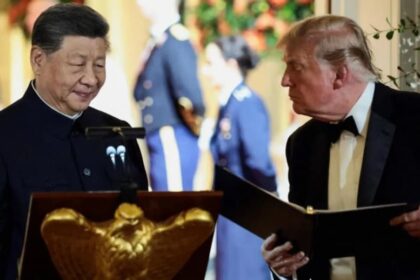
Beijing rejects that framing. The Global Times, a newspaper run by the state that reflects official views, described US limits as part of a Cold War playbook to contain the rise of China. President Xi Jinping arrives in Washington on Wednesday for talks where AI safety sits high on the agenda. Chinese officials say cooperation remains possible, even as both sides accelerate building.
The summit matters because safety rules remain thin while deployment moves fast. Researchers inside leading labs have warned that systems are growing more capable before testing and oversight catch up. US officials say they do not want to pause and risk falling behind. Chinese officials say they want shared rules and a global framework. The gap between those positions will define talks that were meant to build trust.
Open Source Ambition Meets Closed Rivals
Beyond the summit, Beijing is promoting a different path for building models. Xi has urged Chinese firms to develop affordable models with open source licenses, so that people, companies and countries can study, modify and deploy them. The idea has found traction with developers at home and in many markets abroad where budgets are tight and local adaptation matters.
That path contrasts with the closed approach used by firms such as OpenAI and Anthropic, whose design details stay secret. Chinese firms say sharing code speeds repair, invites outside talent and spreads use. Sharing has also helped them cope with limited access to top tier chips. When hardware is constrained, software skill and clever engineering must carry more of the load.
DeepSeek, Huawei and ByteDance have become symbols of that strategy, each pushing models or platforms that others can build upon. State planners see a double gain. Open models can lower costs for factories, hospitals and schools, while giving China a stronger voice in writing global rules. Xi has called repeatedly for stronger regulation and a framework that others can follow, a bid for influence as much as order.
Western rivals respond that openness carries risks when powerful systems spread without strong safeguards. Chinese developers respond that closed systems concentrate power in a few firms and raise prices for everyone else. The debate now shapes procurement from Southeast Asia to the Middle East, where governments weigh cost, control and alignment when choosing a technology stack.
Talent Turns Homeward
Buildings alone do not create an AI power. People do. Here China reports a shift in its favor. Fewer students and researchers are heading to the US, while more are returning from the US to China. University leaders link the turn to visa limits, immigration curbs under Trump and a growing sense that funding, data and industrial partners are easier to find at home.
A New Generation Sees Opportunity at Home
Jack Zhang of the University of Science and Technology of China illustrates the move. After study at Yale in the US and at Cambridge in the UK, he joined a senior recruitment program back home. He wanted to move lab work on AI into human health and medicine, a step that needs staff, clinical data and sustained support from government.
I wanted to take some of the AI work I was doing in the lab and apply it to human health and medicine. That requires more resources, more people and sometimes more government support, which can be difficult to access overseas.
China now produces about five million science and technology graduates each year, compared with about half a million in the US. The scale creates a deep bench for labs and firms, even if training quality varies. AI developer Dang Ronghao, 27, who works for a leading technology company from a base in Shanghai, says campus life feels more connected than in the past. He can discuss research with teams around the world while building products for domestic industry.
I have seen research combining AI with nuclear fusion, AI with astrophysics, AI with new materials, and AI with the development of new drugs. I think we are entering a good era.
Limits remain. Professor Liu Jun of the Department of Statistics and Data Science at Tsinghua University, who has taught at Harvard and Stanford, says he pushes students to ask more questions and to challenge results. Culture and institutional habits make that change slow, in his view. He describes progress, yet adds that openness still falls short of his hopes.
It is not as open as I wish. I keep encouraging students here to ask more questions, to challenge more, but that is hard to change. I think partly it is culture, partly it is the system.
Such frictions do not deter young builders who see funding and scale at home. Many say the chance to test ideas in factories, hospitals and cities outweighs the limits of seminar rooms.
Land Water and Power Under Strain
For all the talk of clean power and cool air, the build brings strains that residents feel first. Power planners admit the grid still leans on coal in places, even as wind and solar grow. Water planners watch rivers and wells in dry country. Construction on this scale can redraw roads, power lines and village boundaries in a single season.
Relocation looms largest. Entire villages have been moved to make open ground for projects and power corridors, though the number of people affected and the compensation offered are hard to pin down. The topic rarely gets open discussion, since public complaint can carry risk. Reporters who ask about deals are often met with silence or short answers.
One local man, speaking anonymously off camera, said the project felt distant from his life. He questioned what gains had reached ordinary households and said few neighbors had found steady work at the sites. Others voiced worry that more land could be taken and that farming, the base of family income for generations, could shrink.
This big data has absolutely nothing to do with ordinary people. What benefits has it brought us.
Other voices sound more hopeful. A man who gave his family name as Zhang stood with potato pickers near the fences and said his children had found jobs linked to the new sites. He described China as now at the forefront of the world, recalling harder decades in the 1960s when the country felt far behind. For him, the servers signal that the country is doing well in economic development and in other areas too.
A National Mission Meets Daily Life
Beijing presents AI as an answer to an ageing workforce and slow productivity in factories. Automation is spreading through manufacturing and logistics, with robots taking on repetitive tasks. Officials argue that machines can offset demographic decline. Workers hear a mixed message of opportunity and displacement, since new roles demand new skills while old posts fade.
Broader economic troubles sharpen the debate. Growth has turned sluggish. Youth unemployment runs high. Consumers spend with care. Property prices in many cities have fallen from past peaks, leaving households feeling poorer. In rural areas, older residents watch young people leave for city jobs while services thin out. Against that backdrop, talk of server halls and model benchmarks can feel remote.
One farmer in Inner Mongolia captured that distance. He rode a cart to check sheep, his phone screen smashed, his link to the internet supplied by a pocket dongle costing just over 40 yuan a month. He said he rarely goes online and has no use for AI in daily work. Life, in his account, has barely shifted.
Big data and all that is pretty good but it has nothing to do with me. There have not really been any changes for me. I do not know about the future.
Surveys suggest public views of AI in China rank among the most positive in the world, with less resistance to adoption than in many other countries. Analysts urge caution with such polls in a heavily censored setting, where open dissent is rare. Anxiety over job loss is real but hard to measure. The gap between official ambition and lived experience may prove the sternest test for a plan that asks society to move at machine speed.
The Bottom Line
- Ulanqab in Inner Mongolia has become a major site for data centers that will power China AI push.
- China is building hundreds of centers in Ulanqab, Ningxia, Gansu and Guizhou for firms such as Huawei, ByteDance and DeepSeek.
- Cool climate, low cost land and large wind and solar resources explain the choice of remote provinces.
- Trump says whoever wins AI wins, while Anthropic chief Dario Amodei backs chip export limits on China.
- Xi promotes affordable open source models and calls for a global framework for AI rules.
- More Chinese researchers are staying home or returning, aided by five million science graduates each year.
- Local concerns include coal power use, water supply in arid zones, village moves and few jobs for residents.
- Many rural people feel untouched by the boom, a gap Beijing must bridge to sustain support.