The Order That Never Arrives
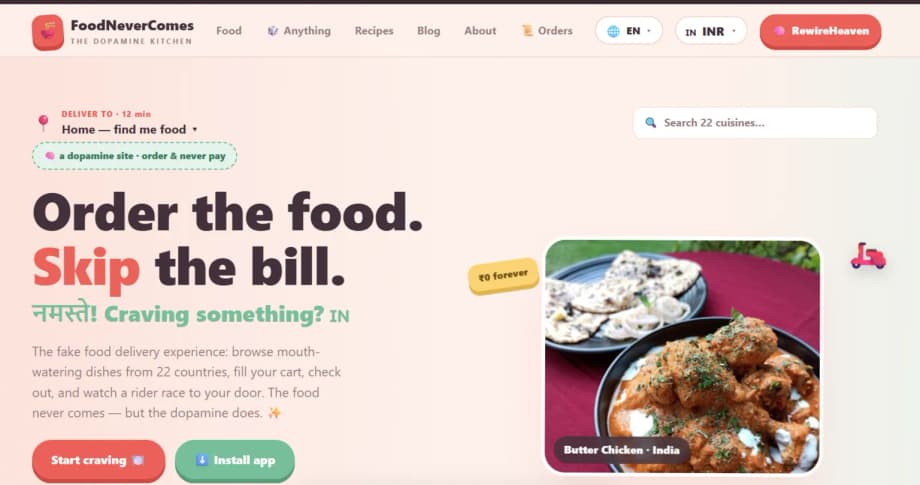
You are hungry. Or you are not. It does not matter. You open FoodNeverComes, pick from 22 cuisines and start scrolling. Butter chicken looks tempting. Bibimbap looks tempting too. You add a few dishes, watch the total climb and tap checkout. A tracker says a rider is on the way. Then a call arrives from inside the site, voiced by AI. The rider says he is outside your building but cannot find your street or door. There was never any food. The order exists only on the screen.
The pitch is direct. Order the food. Skip the bill. Another line on the site puts it even more plainly. The food never comes but the dopamine does. The catalog feels real enough to fool your reflexes for a minute. The team lists 22 kitchens, 327 dishes and 319 real recipes, with fake prices, a simulated checkout and a fictional delivery journey from kitchen to door that stops before it starts. Since launch in June, the founders say the site has drawn more than 2.7 million visitors, many of them in India, many arriving out of curiosity and staying to play with carts they never need to pay for.
Two Friends From Udaipur Who Kept Filling Their Carts
The idea came from everyday habits. Purvansh Parmar and Anshul Sharma are two software developers aged 26 from Udaipur in Rajasthan. They met on a computer science diploma course and later started NeuroX AI, a small studio that builds software and AI products and posts tech explainers on Instagram. They noticed a pattern in their own lives. Baskets filled up with things they wanted, then sat untouched. Sharma would browse electronics, compare models, fill an online basket and walk away. Parmar watched his mother do the same with household goods. She would add things to the cart and say she would order later. Later often never came, yet the browsing itself seemed to satisfy something.
Parmar found his own version at food delivery checkouts. During a two month work project in Mumbai, he says he spent 5000 to 10000 rupees a week on food, sometimes ordering treats he did not need. Belgian waffles, ice cream and once a large jar of sour cream he barely wanted and gave away to friends. He started to wonder if the craving was for food at all. Perhaps, he thought, the real pull was the ritual of ordering itself. What starts as true hunger, the pair argue, can get linked to the pleasure of tapping through menus, applying coupons and waiting for the doorbell. Over time, boredom, stress or habit can trigger the urge even when hunger has gone.
Sharma ran into the same loop with phones. When his screen cracked, he spent a week on a large shopping site comparing six or seven replacements and adding them to his basket. Then he repaired the handset and kept using it. He enjoyed the research, the comparison charts, the feeling of narrowing choices and placing favorites in the cart. In the end he bought nothing. He now catches himself doing the same on food apps, mainly when anxious, filling baskets without checking out. He describes it as a habit he recognized in himself before he saw it in others. That recognition became the seed for a site that lets people enjoy the loop without paying for it.
Inside The New World Of Dopamine Sites
FoodNeverComes belongs to a playful but telling internet genre often called dopamine sites. These pages recreate the rituals of buying without the buying. There are fake stores, fake delivery services and even fake holidays. Visitors browse, customize, check out and track orders that will never arrive. The point is the process, not the product. For people trying to spend less, eat less or simply pause, the simulation promises relief. You get the scroll, the choice, the small rush at checkout, minus the bill, the wait and the regret.
The style took off in South Korea, where playful fake commerce pages turned window shopping into a game. It has since traveled far. Sites with names like Dopamine Shop and Fakehaul mimic fashion checkouts and unboxing flows. Others mimic travel or grocery runs. FoodNeverComes fits that wave with an Indian menu at its center, from rich curries to noodles, desserts and street snacks. The founders have added a companion idea called TripNeverLeaves. It lets users pick a destination, flight, seat, hotel and activities, then boards them on a virtual flight that never leaves the runway. They say that travel game has already drawn more than 100000 visitors.
Part of the appeal is control. Real delivery apps push you toward spending with photos, timers, discounts and ratings. A fake version keeps the theater but removes the cost. You can order 10 desserts at midnight, plan a feast for 20 guests or test how it feels to choose the most expensive dish on the menu. No rider is disturbed. No money moves. No food goes to waste. For students, young workers and anyone watching expenses in cities where delivery fees add up fast, that freedom feels novel. It turns a private habit, the abandoned cart, into shared play.
Why Anticipation Can Feel Better Than Eating
Psychologists have long studied the pleasure that comes before consumption. Ravi Dhar, director of the Yale Center for Customer Insights, calls it anticipatory utility. It is the lift you get from looking forward to something, a new pair of shoes, a holiday, a restaurant meal. Anticipation becomes part of the experience itself. Browsing photos, reading reviews, imagining the first bite, all of it builds tension in a pleasant way. In many cases the wait carries as much joy as the meal, because imagination fills gaps that reality cannot always match.
Dhar points out that this tension explains why the chase can outshine the catch. While you browse, possibilities stay open. Every dish could be perfect. Every choice could be the right one. Once you order, pay and eat, the story closes. Psychological arousal falls. The meal is either good or it is not. The fantasy narrows into fact. That is why window shopping, adding to carts and planning trips can feel so absorbing even when nothing arrives. The mind enjoys rehearsing good outcomes.
The founders describe this in simpler language. Parmar says boredom or a busy mind can spark the urge to open a food app even with no hunger at all. Ordering makes you feel active, cared for, a little excited. You start to link the act of ordering with a lift in mood. Over time, the link hardens into habit. His team wanted to test if people could keep the lift while dropping the cost and calories. To introduce his view, it helps to hear Dhar sum up the chase in a few words. He studies choice and consumption for a living and frames the pull of browsing as central to modern buying.
The thrill is in the chase.
That short line captures why a fake checkout can still feel real. The site preserves the arc of desire. Search, compare, choose, confirm, track. Each step delivers a small signal that something good is coming. The brain responds to those signals even when the kitchen is imaginary. For a few minutes, the wait feels like care. The screen feels like service. The ritual does its work.
Wanting Versus Liking In The Brain
Popular talk often calls dopamine the pleasure chemical. Brain science tells a more careful story. Kent Berridge, a neuroscientist at the University of Michigan who developed the theory of wanting and liking, treats them as separate processes. Wanting is the motivational pull toward something. Liking is the pleasure of having it. They often travel together, but they do not have to. Dopamine, in his account, drives the first far more than the second. It pushes you to seek, to tap, to pursue.
Tempting photos and smooth app flows are built to fire that wanting system. Berridge calls the effect incentive salience. A bright image of butter chicken, a timer that says hot food is near, a coupon that expires soon, all can tag an item as worth chasing. Some settings can trigger wanting by itself. People can chase something hard even when the final pleasure is mild. Anyone who has ordered extra snacks late at night, then felt flat when they arrived, knows the gap. You wanted more than you liked.
Anna Lembke, a Stanford University addiction psychiatrist and author of Dopamine Nation, offers a matching caution in plain terms. She says calling dopamine a chemical of pleasure is an oversimplification. Dopamine is the molecule that says get more of this or do more of that, but it does not equal joy by itself. To introduce her view, she speaks as a clinician who treats compulsive habits and sees how cues build power over time. Her point helps explain why the steps before a reward can matter so much.
To call dopamine a chemical of pleasure is an oversimplification. Dopamine is the molecule that says get more of or do more of, but it does not necessarily equate to pleasure.
Lembke adds that ritual itself can become reinforcing. Cues and habits tied to a reward can gain weight of their own. In addiction care, doctors often see that the routines around use, the place, the time of day, the familiar taps on a phone, start to carry force even apart from the substance or food. She puts it this way as someone who has watched patients struggle with loops they know are costly. Anticipation can train the brain as surely as arrival.
Anticipation of reward can be as reinforcing as the reward itself.
Berridge sees a similar mix in fake ordering. He suggests the ritual could spark a dopamine surge and strong wanting, plus a faint echo of liking learned from past meals. The brain remembers the smell of curry, the fizz of soda, the comfort of dessert, and replays a trace while you browse. That trace may be enough for a brief lift. His caution is about staying power. New games fade. He would be surprised, he says, if many users returned for more than about 10 imaginary orders, once the surprise wears off and the menu holds no mystery.
Can Imaginary Orders Satisfy Real Hunger
The core promise of FoodNeverComes is relief. Simulate the craving, skip the cost, dodge the guilt. Dhar is open to the idea that fake consumption can act as a release valve. He notes that evidence from games shows simulated acts can feel effective. Players who build, cook, race or shop inside games often report real satisfaction. The body stays still while the mind plays out the arc. If a short session on a fake food app lets a stressed student ride out a midnight urge without spending 400 rupees, that looks like harm reduction in action.
There is also a less comforting result to consider. The same ritual that relieves pressure can rehearse it. Each fake checkout practices the path of real checkout. Photos, carts, timers, trackers, all train the same sequence. Lembke says the data are not yet in and effects may differ by person. To frame her concern, she speaks as a psychiatrist who worries about loops that feel harmless at first. She also sees one benefit worth naming. Users who seek a fake outlet have already noticed their own pattern. That honesty, she says, can be a starting point for change.
The one upside, though, is that people using these sites have on some level already admitted to themselves they have a problem, and that admission is often the first step in recovery.
For some users, the blog on the site tells that story. The founders write about food delivery addiction, why fake ordering feels good, how cravings spike with stress, how guilt follows a binge and how cart design keeps people tapping. Readers share notes about late night scrolling, festival sales and office lunch breaks that turn into snack orders. The tone is light, but the theme is steady. Many people feel stuck between wanting comfort and wanting control. A toy that names the loop can feel like company.
The risk remains that play turns into practice. If every dull evening ends with an hour of fake menus, the brain still learns that dullness means open the app. Lembke says her bet is that over time such sites could reinforce the same addictive networks they mimic, even while saving money in the short term. Dhar wants more data before judging. Both agree on one practical test. Watch what happens next. If fake orders reduce real orders, calm anxiety and leave you content, they help. If they leave you more primed to order for real, they do not.
Beyond Food And The Pull On Young Minds
Food was only the start. TripNeverLeaves applies the same logic to travel. Users choose a destination, flight, seat, hotel and activities, then take a virtual flight that stays on the ground. The pages mimic airline seats, boarding passes and hotel photos. The founders say more than 100000 people have tried it. The appeal rhymes with food. Planning a trip delivers a rush of its own. Maps, lists, window seats, sunset photos, all promise a future that feels better than today. You can taste that future without booking it.
Who uses these toys is harder to pin down. Site traffic skews young, urban and phone first, the same group that lives inside delivery and shopping apps. Lembke says younger users may be more open to fast digital rewards because the developing brain is still wiring control systems. To introduce her point, she speaks as a doctor who studies how age shapes habit. She focuses on the front part of the brain that acts like brakes on impulse and connects slowly to emotion centers during teen years.
In childhood and early adolescence, the front lobe, which acts like the brakes on appetite, is not yet fully connected to the emotion centres of the brain. Hence, teens are more likely to take risks without appreciating the negative consequences, and more likely to get addicted to reinforcing substances and behaviours, once exposed.
That biology does not doom anyone, but it raises the stakes for design. Teens are more likely to chase novelty, miss downsides and lock in loops once exposed. A game that rewards tapping through menus for an hour could teach persistence as easily as restraint. Parents and teachers may want to treat dopamine sites like video games. Fine in doses, worth watching in excess, better when paired with sleep, movement, real meals and offline time. The founders say they want to help here by keeping both sites free and sharing patterns with neuroscientists and psychologists for study.
For now the team insists the project is not about money. There are no real orders, no commissions, no delivery fees. The plan is to keep access free, learn from use and invite researchers to probe what helps and what harms. What began as a joke about ordering too much has landed on a larger puzzle of modern buying. So much of the thrill lives in the moments before we get the thing. Search, choice, checkout, tracking, knock on the door. FoodNeverComes asks a simple follow up. If the thrill lives there, do we always need the thing at all. The answer will differ by person, mood and day, but the question itself has already drawn millions to try.
The Bottom Line
- FoodNeverComes lets users browse 22 cuisines, add dishes and track fake delivery with no real food or payment.
- Cofounders Purvansh Parmar and Anshul Sharma, aged 26 from Udaipur, say the site drew 2.7 million visitors since the June launch.
- The catalog lists 22 kitchens, 327 dishes and 319 real recipes with fake prices and simulated checkout.
- Dopamine sites mimic shopping, food and travel rituals, a style that gained pace in South Korea.
- Yale researcher Ravi Dhar links the appeal to anticipatory utility, the joy felt while waiting and imagining.
- Michigan neuroscientist Kent Berridge and Stanford psychiatrist Anna Lembke separate wanting driven by dopamine from liking felt as pleasure.
- Sister site TripNeverLeaves offers virtual holiday planning and has drawn more than 100000 visitors.
- Founders plan to keep the sites free and share use patterns with brain researchers.