Students march on Jharkhand Assembly
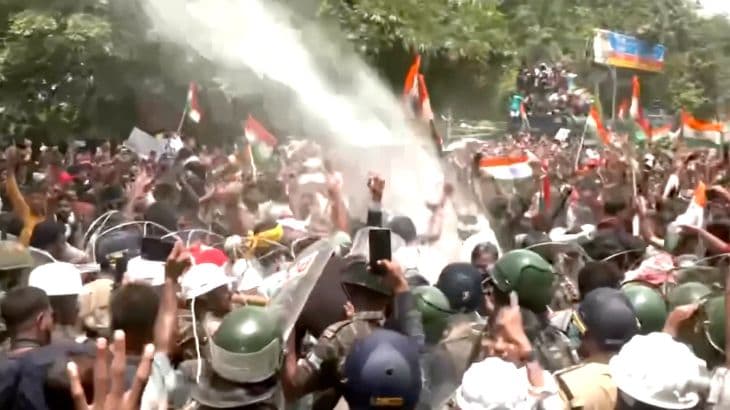
Indian police used batons, tear gas and water cannons on thousands of students and government job applicants who marched toward the Jharkhand Assembly in Ranchi on Monday. The protesters are demanding action over alleged leaks, grading errors and other irregularities in recruitment examinations.
The demonstration followed more than two weeks of protests at Jaipal Singh Munda Stadium. Some students have been sleeping outdoors, while several have taken part in hunger strikes. The marchers carried national flags and placards calling for the cancellation of disputed examinations and an investigation by the Central Bureau of Investigation, or CBI.
Police erected several barricades along the route and deployed more than 1,500 security personnel. Officials said parts of the crowd broke through the barriers and that some protesters threw stones. Police said three officers were injured. Images from Ranchi showed security forces using water cannons and batons as crowds pushed toward the Assembly complex.
Protesters said the police response was excessive. Piyush Kumar Soni, one of the demonstrators, told the Press Trust of India that the crowd had been peaceful and accused authorities of using batons against students.
The baton charge was barbaric. We were protesting peacefully, but the government used batons against us.
The official number of injured protesters was not immediately available, although reports showed some people receiving medical treatment.
What triggered the anger?
The immediate dispute centers on a preliminary civil service examination held in April by the Jharkhand Public Service Commission, or JPSC. Candidates questioned the results announced in July after alleged answer sheets circulated on social media appeared to show successful applicants answering unusually few questions.
Students have also raised concerns about the Jharkhand Staff Selection Commission Combined Graduate Level examination, known as JSSC CGL, and other tests used to select state employees. They say suspected leaks, cheating and administrative failures can deny thousands of applicants a fair opportunity after years of study.
Government recruitment exams are fiercely competitive in Jharkhand, one of India’s poorer states. Public sector positions are sought after because they usually provide steady salaries, health benefits and pensions. One recruitment exercise drew almost 640,000 applications for 2,025 positions. Another attracted more than 322,000 candidates for only 510 vacancies.
Many applicants spend years preparing for these tests and pay for coaching or study materials. When an examination is canceled or its results are challenged, candidates can lose both money and time. The dispute has therefore become a wider complaint about scarce employment, corruption and confidence in public institutions.
Government accepts some demands
The Jharkhand government, led by Chief Minister Hemant Soren’s Jharkhand Mukti Morcha in alliance with Congress and other parties, has held several rounds of talks with student groups. Officials say they have accepted about 98 percent of the protesters’ demands.
After talks over three days, the government agreed to cancel three recruitment examinations, according to reports. It also backed the creation of fast track courts to speed up cases, while several JPSC members resigned. JPSC chairperson L Khiangte stepped down on July 22 and was later arrested in connection with the investigation into alleged irregularities.
The state’s Criminal Investigation Department is examining the allegations. More than a dozen people have reportedly been arrested, and investigators are looking into the role of a private company involved in parts of the examination process. The Enforcement Directorate has also opened a money laundering case linked to the alleged wrongdoing.
Students say the government’s response is incomplete. They claim that only three of 13 disputed examinations have been addressed and continue to demand a CBI investigation. The federal agency has wider jurisdiction and is viewed by the protesters as more independent than a state investigation.
Hunger strike leader taken to hospital
Student leader Devendra Nath Mahto joined the march despite being on hunger strike for nine days. His health deteriorated and he was taken to hospital. Reports said he had lost about 10.5 kilograms during the protest.
Mahto traveled to the demonstration in an ambulance and urged participants to remain calm. He appealed to the chief minister not to allow the confrontation to turn violent, warning that injuries could further anger the crowd.
Before the march, authorities imposed restrictions around the Assembly under Section 163 of the Bharatiya Nyaya Sanhita. The provision allows officials to limit gatherings in specified areas when they believe public order is at risk. Police also increased security across Ranchi and restricted access near the legislature.
The restrictions did not stop the march. Protesters crossed several lines of barricades before police used water cannons, tear gas and batons to push them back. The crowd remained in the area later in the day, despite repeated efforts to disperse it.
Political dispute grows
The BJP, which is in opposition in Jharkhand, has supported the students and demanded a CBI inquiry. It also called for a statewide shutdown to protest the police action. BJP representatives raised the issue in the state Assembly and accused the government of failing to protect young people seeking jobs.
State Higher and Technical Education Minister Sudivya Kumar said the government had repeatedly tried to resolve the matter. He accused the BJP of taking control of the movement and misleading students after officials agreed to many of their demands.
Chief Minister Soren said outside interests were trying to disrupt democracy in the state and warned against turning the protest into a political confrontation. His government has promised action against those responsible for examination violations while defending its decision to continue with a state investigation.
Congress leader Rahul Gandhi condemned the use of force, even though Congress is part of the governing alliance in Jharkhand. He said peaceful student demonstrations should be handled through talks.
The use of force against students protesting in Jharkhand is wrong. Students have a right to peaceful protest, and only dialogue can yield solutions.
Gandhi has also criticized a separate police crackdown on youth protesters in New Delhi, where demonstrators demanded action over alleged leaks in national examinations.
Part of a wider national frustration
The Ranchi protests follow nationwide demonstrations over alleged leaks and failures in India’s education and recruitment systems. Young people have protested the cancellation or review of major entrance tests, including medical admissions examinations, after allegations that question papers were leaked.
A youth movement known as the Cockroach Janta Party, which says it is not a conventional political party, helped organize large demonstrations in New Delhi in July. The movement emerged after controversial remarks comparing unemployed young people to cockroaches. Its five week protest was called off after Education Minister Dharmendra Pradhan resigned, although organizers later said some legal cases against demonstrators had not been withdrawn as promised.
Exam disputes have become especially sensitive in India, where nearly two thirds of the population is under 35. Official figures show unemployment has fallen, yet a 2026 study by Azim Premji University found that almost 40 percent of graduates aged 15 to 25 were unemployed.
The controversy also crosses party lines. Examination leaks and cheating scandals have occurred in several Indian states and predate the current national government. The repeated disputes have damaged trust among candidates who see public examinations as one of the few routes to secure employment.
What happens next?
The state government faces pressure to publish a clear timetable for canceled examinations, explain how affected candidates will be protected and set out reforms for recruitment agencies. Students want an independent inquiry, stronger safeguards against leaks and transparent procedures for evaluating answer sheets.
The arrest of a former JPSC chairperson and the resignations of commission members show that the allegations have already produced institutional consequences. The investigation will now have to establish whether misconduct occurred, who benefited and whether officials or private contractors failed in their duties.
For the protesters, the central issue is trust. Canceling examinations may provide immediate relief, yet candidates also want assurance that future tests will be secure and fairly administered. The confrontation outside the Assembly has widened the dispute from a question about individual results to a demand for lasting changes in how Jharkhand recruits public employees.
Key Points
- Police used tear gas, batons and water cannons during a student march in Ranchi.
- Protesters allege irregularities in JPSC, JSSC CGL and other recruitment examinations.
- The government says it has accepted about 98 percent of the students’ demands.
- Students continue to seek a CBI investigation and broader recruitment reforms.
- Former JPSC chairperson L Khiangte was arrested during the state investigation.
- Student leader Devendra Nath Mahto was hospitalized after a prolonged hunger strike.