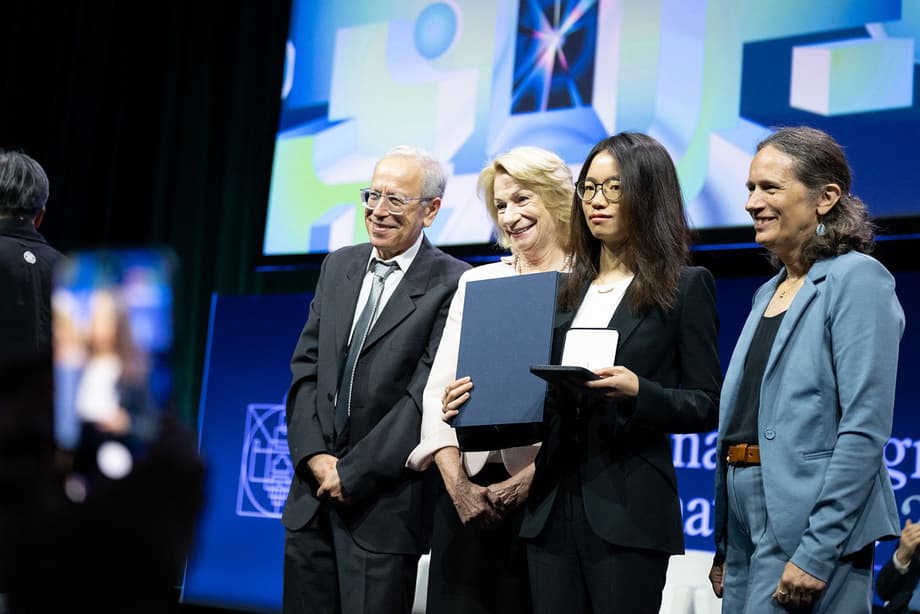
A historic double victory for Chinese mathematics
Chinese mathematicians Wang Hong and Deng Yu have won the 2026 Fields Medal, becoming the first Chinese citizens to receive mathematics’ highest honor. Their awards were announced on July 23 at the opening ceremony of the International Congress of Mathematicians in Philadelphia.
- A historic double victory for Chinese mathematics
- Who are Wang Hong and Deng Yu?
- What discoveries earned Wang her medal?
- How did Deng connect particles and gases?
- The other two laureates broaden the picture
- Why Wang’s award matters for women in mathematics
- China’s scientific ambitions meet a global research system
- Mathematics at a moment of rapid AI change
- What to Know
Wang, 35, and Deng, 37, were among four laureates selected by the International Mathematical Union. The other recipients are American mathematician John Pardon of Stony Brook University and Canadian mathematician Jacob Tsimerman of the University of Toronto.
The Fields Medal is awarded every four years to between two and four mathematicians younger than 40. It recognizes major discoveries as well as the promise of further achievement. Each winner receives a gold medal bearing the image of Archimedes and 15,000 Canadian dollars.
The result carries special weight in China. Wang and Deng are the first Chinese passport holders to win the award, and the first two mathematicians who completed their undergraduate education in mainland China to receive the medal in the same ceremony. China is now the fifth country, after the United States, France, Britain and Russia, to produce two Fields Medalists at one International Congress of Mathematicians.
Who are Wang Hong and Deng Yu?
Wang and Deng were both members of Peking University’s 2007 undergraduate cohort, although their routes into mathematics were very different.
Wang grew up in Guilin in southern China. She initially entered Peking University to study earth and space sciences before transferring to mathematics. Unlike many celebrated Chinese mathematicians, she did not come through the national mathematics competition system. Her progress was driven by a growing interest in mathematical analysis and a decision to return to the subject after a period of uncertainty about her academic direction.
She later studied in France and earned her doctorate at the Massachusetts Institute of Technology in 2019. Wang is now a professor at New York University and also works at the Institut des Hautes Études Scientifiques in France.
Deng grew up in Shenzhen and followed a more traditional competition route. He won gold medals in major Chinese and international mathematics competitions before transferring from Peking University to MIT. He completed his doctorate at Princeton University in 2015 and is now a professor at the University of Chicago.
Their shared university background has become a major part of the celebration in China. It connects a leading mainland institution with two research careers that developed through study and collaboration in the United States and Europe.
What discoveries earned Wang her medal?
Wang was recognized for major work in harmonic analysis and geometric measure theory. These areas examine how waves, signals and complicated shapes can be represented and understood using mathematical structures.
Her best known achievement is the solution, with Joshua Zahl, of the three dimensional Kakeya conjecture. The problem began with a simple question posed by Japanese mathematician Soichi Kakeya in 1917: how little space is needed to rotate a needle through every possible direction?
In two dimensions, the question can be imagined with a pencil moving across a tabletop. The three dimensional version is far harder because the needle must point in every direction in space while remaining inside a set that may have a highly irregular shape.
Mathematicians had spent decades studying these sets because they are linked to questions about waves, light, signal transmission and Fourier analysis. Wang and Zahl proved that a three dimensional Kakeya set must have the full dimension of the surrounding space, resolving a central problem that had resisted generations of researchers.
The proof also produced methods that may help with related questions in harmonic analysis, including problems involving wave equations, distance sets and the way signals concentrate or spread. The work is highly abstract, yet the mathematical tools behind it connect to areas used in imaging, communications and the study of physical waves.
Wang has described the result as part of a wider effort involving many colleagues. Following the announcement, she said that major achievements are built through years of collaboration, chance encounters and questions that lead researchers in unexpected directions.
How did Deng connect particles and gases?
Deng was honored for research in partial differential equations, probability and mathematical physics. His work addresses a basic question in physics: how does the behavior of countless individual particles produce the smooth, large scale behavior of a gas?
At the microscopic level, particles move and collide according to precise mechanical rules. At the macroscopic level, scientists describe a gas through temperature, pressure and statistical averages. The Boltzmann equation, developed in the 19th century, is a central tool for describing how gases change over time.
For more than a century, researchers had struggled to prove rigorously how the equation emerges from the motion of individual particles. Deng and his collaborators established a mathematical link between a system of colliding hard spheres and the Boltzmann equation for dilute gases.
In simple terms, their work shows how many tiny, reversible collisions can produce the large scale behavior associated with irreversible processes. A gas may obey reversible mechanical rules at the level of individual particles, yet a mixture of hot and cold gas will not spontaneously separate again. Deng’s research helps explain how that transition from microscopic motion to macroscopic behavior can be placed on firm mathematical foundations.
The achievement addresses a focused part of David Hilbert’s Sixth Problem, presented in 1900. Hilbert called for physical theories to be expressed with rigorous mathematical foundations. Deng’s work gives researchers a stronger framework for studying statistical mechanics and complex physical systems.
Deng said receiving the medal made him happy both for himself and for the field he represents. His research shows how modern mathematics can connect abstract equations with questions about gases, fluids and the physical world.
The other two laureates broaden the picture
The 2026 awards also recognize major achievements in geometry, topology, number theory and algebraic geometry.
John Pardon, 37, of Stony Brook University, was honored for work in symplectic and contact geometry, as well as topology. These fields study properties of spaces and shapes, including structures linked to the mathematics of physical systems and string theory. Pardon developed tools for distinguishing complicated geometric spaces and used them to solve problems that had remained open for decades.
Jacob Tsimerman, 38, of the University of Toronto, works in number theory and complex algebraic geometry. He has used ideas from mathematical logic, especially o minimality, to address major questions involving Diophantine equations, Shimura varieties and the André Oort conjecture.
The four winners represent a wide range of modern mathematics. Their work includes the study of waves, gases, geometric spaces, prime numbers and mathematical structures with many dimensions. The selection shows how the Fields Medal recognizes discoveries across the discipline rather than a single preferred area.
Three of the four recipients have connections to Princeton University. Deng earned his doctorate there, Pardon studied there as an undergraduate, and Tsimerman received his doctorate from the university.
Why Wang’s award matters for women in mathematics
Wang is only the third woman to win the Fields Medal in its 90 year history. She follows Maryam Mirzakhani, who became the first woman recipient in 2014, and Maryna Viazovska, who won in 2022.
The small number of female laureates reflects the long standing gender imbalance in advanced mathematics. Wang’s award has drawn particular attention in China, where public discussion has focused on the message it sends to girls considering careers in science, technology, engineering and mathematics.
Shing Tung Yau, the first Chinese born Fields Medalist, said the achievement could encourage more young women to study mathematics. He recalled that some Chinese families have viewed mathematics as a less suitable subject for girls, and said Wang’s success gives students a powerful example of what is possible.
Wang’s own academic story also challenges the idea that every leading mathematician must follow the same path. She was not a major competition star as a teenager, changed fields at university and experienced periods of doubt before returning to research. Her career illustrates the value of curiosity and sustained work alongside early academic distinction.
China’s scientific ambitions meet a global research system
The awards arrive as China seeks a stronger role in basic science, the study of principles that may have no immediate commercial use but can shape entire fields over time. Beijing has invested heavily in universities, laboratories and programs designed to attract researchers and improve domestic research capacity.
For years, Chinese students have performed strongly in mathematics competitions. Competition success, however, is different from original research. A Fields Medal usually reflects years of work on problems that may not have a clear solution and require freedom to pursue unfamiliar ideas.
Wang and Deng’s achievement suggests that the education and research links built between China and leading institutions abroad are producing results at the highest level. Both began their undergraduate studies in mainland China, then continued through graduate programs in the United States and research networks spanning several countries.
Chinese social media platforms filled with congratulations after the announcement. State media presented the awards as a response to the old view that China was strong in applied or competitive mathematics but had yet to make comparable breakthroughs in fundamental theory.
Yau has urged Wang and Deng to return to China to teach. He also said he hopes future Fields Medalists will be trained entirely within Chinese institutions. That goal reflects a wider effort to reduce the loss of highly talented researchers to overseas universities while keeping international cooperation open.
We very much hope they will come back, because that is important for China, Yau said in an interview with Chinese media.
Wang’s current work in the United States and France, along with Deng’s position in Chicago, also shows that mathematics remains a strongly international field. Research teams, ideas and academic careers cross national borders even when governments compete for scientific prestige.
Mathematics at a moment of rapid AI change
The medals were announced as artificial intelligence is beginning to affect mathematical research. New systems can produce sophisticated looking proofs and suggest approaches to difficult problems, although mathematicians warn that such arguments can contain errors that are hard to detect.
The debate has created fresh interest in what makes a mathematical discovery reliable. A proof must be checked line by line and accepted by a community of specialists. The work recognized in Philadelphia required deep theory, collaboration and careful verification over long periods.
Tsimerman, one of this year’s laureates, is expected to join OpenAI’s safety division. He has said that advances in AI may alter the mathematics profession, including how researchers search for ideas and test proofs. The Fields Medal ceremony therefore celebrated achievements produced by human collaboration at a time when the tools of discovery are changing quickly.
What to Know
- Wang Hong and Deng Yu won the 2026 Fields Medal in Philadelphia.
- They are the first Chinese citizens to receive the award.
- Both studied as undergraduates at Peking University in the 2007 cohort.
- Wang helped solve the three dimensional Kakeya conjecture.
- Deng rigorously connected particle dynamics with the Boltzmann equation.
- Wang is the third woman to win the Fields Medal.
- John Pardon and Jacob Tsimerman were the other 2026 recipients.
- The medal is awarded every four years to mathematicians younger than 40.