Satellite evidence points to widespread destruction
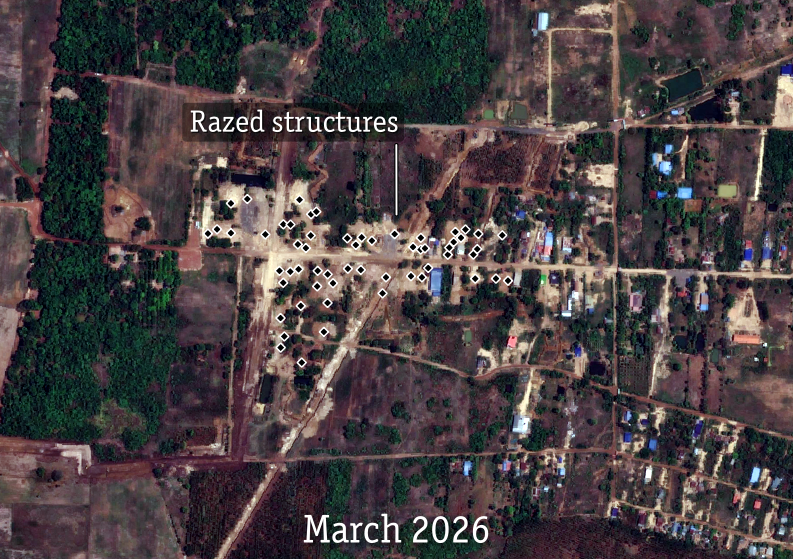
Satellite images released by the Cambodian League for the Promotion and Defense of Human Rights, known as LICADHO, show hundreds of homes and public buildings destroyed in three Cambodian villages held by Thai troops. The affected villages are Chouk Chey, Boeng Trakuon and Prey Chan in Banteay Meanchey province.
LICADHO analyzed publicly available images from the European Space Agency’s Sentinel 2 satellites, comparing conditions in April before Thai forces took control with images captured in March. The organization counted 627 destroyed homes and structures: 270 in Chouk Chey, 299 in Boeng Trakuon and 58 in Prey Chan.
The findings have intensified pressure on Phnom Penh and Bangkok to restart border talks. Cambodia says Thai troops have remained in areas it considers sovereign Cambodian territory despite a ceasefire signed on December 27, 2025. Thailand has rejected accusations of territorial encroachment and has previously said its forces did not target civilian infrastructure.
LICADHO has called for an investigation and urged authorities to provide housing and assistance to families who cannot return.
Why the villages remain empty
More than 20,000 Cambodians remain in temporary camps, according to Cambodia’s Ministry of the Interior. As of August 6, the ministry recorded 20,281 displaced people, including 10,331 women and 6,066 children.
The figure includes families who fled during fighting and those blocked from returning after Thai soldiers installed razor wire, barricades and shipping containers around parts of the villages. Cambodian officials say these barriers have cut residents off from homes, farms and roads.
At Boeng Trakuon, more than 1,800 families are reportedly displaced. In nearby Chouk Chey, local officials have said that most families cannot access their land. Unexploded weapons and continuing military control have added to the risks facing civilians who consider returning.
Residents interviewed during visits to the area have described fear, lost livelihoods and uncertainty over whether their houses still exist. In one account, a villager said soldiers gave her only 20 minutes to leave and would not allow her to retrieve basic cooking equipment. Such experiences have made the ceasefire feel remote for people living in shelters.
Public services and livelihoods under strain
The damage extends beyond private houses. Schools, health centres, roads, bridges, electricity lines, water facilities and religious buildings have also been affected across Cambodia’s border provinces.
Preliminary government assessments list damage to 1,558 houses, 26 schools, 14 health facilities, 74 public buildings, 19 pagodas, four ancient temples, five bridges and 87 road sections. Several schools and health centres remain closed in Oddar Meanchey, Banteay Meanchey and Preah Vihear.
Displacement has also damaged local economies. Border crossings have closed or operated at sharply reduced levels, cutting trade and customs income. Farmers have been unable to cultivate fields, while small businesses near checkpoints have lost customers. The wider conflict also caused large numbers of Cambodian workers to leave Thailand and reduced tourism in both countries.
For families living in pagodas and makeshift shelters, the immediate needs include food, clean water, medical care, schooling and protection from unexploded ordnance. Longer term recovery will require land access, rebuilt houses and confidence that renewed fighting will not force another evacuation.
What international law says
LICADHO says the destruction may violate Article 53 of the Fourth Geneva Convention, which prohibits an occupying power from destroying property unless the destruction is required by military operations. International human rights law also protects access to adequate housing and restricts arbitrary destruction and forced eviction.
The legal question is complicated by the competing territorial claims. Thailand says it is securing its own territory, while Cambodia says the villages lie within borders established by historical treaties and maps. The two governments disagree over the location of the frontier in several areas, even though both have agreed to pursue negotiations.
UN Special Rapporteur on human rights in Cambodia Tom Andrews visited the border and displacement sites during a 12 day mission that ended on July 31. He said international law gives people displaced by armed conflict the right to return home, and that the December ceasefire included a commitment to permit such returns.
Before quoting Andrews, his central point was that a ceasefire cannot protect civilians if military control, blocked roads and destroyed housing prevent them from rebuilding their lives.
It is imperative that Thailand and Cambodia work together to expedite the return of displaced civilians. They need, and deserve, to go home.
Thailand has disputed some figures and rejected parts of Andrews’s assessment. Andrews said his estimates were based on United Nations material and that human rights protections apply regardless of competing claims over territory.
Why the border dispute became a military crisis
Thailand and Cambodia share an approximately 800 kilometre frontier shaped by treaties made during the French colonial period. Cambodia relies on the 1904 and 1907 Franco Siamese agreements, related maps and records from boundary commissions. Thailand disputes some interpretations of those materials and has its own claims in several undemarcated areas.
The International Court of Justice ruled in 1962 that the Preah Vihear temple belonged to Cambodia. A later ruling clarified the area around the temple, yet other sections of the frontier were not settled by the court. Those unresolved areas have remained sensitive, particularly when domestic political leaders use border issues to appeal to nationalist opinion.
Fighting intensified in 2025 after months of military buildup and confrontations. Thailand has said its operations were defensive and aimed at military sites, supply routes and facilities linked to security threats, including alleged scam compounds. Cambodian authorities say attacks struck civilian areas and infrastructure, while rights groups have warned about the use of explosive weapons near populated communities.
Amnesty International has urged both governments to protect civilians and follow international humanitarian law. The organization warned that renewed hostilities could cause further deaths, displacement and damage to essential services.
Diplomacy has yet to restore access
Phnom Penh is pressing for the Cambodia Thailand Joint Boundary Commission, or JBC, to resume field surveys and boundary demarcation. The commission is the main bilateral mechanism for examining disputed sections of the frontier and is separate from military bodies that manage security incidents.
Cambodian government spokesman Pen Bona said joint surveys are needed to allow civilians to return freely, safely and with dignity. Information Minister Neth Pheaktra said the ceasefire’s meaning should be measured by whether displaced people can return to their land, rather than simply by the absence of gunfire.
ASEAN observers have expanded visits to the frontier to check compliance with the ceasefire. Military attachés from countries including the United States, China, Russia, France and Japan have also visited villages, camps and sites containing unexploded weapons. Their presence gives outside governments a clearer view of conditions, although the observers do not have authority to settle the boundary.
Thailand has said it supports peaceful bilateral negotiations and complies with international law. Cambodia has asked Bangkok to withdraw troops from areas it says were occupied after the ceasefire. Each side continues to accuse the other of violations, making the first practical step toward talks politically difficult.
The human cost of a frozen ceasefire
Reports from the border show how a ceasefire can stop large scale fighting without restoring normal life. A person may be safe from immediate shelling yet still unable to reach a home, farm, school or clinic. Barbed wire and military checkpoints have created a physical division in communities where residents once crossed freely for work and trade.
In the camps, families face poor sanitation, limited income and interrupted education. Children make up thousands of the displaced population, while women often carry responsibility for food, care and household recovery. The destruction of homes also removes documents, tools, livestock and other assets that families need to restart their lives.
Disputes over casualty and displacement figures have added to public distrust. Cambodian officials cite more than 20,000 people still in camps, while earlier stages of the conflict displaced hundreds of thousands before many returned after the December truce. Thailand has challenged some Cambodian and United Nations estimates, especially where people moved across the international border.
Regardless of the disputed totals, the satellite images provide a measurable record of destruction in three named villages. Rebuilding cannot begin while residents are denied access or while the status of the land remains managed by armed forces rather than civilian authorities.
Key Points
- LICADHO identified 627 homes and structures destroyed in Chouk Chey, Boeng Trakuon and Prey Chan.
- Sentinel 2 satellite images show major changes between April and March.
- Cambodia says Thai troops still control parts of the villages after the December 27 ceasefire.
- More than 20,000 Cambodians remain displaced, including thousands of women and children.
- Schools, health centres, roads and other public facilities remain damaged or closed.
- Phnom Penh is urging the Joint Boundary Commission to resume inspections and demarcation.
- Thailand rejects claims that it has encroached on Cambodian territory and says it supports bilateral talks.