Shattered Assumptions: The Iran War’s Systemic Shock
The Iran war has delivered a profound shock to the Gulf region, fundamentally challenging assumptions that have underpinned stability for generations. For decades, the Gulf’s economic model thrived on perceptions of safety, reinforced by tax exemptions, flexible regulations, and dynamic start-up ecosystems. Simultaneously, the region’s security architecture rested on a traditional oil-for-security arrangement maintained by American military bases and hardware. Both pillars have weakened after nearly two months of conflict during which missile and drone strikes targeted all Gulf states.
This reality has triggered urgent strategic reassessments of Washington’s reliability as a security guarantor, compelling regional capitals to look eastward with unprecedented intensity. The conflict has strained US-Gulf relations and exposed critical infrastructure to Iranian attacks. Gulf leaders did not want hostilities against Iran to resume and were not consulted by the US in advance, resulting in frustration with the security partnership.
When the war erupted in February, Iran targeted all six Gulf Cooperation Council (GCC) members, hitting both American military assets and civilian infrastructure including oil refineries, airports, and hotels. The United Arab Emirates suffered the brunt of hundreds of drones and missiles despite vowing not to allow its airspace to be used against Iran. Qatar, traditionally a mediator with Iran, experienced devastating attacks on its Ras Laffan LNG production facility, the world’s largest. Saudi Arabia’s Eastern Province, home to critical oil refineries, faced Iranian barrages.
The UAE spent decades fostering Dubai’s global reputation as an oasis of stability, a keystone of economic approach given that over three quarters of its gross domestic product comes from non-oil sectors. Iranian drones proved harder to repel than missiles, causing casualties and damage to major airports and iconic tourist spots that will have lasting consequences on the region’s reputation as a business hub. Even Oman, which maintained a neutral approach, fell victim to attacks, underscoring that in the current conflict, all countries in the region are being pushed to choose a side.
US President Donald Trump told CNN that the Iranian attacks on the Gulf were the biggest surprise of the conflict so far. The Gulf countries, he said, were going to be very little involved and now they insist on being involved. This shift came after years of growing doubt. The 2019 attacks on Saudi Aramco’s Abqaiq facility, which Washington did not answer with military retaliation, reinforced concerns that US forces would not come to their defense. An August 2025 Israeli strike on Hamas personnel in Doha further escalated these concerns, suggesting that Qatar’s status as a US major non-NATO ally could not shield the country from attacks.
The Economic Pivot: New Partnerships Beyond Oil
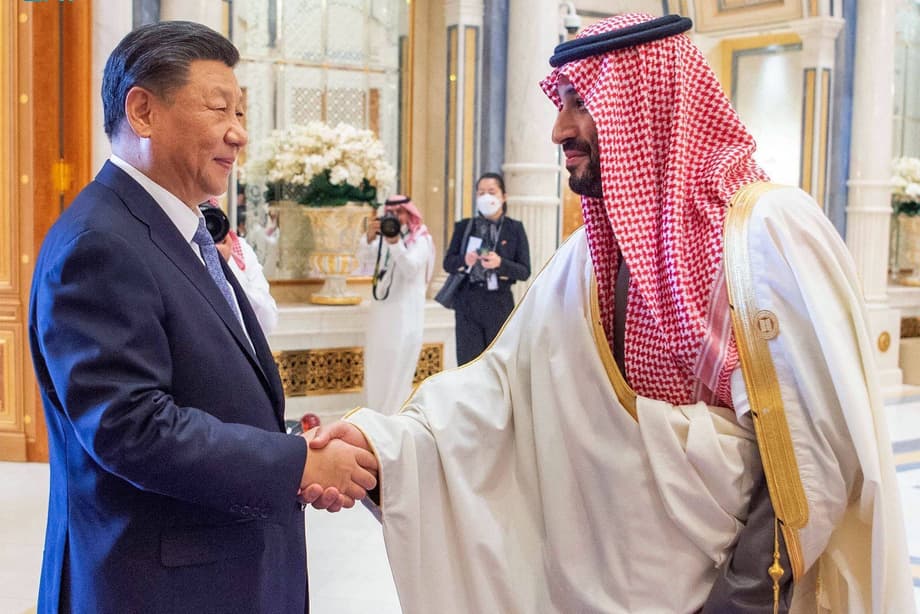
In this post-war period, diversification appears not merely plausible but necessary for survival. China, whose economic footprint has expanded through trade, investment, and infrastructure engagement, emerges as the most logical partner for deepening ties. While the relationship carries limitations, the scale of Chinese involvement provides gravitational pull that is becoming impossible to ignore.
Following Xi Jinping’s landmark 2023 visit to Riyadh for the GCC Summit, the partnership manifested as comprehensive strategic alignment. Last year, multilateral trade between China and the GCC reached approximately $300 billion, confirming China’s position as the region’s primary trading partner. Chinese firms have amassed roughly $270 billion in investments and construction projects across the Middle East over the past two decades.
Three critical sectors define this economic partnership’s future. First, green energy represents a field where China holds undisputed leadership, controlling over 80% of global solar manufacturing capacity. Chinese wind turbine exports jumped approximately 50% in 2025, and electric vehicle production accounts for 70% of global output. This aligns with Gulf nations’ long-term objectives to transition away from hydrocarbon reliance, with brands like BYD, Geely, and Changan transforming regional transportation sectors and power grids.
For the Gulf, partnering with Chinese firms is about securing the technology needed to transform their own power grids and transportation sectors. This cooperation extends beyond mere commerce into critical infrastructure transformation.
Second, financial integration is accelerating through expanded BRICS+ frameworks, providing platforms that could hedge against Western financial systems. While moving to a fully yuan-based trade system remains difficult given the petrodollar’s dominance, new mechanisms are being tested. The mBridge project, involving central banks of China and the UAE, experiments with digital currency platforms to settle cross-border payments without Western intermediary banks. Such experiments allow the Gulf to diversify financial risk while maintaining traditional ties.
Third, connectivity projects like the China-Pakistan Economic Corridor (CPEC), representing roughly $62 billion in investment, offer Gulf states opportunities to integrate maritime routes with land corridors into Central Asia. This positioning allows Gulf states to serve as central nodes in a new multipolar trade map, particularly as China imports 42% of its crude oil from the Middle East, with Saudi Arabia providing 14% and the UAE 7% in 2025.
The UAE’s investments in CPEC and the Gwadar Port could develop deals that integrate their own maritime routes with land corridors, allowing Gulf states to bypass traditional chokepoints and position themselves as central nodes of a new, multipolar trade map.
Beijing’s Balancing Act: Between Tehran and the Gulf
The growing closeness has clear boundaries, particularly regarding military commitments. This is not a simple pivot from Washington to Beijing, but rather a calculated diversification. China faces a distinctive dilemma in the region, maintaining strategic partnerships with both Iran and the Gulf states, creating a diplomatic tightrope between conflicting interests.
When conflict erupted, China condemned US-Israeli strikes on Iran and urged immediate ceasefires, yet stopped short of providing military support to Tehran. Chinese Foreign Ministry spokespersons dismissed reports of military supplies to Iran, insisting Beijing acts prudently and responsibly in export controls. Yet evidence suggests Chinese firms have supplied dual-use components feeding into Iran’s ballistic missile and drone programs, along with BeiDou satellite navigation support enhancing Iranian strike accuracy.
China buys approximately 90% of Iran’s oil exports, often at steep discounts, providing a crucial economic lifeline to the sanctioned regime. Beijing has helped build maritime and financial architectures designed to blunt American sanctions, including shadow fleets of aging tankers and yuan-based settlement systems outside traditional Western banking channels. In exchange, Iran gets a reliable export market and diplomatic support from a permanent UN Security Council member.
Simultaneously, Beijing courts Gulf partners aggressively. Sheikh Khaled bin Mohamed, Crown Prince of Abu Dhabi, recently traveled to China to witness signing of 24 agreements strengthening bilateral trade and investment. Chinese special envoy Zhai Jun described dangerous overland journeys through war zones to maintain diplomatic engagement, highlighting Beijing’s determination to preserve relationships with both sides.
Airspace closures in some of the countries we visited led to flight cancellations, forcing us to travel by car. Along the way, we heard air raid sirens and witnessed missile interceptions.
Zhai’s account, reported in China Daily, underscores the risks Beijing is willing to take to maintain its balancing act. However, analysts caution that China’s influence has limits. Ali Wyne, a senior adviser at the International Crisis Group, noted that when a country is in a struggle for survival, outside pressure to exercise restraint often meets rebuttals about backs being against the wall.
Andrea Ghiselli, a China expert at Exeter University, observed that any economic pressure on Iran would take time to take effect. In this moment, the priority for the Iranians is to solve the problem they have in front of them, not to think about what China might do one or two months later. Erica Downs, a senior research scholar at Columbia University, emphasized that China wants to maintain good relations with both Iran and the Gulf States, but sees the Gulf states as more important due to economic ties including renewable energy projects.
The longer this conflict drags on, the more China runs the risk of straining its partnerships with the Gulf countries, turning an already difficult balancing act into an increasingly precarious exercise.
Military Realities: The American Security Umbrella
Despite economic integration deepening, the security domain remains the most significant constraint on Gulf-China relations. The structural disparity in military commitments is vast and cannot be bridged quickly. The United States maintains approximately 40,000 to 50,000 personnel across roughly ten countries in the region. Al Udeid Air Base in Qatar alone hosts over 10,000 troops. In contrast, China’s military presence is confined to a single logistical support base in Djibouti, emphasizing Beijing’s traditional foreign policy of non-interference.
Arms import data reveals the gap starkly. According to SIPRI, the US accounted for 54% of all arms imports to the Middle East between 2021 and 2025, with Saudi Arabia serving as Washington’s largest global recipient. Over the same period, Chinese arms exports to the region totaled approximately 732 million TIV (Trend-Indicator Value), a fraction of the $19.5 billion TIV exported by the United States.
While Chinese drones attract interest for their lack of political strings, they do not yet offer the integrated air defense systems that US military infrastructure provides. Gulf militaries have been configured around American equipment for decades, including critical interceptors that repelled recent Iranian attacks. This military reality shapes the limits of diversification.
The post-war context has provided a wake-up call, though Gulf leadership remains too pragmatic to trade one dependency for another. Saudi Arabia and the UAE initially refused to allow their territory or airspace to be used for offensive operations, but reversed their stance as costs mounted. The UAE alone has intercepted hundreds of ballistic missiles and nearly 2,000 drone attacks. Saudi Arabia opened King Fahd Air Base to American forces in response to escalating attacks.
Saudi Crown Prince Mohammed bin Salman has recently changed his views and now sees the US military campaign as a historic opportunity to eliminate Iran as a threat. The UAE is cracking down on Iranian financial networks that have long served as an economic lifeline for the heavily sanctioned Iranian regime. Qatar, however, is doubling down with its call for an end to the conflict without conditions, demonstrating differing approaches within the GCC.
Hardliners in Iran are pushing for a new status quo in the Persian Gulf, seeking to expel US forces from the region and impose transit fees on vessels passing through the Strait of Hormuz. This creates further impetus for Gulf states to maintain strong defensive capabilities, currently provided primarily by American systems.
Strategic Autonomy: Charting a Multipolar Course
The post-war reality is not about radical shifts from Washington to Beijing. It is about the pursuit of strategic autonomy as middle powers navigating a fragmenting global order. Gulf states view China not as the new America, but as a necessary hedge against over-reliance on a single power. By diversifying their security and economic portfolios, they are opting for a multipolar insurance policy that is less risky than relying on a single, fraying umbrella.
This approach reflects broader international patterns. America’s allies in Europe confronted similar dilemmas after the Ukraine war, prompting concepts like European Strategic Autonomy. In East Asia, nations have adopted dual hedging strategies, preserving security ties with Washington while deepening economic integration with Beijing.
The Gulf possesses exceptional assets for this multipolar positioning: sovereign wealth funds managing over $4 trillion, strategic geography controlling vital maritime corridors through which 30% of global seaborne oil trade passes, and accumulated diplomatic capital from mediating conflicts from Afghanistan to Yemen. Gulf states are increasingly coordinating with other middle powers including Turkey, Pakistan, and Indonesia to formulate positions on regional security.
They are developing autonomous cyber capabilities, investing in defensive artificial intelligence, and establishing national cybersecurity authorities to protect critical infrastructure. This comprehensive deterrence encompasses cyber and technological dimensions, recognizing that sophisticated air defense systems alone are insufficient to protect critical infrastructure against evolving threats.
China benefits from this diversification without bearing security costs. Beijing positions itself as a mediator, having brokered the 2023 Saudi-Iran security agreement that stabilized relations until the current war. Xi Jinping portrays China as a responsible stakeholder opposing the law of the jungle, conveniently contrasting Beijing’s rhetoric with American military actions. The Chinese leader has assumed the role of a respected world leader, welcoming foreign dignitaries with remarks about standing on the right side of history.
Yet China operates within strict constraints. Beijing has little appetite for military entanglements that could create tensions with Tehran or Gulf partners. It offers no NATO-style security guarantees and maintains formal treaty alliances only with North Korea. This limitation means that while Chinese economic influence expands, security architecture remains predominantly American.
When the war concludes, Gulf states will need to define new terms for their relationship with Iran. Geographic proximity and the priority Gulf leaders place on regional stability necessitate a managed coexistence. The outcome of the war and the nature of Iran’s post-war leadership will shape Gulf threat perceptions and their options for future engagement. Gulf leaders fear two extremes: a hostile, capable regime in Tehran intent on controlling Gulf waterways, or a regime collapse that creates a security vacuum and widespread instability.
The Abraham Accords, normalization agreements with Israel signed by the UAE and Bahrain, have proven insufficient to protect Gulf states from Iranian aggression. This failure has accelerated the reassessment of security assumptions and the turn toward diversified partnerships.
Key Points
- The Iran war has fundamentally challenged the oil-for-security arrangement between the Gulf and the United States, exposing infrastructure to unprecedented attacks and triggering strategic reassessments of American reliability
- Gulf states are pursuing economic diversification toward China, with bilateral trade reaching $300 billion and expanding into green energy, digital currency platforms like mBridge, and infrastructure connectivity through projects such as CPEC
- Beijing maintains a delicate balancing act, supporting Iran economically through oil purchases and dual-use technology while deepening trade partnerships with GCC members and positioning itself as a neutral mediator
- Military realities prevent a complete pivot to China, as the US maintains 40,000-50,000 regional troops and accounts for 54% of arms imports compared to China’s minimal military footprint confined to Djibouti
- The shift represents strategic autonomy rather than alliance replacement, with Gulf states positioning themselves as middle powers in an emerging multipolar order, diversifying defense partnerships while maintaining US security ties
- China provides no NATO-style security guarantees and avoids military entanglements, limiting its role to economic and diplomatic dimensions while Gulf states develop autonomous cyber and defense capabilities