A Colossal Undertaking
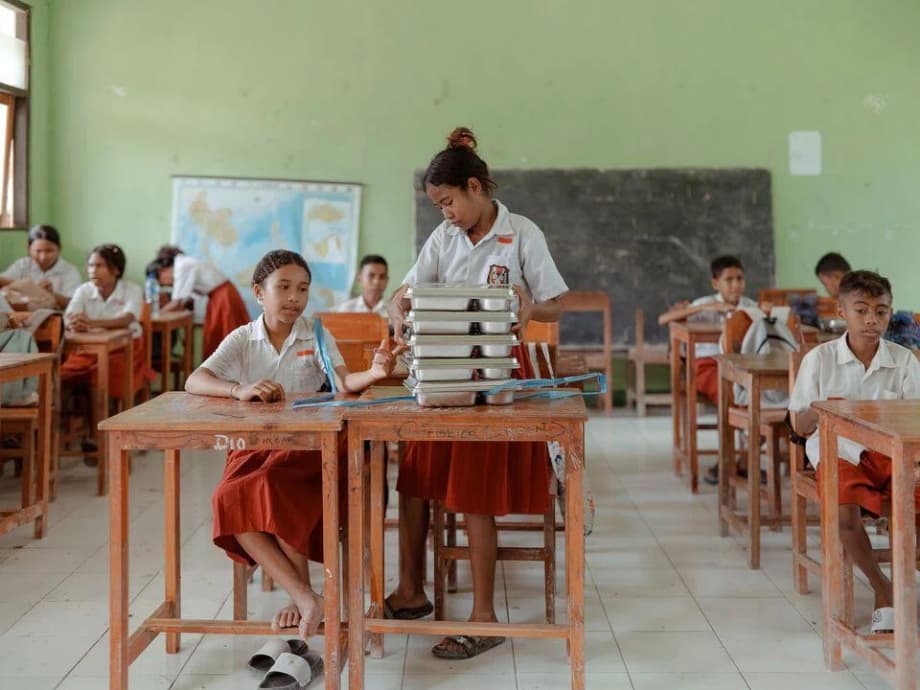
Before dawn breaks over Indonesia’s southernmost province, workers at a small blue and white building begin preparing thousands of meals. In Toineke, a coastal village on Timor closer to Australia than to Jakarta, Yufrianti Hautias supervises the daily production of 2,500 lunches for local schools and health centers. This kitchen represents just one node in a sprawling network that President Prabowo Subianto has deployed at breakneck speed to feed millions of children across the archipelago. The program, launched in January 2025, has rapidly become one of the largest of its kind in the world, with more than 25,000 kitchens now operating across the thousands of islands that comprise Indonesia.
The scale of the Makan Bergizi Gratis (MBG) initiative is staggering. The government aims to serve nearly 83 million people, approximately 30 percent of the population, including schoolchildren, toddlers, pregnant women and nursing mothers. For 2025, authorities allocated 51.5 trillion rupiah (approximately $3.8 billion), but the 2026 budget has ballooned to 335 trillion rupiah (roughly $19.7 billion), representing nearly 10 percent of total state expenditure. President Prabowo, a retired army general who took office in 2024, campaigned heavily on the promise of free nutritious meals, framing the initiative as a pathway to better nutrition, improved school retention, and economic stimulus at the village level.
Despite these ambitions, the program has become a flashpoint for concerns about fiscal sustainability. Indonesia faces a statutory cap on its budget deficit at 3 percent of GDP, a legal constraint that has guided macroeconomic discipline for years. The 2025 deficit reached 2.92 percent, dangerously close to the ceiling, while the 2026 target of 2.68 percent leaves little room for error. With global oil prices climbing past $100 per barrel due to Middle East tensions, and energy subsidies already consuming 210 trillion rupiah ($12.3 billion), the free meals program is squeezing an already tight fiscal space. The concentration of resources in this single initiative has raised alarms among economists who warn that Indonesia’s tax-to-GDP ratio, hovering around 9 percent, provides insufficient revenue to support such expansive social programs without risking debt sustainability.
Operational Challenges in Remote Regions
The logistical reality of delivering meals across Indonesia’s vast geography has proven far more complex than planners anticipated. In Toineke, supplying fresh ingredients requires a four hour round trip because local farmers cannot produce sufficient quantities to meet kitchen demands. When trucks attempt deliveries to remote health hubs, muddy roads and frequent flooding often halt progress, forcing workers to carry trays the remaining distance on foot. Hautias describes the daily struggle of serving scattered communities where some delivery points cater to as few as 10 or 20 people. The BGN has instructed kitchen heads not to force participation, recognizing that uptake remains uneven in areas where families prefer traditional home cooking or commercial options.
These field level difficulties reflect broader structural problems. The National Nutrition Agency (BGN), which oversees the program, has suspended operations at more than 2,000 kitchens for hygiene breaches and temporarily halted payments to others. Food safety issues have plagued the rollout, with over 5,900 documented cases of food poisoning affecting students since January 2025, according to government figures. Independent monitors suggest the actual toll may approach 6,500. In one incident in Timor’s East Nusa Tenggara province, children pushed green beans around their trays while eyeing fried eggs with thick red sauce with obvious disdain, preferring snacks from outside vendors.
Dadan Hindayana, who heads the BGN, acknowledges these teething problems but insists the program will proceed as designed. He speaks with the president several times weekly, receiving consistent guidance to accelerate rather than pause. The agency has proposed an accreditation system rating kitchens “A”, “B”, or “C” based on performance metrics, prioritizing quantity before quality. Yet critics argue that this military style command structure, appropriate for logistics but not public health, has sidelined professional nutritionists in favor of retired officers who lack expertise in food safety or child development.
Economic Impact and Opportunity Costs
While President Prabowo claims the program has increased prosperity at the village level, quantitative assessments paint a murkier picture. Economic modeling by the National Research and Innovation Agency projects the initiative could add between 14.5 trillion and 26 trillion rupiah to gross domestic product. This represents a tiny fraction of the annual outlay, suggesting limited multiplier effects. Analysts at INDEF warn that the massive allocation reduces funding for other essential sectors. Bhima Yudhistira Adhinegara, executive director of the Jakarta-based Center of Economic and Law Studies, delivered a harsh assessment of the program’s fiscal efficiency.
“I would give it an ‘F’. The free meals programme is quite problematic in the fiscal space but also on the ground.”
The fiscal burden has forced difficult trade-offs. Funding for the meals has largely come from cuts to education and health budgets, diverting resources from teacher salaries and school operations. The Institute for Development of Economics and Finance (INDEF) estimates that the education sector faces a shortfall of 27 trillion rupiah, potentially eliminating approximately 723,000 jobs. At a Kupang elementary school, the headmistress noted that while free lunches help, funds for better facilities, libraries, and technology would improve retention more effectively than food alone. The school shares a single projector and three laptops among hundreds of students.
Farmers, whom the program was supposed to benefit through local procurement, report sporadic and stressful interactions with kitchen operators. In Kupang markets, vendors describe receiving late orders that force frantic sourcing, or prices set barely above production costs that make participation economically unviable. Rinto Jami, a 26-year-old vegetable farmer, rejected a supply contract because the offered price would have generated losses. His mother, Dina Udju Edo, questioned the logic while sorting vegetables in their field: “If we were making losses, who exactly is feeding the children, the farmers or the government?”
Credit Risks and Global Pressures
International rating agencies have taken notice of Indonesia’s deteriorating fiscal position. Moody’s and Fitch have already cut the country’s credit outlook to negative, while S&P Global warns that Indonesia is more vulnerable than its Southeast Asian neighbors to weakening credit metrics amid Middle East turmoil. Higher energy prices inflate subsidy payments, weighing on deficits, while rising interest rates could increase government debt servicing costs. S&P Global highlights that supply disruptions from the Strait of Hormuz closure could last months, and government interest payments could rise if inflation triggers higher market rates.
Finance Minister Purbaya Yudhi Sadewa has acknowledged the strain, announcing measures to trim the program from six days to five days weekly, a move projected to save 40 trillion rupiah annually. The government has also revived austerity measures, restricting non-essential travel and considering salary cuts for ministers. However, President Prabowo remains publicly committed to expanding rather than contracting the initiative, suggesting potential inclusion of elderly beneficiaries. When asked in March whether he would reduce the program to tame the budget, he responded definitively.
“I wouldn’t touch free meals. I did it because I could not see our children malnourished.”
This unwavering stance concerns investors. Louis Lau, a portfolio manager at Brandes Investment Partners, views the program’s scale as a net negative development that raises questions about fiscal priorities. The administration’s enlarged cabinet, with 48 ministers and 56 vice-ministers, plus new coordinating ministries, has increased fiscal overheads without clear efficiency gains. Meanwhile, tax collection remains chronically weak, with the tax-to-GDP ratio hovering around 9 percent compared to 30 percent in developed economies, leaving the government dependent on borrowing to fund its ambitions.
Governance and Oversight Failures
Beyond logistics and finances, the program has exposed deeper governance vulnerabilities. The BGN faces scrutiny over procurement practices, with revelations that the agency allocated 113.9 billion rupiah ($6.65 million) to 16 event management companies for activities ranging from headquarters office support to a fun run for International Anticorruption Day. These expenditures have fueled criticism about spending priorities while education budgets face cuts and kitchens operate with minimal oversight. The data, published by the National Procurement Agency, revealed packages including Rp 19 billion for the BGN headquarters and Rp 1.34 billion for the Senayan fun run.
The agency’s leadership structure reflects a broader pattern of military appointments overriding technical expertise. While the BGN employs a few civil service deputies, it lacks trained public health experts in senior positions, instead relying on retired military and police officers. An internal memo made clear the agency would utilize the army’s logistics network, integrating officers into organizational structures based on the assumption that feeding children resembles a military operation. This approach has sidelined nutritionists who understand the complexities of childhood dietary needs and food safety protocols, leaving critical programs vulnerable to inefficiency or failure.
Court cases challenging the program’s legality are working their way through the Constitutional Court, with petitioners arguing that universal distribution wastes resources that should target regions with demonstrated need. Polls indicate that while President Prabowo maintains popularity near 80 percent, support for the free meals program specifically has declined by 0.27 points on a four-point scale between March and October 2025, suggesting growing public skepticism about effectiveness.
Political Stakes and Populist Pressures
President Prabowo has framed the MBG program as a moral obligation, citing encounters with stunted children during his 2024 campaign as motivation. With his approval ratings remaining near 80 percent according to Indikator Politik Indonesia, the meals serve as a tangible fulfillment of campaign promises that could prove valuable if he seeks re-election after his five-year term. Support remains highest in rural villages, where the program’s visibility reinforces a paternal image of the president as a father figure feeding his people.
However, the administration’s prioritization of meals over other pressing needs has drawn criticism. While Prabowo has pursued military procurement including a proposed $450 million purchase of a decommissioned Italian aircraft carrier, education advocates note that 4.3 million children aged 7 to 18 remain out of school. The MBG budget dwarfs spending on teacher training and school facilities, raising questions about whether the program represents genuine human capital investment or political theater designed to bolster popularity.
The president’s unwavering stance suggests little room for substantive policy adjustment despite mounting evidence of implementation failures. Cabinet ministers reportedly fear raising concerns about the program’s cost given Prabowo’s temper and deep personal commitment to the initiative. This dynamic has created a governance environment where loyalty outweighs technical competence, potentially leaving structural fiscal imbalances unaddressed until they trigger a full-blown crisis.
The Bottom Line
- Indonesia’s free meals program targets 83 million beneficiaries with a 2026 budget of 335 trillion rupiah ($19.7 billion), consuming nearly 10 percent of state expenditure and straining the statutory 3 percent deficit ceiling.
- International rating agencies including Moody’s, Fitch, and S&P Global have issued negative outlooks or warnings about Indonesia’s fiscal vulnerability amid rising oil prices and expanding subsidy burdens.
- Over 5,900 food poisoning cases have occurred since January 2025, while the National Nutrition Agency has suspended more than 2,000 kitchens for hygiene breaches and mismanagement.
- Funding has largely come from cuts to education and health budgets, potentially eliminating 723,000 education jobs while schools lack basic facilities like libraries and computers.
- President Prabowo remains committed to the program despite fiscal pressures, rejecting calls for cancellation while officials implement modest efficiency measures like reducing distribution from six to five days weekly to save 40 trillion rupiah.
- Critics argue the program would be more effective if targeted to specific needy regions rather than implemented universally, and call for professional leadership to replace military appointees at the National Nutrition Agency.