When Size Sparks Suspicion
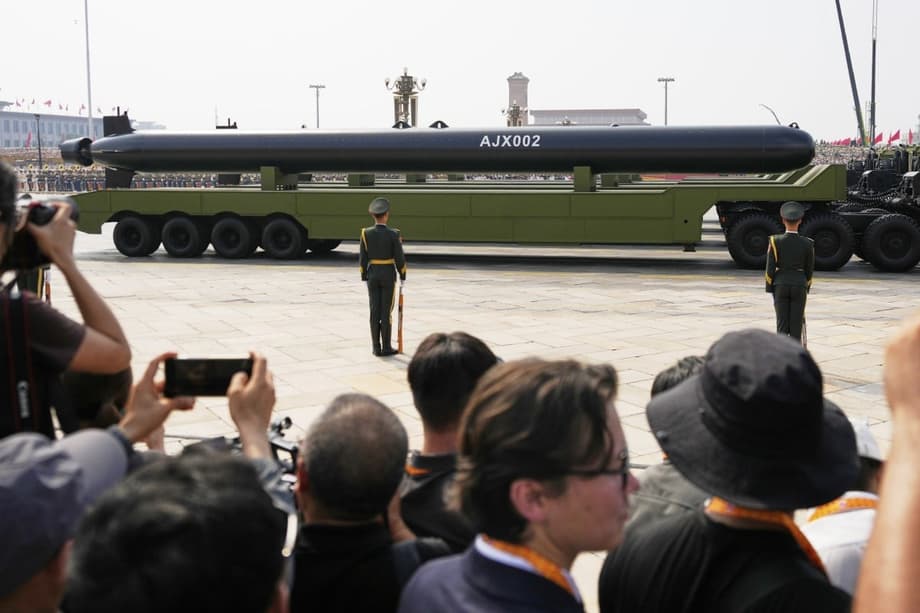
China has developed unmanned submersibles that now stand as the largest underwater drones ever built, triggering intense debate about their intended purpose. Last year, Beijing showcased two models during a military parade, the HSU001 and AJX002, each stretching nearly 20 meters in length. Satellite imagery reviewed by Western media later revealed a classified variant exceeding 40 meters at a naval installation, establishing an entirely new category of autonomous vessels known as XXLUUVs.
These underwater giants dwarf the United States’ largest unmanned underwater vehicle, the 15 meter Orca developed by Boeing. The sheer scale of these platforms has prompted US defense experts to issue stark warnings about potential vulnerabilities along America’s West Coast, with some analysts identifying Seattle, Oakland, Los Angeles, and even the Panama Canal as possible targets. Technical capabilities suggest ranges exceeding 10,000 nautical miles, theoretically allowing these autonomous vessels to cross the Pacific Ocean entirely submerged.
The Scientist’s Clarification
Yan Zheping, China’s leading authority on submersibles and director of unmanned systems at Harbin Engineering University’s College of Intelligent Systems Science and Engineering, has directly addressed these concerns in peer reviewed research published last month. His work marks the first official clarification of these vessels’ strategic purpose to the public.
China’s ultra large models prioritise regional security and near coast defensive reconnaissance while simultaneously supporting civilian research and environmental monitoring.
Yan wrote these words in the Chinese Journal of Ship Research, indicating that these deep sea giants would primarily counter US military operations in potential Taiwan Strait or South China Sea contingencies, rather than conducting trans Pacific strikes against American cities. This statement represents Beijing’s first direct response to the mounting speculation about West Coast threats.
Technical Capabilities That Fuel Concern
Understanding why analysts initially feared trans Pacific missions requires examining the engineering behind these vessels. Unlike smaller autonomous submersibles, China’s XXLUUVs employ diesel electric propulsion systems similar to conventional submarines, but without crew compartments taking up valuable space. Builder models displayed at defense exhibitions reveal layouts where diesel generators and massive battery banks occupy the entire hull, maximizing fuel storage and electrical capacity.
These design choices prioritize endurance and range over human accommodation. Analysts estimate the drones can achieve approximately 10,000 nautical miles of operational range, a figure derived from specifications published by Chinese shipbuilders and calculations based on hull dimensions. The vessels can reportedly travel roughly 7,000 nautical miles using diesel engines while snorkeling at periscope depth, followed by an additional 3,000 nautical miles of fully submerged travel on battery power alone.
The battery configuration utilizes lithium iron phosphate technology, allowing the drones to sail roughly six times farther underwater than conventional diesel submarines on silent electric propulsion. This submerged endurance could allow the vessels to approach coastlines while avoiding detection, crossing the final ocean gap entirely underwater to evade patrols.
Potential Payloads and Mission Profiles
Defense analysts have identified several capabilities that contributed to initial fears about West Coast targeting. The XXLUUVs feature modular payload bays capable of carrying torpedo tubes, naval mines, and even smaller underwater vehicles. These autonomous platforms could theoretically perform many missions traditionally assigned to manned submarines, including laying minefields, attacking surface ships, or deploying swarms of mini drones. The AJX002 minelayer UUV, also tested near Hainan, demonstrates specific capabilities for mine laying campaigns against Taiwan or naval choke points.
Beyond direct attacks, researchers have highlighted threats to critical undersea infrastructure. Taiwan depends on just 24 undersea cables for internet connectivity, according to analysis from the Global Taiwan Institute. Severing these cables could disrupt everything from banking to emergency services. The Trans Pacific Cable network linking Japan, Guam, and Hawaii represents another potential target, where sabotage could devastate regional economies and degrade US military command and control in the Pacific.
China has reportedly developed specialized tools for cutting armored undersea cables, including devices mounted on robotic arms that use diamond coated grinding wheels operating at depths up to 4,000 meters. Such capabilities could enable XXLUUVs to conduct infrastructure attacks while maintaining plausible deniability.
Defensive Applications in Regional Waters
Despite the alarming range estimates, Yan Zheping’s research emphasizes that these platforms serve defensive rather than offensive strategic purposes. The vessels are designed primarily for near coast defensive reconnaissance and regional security operations. This positioning suggests they would operate within the First Island Chain, the series of islands stretching from Japan through Taiwan to the Philippines, rather than making intercontinental journeys.
The drones could support China’s Underwater Great Wall sensor network, which monitors US and allied submarine movements. They might neutralize American undersea sensor infrastructure, including the Fish Hook network spanning Japan, Taiwan, the Philippines, and the Java Sea, by planting explosive charges or severing cables before Chinese naval forces attempt to break out into the open Pacific.
Additional civilian applications include environmental monitoring and oceanographic research, functions that align with China’s broader maritime scientific efforts. The dual use nature of these platforms allows them to support peacetime research while maintaining military utility during contingencies.
Current Testing and Deployment
Recent satellite imagery confirms that China is actively testing two distinct XXLUUV designs simultaneously at facilities near Hainan Island, specifically around Gangmen Harbour and Yinggezui, areas west of the PLAN’s Sanya nuclear submarine base. The vessels have been observed partially submerged in floating dry docks, a concealment method reminiscent of how the US Navy shielded experimental vessels during development.
The secrecy surrounding the program contrasts with typical Chinese shipyard practices, which usually promote prototype projects for attention. This unusual concealment suggests a competitive procurement program intended for actual deployment rather than mere research trials. The 705 Research Institute under China Shipbuilding Industry Corporation, known for naval weapons development, is linked to one of the XXLUUV variants.
China is testing two distinct XXLUUV designs simultaneously, implying a competitive evaluation to select the best configuration. This approach mirrors how China developed earlier generations of large displacement UUVs that are now operational. The existence of eight large UUVs showcased at a recent Beijing parade, including five smaller AJX002 mine laying drones and three HSU 100 UUVs, further demonstrates the scale of China’s investment in autonomous undersea systems compared to Western programs.
Strategic Context and US Response
The emergence of XXLUUVs represents a significant shift in naval warfare dynamics. Western analysts had long assumed China lagged behind in advanced uncrewed systems, but this deployment exposes that assumption as outdated. While the US Navy cautiously tests its Orca XLUUV prototypes, China has leapfrogged into fielding full scale operational platforms.
The vessels challenge traditional anti submarine warfare doctrines. Their autonomous nature allows commanders to consider one way or high risk missions that manned submarines would avoid. This risk tolerance creates new strategic possibilities, including saturation tactics where numbers and autonomy overwhelm conventional defenses.
However, the platforms face limitations. Uncrewed submarines lack the adaptability of human crews for complex decision making, particularly regarding target identification. Vulnerabilities to jamming, artificial intelligence errors, or compromised control links could be exploited by adversaries. The US, Japan, and Australia are already investing in counter UUV technologies, including seabed sensors and directed energy weapons.
The Bottom Line
- China has developed the world’s largest underwater drones, classified as XXLUUVs, with prototypes exceeding 40 meters in length
- US defense experts initially warned these vessels could target West Coast cities including Seattle, Los Angeles, and Oakland, citing 10,000 plus nautical mile range capabilities
- Lead Chinese scientist Yan Zheping clarifies the drones prioritize regional security and near coast defensive reconnaissance rather than trans Pacific strikes
- The vessels are primarily intended for Taiwan Strait and South China Sea contingencies, supporting both military operations and civilian research
- Technical specifications include diesel electric propulsion, massive battery banks, and modular payload bays capable of carrying torpedoes, mines, or smaller drones
- Current testing in Hainan Island waters supports the regional defense narrative rather than intercontinental attack preparations
- The platforms represent a significant advancement in autonomous undersea warfare, challenging traditional US naval superiority in the Pacific