A City of Dreams Becomes Unlivable
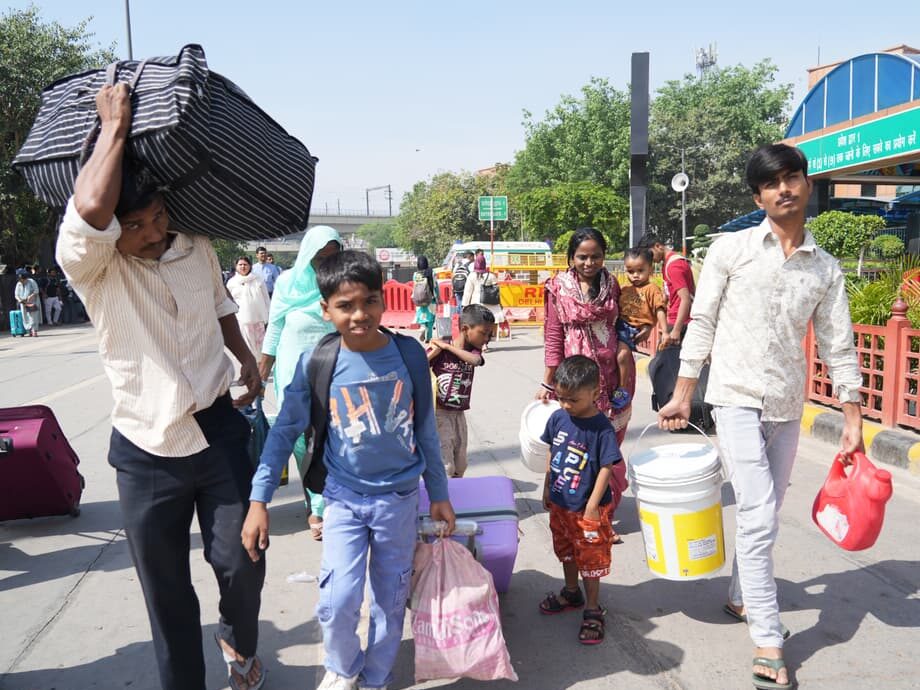
At 9am on a Saturday, Anand Vihar railway station in Delhi resembles a scene from 2020. Families balance mattresses, steel pots, and bundled clothing on their shoulders, children trailing behind clutching whatever possessions they can manage. Thirty-five-year-old Raju Prasad rushes through the crowds with his wife, their youngest daughter in her arms and a white plastic bucket in her hand. Three other children follow, one dragging a trolley bag. The family of seven, joined by Prasad’s brother, are leaving for Gorakhpur, Uttar Pradesh, abandoning the capital after nine months of desperate struggle.
The Prasads represent a growing wave of reverse migration transforming India’s urban landscape. Once drawn to Delhi by promises of daily wages and educational opportunities for their children, they now flee a crisis that has made basic survival impossible. Their last gas cylinder finished fifteen days ago. Firewood collection proved temporary relief, but with savings depleted and black market prices for liquefied petroleum gas (LPG) reaching four or five times normal rates, the family faces a stark choice.
Prasad voices the desperation driving thousands to similar decisions.
“If we stay here even a few more days, our children might die of hunger. They don’t understand what this crisis is. We just see them crying for food.”
Similar scenes unfold across New Delhi Railway Station, where platforms grow crowded with workers from Bihar, Jharkhand, West Bengal, and Rajasthan carrying bulging rucksacks larger than suitcases. Some hide their departure behind fabricated family occasions, as 29-year-old Suman Verma did, claiming he was attending a wedding. His young son Anshu revealed the truth with precocious maturity.
“We all know the real reason. A lockdown is about to happen. My father said all shops will shut and we won’t be able to return later. We had already run out of gas, and my mother was cooking on a makeshift stove.”
Survival Calculations: When Cooking Becomes a Luxury
For millions of India’s internal migrants, the arithmetic of urban poverty has always been brutal. Workers earning between Rs 500 and Rs 800 daily now confront a reality where a single meal can consume half a day’s wages. Twenty-five-year-old Sarfaraz sits beside his bags at Anand Vihar, waiting for his family to transfer Rs 300 so he can purchase a ticket home to Bihar. “I came here to support my family, but now I am asking them to send me money so I can return,” he says. Having married at eighteen and fathered four children, he moved to Delhi to work on the Jewar Noida International Airport construction site, earning Rs 550 daily. For twenty days, his gas supply has remained exhausted. Black market cylinders now cost Rs 4,500, up from Rs 900, while food prices have doubled.
The crisis bites deepest among those without formal documentation. To obtain legal LPG connections in India, households must provide identity and address proof through authorised distributors, booking cylinders in advance. Migrants working in the informal sector often lack local documentation, as landlords frequently refuse to provide address verification. Rajesh Kumar, a trade unionist in Delhi, explains the structural barrier.
“Migrant workers relocate frequently and cannot keep updating documents. Some landlords also refuse to provide proof of address, so getting formal documents in the cities where they migrate often becomes difficult.”
Consequently, many depend on informal refilling centers for smaller cylinders, typically 5kg containers that do not require permanent connections. Since the Middle East conflict disrupted global shipping routes, these centers have shuttered or multiplied prices by fourfold. Shakuntala Devi and Shakiba Bibi, neighbors at a Delhi slum who work as domestic helpers earning Rs 15,000 monthly, have spent three weeks searching for gas. “If it continues like this for a few more days, we will run out of gas in our kitchens and have to return to our villages,” Shakuntala says.
Lalita Devi, a daily wager from Bihar working in Delhi with her family for a monthly household income of Rs 10,000, now survives on raw chickpeas because local retail LPG prices soared to Rs 400-500 per kilogram. She cannot even afford a train ticket. Uday Kumar, a construction worker from Bihar earning Rs 800 daily, asks the question haunting millions.
“If a man earning Rs 800 a day has to spend Rs 400 to Rs 500 just to refill a single gas cylinder, how is he supposed to provide for his children? I have to pay room rent, buy lentils, rice, and vegetables, and also pay school fees for my children. How can all of this possibly be managed?”
Students face similar precarity. Farheen Naaz, a media student at Jamia Millia Islamia University from West Bengal, lives in lodgings with fifty other women. “I have not had gas for the last 10 days, and most of the time now I skip breakfast,” she says. “Many canteens in the university have closed, and the food that is available has become expensive. We come from low-income families and cannot afford this. It is starting to affect our health.” Saeed Khurshid, a BTech student from Kanpur living in Ghaziabad, reports that his hostel mess has reduced meals to dal and rice only, removing rotis and vegetables, triggering student protests.
From Kitchens to Markets: A Cascade of Closures
The disappearance of cooking fuel has triggered economic shockwaves extending far beyond individual households. Delhi’s food ecosystem, built upon a dense network of dhabas, street vendors, and small eateries serving affordable meals to laborers, faces collapse. Without gas and with spiraling food costs, these establishments are reducing menus, hiking prices, laying off employees, or closing entirely.
Anil has operated a restaurant in Nehru Place for thirty years. “It is the first time in my life that the gas cylinder price on the black market has reached Rs 4,500,” he states. “We have shifted back to traditional open-fire cooking on a chulha. It takes more time, and if this situation continues, it will affect my workers too.” His ten employees face uncertain futures as customer numbers dwindle.
In Gandhinagar, home to Asia’s largest ready-made garments market, the impact proves catastrophic. Shri Kishan Goyal, president of the Readymade Garments Merchants Association, reports that seventy to eighty percent of shops and small factories have closed due to labour shortages. “Production in the manufacturing units here are affected by more than 30 per cent, while some businesses have seen a 50-60 per cent impact,” Goyal explains. Mohammad Salim Akhtar, who runs a small tailoring unit, saw all five employees return to their villages. He now works alone, facing daily losses of Rs 10,000 to Rs 12,000, and has stopped buying gas entirely, depending instead on hotel food.
Tajdar Ahmed, who runs a biryani shop in Shakur Basti, has raised prices from Rs 240 to Rs 280 per kilogram and closes by 5pm to reduce costs. Sales have dropped fifty percent. Haji Sahib, operating a tea and sweets stall nearby, pays three workers from his own pocket while struggling to obtain commercial cylinders. “We need one cylinder every day, but supply is irregular,” he says. “The government had yet to find a solution even after a month.”
The agricultural supply chain suffers similarly. At Ludhiana’s Sabzi Mandi, wholesale traders report a thirty percent business slump as migrant laborers who move produce from warehouses to street vendors disappear. “The supply chain within the city is being affected because there are fewer vendors to take the product to the streets,” observes Damanpreet Singh, a tomato wholesaler. The dual blow of harvesting season departures and fuel crisis has stripped the market of both muscle power and distribution networks.
Global Conflict, Local Devastation
The roots of this domestic crisis lie eight thousand kilometers away, in the military conflict between Iran and the US-Israel alliance. India’s dependence on imported LPG, with nearly sixty percent of consumption coming from abroad and ninety percent of those imports passing through the Strait of Hormuz, has made the nation vulnerable to geopolitical tremors. When Iran closed this critical shipping artery in retaliation for attacks, global energy markets convulsed.
Though a fragile ceasefire now holds, the Strait remains closed to many vessels, with oil prices hovering near $100 per barrel. India relies heavily on LPG imports reaching through this narrow passage, and while Iranian authorities currently allow Indian vessels passage, uncertainty persists with several ships waiting near the strait.
The government maintains that supply remains stable, reporting over 180 million cylinder deliveries since March 1, averaging five million daily, with ninety-seven percent of bookings now made online. Authorities have doubled daily quotas for market-priced 5kg cylinders specifically targeting migrant workers, and conducted raids on black-market storage points. Praveen Shankar Kapoor, the BJP’s Delhi spokesperson, acknowledges challenges while promising resolution.
“We are actively trying to resolve the shortages being faced in both household and commercial LPG supply chains. Yes, the 5kg LPG category is facing more acute challenges at the moment, especially among migrant and low-income groups who depend on it for daily cooking. We are hopeful that these issues will be addressed soon.”
Political Fault Lines and Official Denials
Despite official assurances, a chasm separates government pronouncements from ground reality. The Delhi BJP has dismissed reports of mass migration as “misleading” and “imaginary,” with Vice President Dinesh Pratap Singh and Purvanchal Morcha President Santosh Ojha asserting that only negligible numbers have left. They accuse Aam Aadmi Party (AAP) MLA Sanjeev Jha of manufacturing narratives to mislead the public, referencing the COVID-19 period when they claim Delhi government announcements triggered previous migrant returns.
Jha counters with explosive allegations, suggesting the BJP centrally engineered the LPG crisis to drive poor migrant workers back to their home states where their votes can be manipulated. “Black marketing is being enabled under government protection,” Jha claims, “with gas selling at Rs 500 to Rs 1,000 per kilo, leaving migrant workers without fuel or work and pushing them to leave the city.”
Prime Minister Narendra Modi addressed Parliament on March 23, urging calm while invoking pandemic memories.
“We have faced such challenges with unity during the Covid period and now we have to be prepared again.”
He warned that “difficult global conditions may persist.” The remarks triggered social media anxiety, with “India lockdown again” trending on X. Labour advocates criticize the government for failing to establish community kitchens or ration supplies during the disruption. Nirmal Gorana, convener of the National Campaign Committee for Eradication of Bonded Labour, calls the situation an “absolute injustice,” noting the continued failure to register unorganized workers under the Interstate Migrant Workmen Act of 1979.
The Invisible Infrastructure of Poverty
Beyond immediate fuel shortages, the crisis exposes structural vulnerabilities plaguing India’s informal workforce. Approximately 54 million interstate migrants powered the nation’s cities according to the 2011 census, though analysts believe current numbers far exceed this figure. Many exist within administrative blind spots, unable to access subsidized utilities or social security protections due to documentation barriers.
Arvind Goel, co-chairman of the industrial relations committee of the Confederation of Indian Industry, warns of cascading economic impacts.
“If this reverse migration continues, it will have significant impact, especially on micro, small and medium enterprises, particularly in labour-intensive sectors such as construction, textiles and manufacturing.”
Social scientist Pushpendra Kumar argues that migrants possess minimal capacity to cope with disasters, possessing neither political voice nor policy attention. “Migrants have no political voice, especially poorer migrants,” Kumar explains. “There is no pressure on those in power to cater to this constituency or address its problems.”
Alternative solutions remain impractical for the urban poor. Induction cooktops that sold for Rs 1,300 now command Rs 5,000. Piped Natural Gas (PNG) installation costs approximately Rs 7,000, requiring landlord cooperation unavailable to tenants in unauthorized colonies where one-third of Delhi’s population resides. Firewood cooking proves impossible in cramped slum quarters and dangerous in dense rental clusters where landlords prohibit open flames. Zareena Khatun, a 43-year-old migrant from Bihar working as domestic help in Palam Colony, received only 10kg of gas from an agency owner who usually delivers by truck but arrived by bicycle. She doubts it will last a month.
Waiting for Normalcy
At railway stations across the capital, the psychology of departure varies. Some, like Amazon warehouse worker Brij Kumar from Jharkhand, expect return once conflict resolution stabilizes markets. Others, like construction laborer Lakhe Chauhan facing his second forced departure after COVID-19, question whether urban survival remains viable. “There is no gas, no work and no hope here,” Chauhan states. “We don’t want to die here starving, as we cannot afford outside food every day.”
For Radhey Sham, a 38-year-old gig worker and security guard returning to Bithoor, Uttar Pradesh, the calculation is purely economic. “Even after doing multiple jobs, I don’t make more than Rs 20,000. My wife works in nearby houses and adds another Rs 5,000. I have two grown-up children to look after. How can I afford Rs 3,000 for an LPG cylinder? In the village, we can still cook on a chulha. Hopefully, things will improve in a month, and I’ll be back.”
Whether this represents a temporary retreat or permanent urban depopulation depends on resolution timelines beyond India’s control. As diplomatic efforts address Middle East tensions, millions of workers watch from village courtyards, their return contingent on cylinders refilling at prices wages can afford. Until then, the trains departing Delhi carry more than passengers; they carry the suspended dreams of a workforce that discovered cities can become as unlivable as the poverty they sought to escape.
Key Points
- Thousands of migrant workers are leaving Delhi and other major cities due to severe LPG shortages and price spikes linked to the Iran-US-Israel conflict affecting Strait of Hormuz shipping routes.
- Black market LPG cylinder prices have surged from Rs 900 to Rs 3,000-Rs 4,500, while informal refills cost Rs 300-Rs 1,000 per kilogram, consuming half or more of daily wages ranging from Rs 200-Rs 800.
- Workers from Bihar, Uttar Pradesh, West Bengal, and Jharkhand report choosing between purchasing cooking fuel and buying food, with many returning to villages where traditional wood-fired stoves provide alternatives.
- Small businesses, restaurants, textile markets, and food supply chains face severe disruptions, with some markets reporting 30-80 percent closure rates due to worker exodus and fuel costs.
- Government officials deny mass migration is occurring, citing railway footfall data and claiming adequate LPG supplies, while opposition parties accuse authorities of engineering the crisis or failing to prevent black market profiteering.
- Migrant workers without permanent local addresses face particular hardship, as they cannot access subsidized government LPG connections and depend on informal markets that have dried up or inflated prices.