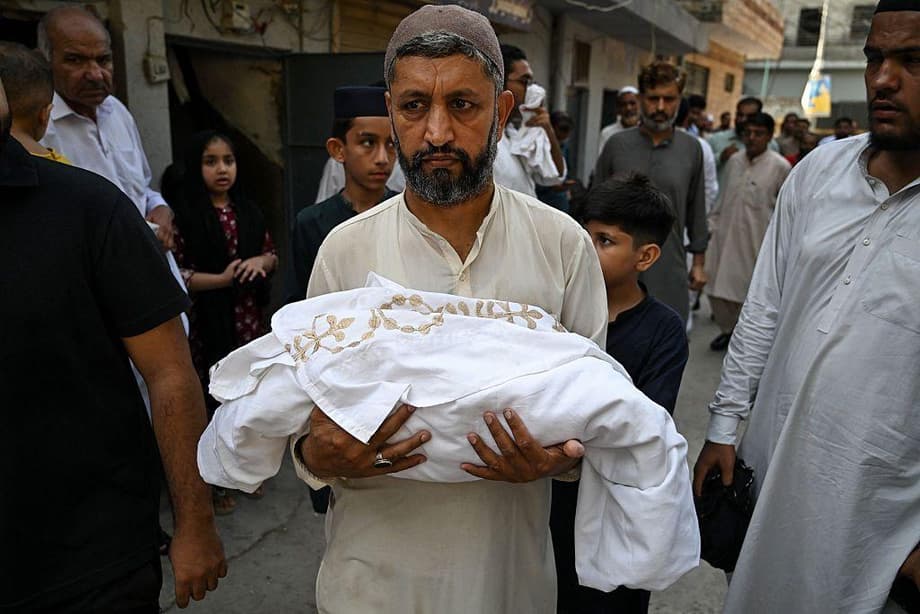
A preventable disaster inside a neonatal ward
An official inquiry into the fire at Pakistan Institute of Medical Sciences in Islamabad has found that the deaths of 14 newborn babies followed a chain of failures, rather than a single mistake. The neonatal unit had no functioning smoke detection system, fire alarms or sprinklers. Emergency exits and doors were difficult to access, staff had no properly practiced evacuation plan for newborns, and outside help was called almost 20 minutes after the fire began.
- A preventable disaster inside a neonatal ward
- How the fire spread so quickly
- Staff faced smoke, locked doors and confusion
- Why evacuation was nearly impossible
- Warnings had already been recorded
- Disciplinary and criminal action
- Pakistan’s wider hospital safety problem
- What the inquiry could change
- The Bottom Line
The fire broke out on 26 August in a 10 bed nursery where 15 critically ill babies were being treated. Fourteen died and one survived. Many of the infants were premature or depended on oxygen and respiratory support, making a rapid evacuation especially difficult.
A committee appointed by Prime Minister Shehbaz Sharif reviewed CCTV footage, forensic material, maintenance records, duty rosters, medical documents, call records and witness statements. Its report described the failures at PIMS and its senior management as institutional and concluded that known risks had not been turned into an effective safety system.
The findings have prompted recommendations for criminal investigation, disciplinary action and fire and electrical safety audits across public and private buildings in Pakistan.
How the fire spread so quickly
Technical investigators identified the power cable connected to air conditioner No. 2 as the most probable starting point. Possible causes included local overheating, excessive current, a high resistance connection or another electrical defect that damaged the cable insulation and ignited nearby materials.
The inquiry found no evidence that the blaze was deliberately started. It also ruled out an external fault involving the Islamabad Electric Supply Company, an oxygen leak as the initial source, and incubators or infant warmers. The precise electrical defect still requires further investigation.
Maintenance records showed that the air conditioning units had been serviced. The committee stressed that servicing equipment is different from carrying out a full electrical safety inspection. A unit may continue to work while cables, connections, insulation, earthing or circuit protection remain unsafe.
Once the fire began, plastic materials, medical equipment and waste containers helped it spread. The oxygen rich environment may have intensified the flames and smoke, although investigators found no evidence that oxygen created a route for the fire to travel.
CCTV footage showed the emergency developing within seconds. At about 06:38, a nurse ran from the ward for help and returned with a security guard. Staff nurse Razia Noreen then entered the nursery and emerged with the only baby who survived. Within roughly a minute, thick smoke blocked the camera’s view.
Staff faced smoke, locked doors and confusion
The inquiry rejected broad claims that frontline staff abandoned the babies. It recorded immediate rescue efforts by nurses, a security guard and a doctor. Noreen rescued one infant and tried to return to the nursery. Charge Nurse Nasreen Akhtar, Security Guard Maria Saleem and Dr Muhammad Abdul Rehman were also identified as responding during the first moments of the fire.
A firefighter who spoke anonymously described the rescue as extremely difficult. He said rescue workers had to break through windows because some doors were locked, and that doors leading toward the ward were also inaccessible.
The firefighter arrived after the flames had been extinguished, when the scene was still deeply dangerous. He described medical equipment above the babies as having melted and collapsed onto them.
Patients and relatives in nearby wards also described panic. Abdul Ghafoor, who was visiting his mother, said smoke filled the corridor so completely that people could not see. He joined a group of seven or eight people who broke glass panels at the end of a corridor to help release smoke before firefighters arrived.
Hivsa Walid, whose newborn niece and sister in law were in a neighboring ward, said the first warning was a loud commotion followed by smoke emerging from the nursery. People concentrated on getting downstairs and saving themselves.
"There should have been fire extinguishers and protocols, but no one was doing anything. Everyone was just running," Walid said.
The inquiry said security controls may be justified in a hospital where authorities have previously faced baby abduction incidents. Those controls cannot, however, block emergency routes or prevent rescuers from reaching patients.
Why evacuation was nearly impossible
The nursery was designed for 10 beds but held 15 newborns when the fire began. Most needed oxygen or respiratory support, and only a limited number of doctors and nurses were present. Moving fragile babies requires equipment, trained personnel and a clear destination. The inquiry found no approved and practiced standard operating procedure for evacuating newborns from the unit.
Staff had not been trained to isolate the oxygen supply during an emergency. There was also no evidence of regular evacuation drills designed for premature or critically ill babies. Without a plan, workers had to make decisions in darkness and smoke while trying to carry or move infants connected to medical equipment.
The report found that the ward had no reliable automatic fire detection, alarm or sprinkler system. These systems are designed to provide extra time before smoke becomes overwhelming and to contain or suppress a fire before it reaches a life threatening scale. Their absence meant that the first warning came from people inside the ward rather than from a functioning safety network.
External emergency services were notified at about 06:54, while the fire had begun around 06:38. Dispatch followed at approximately 06:55 and operational teams arrived at about 07:01. The committee said PIMS had not shown that it possessed a functioning incident command system capable of immediately activating alarms, calling for help, controlling access and coordinating evacuation.
That delay is now one of the areas being examined for possible criminal negligence. The committee also recommended investigation into the electrical installation, maintenance work, blocked emergency access, the failure to respond to earlier warnings and the role of contractors.
Warnings had already been recorded
The inquiry found that the fire did not occur without warning. Correspondence from the Capital Development Authority and recommendations from the Federal Ombudsman had previously identified fire safety weaknesses. PIMS management also acknowledged in 2025 that its safety infrastructure was outdated.
A separate fire had broken out at the hospital’s nursing hostel on 6 July, only weeks before the nursery tragedy. That incident raised concerns about smoke detection, alarms, evacuation planning, firefighting equipment, security response and record keeping.
The committee found that the earlier warnings were not converted into a time limited programme of repairs whose completion was independently checked. An approval to replace and upgrade air conditioning units had reportedly existed since 2018, yet the work had not been completed years later.
This distinction matters in safety management. Identifying a risk is only the first step. A hospital must assign responsibility, set a deadline, complete the correction and verify that the hazard has actually been removed. Without that final check, a repair order can create the appearance of action while leaving patients exposed.
The report placed primary responsibility on PIMS and its senior management for failing to act on known risks. It did not, however, say that every individual present during the fire should be blamed for the deaths. Personnel whose rescue efforts are supported by evidence, the committee said, should not be punished simply because the outcome was tragic.
Disciplinary and criminal action
The prime minister ordered short term measures to be implemented within three months and directed fire safety audits of public and private offices and buildings. The initial findings called for eight officials to be suspended and for criminal proceedings to begin. A later account of the full report recommended departmental action against nine PIMS officers.
Two nurses who had initially faced temporary suspension were cleared of wrongdoing and recommended for reinstatement. The committee also recognized the actions of Noreen and other frontline personnel who tried to rescue the babies.
The report did not establish a criminal offence by a named person on the existing record. It recommended further investigation to determine whether anyone was culpably negligent in the electrical installation or maintenance of the air conditioner, the obstruction of emergency routes, the failure to act on previous warnings or the delay in seeking outside help.
That approach separates administrative responsibility from criminal liability. Hospital management can be held responsible for failing to maintain a safe system, while prosecutors must still prove the specific duties, knowledge and conduct of any individual accused of a crime.
Pakistan’s wider hospital safety problem
The PIMS fire has also drawn attention to the condition of electrical systems in hospitals across Pakistan. Fire safety depends on more than extinguishers and evacuation signs. Hospitals require reliable wiring, properly rated circuit protection, safe grounding, emergency power, inspected equipment and special protection for intensive care and neonatal areas.
Pakistan has engineering and building safety codes, yet responsibility for enforcement is divided among engineering authorities, local governments, electric inspectors, electricity distributors and provincial or Islamabad health regulators. The central question is often unclear: which authority must confirm that a hospital’s electrical system remains safe throughout its operating life?
Punjab Rescue 1122 recorded 15,590 fires in 2020, with 47.1 percent attributed to electrical short circuits. The number of recorded fire incidents in the province rose to 28,018 in 2024. Applying the earlier electrical share to the later total would suggest roughly 13,200 electrical fires, although that is an estimate rather than an official 2024 cause count.
Safety rules have little value if no agency checks compliance. Hospitals should have regular independent electrical audits covering circuit loads, cables, panels, sockets, earthing, emergency generators, automatic transfer systems, cable penetrations and supplies serving critical care areas. Problems should be ranked by risk, assigned correction deadlines and checked by an authority separate from the hospital’s routine maintenance team.
Hospitals should also record near misses, such as overheated sockets, repeated breaker trips, burnt plugs, small electrical fires and equipment insulation failures. These incidents can reveal danger before a patient is harmed.
What the inquiry could change
The committee recommended immediate fire and electrical audits, working detection and alarm systems, improved firefighting equipment, newborn evacuation procedures, regular drills and stronger administrative oversight. It also proposed changes to the administrative structure of PIMS and called for a permanent management model rather than an experimental arrangement.
A national hospital safety framework could clarify which standards apply to public and private facilities, who must inspect them and how often inspections must occur. It could also require trained and certified personnel to design, install, maintain and inspect electrical systems in medical facilities.
For neonatal wards, ordinary fire planning is not enough. Plans must account for infants connected to oxygen, incubators and monitors, limited staff numbers, smoke movement, locked access points and the need to move patients without causing further medical harm. Drills should test the full chain from detection and alarm to evacuation, oxygen isolation, emergency access and transfer to another ward.
The deaths at PIMS were caused by an electrical fault, according to the inquiry’s technical findings, yet the scale of the tragedy came from the failure of several protective layers. A manageable equipment problem became a mass casualty event because warnings were not acted upon, safeguards were absent, emergency access was restricted and assistance was delayed.
The Bottom Line
- Fourteen newborns died and one survived after the 26 August fire at PIMS in Islamabad.
- Investigators identified the cable of air conditioner No. 2 as the most probable ignition point.
- The nursery lacked functioning smoke detection, fire alarms, sprinklers and a practiced newborn evacuation plan.
- Fifteen babies were being treated in a unit designed for 10 beds.
- External emergency assistance was requested about 16 minutes after the fire was first detected.
- The inquiry rejected claims that frontline staff simply abandoned the babies.
- PIMS management faced primary institutional responsibility for failing to act on earlier safety warnings.
- Further disciplinary and criminal investigations, along with nationwide fire and electrical audits, have been recommended.