Beijing Turns an AI Conference Into a Diplomatic Stage
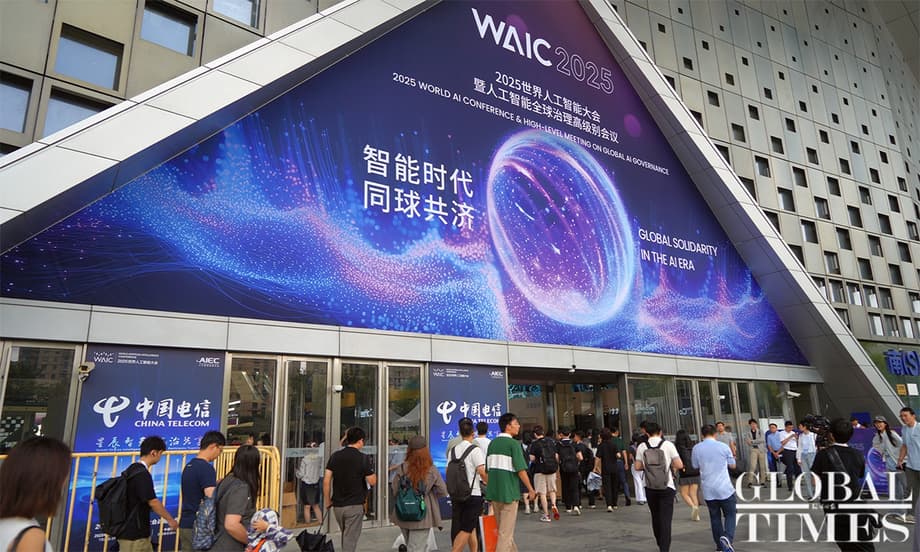
China is using the 2026 World Artificial Intelligence Conference in Shanghai to present itself as a leading voice in the debate over who should control artificial intelligence, how its risks should be managed and who should share in its economic gains.
- Beijing Turns an AI Conference Into a Diplomatic Stage
- What Does WAICO Actually Do?
- Why Developing Countries Are Listening
- Open Source Becomes China’s Main Selling Point
- Indonesia Shows the Promise and the Risk
- A Wider Contest With the United States
- Governance Concerns Go Beyond Access
- What Happens Next?
- Key Points
President Xi Jinping opened the conference and the High Level Meeting on Global AI Governance on July 17 with a call for countries to create a fairer international system. His message placed developing countries at the center of China’s proposal, combining promises of training, computing access and practical AI applications with a wider appeal for multilateral rulemaking.
“All countries should take a people centered approach and develop AI for the positive and for good,” Xi said. “We should ensure that AI is an important driver for shared prosperity and common security.”
The speech came one day after 29 countries signed an agreement establishing the World Artificial Intelligence Cooperation Organization, or WAICO, with its headquarters planned for Shanghai. The organization gives China a permanent diplomatic platform for promoting its preferred approach to AI governance. Its founding members include China, Russia, Brazil, Indonesia, Malaysia, Pakistan, South Africa and Kazakhstan. The United States, European Union member states, Britain, Japan and other major Western economies are absent.
That divide reflects a growing contest between competing technology and governance networks. Washington and its partners have focused on trusted supply chains, advanced chip controls and safety standards. Beijing is presenting open source models, affordable computing and development assistance as an alternative for countries that have limited access to the most advanced systems.
What Does WAICO Actually Do?
WAICO is intended to promote international cooperation on AI development and governance. Its stated principles include a people centered approach, safety, fairness, shared benefit and respect for the United Nations Charter.
The organization is still at an early stage. The public information available so far does not fully explain how members will vote, how the body will be funded, what commitments will be binding or how decisions will be enforced. Establishing a charter and a headquarters creates an institution, yet it does not automatically give that institution the power to set rules that governments must follow.
Its immediate value may be diplomatic rather than regulatory. WAICO can give developing nations a place to coordinate positions before discussions at the United Nations and other international forums. It also gives Beijing a channel for promoting standards linked to Chinese technology, training programs and infrastructure.
Humphrey Arnaldo Russel, head of the ASEAN China Research Center at the University of Indonesia, said AI creates challenges that cross national borders, including safety, ethics, misuse, technical standards, regulatory fragmentation and unequal access to digital resources.
He said China’s Global AI Governance Initiative, first proposed by Xi in 2023, could help bring developing countries into international discussions that have often been led by wealthier economies.
“The proposal is especially important for the Global South, whose interests remain underrepresented in global technology governance. A broadly accepted, United Nations centered framework could strengthen developing countries’ participation in global AI governance while respecting different national conditions,” Russel said.
WAICO will need to show that it can deliver practical programs and include members in meaningful decisions if it is to become more than a China led discussion forum. Its influence will depend on whether countries use it to shape common standards or mainly to secure access to Chinese technology.
Why Developing Countries Are Listening
Many countries in Africa, Asia and Latin America face a basic problem in the AI race. They may have large populations, growing digital economies and urgent needs in areas such as health, agriculture, education and disaster response, yet lack the data centers, advanced chips, researchers and funding needed to build major AI systems.
China’s proposal responds to that gap with specific commitments. Xi pledged 5,000 AI training and seminar opportunities for developing countries over the next five years. He also announced plans for international AI application cooperation centers with ASEAN, the League of Arab States, the African Union, the Community of Latin American and Caribbean States, the Shanghai Cooperation Organization and BRICS.
China will also promote the use of its MAZU AI meteorological early warning system in 30 countries. The system combines satellite observation, weather forecasting and automated warnings to help governments prepare for floods, droughts and other extreme weather.
Philip Okello, principal meteorologist at the Kenya Meteorology Service, said the proposal matched Africa’s need for stronger forecasting systems as climate risks become more frequent.
“President Xi’s speech is timely because climate change is no longer a future risk; it is a present day reality that is affecting countries across the globe,” Okello said.
Gordon K’achola, founder and chief executive of the Africa Center for Diplomatic Affairs, said African countries want more than access to finished products. They need the ability to create, manage and adapt their own systems.
“For Africa and the broader Global South, the goal is not just getting the latest tech. It is about building the capacity to create and control their own AI writing algorithms, growing research centers, and strengthening local institutions,” K’achola said.
That distinction is central to the debate. A country that imports an AI service may gain short term benefits while remaining dependent on foreign companies for updates, data processing and technical support. A country that trains researchers, builds computing facilities and develops local models gains more control over how AI is used in government and business.
Open Source Becomes China’s Main Selling Point
China is presenting open source and open weight AI models as a way to reduce the cost of adoption. Open source systems make parts of the code or model available for inspection, modification and reuse. Open weight models release the trained parameters that allow a system to generate results, although they may not disclose every detail about the data and training process.
Chinese companies such as DeepSeek, Alibaba and Moonshot AI have gained attention with models that are often cheaper to run than leading proprietary systems from American companies. Moonshot introduced its Kimi K3 model during the conference and described it as the largest open AI model by parameter count. Parameter count is one measure of a model’s scale, although a larger number does not automatically mean better performance.
China’s open model strategy also serves a geopolitical purpose. Affordable systems can help Chinese firms gain users, developers and institutional partners across emerging markets. Once companies build products around a particular model, cloud platform or hardware system, switching to a competitor can become costly.
Maria Sun, co chair of the FIRA RoboWorld Cup 2026, said wider international exchanges could help more countries enter the AI era.
“China’s efforts to promote AI cooperation with developing countries are very encouraging. International exchanges like these help bring more countries into the AI era,” Sun said.
She also described China as an important global AI player whose openness could support research and cooperation. The claim is contested in practice. China promotes international access to selected models and applications, while national security rules may limit foreign access to some advanced systems. Beijing has also criticized restrictions imposed by the United States on advanced chips and AI technology, even as it maintains its own controls over data and technology.
Indonesia Shows the Promise and the Risk
Indonesia’s participation in WAICO illustrates why China’s offer appeals to many developing economies. With a population of more than 280 million and a fast growing digital market, Indonesia wants foreign investment while also building domestic research and engineering capacity.
Indonesian officials have sought cooperation with Chinese companies in cloud computing, robotics, telecommunications, health care, agriculture and fisheries. Chinese firms have expanded data center and cloud services in Southeast Asia, giving local companies access to computing resources without requiring them to build expensive facilities themselves.
Indonesia is also seeking technology transfer, university cooperation and local laboratories. Its goal is to become a producer of digital services rather than simply a large market for imported applications.
The limits are substantial. Indonesia has shortages of AI researchers, engineers and investment. Its national AI policy remains divided among ministries, and many businesses are still experimenting with AI rather than using it in daily operations. Without a clear policy framework and sustained investment in local skills, foreign partnerships could leave Indonesia dependent on systems developed elsewhere.
This concern applies across the Global South. Training programs and cloud access can widen participation, yet lasting independence requires local data governance, research institutions, technical standards and public oversight. The success of China’s proposal will be judged partly by whether its partners gain those capabilities.
A Wider Contest With the United States
Xi’s call for openness also carries a direct message to Washington. He urged countries to oppose what he called the “overstretching” of national security concerns in AI and objected to placing one country’s security above that of others. He did not name the United States, although the remarks were widely understood as criticism of American restrictions on advanced chips and other technologies.
The United States and China are competing over more than model performance. They are competing over access to computing power, supply chains, technical standards, research talent and international partnerships.
American companies still hold major advantages in private investment and advanced chip supply. China, however, has narrowed the performance gap between its strongest models and leading American systems, while gaining strength in research output, patents, industrial robotics and lower cost open models.
Washington has gathered countries around initiatives focused on AI opportunity, secure supply chains and cooperation among trusted partners. China is seeking support from BRICS, ASEAN, African and Arab states, Latin American countries and members of the Shanghai Cooperation Organization. India attended the Shanghai conference but was not among WAICO’s founding members, making it a key country to watch as both sides compete for support.
David Tuffley, an adjunct senior lecturer at Griffith University in Australia, said the people centered approach addresses the risk that AI gains will remain concentrated among a small number of companies and countries.
“For the international community, particularly developing countries, the commitment to capacity building and greater access to computing power is especially significant, as much of the world’s population currently has little voice in shaping the rules that govern AI,” Tuffley said.
He added that Australia and China share an interest in AI safety research, standards for testing advanced systems and preserving human judgment in areas such as health care and education.
Governance Concerns Go Beyond Access
China’s approach has received support from some international officials and developing country representatives, yet it has also drawn criticism from analysts who question Beijing’s motives and governance record.
Critics argue that China’s call for openness is partly driven by its need to gain access to global models, chips, research and talent while reducing the effect of American controls. They also warn that Chinese participation may bring standards that place state authority and information control above privacy, political rights and independent oversight.
Those concerns do not remove the development needs that China is addressing. Many countries cannot afford the most expensive Western systems, and they may prefer partners that provide hardware, software, training and infrastructure together. The choice for governments is often less about selecting a perfect model than finding a workable way to use AI for public services and economic growth.
United Nations officials have stressed that AI governance needs both safety rules and wider access. Stephen Jackson, the UN resident coordinator in China, has said AI can support every Sustainable Development Goal, from food security and health care to climate response, while also widening national and domestic inequalities.
He has pointed to cases in which Chinese satellites and AI analysis produced disaster maps for humanitarian teams within 48 hours. Such examples show how AI can serve as a public resource when data and tools are shared during emergencies.
At the same time, AI systems require large amounts of electricity and computing capacity. A fairer AI system will need investment in energy, connectivity, digital literacy and safeguards against misuse. Rules must also address privacy, cybersecurity, labor disruption and the use of automated systems in sensitive decisions.
What Happens Next?
WAICO’s first test will be whether its founding agreement becomes a functioning institution with a secretariat, budget and funded projects. Its next test will be whether members can influence decisions rather than simply endorse China’s proposals.
The planned cooperation centers and MAZU deployment provide measurable targets. The 5,000 training opportunities offer another way to assess whether China’s promises create durable local expertise. Governments will also need to decide how Chinese models fit with their own laws on data, privacy, national security and public procurement.
The United Nations is likely to remain the main forum for creating rules with global legitimacy. WAICO may work alongside that process, or it may become a separate bloc that promotes standards shaped largely by Beijing. Countries such as Indonesia, Brazil, South Africa and Kazakhstan may seek benefits from Chinese cooperation while resisting pressure to choose one side in the wider US China contest.
China has made a clear bid to shape the language and institutions of the AI era. Its message combines practical assistance with a vision of international governance centered on sovereignty, development and state cooperation. Supporters see a route toward reducing the digital divide. Critics see an attempt to export Chinese norms and gain influence over future standards.
The outcome will depend on what partner countries can build with the assistance they receive, how transparent WAICO becomes and whether its members can preserve genuine choice in a field increasingly divided by technology controls and geopolitical rivalry.
Key Points
- President Xi Jinping called for a fair and people centered global AI governance system at the 2026 World AI Conference.
- Twenty nine countries founded the World Artificial Intelligence Cooperation Organization, headquartered in Shanghai.
- China pledged 5,000 AI training opportunities and cooperation centers with major Global South blocs.
- China plans to promote its MAZU weather warning system in 30 countries.
- Open source Chinese models are being presented as lower cost alternatives to proprietary Western systems.
- Critics question WAICO’s transparency and warn that Chinese governance standards may give state control priority over rights protections.
- The organization’s influence will depend on whether it delivers local skills, infrastructure and meaningful participation for its members.