A City Within a City
Every Sunday, hundreds of thousands of people descend upon a three and a half mile stretch of streets in central Seoul, transforming the Sinseol-dong and Dongmyo neighborhoods into one of the world’s largest unofficial open-air flea markets. Locals and tourists alike navigate through approximately 30 city blocks plus countless side alleys, hunting for bargains on vintage military clothing, antique watches, decades-old cigarette cartons, and electronic gadgets that may or may not work. This is not organized tourism. It is controlled chaos.
The market operates year-round, regardless of weather conditions, though Sundays draw the maximum number of sellers. Goods spill from permanent shops onto sidewalks and traffic islands, creating impromptu retail zones where vendors dump piles of clothes, kitchenware, and skincare products for treasure hunters to rummage through. Authorities operate vans with loudspeaker announcements, warning unauthorized sellers to clear the streets, yet acknowledge that the popularity of this weekly phenomenon has overwhelmed their capacity for enforcement.
From War Survivors to Vintage Culture
The roots of this commercial tradition stretch back to the aftermath of the Korean War in the 1950s. When poverty gripped the nation, citizens began selling personal belongings simply to survive. What started as desperate measures evolved into a culture of street vending, with merchants moving through different parts of the capital as urban redevelopment forced constant relocation.
The modern Seoul Folk Flea Market, the indoor anchor of this Sunday sprawl, occupies a 54,422-square-foot facility that opened in 2008. City government records indicate the building cost approximately 13 billion won ($9.4 million) and houses 851 small shops across two floors. Yet this represents merely the formal tip of an informal iceberg. The market has migrated repeatedly over decades, from its original location along Cheonggyecheon Stream in Hwanghak-dong, to a temporary home in the old Dongdaemun Stadium, and finally to its current location at the former site of Sungin Girls’ Middle School on Cheonggyeo 8-ga Street.
During each relocation, some vendors chose not to move indoors, instead spreading westward toward Dongmyo Station and eastward along the stream, creating the sprawling street market that exists today. Merchants call themselves nomads, and the market has earned nicknames including the Dokkaebi Market or Goblin Market, because broken goods seem to get fixed like magic, and the Ant Market, referencing the tireless work ethic of the vendors.
Two Districts, Two Temperaments
Visitors encounter two distinct personalities within this shopping expanse. Near Sinseol-dong Station (Lines 1 and 2, Exit 9 or 10), the Seoul Folk Flea Market offers a relatively well organized experience. The indoor facility features color coded sections: yellow for sundry goods, orange for vintage clothing, red for the food court, purple for hobbies, blue for clothing, indigo for more sundry goods, and green for antiques and all things. Here, master craftsmen occupy workshops where they repair instruments, leather goods, and motorbike accessories, sometimes serenading shoppers with impromptu violin performances.
Travel west toward Dongmyo Station (Lines 1 and 6, Exit 3 or 4), and the atmosphere shifts dramatically. This area, named after a Joseon Dynasty shrine built in 1601 to honor Chinese military commander Guan Yu, hosts a more raucous, dusty, and overwhelming bazaar. The vibe here is chaotic, with corners and intersections overflowing with piles of merchandise that require digging and determination to navigate. Fashion designers and vintage enthusiasts favor this district, where camouflage patterns and military surplus sparked trends that later appeared in international collections.
The Global Fashion Connection
What happens in Dongmyo does not stay in Dongmyo. In 2018, Bulgarian fashion designer Kiko Kostadinov posted Instagram stories calling these streets the best street in the world, capturing images of older locals wearing military clothing in ways that inspired his subsequent 2024 collections with Prada and Asics. The vintage trend that now sweeps through Seoul’s youth culture originated here, where university students hunt for camouflage patterns and 1970s pop culture artifacts.
A 22-year-old student named Park, visiting for a pattern hunt, explained that the appeal lies in the authenticity of the style. The camouflage trend probably started with many older locals wearing military clothing around Dongmyo and Dongdaemun, he noted. Unlike curated vintage boutiques, the market offers unfiltered access to how previous generations actually dressed, worn items with genuine patina rather than manufactured distress.
Regular visitors establish chat groups to share discoveries, arranging meetups for meals after shopping. Si Hwa Lee, a 10-year veteran of Sunday visits after church services, described the experience as addicting and exciting.
It is addicting and exciting to see what unexpected things you could find every week.
Lee noted that some customers operate as professional resellers, buying items for $20 that prove worth $650 online, while others search for quirky Hollywood history like movie props discarded by celebrities who lacked other disposal options.
Characters of the Commerce
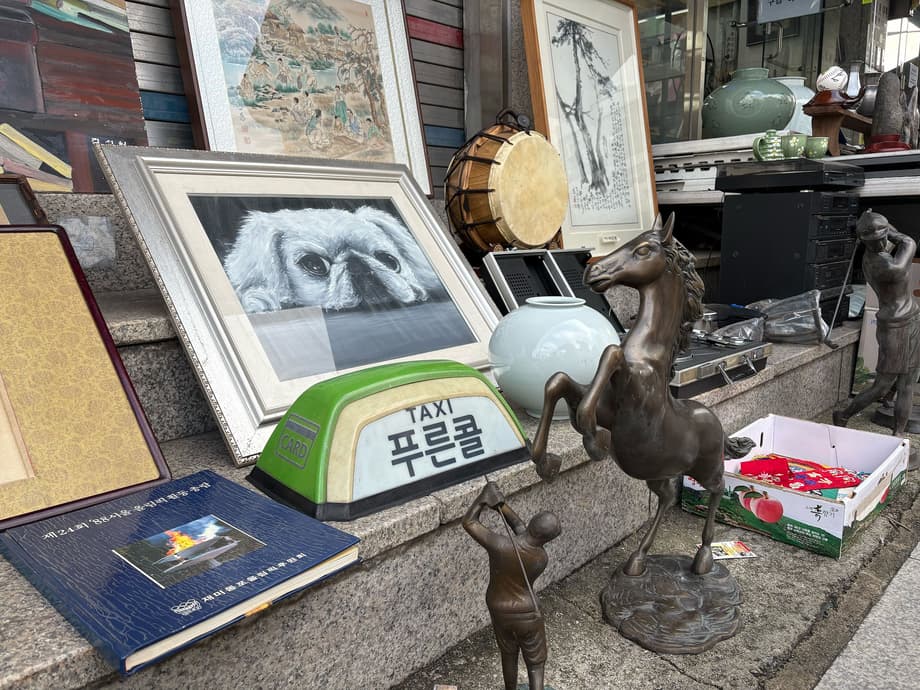
The soul of the market resides in its vendors. Changhoon Han operates a secondhand shop on the edges of Sinseol-dong, displaying watches, artwork, sculptures, and taxi roof signs on the sidewalk while careful not to spill onto the road and attract authorities. A sign hangs at his shop reading “We buy everything,” reflecting a business model built on the cycle of collecting.
Once-avid collectors of all sorts have sold me their collections. Interest fades, items are sold and new collectors and trends take their place. It is a cycle.
Nearby, Robert Kim sells small patches of leather while singing the Beatles’ “Love Me Do” to attract customers. He has maintained this performance for six years, explaining that the COVID-19 pandemic inspired him to live by the motto “you only live once.” His playlist consists mainly of 1970s pop songs selected because his demographic of shoppers falls in an older age range.
Not all interactions remain musical. Tae-sung Ha, who sells an eclectic mix including single-use vapes, frying pans, and six-foot-tall axes, has dealt with rude customers throwing merchandise. When one shopper chucked a vape onto the ground during a recent visit, Ha stopped him immediately.
Hey, you do not throw others’ belongings. Do not make me mad.
Yet good manners beget bargains, as demonstrated by a woman who haggled down the price on an egg frying pan simply by asking nicely.
The Hunt and Its Rules
Success requires understanding unwritten codes. Hesitation often means losing the prize. One shopper recently spent ten minutes examining a luxury brand watch, asking the seller whether it was real. The vendor admitted he lacked paperwork but priced the item far below retail. The prospective buyer said he would come back later. Upon returning twenty minutes later, he found the seller dropping the timepiece into a plastic bag for a competitor wearing a sly smile.
Bargaining is expected, even for small items. Vendors employ creative sales pitches, with one hawker claiming his goods bring pleasure in the bedroom while another promises toned calf muscles. As evening falls, teenagers use smartphone flashlights to sift through mountains of watch dials and straps, searching for Louis Vuitton timepieces among thousands of pieces. The owner might loudly explain gender classifications to giggling customers, but the search continues.
Practical considerations matter. The Dongmyo area is notably dusty, prompting advice to bring face masks when sifting through clothing piles. The market accepts cash transactions predominantly, requiring familiarity with Korean won denominations. While the Seoul Folk Flea Market operates daily from 10:00 AM to 7:00 PM (closed every 2nd and 4th Tuesday), the full street spectacle peaks on weekends.
City Planning vs. Street Reality
The tension between official urban development and organic commerce defines this market’s existence. The Seoul Metropolitan Government invested billions to create the indoor facility precisely to remove vendors from the Cheonggyecheon Stream restoration zone, yet street sellers persist along the stream edges every weekend. City official Lee Byung-jin acknowledged receiving resident complaints about unauthorized vendors, admitting that rooting them out proves really difficult despite laws against street vending in the refurbished stream area.
Merchants pay approximately 50,000 to 60,000 won per month for indoor stalls, yet many prefer the unauthorized outdoor spots because that is where the customers gather. The management of the market created Youth 1st Street on the second floor to attract younger visitors with vintage cafes and school uniform photo opportunities, but the street-level chaos remains the primary draw.
Some vendors have occupied this commercial ecosystem for thirty years, surviving three major relocations. They have witnessed the transition from selling U.S. military surplus discarded by American bases in the 1950s and 1960s, to antiques and LP records, to the current vintage fashion boom. Their inventory reflects Korea’s economic history, from postwar scarcity to industrial growth to digital-age nostalgia.
What to Know
- The Sunday market stretches over three and a half miles through Sinseol-dong and Dongmyo neighborhoods, operating year-round regardless of weather.
- The Seoul Folk Flea Market (indoor) is located at 21 Cheonho-daero 4-gil, accessible via Sinseol-dong Station Lines 1 and 2, Exit 9 or 10.
- Dongmyo Flea Market (outdoor/chaos) is accessible via Dongmyo Station Lines 1 and 6, Exit 3 or 4.
- Peak hunting occurs Sundays, though indoor sections operate daily 10:00 AM to 7:00 PM (closed every 2nd and 4th Tuesday).
- Merchants sell everything from vintage military gear and antique cigarette cartons to luxury watches and movie props, with prices negotiable through direct bargaining.
- The market inspired international fashion trends after being discovered by designer Kiko Kostadinov in 2018 and featured on Korean television programs.
- Bring cash, face masks for dusty clothing piles, and patience for navigating crowded alleys.
- The market originated in the 1950s postwar era and has relocated multiple times due to urban development projects.