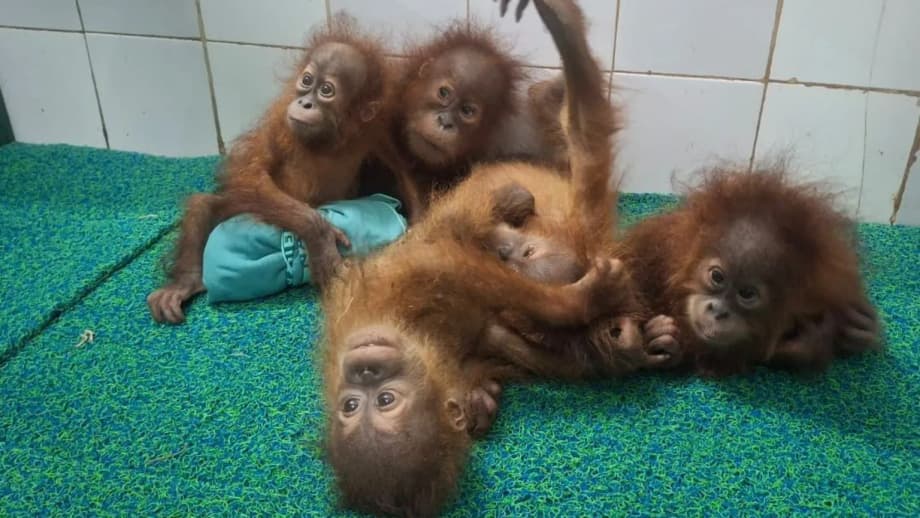
Five young apes far from their natural home
Five young orangutans found in a coastal forest in Odisha have triggered a police and wildlife investigation after officials concluded that the animals could not have reached India naturally. The apes were discovered in the Balasore district, thousands of kilometres from the rainforests of Southeast Asia where all wild orangutans live.
- Five young apes far from their natural home
- Why the animals could not have arrived naturally
- Police follow a possible vehicle trail
- How the rescued orangutans are being cared for
- Why infant orangutans are especially vulnerable
- A global trade that is already banned
- Earlier cases have raised similar concerns
- What happens after quarantine
- The Bottom Line
Villagers spotted the animals in a casuarina plantation in the Udayapur-Talsari area of Bhograi block on the morning of September 8, 2026. Images and videos showed the young apes sitting together, clinging to trees and eating bananas. Local people alerted forest officials, who rescued the group and provided first aid before moving them to Nandankanan Zoological Park in Bhubaneswar.
The group consists of three males and two females. Zoo officials estimate that they may be between six months and one year old, although other early reports placed some of them at up to two years. Their exact ages and species have not yet been publicly confirmed.
The discovery has raised concern that the orangutans may have been transported into India as part of an illegal trade in rare animals. Investigators are examining whether the group was abandoned after a transport operation went wrong, or whether they were deliberately left near the forest and a nearby highway.
Why the animals could not have arrived naturally
Orangutans are native to the tropical forests of Borneo and Sumatra. Borneo is shared by Indonesia, Malaysia and Brunei, while the Sumatran and Tapanuli orangutans live in Indonesia. India has no wild orangutan population and no natural forest corridor connecting Odisha with their habitat.
Balasore Divisional Forest Officer Pratik Prakash Indalkar said the location made a natural arrival impossible. He said the forest was made up largely of casuarina trees rather than the dense tropical canopy that orangutans require, and that the area was close to a state highway.
Indalkar said officials believed the animals had probably been in the area for only two or three days. A search of the surrounding forest found no adult orangutans, additional animals or obvious evidence explaining how the five juveniles reached the site.
Regional Chief Conservator of Forests Prakash Chand Gogineni said one possibility was that the animals had been left behind after a failed transit operation. Authorities have not confirmed the animals’ country of origin or the route used to bring them to Odisha.
Police follow a possible vehicle trail
Odisha Police’s Special Task Force began investigating on September 9. Forest officials, local police and the Wildlife Crime Control Bureau are working together to establish where the orangutans came from and who may have transported them.
A black Thar SUV has emerged as one possible lead. Residents reportedly saw a black vehicle near the forest on the night before the orangutans were found. The vehicle was said to have returned to the area about 10 minutes after leaving, and nearby CCTV cameras captured movement matching the description.
Investigators are collecting local accounts and checking footage from roads and other transport points. They are also examining railway stations, airports and ports to determine whether the animals may have entered Odisha by land, air or sea. Authorities have contacted the Indian Coast Guard while exploring whether waterways played a role.
STF Deputy Inspector General Kanwar Vishal Singh said the investigation was at an early stage and that officials were gathering facts before drawing conclusions. He said a team had been sent to Balasore to speak with forest officials and examine the circumstances in which the animals were found.
STF Inspector General Himanshu Lal said investigators would examine the animals’ origin, intended destination, possible interstate links and any wider group involved in the suspected crime.
We will now conduct a thorough and proper investigation. We will examine every aspect, including the interstate network involved, the origin and intended destination of the orangutans, the gangs implicated and the individuals behind such activities.
Forest officials have also contacted zoos across India to check whether any orangutans are missing from registered collections. This could help investigators distinguish between animals taken from a licensed facility and animals captured or acquired through an international trade route.
How the rescued orangutans are being cared for
The five animals were transferred to Nandankanan Zoological Park in Bhubaneswar on the night of their rescue. They have been placed in quarantine, meaning they are being kept separately from other zoo animals while veterinarians observe their health and guard against infectious disease.
Zoo staff are monitoring the group around the clock. The animals have been given bananas and apples, while the youngest orangutan is receiving liquidised food at frequent intervals. Care teams are also providing oral rehydration support, milk and other suitable foods as doctors assess their condition.
Reports from officials said the animals were stable after rescue. Staff members are working in shifts and following strict sanitation and biosecurity measures. These precautions are especially important because the young apes may have experienced dehydration, stress, injury or poor nutrition during transport.
Nandankanan has previous experience with orangutans. Its enclosure remained empty after Bini, a 41-year-old female orangutan, died in 2019 following age related health problems. Bini had arrived from Pune Zoo in 2003 and lived at Nandankanan for nearly 16 years.
Odisha Forest and Environment Minister Ganesh Ram Singhkhuntia said no decision had been made about putting the rescued animals on public display. Any such move would require permission from India’s Central Zoo Authority and would depend on the animals’ welfare, legal status and the results of the investigation.
Why infant orangutans are especially vulnerable
Orangutans are great apes, rather than monkeys. They have no tails, long arms and grasping hands and feet adapted to life in the forest canopy. They are the only great apes naturally found in Asia and are among the world’s largest tree dwelling mammals.
Fruit makes up much of their diet, although wild orangutans also eat leaves, flowers, bark, insects and other plant material. Their survival depends on large, connected forests that provide food, nesting sites and safe routes through the trees.
Young orangutans normally remain closely dependent on their mothers for several years. During that time, they learn how to identify food, move through the canopy, build sleeping nests and avoid danger. A lone infant would have little chance of surviving in an unfamiliar forest, and five infants together without an adult would be even more unusual.
Female orangutans reproduce slowly, often giving birth only once in about eight years. The loss of a mother and infant can therefore affect a population for many years. Poachers targeting infants may kill the mothers during capture, adding to the pressure caused by deforestation, logging, forest fires, agricultural expansion and hunting.
A global trade that is already banned
Three living orangutan species are recognised: the Bornean orangutan, the Sumatran orangutan and the Tapanuli orangutan. All are classified by the International Union for Conservation of Nature as critically endangered, meaning they face an extremely high risk of extinction in the wild.
International commercial trade in orangutans is prohibited under the Convention on International Trade in Endangered Species of Wild Fauna and Flora, commonly known as CITES. Indian wildlife laws also protect the animals. Those rules, however, have not eliminated demand from private collectors and people seeking exotic pets.
Young animals are particularly attractive to illegal traders because they are small and easier to handle than adults. Their high value in international markets has added to suspicion surrounding the Odisha case. The state forest minister has said an orangutan may be worth around 2 million to 2.5 million rupees in illegal markets, although investigators have yet to establish whether money changed hands in this incident.
Wildlife crime investigations often require authorities to connect several parts of a journey. Officers must identify the original capture site or facility, the people who arranged transport, the border or port used, the vehicle operators and the intended buyer. Evidence can include CCTV recordings, phone records, travel documents, veterinary records and information from international agencies.
Earlier cases have raised similar concerns
The Odisha rescue is not the first time young orangutans have been found unexpectedly in India. In 2022, two baby orangutans were discovered abandoned at a checkpoint near the border between Assam and Mizoram. Officials suspected that they had entered India through neighbouring Myanmar.
Indian authorities have also reported orangutan rescues in Maharashtra, Assam and Mizoram since 2020. The cases do not by themselves prove that one organisation is responsible, yet they show that orangutans can appear in illegal animal shipments far from their native forests.
The current case is unusual because five juveniles were found together in a public forest area, with no adult animals nearby. Their apparent closeness may mean they were transported as a single group, rather than arriving through separate incidents. Investigators are treating that possibility as one part of a wider inquiry rather than as established fact.
What happens after quarantine
The immediate priority is keeping the animals alive and stable while officials document their health and identify their origin. Quarantine may last several weeks, with veterinary teams watching for illness, parasites, injuries and signs of nutritional deficiency.
Their longer term care will depend on the investigation. If authorities establish a lawful foreign source, repatriation may be considered in consultation with the relevant country and conservation authorities. If their origin cannot be confirmed, officials may need to determine whether they can remain at an approved facility in India.
Any future decision must account for the animals’ age, health, social bonds and ability to adapt. Releasing them into an Indian forest would not be a practical conservation measure because India is outside their native range and the rescued infants have not learned the skills needed to live independently.
For now, the black SUV sighting, CCTV footage, transport records and international wildlife crime intelligence are central to the probe. The evidence will determine whether the case involved an isolated act, a failed shipment or a wider smuggling network.
The Bottom Line
- Five young orangutans were rescued from a casuarina forest in Balasore, Odisha, on September 8, 2026.
- Orangutans are not native to India and live naturally only in parts of Indonesia and Malaysia.
- The Odisha STF, Forest Department, local police and Wildlife Crime Control Bureau are investigating suspected illegal transport.
- A black Thar SUV and nearby CCTV footage are among the early leads being examined.
- The three male and two female orangutans are in quarantine at Nandankanan Zoological Park in Bhubaneswar.
- The animals are receiving veterinary care, specialised food and constant observation.
- All three living orangutan species face an extremely high risk of extinction, while international commercial trade in the animals is banned.