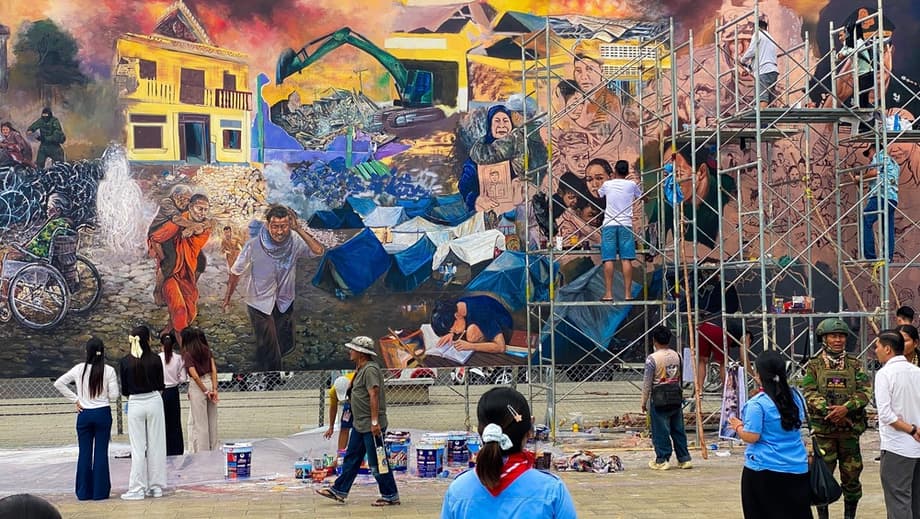
A temporary life that is becoming permanent
More than a year after fighting along the Cambodia Thailand border forced families from their homes, thousands of Cambodians are still living in crowded camps and host communities with no clear date for return. The crisis has moved beyond the first emergency. Families now face damaged homes, blocked farmland, unexploded weapons and disrupted public services, while children grow up in shelters that were meant to be temporary.
- A temporary life that is becoming permanent
- Why families cannot simply go home
- Children carry the heaviest burden
- A new crisis in a country marked by old wars
- Art gives children a way to speak without words
- Monks provide care rooted in community and faith
- The conflict has damaged livelihoods on both sides
- Relief must continue after the emergency phase
- Key Points
Figures have changed as people move between camps, host communities and areas of origin. Cambodia’s government initially reported that more than 20,000 people, including over 6,000 children, remained displaced. A National Committee for Disaster Management report recorded 141,850 people still displaced as of January 15, 2026, across 102 sites and host communities. The figure was down from nearly 649,000 at the height of the crisis on December 27, yet humanitarian agencies warned that many returns were fragile and that some families had already been forced to move back to displacement sites.
The difference between these figures reflects changing definitions and dates, rather than an end to the crisis. Some people have returned, while others remain unable to reach homes near contested areas. Housing damage, interrupted services and fears about explosive hazards continue to make return unsafe for many households.
One aid worker with a Western agency described the camps as unhealthy and difficult to manage during the rainy season.
These are not nice places. The government and NGOs are doing their best, but it is not easy, especially now with the rainy season.
Many families live in small tin shelters or tents that leak during heavy rain. Water, toilets, food supplies and basic health care remain uneven from one site to another.
Why families cannot simply go home
For displaced residents, returning home is more complicated than leaving a camp. Some villages lie behind military barricades and trenches. Farms, livestock and tools may have been abandoned or damaged. Even where houses are standing, families may lack clean water, electricity, schools or functioning clinics.
Humanitarian agencies reported that some households temporarily returned to camps after finding their homes damaged or essential services unavailable. Concerns about unexploded ordnance add another layer of danger. Border fighting can leave behind shells, mines and other weapons that remain lethal long after the shooting stops.
Bopha Moly, a 42 year old mother of three living in Rong Cham, a camp nearly 400 kilometres northwest of Phnom Penh, said school had brought some stability to her children, yet the family still felt unsettled.
She described the contradiction at the heart of the crisis: life in the camp has become manageable in some ways, while remaining far from normal.
It is OK now the children can go to school. But it is not home. I am afraid they will get sick here. But I am afraid we may never go back.
The Cambodia Humanitarian Response Forum and government authorities say the response now needs two tracks. One must support people who have returned by repairing homes, restoring services and rebuilding livelihoods. The other must keep providing shelter, food, water, health care and protection for those who cannot leave the camps.
Children carry the heaviest burden
Children are facing the sharpest disruption. A January humanitarian update said 69 schools remained closed in several border provinces, affecting 12,601 students and almost 500 teachers. Earlier figures from Cambodia’s education authorities showed a far wider impact during the height of the fighting, with 1,311 schools closed in seven provinces, affecting more than 322,000 students and 15,000 teachers.
Temporary learning spaces have opened in some camps, although attendance is irregular and supplies are limited. For children, classrooms provide more than lessons. They create routine, contact with friends and a place where adults can watch for signs of distress.
Humanitarian partners recently screened 1,452 children under five and found cases of moderate and severe acute malnutrition requiring treatment or supplementary food. Infants, pregnant women and nursing mothers are particularly exposed when families lose income and rely on irregular assistance.
UNICEF Cambodia representative Will Parks warned that crowded sites with limited water, sanitation and medical care could increase the risk of diarrhea, respiratory infections, waterborne illness and diseases preventable through vaccination. Closed local clinics also make routine immunization and maternal care harder to reach.
A new crisis in a country marked by old wars
The current displacement is taking place in a country where memories of violence remain close to the surface. Cambodia is still dealing with the psychological legacy of the Khmer Rouge genocide of the 1970s, the later Vietnamese occupation and decades of conflict. Many parents and grandparents carry memories of forced relocation, hunger, loss and fear.
Psychologists describe intergenerational trauma as the way severe stress can affect children through family behavior, stories, silence, insecurity and disrupted relationships. It does not mean that every child will develop a mental health disorder. It means that unresolved fear can shape how families respond to danger and how children understand the world around them.
Sothy Eng, an associate professor at the University of Hawaii at Manoa, commissioned a survey of 828 Cambodians in August 2025. Nearly nine in ten respondents said the conflict affected their ability to concentrate or function at work or school. More than 70 percent reported sleeping fewer than seven hours a night, while more than three quarters said they felt much more worried about the future. More than 90 percent said the violence brought back memories of war experienced by their parents or grandparents.
These findings include people who were not directly displaced, showing that the conflict has affected public life far beyond the camps. For those who have lost homes, land or relatives, the strain can be sharper. Repeated moves, family separation and uncertainty may turn short term fear into lasting anxiety, depression or post traumatic stress.
Parks said children exposed to prolonged uncertainty may struggle with sleep, concentration and emotional expression. Parents who are exhausted and frightened may also find it harder to provide the calm reassurance children need.
Art gives children a way to speak without words
Phare Ponleu Selpak, whose name means the brightness of the arts, has brought drawing, painting, music and play to children in displacement sites. The organization began as emergency support after families fled the fighting, then shifted toward longer term care as small camps merged into larger settlements.
Phare was founded by people who grew up in refugee camps created by earlier wars, including Site 2 near Aranyaprathet in Thailand. Their personal experience has shaped a program aimed at helping children regain routine, confidence and a sense of control.
Ponlork Van, Phare’s communications manager, said the organization intends to keep activity centers open for as long as children remain displaced and is searching for new sites as families are relocated.
Without intervention, the traumas of forced displacement can set in permanently. Prolonged stress can replace a sense of normalcy with a permanent state of fear and survival.
Art therapy is a form of psychosocial care that uses creative activity to help people process emotions and rebuild social connections. It is especially useful for young children who may not have the vocabulary to describe fear, grief or confusion.
Australian psychologist Cait McMahon, who has worked with war trauma survivors across Southeast Asia, said children do not have to explain their experiences verbally during arts sessions. Drawing and music can give them a low pressure way to express themselves while playing with other children.
Trauma takes away a sense of power and control from you. This sort of therapy can help you reinstate that.
Monks provide care rooted in community and faith
Formal mental health services are scarce in many rural and border areas. Some displaced people may also feel uncomfortable seeking clinical counseling, especially when familiar religious and community networks are available.
Khmer Buddhist monks have visited villages and camps to distribute aid, lead prayers, teach meditation and speak with people experiencing fear, grief and sleeplessness. Temples can function as trusted communal spaces where displaced families find familiar rituals and contact with neighbors.
Buddhist teachings about suffering, change and compassion can help people make sense of painful experiences without treating distress as a personal failure. Group prayer, meditation and religious ceremonies may also rebuild social bonds weakened by flight and separation.
Monks cannot replace trained psychologists, doctors or child protection specialists. Their role can complement professional services when humanitarian agencies work with religious institutions in a safe and coordinated way. Such cooperation would also help identify people who need urgent medical or mental health treatment.
The conflict has damaged livelihoods on both sides
The border dispute centers on contested territory and competing interpretations of century old French maps. Tensions intensified after a minor confrontation in May, followed by full scale clashes on July 24. The worst violence came in December, and both governments accused the other of violating a ceasefire reached that month.
More than 100 people have been killed according to the account provided for this report. At the height of the fighting, about 1.1 million people were displaced in Cambodia and Thailand. Thailand saw most displaced residents return home, while Cambodia, the weaker military power, did not occupy Thai land and has struggled to secure the return of communities near the contested frontier.
Another 900,000 Cambodian migrant workers fled Thailand. Many had borrowed heavily to secure jobs there, leaving families with debt as well as lost wages. The United Nations estimated that lost remittances could cost Cambodia almost 1 billion US dollars in 2025 and 2026, more than 1.8 percent of gross domestic product.
Social media has added anger to a dispute already shaped by nationalism. Online insults and unverified claims can deepen public hostility, making compromise harder and increasing fear among communities that have long traded, worked and traveled across the border.
Chroeck Chhunieng, a 27 year old software engineer in Phnom Penh, reflected the defiance heard from many Cambodians.
They are bigger than us, but they will never beat us. They have bullied us throughout history. But we never give in.
Relief must continue after the emergency phase
Humanitarian partners estimate that more than 239,000 people across nine provinces have received assistance since the fighting began. Cash support reached more than 78,000 households classified as poor during the first half of January. Aid has focused on shelter, food, water and sanitation, yet needs remain high.
Protection teams are also watching for family separation, violence against women and children, exploitation and unsafe living conditions in crowded sites. Accessible toilets, private washing areas, complaint systems and referral services are essential parts of a safe camp, rather than optional additions.
Returning families need more than transport home. They need repaired houses, safe farmland, health services, schools, documentation and income. Families who remain displaced need reliable assistance that does not end simply because the first emergency has passed.
The experience of earlier Cambodian refugee communities shows why mental health care should begin alongside food and shelter. Art, music, play, schooling, family activities, community gardening, meditation and professional counseling can help people regain routines while they wait for a safe and lasting return.
Key Points
- About 141,850 people remained displaced in Cambodia as of January 15, 2026, according to NCDM figures.
- Many returns are unstable because of damaged homes, disrupted services and explosive hazards.
- Children face malnutrition, interrupted schooling, protection risks and rising emotional distress.
- Art therapy is helping children express feelings, rebuild routine and regain confidence.
- Buddhist monks are providing culturally familiar spiritual and psychosocial support.
- Lost Cambodian remittances may cost nearly 1 billion US dollars across 2025 and 2026.
- Long term recovery requires housing, livelihoods, education, health care and sustained mental health services.