A mineral deal with consequences beyond trade
South Korea is turning to Mongolia in search of rare earth elements and other critical minerals as China tightens its control over global supply chains. The partnership promises new access to materials needed for electric vehicles, semiconductors, drones, robotics and military equipment. It also places Mongolia at the center of a contest involving China, Russia and the United States.
- A mineral deal with consequences beyond trade
- Why are rare earths so valuable?
- What does Mongolia bring to the partnership?
- Can Mongolia move beyond exporting raw materials?
- Why is geography Seoul’s biggest concern?
- Is the agreement also a US supply chain strategy?
- How is Mongolia balancing its neighbors?
- What lessons come from uranium and other minerals?
- What could determine the deal’s success?
- The Bottom Line
Presidents of South Korea and Mongolia signed a Comprehensive Economic Partnership Agreement on July 11. The agreement removes tariffs of between 2 and 5 percent on Mongolian copper, molybdenum and rare earth imports. A joint research center, operating since December, is studying Mongolia’s deposits and possible export routes.
For Seoul, the agreement is part of a wider effort to reduce dependence on Chinese supplies. South Korea currently chairs a 17 nation coalition launched by Washington to diversify access to critical minerals. The arrangement has a commercial face, yet its wider purpose is closely tied to the security relationship between South Korea and the United States.
That connection may place Mongolia in a difficult position. The country has long tried to balance its relations with its two large neighbors while building ties with what it calls third neighbors, including South Korea, the United States, Japan and European countries.
Why are rare earths so valuable?
Rare earth elements are a group of 17 metals. Their name does not mean that they are absent from the Earth’s crust. The difficulty lies in finding concentrated deposits and separating the elements from surrounding rock. Processing can require complex technology, large amounts of energy and strict controls on waste.
Small quantities of rare earth materials are essential in powerful permanent magnets. These magnets help electric vehicle motors work efficiently and are also used in wind turbines, computer equipment, precision machinery, aircraft, missiles, fighter jets and drones. Other critical minerals such as copper, tungsten and molybdenum are used in power systems, aerospace equipment, tools and defense production.
China has a commanding position in the sector. Estimates cited in the research place China’s share at about 59 percent of global rare earth mining and roughly 90 percent of refining and processing capacity. The country also produces most of the permanent magnets that contain neodymium and dysprosium, two elements used in high performance motors and other advanced equipment.
The United States imported about 70 percent of its rare earth compounds and metals from China between 2020 and 2023, based on U.S. Geological Survey data. That dependence has made mineral supply a security issue as well as a trade concern.
What does Mongolia bring to the partnership?
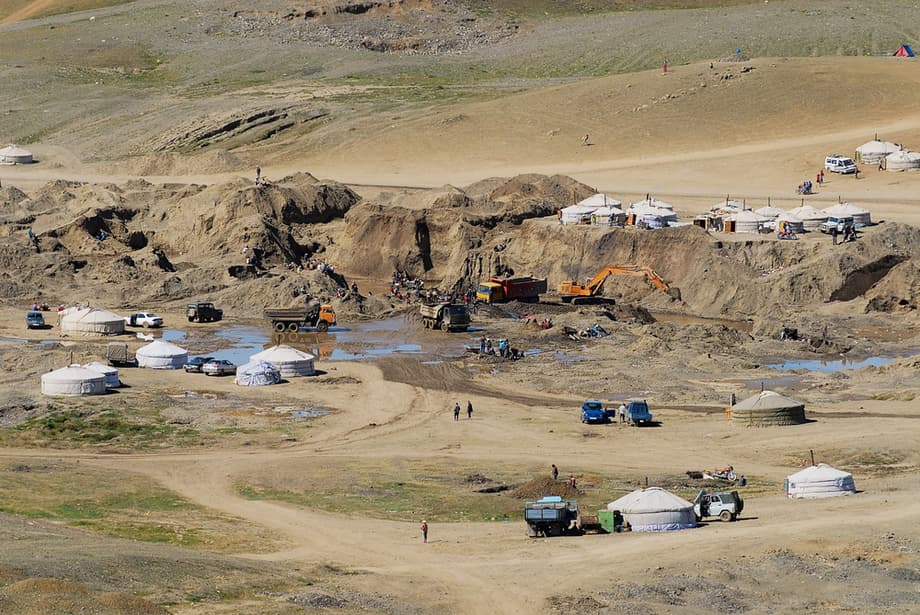
Mongolia is one of the world’s most mineral rich countries. More than 80 types of minerals have been identified, including copper, gold, uranium and rare earth elements. Reports based on existing surveys place Mongolia among the top ten countries for mineral resources.
The country has six registered rare earth deposits and 26 known occurrence sites. One estimate puts its rare earth reserves at about 31 million tons, or around 16 percent of the world total. Mongolia also has estimated copper reserves of 55 million tons and coal reserves of 175 billion tons. The Oyu Tolgoi mine in the southern Gobi region is among the largest copper and gold operations in the world.
Those figures come with a major qualification. Mongolia is roughly 16 times larger than South Korea, yet about 55 percent of its territory has not been explored in detail. Reserve estimates may change as geological surveys improve.
Mining already dominates Mongolia’s economy. In 2024, the sector accounted for about 27 percent of gross domestic product, 70.9 percent of industrial output and 87.2 percent of exports. The government wants to use new mineral projects to attract investment while reducing its reliance on coal and raw material sales.
Can Mongolia move beyond exporting raw materials?
Mongolian officials say the goal is to build local processing capacity rather than simply ship unprocessed ore abroad. Ambassador Sukhee Sukhbold has called for Korean technology and investment to be combined with Mongolia’s mineral resources so the two countries can produce higher value materials together.
We are exporting raw minerals to China and just selling them as they are. But the world needs more processed products. Why are we exporting raw materials only? We need to process them and produce the products the world needs.
Processing ore inside Mongolia could reduce the volume that must cross foreign territory. Tungsten, molybdenum and rare earth materials could be turned into concentrates or intermediate products before shipment. Such steps would make transport more efficient and could create jobs and industrial skills in Mongolia.
South Korean specialists are studying whether processing plants can be built near Mongolian mines. Finished materials could then be transported by air in smaller volumes, although air freight would be costly and would suit refined products better than large quantities of ore. A first shipment of Mongolian tungsten concentrate was flown to South Korea on June 27, according to Professor Song Byeong Gu of Dankook University.
The plan faces practical limits. Processing plants require reliable electricity, water, roads, skilled workers and environmental safeguards. Mongolia’s severe winters, large distances and limited infrastructure can raise construction and operating costs. A plant alone cannot remove every risk from a supply chain that still depends on neighboring countries for equipment, fuel and some transport links.
Why is geography Seoul’s biggest concern?
Mongolia has no coastline. Up to 90 percent of its exports, including minerals, must travel through Chinese or Russian rail networks and ports before reaching global markets. This leaves the country with fewer options than coastal suppliers.
South Korean experts warn that China or Russia could delay shipments, increase customs costs or create administrative barriers if they concluded that Mongolian minerals were being redirected to the United States or Japan. Professor Jang Jae Hyuk of Hankuk University of Foreign Studies described the border as a serious logistical bottleneck.
If China wanted to counter the United States, it could sharply raise customs costs or simply slow things down at the border.
A dispute would not require a formal embargo to cause damage. Delays at border crossings, tighter inspections, changes in rail access or higher insurance costs could make a project commercially unviable. Businesses that depend on just one or two routes are especially exposed to such pressure.
Rail links through Russia carry their own political and commercial risks. Moscow remains an essential transit partner for Mongolia, while its closer relationship with Beijing has increased the importance of trilateral cooperation. China has urged Russia and Mongolia to strengthen energy, financial and infrastructure ties and resist what Chinese President Xi Jinping described as external interference.
Is the agreement also a US supply chain strategy?
Some analysts view the South Korea Mongolia agreement as part of a wider three country arrangement involving Washington. South Korea may import Mongolian minerals, process some of them at home and then supply materials to American manufacturers under the expanding alliance between Seoul and Washington.
That possibility gives the agreement a strategic dimension. If China believes Mongolian resources are being used to weaken its position or support American defense production, Beijing could apply pressure through trade or transit channels. Russia could also object if it sees the arrangement as part of a broader Western effort to reduce its influence in the region.
South Korea is already supporting projects designed to build processing capacity outside China. The United States has acquired a 10.59 percent stake in Korea Zinc, the world’s largest zinc smelter. Korea Zinc and the American government are backing an estimated $7.4 billion integrated metals and critical minerals facility in Tennessee.
Other Korean companies are pursuing related projects. LS Cable and System is discussing a rare earth permanent magnet plant in Virginia, while Posco International has partnered with ReElement Technologies on a separation and refining facility in Indiana. These projects show that Seoul’s interest in Mongolia is connected to a broader attempt to build a supply network that reaches from mining to final manufacturing.
How is Mongolia balancing its neighbors?
Mongolia’s third neighbor policy is designed to widen its diplomatic and economic options without provoking China or Russia. Its geography makes close relations with both neighbors unavoidable. China is Mongolia’s largest trading partner and a major destination for mineral exports. Russia remains important for fuel, transport and energy links.
South Korea became a strategic partner of Mongolia in 2021. Bilateral trade has grown from about $2.7 million when diplomatic relations began in 1990 to more than $600 million in recent years. Cooperation now includes mining, infrastructure, health care, tourism and education.
The relationship has also gained support from Korean development assistance. Korean groups have worked on medical facilities, water resources and urban infrastructure. A Korean consortium completed the basic design for Ulaanbaatar’s first subway line, with construction expected to begin in 2026.
For Ulaanbaatar, cooperation with Seoul provides access to technology and investment without requiring an exclusive political alignment. The ambassador has said Mongolia seeks to communicate and trade with all partners rather than rank countries into fixed categories. That balancing act will be tested if mineral exports become tied directly to the US-China contest.
What lessons come from uranium and other minerals?
The rare earth issue is part of a wider effort by Mongolia to diversify its mining sector. Uranium, copper and other minerals are attracting interest from countries seeking new suppliers for energy, manufacturing and technology.
Mongolia is estimated to hold about 190,000 tons of identified uranium resources, with possible total resources as high as 1.5 million tons. The proposed development of the Zuuvch Ovoo deposit with French company Orano is expected to require about $1.6 billion in investment, with production targeted for around 2028.
Uranium projects have moved slowly in Mongolia because of licensing disputes, changing laws and public concerns about water contamination, radioactive exposure and damage to grazing land. Those difficulties provide a warning for rare earth projects. Investors will need predictable rules, clear environmental standards and stronger public confidence if Mongolia is to become a steady supplier.
Kazakhstan offers one example of how consistent policy and technical expertise can turn mineral reserves into sustained production. Mongolia’s authorities are studying that experience as they seek to attract foreign capital while retaining a larger share of public revenue through a sovereign wealth fund.
What could determine the deal’s success?
The partnership will depend on more than the signing of a trade agreement. Geological surveys must confirm that deposits are large enough and suitable for commercial extraction. Governments and companies must then finance mines, processing plants, roads, power systems and border arrangements.
Environmental concerns will also shape public support. Rare earth processing can produce toxic waste if poorly managed, while mining may affect water supplies and grazing areas. Mongolia’s rural communities will expect transparent consultation and a fair share of economic benefits.
Seoul must also decide how much risk it is prepared to accept. Buying ore from Mongolia may reduce direct dependence on China, yet it does not create a fully independent supply chain while rail and port access remain controlled by China and Russia. Building processing capacity in Mongolia can reduce shipment volumes, though it cannot remove political exposure entirely.
For Mongolia, the central calculation is whether foreign partnerships can support industrial development rather than repeat a pattern of exporting raw materials with limited local value. For South Korea, the calculation is whether a promising new source can be connected to secure transport and reliable processing. For Washington, the partnership is one piece of a larger attempt to reduce China’s influence over materials used in the modern economy.
The Bottom Line
- South Korea and Mongolia signed an agreement removing tariffs on Mongolian copper, molybdenum and rare earth imports.
- Mongolia has major deposits of rare earths, copper, gold, uranium and coal, though much of its territory remains poorly surveyed.
- China controls about 59 percent of rare earth mining and 90 percent of refining and processing capacity.
- Up to 90 percent of Mongolian exports must pass through Chinese or Russian transport networks.
- South Korea is studying processing plants in Mongolia and alternative ways to ship refined materials.
- The partnership supports Mongolia’s third neighbor policy while linking Seoul more closely to Washington’s critical minerals strategy.
- Environmental safeguards, stable regulations and reliable transit will determine whether the agreement becomes a lasting industrial partnership.