A new lunar contest takes shape
The United States and China are competing to return astronauts to the Moon, yet the new contest reaches far beyond planting a flag. Both powers want to establish long term facilities, study the lunar south pole and learn whether resources found there can support future missions.
China says it aims to land astronauts by 2030 and begin building the International Lunar Research Station around 2035. NASA is targeting a crewed landing in 2028 through its Artemis program, although the schedule has shifted several times and depends on spacecraft that are still being developed.
The first country to establish a regular presence near the south pole could gain an early advantage in choosing landing sites, building communications systems and setting technical practices. That does not mean it could legally claim lunar territory. The 1967 Outer Space Treaty bars national ownership of the Moon, while leaving major questions about resource use and safety zones unresolved.
The contest also carries a wider strategic message. A successful lunar program can display industrial strength, support commercial space companies and provide experience for later journeys to Mars and other destinations.
Why the lunar south pole matters
The south pole is the center of both countries’ plans because some craters there remain permanently in shadow. Without direct sunlight, temperatures can fall more than 200 degrees below zero. Scientists believe these frozen areas may contain water ice preserved for billions of years.
Water would be valuable for several reasons. It could be purified for drinking, processed into oxygen for breathing and split into hydrogen and oxygen to make rocket propellant. Producing these materials on the Moon would reduce the need to launch every kilogram of water and fuel from Earth.
The region is also difficult to work in. Low sunlight makes solar power less reliable, while deep craters create extreme cold and communication problems. Some elevated areas receive sunlight for long periods, yet spacecraft may need relay satellites to maintain contact with crews operating below the lunar horizon.
Suitable sites may be limited. Ice deposits are not evenly spread, and areas with access to both water and dependable sunlight could become especially valuable. That has led some analysts to warn that competition could resemble a lunar land grab, even if formal territorial claims remain prohibited.
China builds toward a 2030 landing
China has followed a steady sequence of robotic and crewed space projects. It operates the Tiangong space station, has returned samples from the far side of the Moon and has demonstrated the ability to guide spacecraft across difficult lunar terrain.
The Chang’e program has been central to that progress. The Chang’e 6 mission returned the first samples ever collected from the far side in 2024. China plans to launch Chang’e 7 to the south pole in 2026, using an orbiter, lander, rover and mobile flying vehicle to survey the region and search for ice.
Chinese mission officials say Chang’e 7 will include instruments capable of studying material in permanently shadowed areas. Chang’e 8, expected around 2028, is intended to test technologies that can use local lunar materials, a process known as in situ resource utilization.
Tang Yuhua, deputy chief designer of Chang’e 7, described the value of finding ice in a 2025 interview with Chinese state media.
If lunar water ice is successfully located, it could significantly reduce the cost and time required to transport water from Earth, facilitating the establishment of a human base for long term activities on the Moon and enabling further exploration of Mars or deep space.
China is also testing the hardware for crewed missions. Its planned Long March 10 rocket would launch the Mengzhou crew capsule, while a second rocket would carry the Lanyue lander. The two spacecraft would meet and dock in lunar orbit. Two astronauts would descend to the surface while a third remained in orbit.
Public reports describe tests of the Long March 10A first stage, Mengzhou spacecraft and the lander’s navigation and propulsion systems. China has also developed concepts for using autonomous machines, including quadruped robots, to inspect facilities, carry equipment, collect samples and help prepare construction sites.
NASA faces a more complicated return
NASA’s Artemis program has made progress with the successful Artemis II crewed lunar flyby, which carried four astronauts around the Moon. The mission marked the first crewed journey to the lunar vicinity since the Apollo era, yet NASA still needs a working lunar lander before astronauts can reach the surface.
Artemis III is intended to use a lander developed by SpaceX, while Blue Origin is developing a second vehicle for later missions. NASA has said it can use whichever provider is ready first. Both companies face major engineering tasks.
SpaceX’s Starship and Blue Origin’s Blue Moon landers must be refueled in Earth orbit before traveling to the lunar surface. That would require transferring large amounts of super cold propellant between spacecraft, a process never completed in space at the scale required for a lunar landing.
NASA’s approach also depends on private companies whose schedules and finances are outside direct government control. The agency has chosen this model partly because its budget is much smaller than during Apollo. Adjusted for inflation, NASA spent roughly $43 billion a year at the height of the Apollo program. Its total budget in 2025 was about $25 billion.
Casey Dreier, chief of space policy at The Planetary Society, said the United States has not funded NASA as if it were pursuing an Apollo scale race.
We do not want to put our space agency in the position of suddenly being framed as losing when we have not really given them the resources necessary even to truly compete.
NASA’s schedule is also more exposed to changes in presidential administrations and congressional funding. China uses a centralized planning model that allows it to keep major programs focused across many years. That difference helps explain why observers view China’s 2030 target as credible, even though it has never sent astronauts beyond low Earth orbit.
Who is more likely to land first?
The answer depends on how the timelines are measured. NASA is aiming for 2028, while China has set 2030 as its target. A delay of months could decide which nation returns first, although neither schedule is guaranteed.
Jared Isaacman, NASA’s administrator, has called China a great competitor and said Chinese astronauts will reach the Moon. He has also expressed confidence that the United States can meet its target.
The difference between winning and losing will be measured in months, not years.
China has a record of setting fewer public deadlines and then meeting many of them. Its robotic lunar missions have proceeded with careful preparation. The United States has greater experience from Apollo and a broad network of international partners, yet its current landing system remains unfinished.
Patrick Besha, a former NASA strategic adviser who studies China’s space program, has described China’s route as more direct. Its proposed lunar mission requires two launches and an orbital docking, while the US architecture depends on complex refueling operations and several linked vehicles.
A first landing would carry enormous prestige for either country. Still, a single landing would not determine lasting leadership. The more meaningful measure would be the ability to send missions repeatedly, keep equipment working and maintain people on the Moon for long periods.
From visits to permanent settlements
The ambitions of this contest differ from Apollo. The US missions of the 1960s and 1970s focused on exploration, scientific experiments and national prestige. The new programs aim to build infrastructure that can support rotating crews and eventually larger settlements.
NASA’s plans include robotic landers, power systems, communications equipment, cargo deliveries and mobile laboratories. A Japanese built pressurized rover could allow astronauts to live and work without wearing bulky spacesuits during every task. Some facilities may be placed partly underground to protect crews from radiation and small impacts.
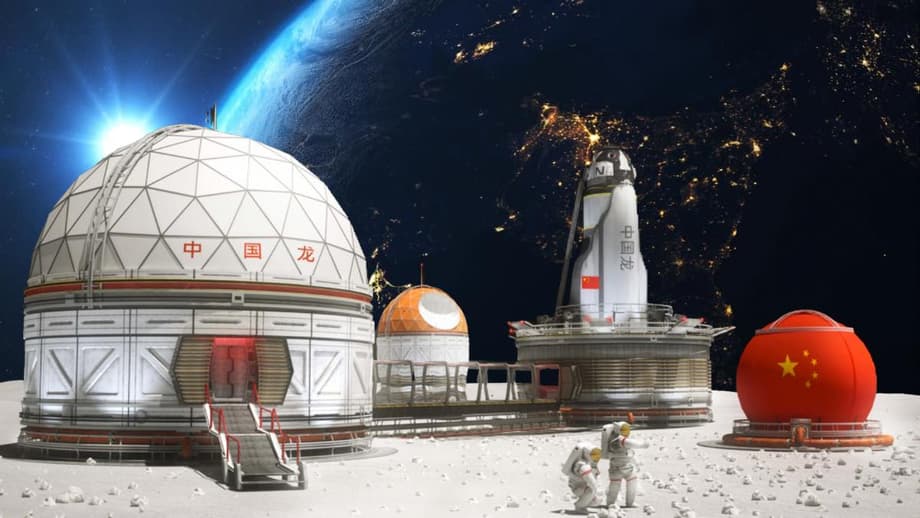
China and Russia have outlined the International Lunar Research Station as a robotic research network that could later support human visits. Chinese officials have discussed cooperation with several other countries and have considered nuclear power for the station. Nuclear systems could provide steady energy during long periods of darkness, though transporting and operating a reactor on the Moon presents major technical and safety challenges.
Clayton Swope, deputy director of the Aerospace Security Project at the Center for Strategic and International Studies, described the scale of a true lunar settlement.
It is a scenario where there are people being born, people dying, their families, children growing up in a place that is not Earth. That looks a lot like a city, more than it looks like an expedition to the south pole.
Such a settlement would require dependable food, air, water, shelter, medical care and power. It would also need systems for repairing equipment and producing basic materials locally. The Moon’s low gravity could make it useful as a launch site for missions deeper into the solar system.
Law and resource rights remain unsettled
The Outer Space Treaty prohibits countries from claiming the Moon as sovereign territory. It does not give a complete answer about mining, private ownership of extracted materials or the size of safety areas around industrial sites.
The United States promotes the Artemis Accords, signed by 70 countries. The agreement supports resource extraction and allows temporary safety zones around lunar operations. China, Russia and several close partners have not signed the accords and favor their own diplomatic framework.
The legal tension is easy to see. A power plant or mining operation may need an area where other spacecraft cannot safely operate. That zone might not be a territorial claim in name, yet it could function like control over a valuable location.
Helium 3, titanium, silicon and aluminum have been discussed as possible lunar resources. Helium 3 is rare on Earth and has been studied for possible use in fusion research, although large scale commercial use remains distant. Water is likely to be far more useful in the near term because it directly supports life and propulsion.
International rules will need to address traffic, rescue duties, debris, communications, environmental damage and access to sites with ice. Without shared procedures, a damaged rover, blocked landing area or disputed safety zone could create a serious confrontation.
Competition and cooperation can coexist
Washington and Beijing currently have few direct channels for joint lunar work. US export controls and the Wolf Amendment restrict NASA from collaborating with China, while American officials cite concerns about technology transfer, espionage and military use.
That separation may limit scientific exchange, yet complete isolation would be difficult to maintain as more countries and private firms enter lunar exploration. Europe, Japan, Canada, Russia and other nations are involved in separate partnerships, missions or research projects.
The previous space race shows that competition can eventually produce cooperation. The United States and the Soviet Union moved from rivalry to joint work on the International Space Station. Future cooperation could focus on collision avoidance, emergency assistance, shared scientific data and warnings about objects that threaten Earth.
Scott Manley, an astrophysicist who studies rocket engineering, has argued that endurance will matter more than a single historic landing.
It does not matter who gets to the Moon next. It matters who gets to the Moon the next 10 times.
That view captures the central challenge. The first crew to reach the south pole may win a major symbolic victory, yet lasting influence will depend on repeated missions, reliable infrastructure and rules accepted by enough countries to keep lunar activity safe.
The Bottom Line
- NASA aims to land astronauts on the Moon in 2028, while China targets a crewed landing by 2030.
- Both programs focus on the south pole because water ice could support life and produce rocket fuel.
- China plans Chang’e 7 in 2026 and an International Lunar Research Station around 2035.
- NASA depends on SpaceX and Blue Origin to complete complex lunar landers.
- The Outer Space Treaty bans territorial ownership, yet resource and safety rules remain unclear.
- Long term leadership will depend on sustained operations, not one landing.