When Disaster Strikes, Gender Assumptions Can Prove Fatal
In Japan’s northernmost prefecture of Hokkaido, the statistics tell a troubling story that extends far beyond administrative record keeping. While communities across the nation grapple with earthquake and tsunami preparedness, Hokkaido ranks last in female representation on municipal disaster prevention councils, with women holding just 6.3% of seats as of 2025. At the prefectural level, the figure stands at a mere 18.8% in 2026. These numbers represent more than bureaucratic imbalances. They indicate a dangerous gap in perspective that could cost lives when the next major earthquake strikes this seismically active region.
- When Disaster Strikes, Gender Assumptions Can Prove Fatal
- The Hidden Dangers of Disaster Kitchen Duty
- Historical Hardships Offer Hard Lessons
- Breaking the Cycle Through Direct Experience
- Infiltrating the Decision Making Rooms
- Creative Approaches to Inclusive Preparedness
- The Call for Bottom Up Protection
- Reimagining Safety for All
- Key Points
The issue extends far beyond boardroom representation into the practical realities of survival. Across Japan, traditional community disaster manuals still dictate that women are responsible for cooking during emergencies while men handle debris removal and heavy infrastructure work. This division of labor might seem practical or even natural to some long time community members, but disaster survivors and academic experts argue it creates deadly inequalities that undermine entire communities. Following the 2011 Great East Japan Earthquake and subsequent tsunami, this rigid gendered approach led to severe long term consequences: men received daily wages for cleanup and reconstruction work while women provided meals, childcare, and eldercare without any financial compensation, leaving female victims economically disadvantaged and considerably slower to rebuild their homes and lives in the months and years following the devastation.
The disparity revealed by the 2011 disaster exposed fundamental flaws in how Japanese society conceptualizes emergency labor. Cooking for hundreds of displaced people in evacuation centers without running water, stable electricity, or proper ventilation constitutes industrial scale food service operation, yet it remains classified as women’s work and therefore outside the formal economic structures of disaster relief. This classification has profound implications for family survival, economic recovery, and social stability in affected regions.
The Hidden Dangers of Disaster Kitchen Duty
Ayaka Mizuguchi, who leads the Sapporo based nonprofit organization Bosai Shitakke, has spent years challenging the deeply rooted assumption that cooking during disasters constitutes light domestic work suitable for women. She explains with specific examples that preparing emergency meals under crisis conditions involves heavy labor fundamentally different from ordinary home cooking. To make emergency rice for just 50 people, workers must transport and handle approximately 9 liters of water, often across damaged ground or up stairs in buildings without working elevators. Pouring boiling water from massive commercial pots amid ongoing aftershocks creates serious scald risks that require safety training and physical strength to manage properly.
Preparing 100 servings of tonjiru, a hearty miso soup with pork and vegetables that provides essential nutrition and warmth in cold evacuation centers, requires lifting and managing several kilograms of raw ingredients plus heavy stock pots. It is difficult for the same person to be responsible for all three meals per day, Mizuguchi notes, highlighting the physical impossibility and health dangers of expecting women to maintain this crushing workload indefinitely while simultaneously caring for children, elderly relatives, or injured family members. The labor is not merely tedious household activity; it constitutes dangerous physical toil that demands strength, stamina, safety awareness, and logistical planning comparable to any debris removal or construction operation.
Historical Hardships Offer Hard Lessons
The 2011 Great East Japan Earthquake and subsequent tsunami exposed the harsh realities of gendered disaster response to public scrutiny. In affected areas along the Tohoku coastline, the division of emergency labor followed predictable traditional patterns. Men engaged in debris clearing, temporary housing construction, and infrastructure repair, often receiving daily wages from government relief programs or private contractors for their efforts. Women, meanwhile, found themselves automatically expected to provide large scale cooking, cleaning, laundry, and caregiving services without any financial compensation or formal recognition as emergency workers.
This systematic unpaid labor burden created a secondary economic disaster for female survivors. Without access to income from relief work, women lacked the independent economic resources necessary to rebuild their homes, replace destroyed appliances, or secure new housing for their families. The gap between male and female recovery trajectories widened considerably over the following years, with women reporting greater difficulty accessing housing reconstruction funds, economic restart programs, and mental health services. The lesson was clear and stark: disaster policies that ignore gender equity in labor distribution ultimately hinder community wide recovery and perpetuate poverty among the most vulnerable survivors.
Research into the 2018 Hokkaido Eastern Iburi Earthquake further illuminates these vulnerabilities specific to Hokkaido’s demographic situation. Academic studies examining evacuation behavior in Hokkaido’s rapidly aging communities found that elderly residents, particularly women living alone in rural areas, face severe disadvantages during emergencies. The research highlighted that factors like homeownership status, advanced age, and solitary living arrangements negatively impact evacuation intentions and physical ability to reach safety. These findings underscore why diverse perspectives, including those of women who traditionally care for the elderly and children, must inform practical disaster planning rather than remaining peripheral to policy discussions.
Breaking the Cycle Through Direct Experience
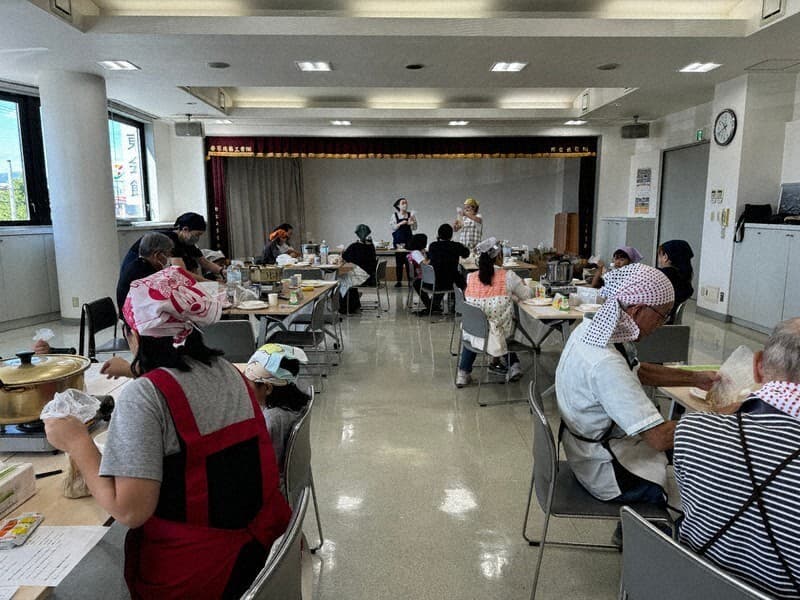
Mizuguchi’s approach to changing community minds relies on physical experience rather than abstract theoretical arguments about gender equality. By having neighborhood association members, regardless of gender or age, participate in realistic cooking drills during evacuation exercises, she demonstrates the actual physical demands and safety hazards of disaster food preparation. Male participants, including retired construction workers and office employees, quickly discover that carrying 20 liter water containers across unstable ground, managing industrial scale cooking equipment in dim lighting, and working in structurally compromised kitchens requires skills and physical strength that transcend traditional gender stereotypes about domestic work.
Precisely because disaster manuals have been passed down in communities for generations, people tend to take them for granted, Mizuguchi observes. But this inherited wisdom could ultimately lead to heavily disproportionate burdens in times of disasters, creating burnout and medical emergencies among the very people we need most for community survival. Her practical work reveals how unquestioned traditions, when applied to extreme circumstances, become dangerous liabilities rather than community assets. When she demonstrates that preparing three meals daily for hundreds of evacuees requires a team of strong, trained adults working in shifts, the artificial gender divisions begin to dissolve in favor of practical capability based assignments.
Infiltrating the Decision Making Rooms
Progress is coming slowly but visibly to Hokkaido’s disaster prevention establishment. This fiscal year brought a symbolic and practical victory when Yukari Kaneko, representative of the Kushiro based civil group Team Kushiro Bosai Joshi, secured appointment to the Hokkaido prefectural disaster prevention council alongside Mizuguchi. Kaneko, 58, runs her own construction company while working to raise disaster awareness among women from diverse professional backgrounds, including public school teachers, nursing care facility cooks, and retail workers. Her presence in the prefectural chamber represents a crack in the wall of male dominated emergency management.
The appointment highlights both emerging progress and persistent structural problems. A prefectural government official acknowledged candidly to the Mainichi Shimbun that in small municipalities throughout the vast prefecture, few women hold leadership positions in traditional community organizations, resulting in disaster prevention councils comprised almost entirely of retired men. This explanation, while honest about current conditions, underscores the structural barriers preventing gender equity in disaster governance and the need for proactive recruitment rather than waiting for demographic changes to happen naturally.
Kaneko’s first attendance at a prefectural disaster prevention council meeting in February marked a potential turning point. I would also like to attend small meetings, where detailed discussions can be held in small groups, and send out my messages, she said enthusiastically, signaling her intent to influence policy at every level of the decision making process.
Creative Approaches to Inclusive Preparedness
Kaneko’s strategy for broadening disaster preparedness participation focuses on engagement through enjoyment and creativity rather than fear based messaging. She adopts innovative ideas from members of her diverse network, including hands on workshops where elementary school children craft personal safety pouches decorated with their favorite cartoon stickers. These tactile, personalized emergency items help young people develop emotional attachments to preparedness concepts, transforming abstract safety protocols into concrete personal responsibilities they can understand and remember during stressful situations.
Her group also distributes digital content allowing users to learn about disaster prevention through interactive tablet games that can be played during commutes or breaks. By meeting people within their existing daily contexts, whether as parents, educators, caregivers, or business owners, Kaneko demonstrates that disaster preparedness need not remain the exclusive domain of traditional civil defense organizations and fire departments. These grassroots innovations complement formal policy structures, creating multiple entry points for community members previously excluded from disaster planning conversations, particularly working women who cannot attend daytime meetings dominated by retired men.
The Call for Bottom Up Protection
Mutsuko Tendo, a professor emeritus at Miyagi Gakuin Women’s University who has studied gender and disaster for decades, argues that Japan needs fundamental structural changes in how it develops disaster policy. She advocates specifically for a bottom up approach that listens to the voices of the vulnerable. Her criticism targets a cultural tendency in disaster stricken areas where enduring hardship stoically becomes normalized and even praised, potentially masking the desperate needs of the most vulnerable community members who cannot advocate for themselves.
If we aim for lives with dignity, it is crucial to adopt an inclusive approach that stands by the most vulnerable, Tendo stated, challenging authorities to move beyond traditional top down emergency management models that assume uniform community needs.
During disasters, burdens fall disproportionately upon socially vulnerable populations, including women managing children alone, elderly people with mobility limitations, and people with disabilities requiring assistance. Many victims struggle with problems they find difficult or dangerous to share with authority figures, including sex crimes and domestic violence at overcrowded evacuation shelters and poorly monitored temporary housing, alongside the crushing burden of unpaid labor such as cooking and caregiving for extended families. Tendo stresses that because diversity exists even within the category of women, simply increasing female representation on official councils will not automatically solve these complex, intersectional problems without deeper cultural change.
I hope the authorities will also listen carefully to the voices of people who are not represented in disaster prevention councils, Tendo urged, highlighting the need for active outreach beyond formal governance structures to capture the experiences of the most isolated survivors who may lack the social capital to attend public meetings.
Reimagining Safety for All
The challenges facing Hokkaido reflect broader national and international questions about who bears the human costs of catastrophe. As climate change increases the frequency and intensity of natural disasters around the world, the inefficiency and cruelty of gendered emergency response becomes ever more apparent to researchers and policymakers. Communities that fail to utilize all available human resources equitably, or that impose disproportionate physical and economic burdens on specific demographics, fundamentally weaken their collective resilience and prolong recovery times.
The collaborative work of activists like Mizuguchi and Kaneko, combined with academic pressure from experts like Tendo, creates momentum for institutional change. Yet the stubbornly low representation numbers in Hokkaido demonstrate that cultural inertia and traditional power structures remain powerful forces. Changing disaster manuals that have governed community behavior for generations requires more than symbolic appointments of token women; it demands systematic rewriting of emergency protocols, comprehensive retraining of local leaders, and official recognition that cooking 100 servings of hot soup while aftershocks rumble and buildings sway constitutes essential infrastructure work deserving of resources, hazard pay, safety equipment, and fair rotation among all able bodied community members regardless of gender.
Japan stands at a critical crossroads where disaster preparedness intersects with gender equality and demographic reality. The choices made in Hokkaido over the coming years will likely influence national standards for emergency management across the archipelago. Whether that influence pushes toward greater inclusivity and practical effectiveness or reinforces traditional divisions that have already proven dangerous depends on whether officials heed the warnings emerging from community kitchens and council chambers alike. The next major earthquake will test whether these lessons have been learned.
Key Points
- Hokkaido ranks lowest in Japan for female representation on municipal disaster prevention councils at just 6.3%, with the prefectural council at 18.8%.
- Traditional disaster manuals assign women to unpaid cooking labor while men receive wages for debris removal, creating economic inequality in recovery.
- Disaster meal preparation involves dangerous heavy labor, including handling 9 liters of water for 50 servings and managing boiling water amid aftershock risks.
- The 2011 Great East Japan Earthquake demonstrated how gendered disaster roles left women economically disadvantaged and slower to rebuild their lives.
- Experts advocate for bottom up approaches that listen to vulnerable populations including the elderly, disabled, and survivors of domestic violence in shelters.
- Activists are introducing creative engagement methods, from children’s craft workshops to digital games, to broaden community participation in disaster preparedness.