From Starving Livestock to Solar Pastures
Yehdor, a herder aged 49 in northwest China, once crossed difficult terrain with his father to buy hay because the Talatan Gobi Desert could no longer feed their animals. Today, his flock has grown from 200 to more than 300 sheep, and his family earns nearly 100,000 yuan a year, about $14,000, from raising them beneath solar panels in Gonghe County, Qinghai Province.
Contents
- From Starving Livestock to Solar Pastures
- A Power Base Nearly 10,000 Feet Above Sea Level
- Research Measures the Ecological Change
- How Panels Help the Ground Hold Water
- Why Solar Operators Invited Sheep In
- A Livelihood Built Around Photovoltaic Sheep
- Evidence From Other Chinese Deserts
- A California Test of the Same Water Saving Principle
- Design and Scale Shape the Benefits
- The Bottom Line
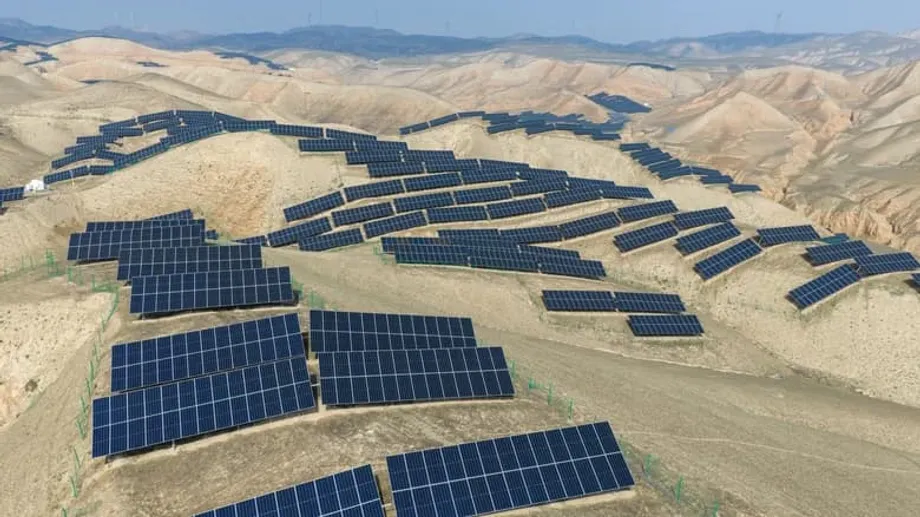
The change is taking place at the Gonghe Photovoltaic Park on the Tibetan Plateau. Deep blue panels stretch across a landscape described as covering 162 square miles when associated installations are included. Beneath the arrays, grass has become so thick that it sometimes obstructs the panels, creating both a benefit for herders and a maintenance problem for electricity producers.
Yehdor remembers a very different landscape in 1998. Natural grass had disappeared, leaving his cows and sheep hungry. He and his father hauled hay home from distant villages on a tricycle. On one journey, he injured his ankle while pulling the overloaded cart. By the end of the last century, desertification in the area had reached 98.5%.
Yehdor now travels through the park by motorcycle. The land that sent sandstorms outward about 30 years ago now supplies clean electricity and mutton sold under the name "photovoltaic sheep." The park is described as the world's largest solar installation on the Tibetan Plateau.
Yehdor, who grazes his animals beneath the arrays, described what the change has meant for his family:
Our family earns nearly 100,000 yuan a year from raising sheep. My flock has grown from 200 to over 300, and our sheep are healthy and strong. Life is much better.
A Power Base Nearly 10,000 Feet Above Sea Level
The Talatan Solar Park sits nearly 10,000 feet above sea level on the Qinghai Xizang Plateau. Thin air and intense solar radiation make the location suitable for photovoltaic generation, the process through which solar panels convert sunlight into electricity.
Construction began in 2012 as part of China's first solar power base in the class of 10 million kilowatts. By the end of 2024, official accounts put the park's area at more than 300 square kilometers, or 116 square miles. The figure of 162 square miles includes associated installations, giving a broader measure of its coverage.
The entire complex hosts 91 energy enterprises: 63 solar photovoltaic companies and 28 wind power operations. Their combined capacity connected to the grid is 17.73 million kilowatts. That total covers both solar and wind operations within the complex.
Power lines operating at high voltage carry electricity more than 1,000 miles to industrial centers, supporting China's expanding electric vehicle market and artificial intelligence data centers. The complex's scale dwarfs comparable facilities in the United States. Construction of new energy projects in the area created more than 3,000 jobs for local farmers and herders last year.
Talatan offered practical advantages for developers: extensive flat ground, few competing land uses and some of the strongest solar resources on Earth. Sunlight on the plateau is much brighter than at sea level because it passes through a thinner atmosphere. Yet the intense radiation and dry conditions that suit electricity generation had also restricted plant growth and contributed to severe desertification.
Research Measures the Ecological Change
Researchers from Xi'an University of Technology assessed the Gonghe site using 57 ecological indicators. Their findings, published in Scientific Reports in 2024, recorded measurable improvements in the desert environment beneath the installation.
The team used the DPSIR framework, which stands for Drivers, Pressures, State, Impact and Response. Developed by the European Environment Agency, it provides a way to organize an environmental assessment around what causes change, what pressures follow, the condition of the environment, the effects and the responses.
Areas directly beneath the panels received a general ecological health score of 0.4393. Transitional zones scored 0.2858, while untouched desert areas scored 0.2802. The comparison places the strongest improvement under the arrays, with the transitional and untouched areas much closer to each other.
Researchers monitoring the ecological changes described how the panels alter conditions at ground level:
The presence of solar panels modifies the energy balance at the surface. We are seeing higher biological activity under the arrays compared to the bare desert outside.
The findings describe a change extending beyond the return of visible grass. Cooler, wetter conditions beneath the installation support vegetation and biological activity in the soil, helping the desert floor become a working ecosystem alongside electricity generation and livestock grazing.
How Panels Help the Ground Hold Water
Solar panels intercept direct sunlight before it reaches the ground. Their shade lowers ground temperatures and slows evaporation, allowing moisture to remain in soil where it would otherwise disappear within hours.
Satellite remote sensing data indicate that wind speed within the photovoltaic park has fallen by 50%, while evaporation of soil moisture has dropped by 30%. A study published in Frontiers in Environmental Science in 2025 found that soil beneath fixed panels held approximately 75% more water than nearby exposed ground.
Panel cleaning supplies another source of moisture. Dust reduces the efficiency of solar panels, so operators wash them regularly. Water running off the panels seeps into the ground beneath the arrays. In the Talatan Desert, this small but steady supply, combined with slower evaporation, has helped grass grow more than one meter tall in some places.
Data from State Power Investment Corporation Limited and Xi'an University of Technology put vegetation coverage within the park at 80%. Shade also reduces the difference between daytime and nighttime temperatures, easing the temperature swings that can stress plants.
The physical structures interrupt winds that would otherwise strip away topsoil and young seedlings. Hardy plants and soil microbes can then establish themselves. More moisture supports plant growth, and the vegetation helps hold soil in place and reduce dust. Each improvement helps sustain the next.
Why Solar Operators Invited Sheep In
Grass returning beneath the panels initially created extra work for the companies operating them. Tall vegetation blocked sunlight and reduced electricity generation. During winter, dry grass also posed a fire risk.
Companies first hired workers to clear it manually, a costly process requiring considerable labor. In 2018, operators turned to local herders, allowing sheep to graze beneath the arrays at no cost. The animals gained pasture while keeping vegetation short enough for the panels to operate.
The arrangement is an example of agrivoltaics, which combines solar electricity generation with farming or livestock production on the same land. At Talatan, grazing provides natural vegetation control and removes the need for herbicides or mechanical clearing.
Technicians changed the infrastructure to make room for the animals. They widened the spacing between arrays from three to five meters and raised the mounting height from 50 centimeters to between 1.5 and 1.8 meters.
Sheep benefit from abundant grass nourished by the improved conditions and from shade during very hot summer days. Operators benefit from animals doing work that previously required paid clearing crews. The approach has become a model for combining grazing and solar generation worldwide.
A Livelihood Built Around Photovoltaic Sheep
The prefecture has established 32 photovoltaic ecological pastures and 56 centralized grazing sites within the solar park. They support 18 surrounding villages that raise more than 20,000 sheep annually.
The park produces an estimated 118,000 tonnes of grass each year, enough in theory to support 200,000 sheep. That estimate describes the potential feed supply, while the figure of more than 20,000 sheep describes the animals raised annually by the surrounding villages.
Herders have developed "photovoltaic sheep" into a branded product recognized for its quality and sold nationwide through online commerce platforms. Each animal has a digital identification card carried on a QR code ear tag, recording its age, vaccination history and ownership.
Sales of photovoltaic sheep brought herders a total income of 11 million yuan in 2023. Solar related businesses also generated 67 million yuan for 173 villages formerly affected by poverty that year. Those figures cover different activities and groups, showing that income from the solar economy extends beyond grazing alone.
Yehdor's larger flock and annual family earnings illustrate how those changes reach individual households. The combination of pasture, livestock sales and jobs from energy construction gives local farmers and herders several ways to earn income from land that previously struggled to sustain their animals.
Evidence From Other Chinese Deserts
The Gonghe findings need comparison with other locations to establish how widely the ecological benefits can occur. Similar changes have emerged at other desert solar installations in China, suggesting that the pattern extends beyond this one park.
In the Kubuqi Desert, 30 years of development have transformed an area that once exported sandstorms. The Junma Solar Power Station now produces electricity while supporting shrubs, bushes and wildlife, including foxes and hares.
A study published in the Journal of Environmental Management examined 12 major Chinese deserts using remote sensing data from 2010 to 2018. Across that period, the area occupied by photovoltaic power stations increased from zero to 102.56 square kilometers.
The area that became greener within those installations reached 30.80 square kilometers, equivalent to 30% of the total solar farm footprint. Researchers attributed the change primarily to government led Photovoltaic Desert Control Projects, together with favorable climatic conditions.
The comparison adds a broader perspective to the 80% vegetation coverage recorded at Talatan. The study across 12 deserts measured the share of solar farm land showing greening, while the Talatan figure describes vegetation coverage within that park. Both measurements help explain the changes observed, with their different measures and geographic scope kept explicit.
A California Test of the Same Water Saving Principle
California's Project Nexus is examining the use of solar panels over the Hickman Canal, east of San Francisco. The project is testing how covering water with panels might reduce evaporation, with a potential saving of 63 billion gallons under examination.
The setting differs from the desert pastures of Qinghai, but the physical process is the same: shade reduces water loss and moderates temperatures. At Talatan, those changes help moisture remain in soil and support vegetation. Over a canal, the focus is conserving water beneath the panels.
Project Nexus offers another application of the relationship between solar infrastructure and water in dry environments. Its water saving potential is being examined, while the Gonghe studies describe ecological changes already measured around an operating installation.
Design and Scale Shape the Benefits
Research points to ecological gains at individual solar sites, while also identifying reasons for careful expansion. Climate models indicate that extremely large installations could alter regional air circulation and affect precipitation zones far from the arrays.
Changes in albedo, meaning the amount of sunlight a surface reflects, and in the redistribution of heat could produce effects beyond a park's boundaries. The scale of an installation therefore matters alongside the conditions immediately beneath its panels.
Panel height, spacing between rows and orientation affect how much sunlight and moisture reach the ground. Configurations running east to west can distribute light more evenly than arrays facing south. The changes made to accommodate sheep at Talatan show how design decisions also influence whether electricity generation and grazing can share the same space.
Erosion control and water management help sustain the ecological gains. Without them, improvements may be fragile or temporary. Site selection is also critical, with projects needing to avoid sensitive habitats and migration corridors.
Most solar farms in these deserts have operated for less than 15 years. Scientists need decades of monitoring to determine whether vegetation gains last as installations age, how dust accumulation changes and whether the modified conditions produce unexpected effects on local biodiversity or soil chemistry.
As of March 17, 2026, the long term durability of those gains remains unsettled. Gonghe's measured ecological improvements and expanding grazing economy show what the approach has achieved so far; sustained observation will be needed to understand how the land changes over a much longer period.
The Bottom Line
- Construction at Talatan began in 2012. Official accounts put the park at more than 300 square kilometers by the end of 2024; the wider footprint including associated installations is described as 162 square miles.
- The complex hosts 63 solar companies and 28 wind operations, with a combined capacity connected to the grid of 17.73 million kilowatts.
- A 2024 ecological assessment scored areas beneath panels at 0.4393, compared with 0.2858 in transitional zones and 0.2802 in untouched desert.
- Vegetation coverage within the park has reached 80%. Wind speed has fallen by 50%, and evaporation of soil moisture has dropped by 30%.
- A 2025 study found approximately 75% more water in soil beneath fixed panels than in nearby exposed ground.
- Grazing sites support 18 surrounding villages raising more than 20,000 sheep annually. Photovoltaic sheep sales earned herders 11 million yuan in 2023.
- Research across 12 Chinese deserts recorded greening on 30.80 square kilometers, or 30% of the solar farm area examined.
- Careful design, suitable locations, water management and monitoring over decades remain necessary to sustain the benefits and track wider environmental changes.