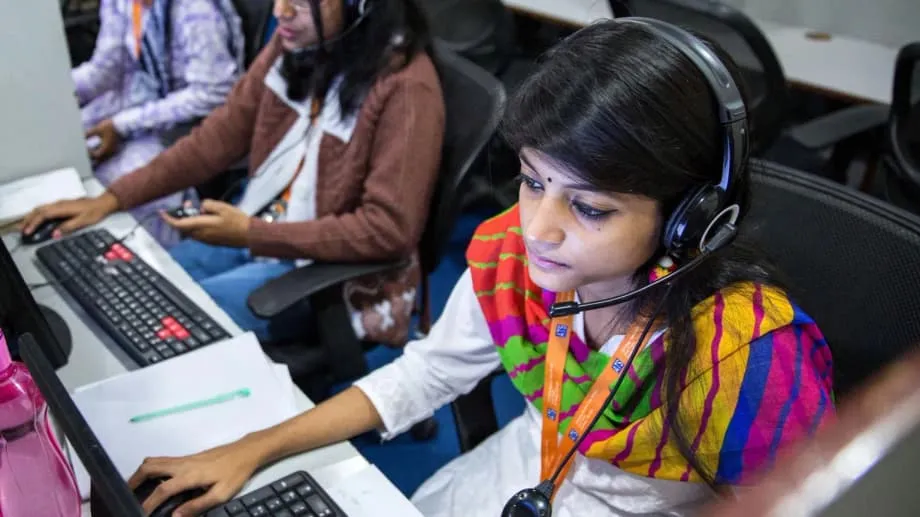
A Software Release Shakes an Economic Engine
India's Nifty IT index fell nearly 6% on February 4, 2026, as investors confronted a threat to the country's $300 billion outsourcing industry: software that could perform work previously assigned to large teams of people. Within a week, about $22.5 billion in market value had disappeared from Indian software exporters. By March 17, the index had fallen 20% this year.
Contents
- A Software Release Shakes an Economic Engine
- Predictions Range From Disappearance to Gradual Change
- Why Charging for Time Is Under Pressure
- Graduate Jobs and the Hiring Slowdown
- What India's Jobs Data Shows
- US Policy Adds Another Source of Pressure
- India Tries to Become an AI Infrastructure Hub
- The Contest to Own Products, Not Just Deliver Services
- A Familiar Choice Returns With Greater Stakes
- The Bottom Line
Anthropic, the artificial intelligence company backed by Amazon and Google, helped trigger the selloff with new capabilities for Claude Cowork, its agentic system. An agentic system can carry out a sequence of tasks, rather than simply answer a question. The new plugins were designed to automate contract reviews, regulatory compliance tracking, sales forecasting and data analysis.
Indian outsourcing companies have spent decades building businesses around precisely this kind of repetitive knowledge work. Their traditional model, often called "man-day billing," charges clients for employees' working time. Software that completes the same assignment with fewer people puts pressure on both staffing and fees.
An American bank using Claude Cowork internally to review contracts, for example, would have less reason to keep paying for a team of 50 people in Bengaluru to handle that work. The immediate concern for investors was how quickly such choices might spread across customers and services.
India's technology services industry contributes roughly 8% of gross domestic product and directly employs more than five million people. Over three and a half decades, it has helped create a middle class whose spending supports apartments, cars and restaurants in Bengaluru, Hyderabad and Gurugram. Its most serious challenge since emerging in the 1990s therefore reaches well beyond software companies and their shareholders.
Predictions Range From Disappearance to Gradual Change
Vinod Khosla, the venture capitalist, delivered one of the strongest warnings at the India AI Impact Summit in New Delhi in February 2026. He said India's IT services and business process outsourcing firms could "almost completely disappear" within five years, with the sector potentially "gone by 2030." He argued that many people in India still underestimate how rapidly AI could eliminate large portions of employment in office occupations.
JPMorgan Chase takes a different view. The investment bank describes Indian IT companies as the "plumbers of the tech world," connecting and maintaining the systems that businesses depend on. It considers it "simplistic to assume" that AI tools can match established providers' ability to customize software and integrate it with a customer's existing operations.
HSBC's research report, titled Software Will Eat AI, makes a related argument. It describes large AI systems as "inherently flawed" and unsuitable for a "lift and replacement" of major enterprise software platforms. Those platforms have developed over decades toward almost error-free operation. Producing code quickly and reliably replacing a company's central systems are different tasks.
Kris Gopalakrishnan, the Infosys co-founder, expects the transformation to take five to ten years. Speaking at an industry conference, he compared the moment with the move to cloud computing, which initially unsettled established business models before creating fresh demand. He cautioned against treating market volatility as a guide to the speed of business change.
It is definitely going to have an impact but the change will be slow and steady," he said. "What I am confident about is that the Indian IT industry will respond positively.
India's industry now faces both possibilities at once: customers may automate existing work while continuing to need outside help to connect, manage and adapt the technology.
Why Charging for Time Is Under Pressure
Tata Consultancy Services, Infosys and Wipro built their businesses around labor arbitrage: employing educated, English-speaking workers in places where salaries are 60% to 80% lower than in North America or Europe. They then provide services to global companies at competitive prices.
Billing by hours ties revenue to the amount of human work a project requires. It also creates a financial incentive to maintain large teams and extend project timelines. AI reverses that calculation when software makes a task much faster or removes the need for some of the work.
Jefferies expects client engagements to move "structurally towards advisory and implementation." That means more work helping companies choose and install technology, while routine maintenance becomes harder to charge for at existing rates. Application managed services, which account for 22% to 45% of current revenues, face what the firm calls "sharp revenue deflation."
Application managed services include running software, fixing bugs and handling updates. When automated systems perform more of those tasks, providers may collect less money even while delivering the same service. Jefferies' worst case projects revenue growth 3% lower over the next five years, followed by no growth beyond 2031.
Nasscom, India's software industry lobbying group, says companies have begun moving from billing for time and materials toward pricing based on outcomes. Instead of paying for hours worked, a customer pays for an agreed result.
Nuvama Institutional Equities expects that transition to hurt before it helps. Its analysts say "there will be no escaping the pain": revenue would fall initially, with benefits appearing only in the medium term. For providers, the challenge is to retain enough of the value created by automation as customers demand lower costs.
Graduate Jobs and the Hiring Slowdown
Some chief executives have warned that AI could eliminate 50% of entry level jobs in office occupations. Routine coding, testing, data processing and documentation are particularly exposed. Those assignments have also been the first step into the industry for generations of Indian engineering graduates.
India expects approximately 200 million young people to reach working age by 2030. A reduction in opportunities at major services employers would arrive as this large population seeks work, making the industry's employment decisions a national concern.
Net employee strength in the industry is expected to grow only 2.3% in 2026, a sharp slowdown from the rapid expansion of earlier decades. Companies are also trying to change the skills of their existing workforce. India's five largest IT firms had trained more than 250,000 employees in AI technologies by the middle of 2025.
Infosys predicts that generative AI could displace 92 million jobs, including developers who build the parts of applications that users see and software testers, while creating approximately 170 million positions such as data annotators, AI engineers and AI leads. Data annotators prepare and label information used by AI systems.
Workers losing familiar assignments will need access to training and a route into different roles. The new positions demand different qualifications, and the hiring opportunities are concentrated in particular companies and cities.
TCS has disclosed annualized AI services revenue of $1.8 billion. The revenue disclosure was described as representing roughly 5% of quarterly consolidated revenue. The company is already earning money from the technology that threatens parts of its established business, although the broader shift in employment and billing is still unfolding.
What India's Jobs Data Shows
International Monetary Fund economists examined postings on India's largest employment website to measure how AI adoption changes recruitment. Their findings show pressure on skilled intellectual work, including corporate managers and engineering professionals, rather than only routine manual tasks.
Businesses adopting AI recorded a 3.61 percentage point reduction in the growth of vacancies unrelated to AI over the medium term. Growth in total vacancies at those establishments fell by 3.57 percentage points. In other words, additional specialist AI jobs were outweighed by reduced recruitment for other work.
Three years after adoption, businesses posted approximately 1% fewer vacancies unrelated to AI than businesses that had not adopted it. This measures a difference in vacancy levels, while the figures in percentage points describe changes in growth.
Job descriptions also changed. The researchers found a net decline in verbs associated with forecasting, analysis and complex communication. Words describing intellectual activities, including "investigate," "predict," "forecast" and "describe," appeared less frequently as AI adoption increased.
Companies adopting more AI also lowered the distribution of wages they offered. The researchers interpreted that pattern as evidence that technology was substituting for labor, rather than employers merely struggling to find enough workers.
AI skills nevertheless command a premium. Roles requiring them offer salaries 13% to 17% higher and tend to require graduate degrees. Demand for these skills accelerated after 2016, particularly in IT, finance and professional services.
Bangalore, Mumbai and Hyderabad account for important concentrations of AI employment, as do the largest firms. The research also found local diffusion: when one business in an area adopted AI, neighboring businesses became more likely to follow. Access to the emerging opportunities is therefore uneven across both geography and employers.
US Policy Adds Another Source of Pressure
The United States, the largest market for Indian outsourcing companies, presents risks beyond automation. Senator Bernie Moreno's proposed Halting International Relocation of Employment Act, or HIRE Act, would impose a 25% tax on payments by American companies to foreign service providers. It would also remove tax deductions for offshore outsourcing expenses. The measure is a proposal.
The industry's financial exposure is substantial. Alongside the broader $300 billion description of the industry, the fiscal 2025 figure given for Indian IT and business process management revenue is $225 billion. More than 50% of that revenue came from American clients.
Individual companies show similar dependence on the wider region. Infosys earns 57.9% of its revenue from North America, while the Americas account for nearly half of Tech Mahindra's business. A change in American customers' willingness or ability to outsource would therefore affect major revenue streams.
New US visa fees are also expected to add $100 million to $250 million to operating expenses for India's leading IT companies, estimated at approximately 1% of their revenues by Moody's Analytics. Higher expenses would arrive while automation is already putting pressure on profit margins.
Rohit Jain of Singhania & Co described how these pressures could affect business decisions:
New contracts could dry up, margins will shrink, and firms will scramble to expand beyond the US.
Indian providers consequently face two demands at the same time: change what they sell as AI spreads, and reduce their dependence on a market where outsourcing policy could become less favorable.
India Tries to Become an AI Infrastructure Hub
Indian companies and the government are responding by seeking a larger role in AI infrastructure and deployment. During the February summit in New Delhi, major Indian IT firms announced collaboration agreements with American hyperscalers and AI companies, including OpenAI and Anthropic. Hyperscalers operate enormous cloud computing networks.
India has offered foreign firms zero taxes until 2047 when they use Indian data centers to provide cloud services to customers around the world. The incentive aims to attract the computing facilities needed to run AI and other digital services.
Reliance Industries outlined $109.8 billion for AI and data infrastructure. The Adani Group announced $100 billion for AI data centers by 2035. Google, Microsoft and Amazon have committed a combined $68 billion to AI and cloud infrastructure in India by 2030.
These commitments point toward a different source of revenue: supplying computing and hosting capacity rather than relying principally on teams of comparatively inexpensive workers. India already commands roughly 55% of the global IT outsourcing market, giving its companies a large base of customer relationships as they attempt the transition.
Gartner projects that AI agents will resolve 80% of customer queries by 2029. If that shift occurs, maintaining India's position will require more than charging customers according to the number of people assigned to a contract.
One analysis describes India as "trading one services model for another." Data centers could give the country a substantial role in operating AI, while leaving the ownership of the most valuable technology elsewhere.
The Contest to Own Products, Not Just Deliver Services
Analysts at a16z, the venture capital firm, identify a "fundamental business model mismatch" between building products designed around AI and running a traditional business process outsourcing company. Most BPO firms charge a markup of 20% to 30% on labor costs.
A successful AI product can reduce the labor a customer needs. For an outsourcing provider paid according to staffing costs, selling that product can shrink an existing source of income. The a16z argument is that becoming a business centered on AI products would compress margins, undermine dependable revenue streams and demand cultural changes that publicly listed companies rarely manage successfully.
Specialized AI agents are already turning core outsourcing tasks into products in auto lending, healthcare revenue cycle management and transportation logistics. Healthcare revenue cycle management covers the administrative work involved in collecting payment for care.
Decagon has built AI customer support agents showing resolution rates above 80% while improving customer satisfaction scores. Such applications can require complicated connections to other software platforms and detailed knowledge of regulation. Those requirements offer protection against more general AI tools.
Indian services companies therefore have an opening in the same customer knowledge and integration skills that investment banks cite in their defense. The commercial question is whether they can turn that expertise into products they own while managing the decline of work billed by the hour.
A Familiar Choice Returns With Greater Stakes
India's experience during the Y2K boom provides a comparison. The country captured work based on labor cost advantages without building the intellectual property layer above it. Intellectual property means technology or products that a business owns and can sell repeatedly.
No Indian company currently owns a global operating system, a hyperscaler cloud or a dominant enterprise software suite. The data center strategy follows a familiar approach: enter through execution, expand through cost and capacity, and leave the harder question of developing frontier AI models for later.
The developments leading to the present challenge span several years:
- After 2016, demand for AI skills accelerated in India's IT, finance and professional services sectors.
- By the middle of 2025, India's five largest IT companies had trained more than 250,000 employees in AI technologies.
- On February 4, 2026, the Nifty IT index fell nearly 6% as investors reacted to the threat from AI automation.
- During the February 2026 India AI Impact Summit in New Delhi, industry warnings coincided with partnerships and plans to expand AI infrastructure.
Companies now have to finance new capabilities while protecting revenue, retrain workers while recruitment slows, and pursue American customers while facing possible additional outsourcing costs. Each task affects the others: faster automation can help win a contract while reducing the hours available to bill.
Former Reserve Bank of India Governor Raghuram Rajan captured the desired outcome for the services industry in a short phrase:
disrupted, not derailed.
India's response combines training, partnerships, new pricing arrangements and large infrastructure commitments. The central challenge is to turn those efforts into revenue and employment as the work that sustained the outsourcing boom becomes increasingly automated.
The Bottom Line
- The Nifty IT index fell nearly 6% on February 4 and was down 20% this year by March 17, 2026. Indian software exporters lost about $22.5 billion in market value within a week.
- India's roughly $300 billion outsourcing industry contributes about 8% of GDP and directly employs more than five million people.
- AI threatens routine services and billing based on working time, while creating demand for implementation, integration and specialized products.
- IMF research found a 3.61 percentage point reduction in growth of vacancies unrelated to AI at businesses adopting the technology.
- The proposed US HIRE Act would tax offshore service payments at 25% and remove associated tax deductions.
- Indian firms are retraining employees and partnering with AI companies, while major groups commit billions to computing infrastructure.
- Forecasts range from severe disruption by 2030 to a transition lasting five to ten years.