350 Marchers Bring Their Demands to Ueno
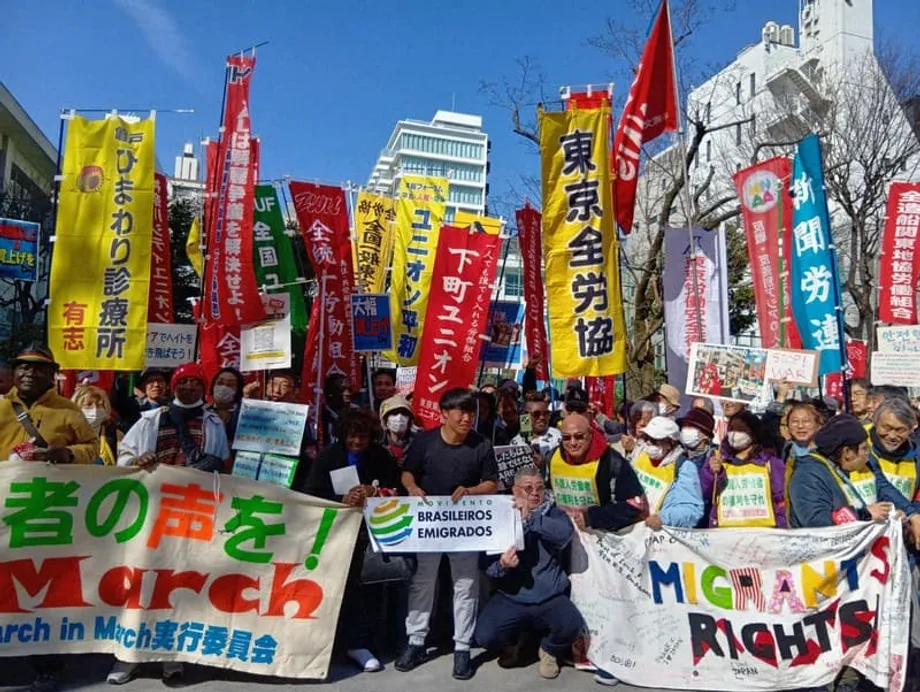
Some 350 demonstrators marched around Ueno Park in Tokyo's Taito Ward on March 15, 2026, calling for dignity, respect and legal protection for foreign workers. A samba group led the procession, combining the sound of drums with messages about the people who prepare meals, clean clothes and keep everyday services running in Japan's capital.
Contents
- 350 Marchers Bring Their Demands to Ueno
- A Union Leader Describes a Growing Sense of Crisis
- Why the July Election Matters to the Marchers
- A Labor Campaign With Roots in 1993
- Workers Make Their Contribution Visible
- March 11 Protest Focuses on Military Policy
- Women's March Calls for Solidarity
- Iran Rallies Show Different Views Within Tokyo
- The Dates Behind a Busy Month of Protest
- Organizers Seek Support Beyond the Annual March
- The Essentials
The March in March 2026 protest drew more participants than the previous year's gathering. Its organizers described an increasingly hostile social climate, with foreign union members reporting discrimination at work and uncomfortable encounters during their journeys on public transport. They identified rhetoric surrounding the July 2025 House of Councillors election as a turning point.
The route passed near Ueno Station, where commuters paused to watch the colorful procession. Placards made the marchers' connection to daily life direct: "I am making your convenience store's bento," read one. Another said, "I'm the one ironing clothes at the dry cleaners." Bento refers to a prepared boxed meal.
The messages highlighted a central concern of the demonstration: workers who help sustain life in the world's largest metropolitan area can remain politically marginalized and socially vulnerable. Organizers presented the march as both a demand for protection and a declaration that foreign residents belong in the communities where they live and work.
The gathering continued a labor campaign that began in 1993. This year's event also came during an unusually active month of demonstrations in Tokyo, with residents taking to the streets over constitutional pacifism, gender equality and international conflict. Although the foreign workers' march brought hundreds rather than thousands onto the streets, participants and observers saw it as an important expression of migrant workers' experiences during a period of political tension and social division.
A Union Leader Describes a Growing Sense of Crisis
Yumiko Nakajima, chair of the National Union of General Workers Tokyo Nambu, has spent 30 years working on issues affecting laborers from overseas. She said her organization began receiving more reports of discriminatory incidents after the July 2025 upper house election.
Nakajima described complaints about hostile encounters while commuting and discriminatory treatment in workplaces that had previously welcomed foreign workers' contributions. For her, the change involved more than individual unpleasant experiences. She saw a worsening pattern affecting how members felt about their place in Japanese society.
Nakajima explained the concern in these words:
I have worked on issues surrounding foreign workers for 30 years, but I feel a growing sense of crisis over the spread of hate. Union members tell us about sensing cold stares on the train and being treated in a discriminatory way at work. These are not isolated incidents but part of a pattern.
The union's account connected public rhetoric with experiences in ordinary settings, from train carriages to workplaces. Organizers said tensions that had previously been manageable were becoming a crisis of social cohesion, meaning the ability of people from different backgrounds to live together with trust and mutual respect.
Why the July Election Matters to the Marchers
The July 2025 House of Councillors election took place amid intense debate about Japan's dependence on foreign workers to address severe labor shortages. Elder care and construction were among the sectors involved. Candidates and media commentators used rhetoric targeting residents who are not Japanese, according to Nakajima's account of the changing public atmosphere.
The House of Councillors is the upper house of Japan's National Diet, the country's parliament. It has substantial influence over legislation affecting immigration and labor policy. Debate during its election therefore mattered to workers whose residence and employment depend on those rules.
Civil society groups described campaign discussions as moving away from integration and protection of rights toward national identity and security. They said this created a more permissive environment for xenophobic expression. Xenophobia means hostility toward people perceived as foreign.
Foreign residents who have lived in Japan for years, pay taxes and contribute to social insurance programs were among those left feeling suddenly unwelcome. Their concern was especially sharp because visible activism can carry risks for people navigating uncertain visa status. The march nevertheless attracted greater participation than in 2025; no attendance figure for that earlier event was given.
The organizers' argument linked two parts of the same situation: Japan relies increasingly on workers from overseas, while some of those workers describe a declining sense of acceptance. The demonstration sought to bring that tension into public view through accounts of work, contribution and discrimination.
A Labor Campaign With Roots in 1993
Labor unions and citizens' groups launched the first March in March in 1993 under the name "foreign workers' spring labor offensive." Its timing connected the gathering with shunto, Japan's traditional spring wage negotiations.
That connection placed foreign workers' demands within the wider labor movement. The organizers were presenting them as workers entitled to rights, rather than treating them as a separate category of temporary help. Over more than three decades, the annual event developed from a gathering centered on unions into a broader social movement seeking what organizers call "mutual coexistence."
Union members remained the organizational backbone of the 2026 march. Anti-discrimination networks, immigration lawyers and community organizers also joined the coalition, bringing attention to the different vulnerabilities faced by foreign workers.
Those groups included technical intern trainees under a program frequently criticized for enabling labor exploitation. They also included specified skilled workers, admitted through visa categories introduced in 2019 to respond to demographic decline. Different categories can mean different residence requirements, but the march brought their concerns together around dignity and protection at work.
Workers Make Their Contribution Visible
The declaration "We are here!" captured the demonstration's effort to move beyond responding to discrimination and toward an affirmative claim of belonging. Its placards put familiar services at the center of that claim, making visible work usually done behind counters or in back rooms.
One male participant declined to give his name because he feared retaliation in his professional life. He described the basis of the marchers' demands in terms of work, taxes and participation in society:
We work in this country, pay taxes and contribute to society," he stated. "Migration is not a crime, and living isn't a crime either.
His remarks reflected the precarious position of residents who must navigate complex visa requirements while doing essential jobs that Japanese workers increasingly refuse. The fear of professional retaliation also showed why joining a public demonstration could be a difficult decision even for someone seeking basic respect.
Organizers used the examples of convenience store meals and dry cleaning to counter portrayals of immigrants as threats or burdens. These were services Japanese consumers could recognize immediately, connecting the march's demands to their own routines.
The samba group brought festive energy to that serious message. Alongside the signs about work, its presence expressed the cultural contributions that diverse communities bring to urban life.
March 11 Protest Focuses on Military Policy
Four days before the foreign workers' march, a much larger demonstration gathered outside the National Diet Building against the military policies of Prime Minister Sanae Takaichi's government. Opposition parties and peace groups organized the March 11 protest.
The gathering was described as drawing nearly 10,000 people. The attendance breakdown put approximately 8,000 at the demonstration in person and another 1,000 participating online.
Protesters focused on the recent deployment of launchers for missiles with a long range in Kumamoto Prefecture and proposed revisions to constitutional restrictions on exports of lethal arms. They carried signs reading "No to war!" and "Stop trampling on the Constitution!"
The crowd collectively read aloud Article 9 of Japan's Constitution, which renounces war and the maintenance of military force. The public reading outside parliament made constitutional pacifism the central image of a demonstration opposing the government's military expansion agenda.
Taku Yamazoe, policy chief of the Japanese Communist Party, addressed the gathering. He described Japan's alignment with United States hegemonic policies in the region as dangerous, referring to policies intended to maintain a dominant position. Yamazoe called for diplomacy based on dialogue:
"If the spirit of the Constitution were truly upheld, Japan should not pursue diplomacy based on preparations for war, but instead promote diplomacy aimed at resolving issues through dialogue," Yamazoe stated.
The scale of the event suggested renewed activity among Japan's pacifist civil society after years of relative quiet over constitutional revision. Observers also noted substantially more young participants than at previous rallies opposing military expansion, suggesting concern among younger people about Japan's military direction and constitutional identity.
Women's March Calls for Solidarity
Approximately 800 people took part in Women's March Tokyo on March 8, International Women's Day. The procession moved through Shibuya Ward around the famous scramble crossing, with placards opposing sexual violence and discrimination based on gender.
The event was the ninth iteration of a march that began in 2017. Its organizers addressed what they called "engineered divisions surrounding race and gender" in the current political climate.
A representative of the organizing committee said "solidarity, not exclusion, is necessary" to achieve meaningful gender equality. The committee's message explicitly connected misogynistic political rhetoric with xenophobic nationalist discourse, describing both as tools of social division.
The connection mattered to the wider pattern of March demonstrations. The women's march and the foreign workers' protest had different immediate demands, but both challenged exclusion and called for people facing discrimination to support one another. The concentration of activism gave groups with long suppressed grievances a public setting in which to speak.
Iran Rallies Show Different Views Within Tokyo
Iranian residents gathered outside their country's embassy in Tokyo's Minato Ward on March 2. Those demonstrators welcomed recent military strikes against Iran as possible catalysts for fundamental political change.
Participants waved flags associated with the monarchy that ruled Iran before the 1979 revolution and chanted slogans demanding freedom from clerical rule. Their rally took place shortly after reports circulated about the death of Supreme Leader Ali Khamenei.
The embassy protest reflected the complicated position of diaspora communities, people living outside their country of origin, whose political concerns can span both their homeland and their place of residence.
Other activists gathered at Shinjuku Station on the same day to oppose those military actions. They carried signs reading "Hands off Iran" and warned that a wider escalation in the Middle East could draw Japan into conflict.
Tokyo therefore hosted sharply different responses to the same international events. The embassy demonstrators sought political change in Iran, while the Shinjuku protesters focused on opposing military action and preventing a broader war.
The Dates Behind a Busy Month of Protest
The demonstrations unfolded over two weeks, with the foreign workers' march following rallies about Iran, gender equality and Japan's military policy. The sequence helps show how several distinct campaigns became visible in the capital during the same period.
- 1993: Unions and citizens' groups began the foreign workers' spring labor offensive, the origin of March in March.
- 2017: Women's March Tokyo began.
- 2019: Japan introduced specified skilled worker visa categories to address demographic decline.
- July 2025: The House of Councillors election marked the turning point after which Nakajima said her union received more reports of discrimination.
- March 2, 2026: Iranian residents rallied outside Iran's embassy, while other activists opposed military strikes at Shinjuku Station.
- March 8, 2026: Approximately 800 people joined Women's March Tokyo in Shibuya.
- March 11, 2026: Protesters gathered outside the National Diet Building against the Takaichi government's military policies.
- March 15, 2026: Some 350 people joined March in March around Ueno Park.
The groups did not all share the same demands. Together, their demonstrations brought questions of national identity, security policy and social inclusion into public spaces across Tokyo.
Organizers Seek Support Beyond the Annual March
The March in March organizing committee plans to expand its message through the nationwide "No to hate!" campaign. Its goal is to turn the energy of the annual demonstration into continuing advocacy for a multiethnic and multicultural society that protects residents regardless of nationality.
Organizers hope to establish regional chapters able to respond quickly to discriminatory incidents. They also want to build the political strength needed to influence immigration and labor policy debates.
The campaign faces the task of maintaining cooperation among people with different national origins and visa categories, from temporary trainees to permanent residents with deep roots in local communities. Those differences affect individual circumstances, even when participants share demands for dignity and fair treatment.
Hostile rhetoric during the 2025 election cycle has generated harm, according to organizers, while also activating solidarity networks that had been dormant. The larger turnout in 2026 indicated that awareness was spreading beyond the immigrant communities directly affected.
The march's central message joined economic contribution with social belonging. Foreign workers wanted recognition for the services they provide, protection against discrimination and a place in decisions affecting their lives. The planned campaign would carry those demands beyond Ueno and the annual spring gathering.
The Essentials
- Some 350 people joined March in March 2026 around Ueno Park on March 15, more than attended the previous year's event.
- Union chair Yumiko Nakajima linked growing reports of discrimination to the period after the July 2025 House of Councillors election.
- The annual march began in 1993 as the foreign workers' spring labor offensive, connected to Japan's spring wage negotiations.
- Participants highlighted their work preparing convenience store meals, cleaning clothes and supporting everyday services.
- Other March demonstrations addressed military policy, gender discrimination and conflicting responses to military strikes against Iran.
- Organizers plan to extend advocacy through the nationwide "No to hate!" campaign and hope to establish regional chapters.