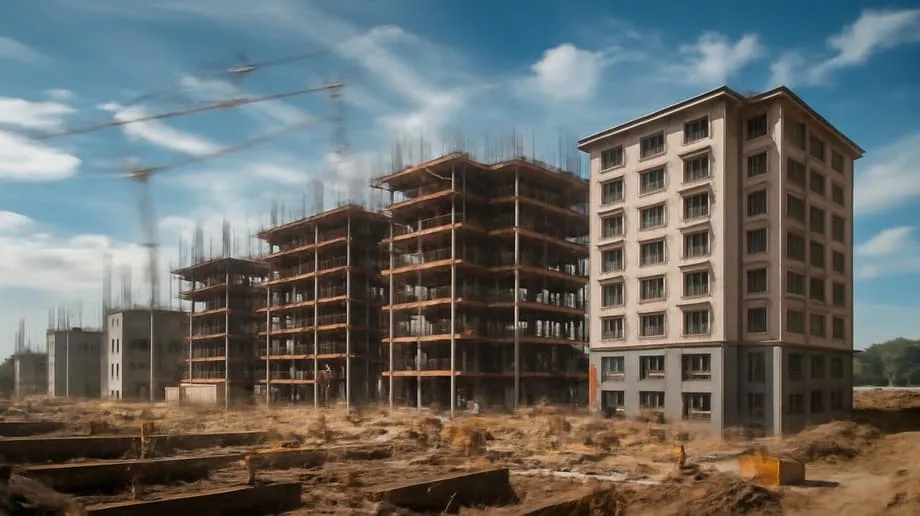
Ten Stories in 28 Hours and 45 Minutes
Broad Group assembled a 10-story hotel in Changsha, the capital of central China's Hunan province, in just 28 hours and 45 minutes. The operation brought together 3,000 workers, towering cranes and stainless steel building modules made in a factory before reaching the construction site.
Contents
- Ten Stories in 28 Hours and 45 Minutes
- What Arrives From the Factory?
- A Decade of Faster Building
- Five Days for Housing in Xiangyin
- The Workers Behind the Clock
- What Does a Holon Building Feel Like?
- The Changsha Collapse and Its Consequences
- Less Waste and Lower Cooling Costs
- Housing, Disaster Response and Overseas Trials
- The Essentials
Work was under way before dawn. As the sun rose, residents could see the structure taking shape at a pace far beyond a conventional building schedule. A timelapse video of the operation spread around the world, showing large modules being lifted, positioned and secured like giant building blocks.
The Chinese company, also known as Broad Sustainable Building, calls the structure a "Living Building." Its modules arrived with electrical systems, interior finishes, windows and even furniture already installed. Workers fastened them with industrial bolts, connected utilities and unfolded balconies that had travelled flat against the module walls.
Broad Group says the resulting building can withstand major earthquakes, last for 1,000 years and be taken apart for relocation. Those claims extend the company's pitch beyond a short construction schedule: it presents its system as a way to build durable structures that can move when needs change.
The 28-hour-and-45-minute achievement describes assembly at the site. Factory production, transport and foundation work are also part of the process. Understanding where that work happens explains how a building can rise so quickly without every component being made during the hours shown in the video.
China's investment in prefabricated building technology has helped companies develop this approach. It shifts much of construction into factories and allows several jobs to proceed at once, with potential uses in urban housing, disaster response and efforts to reduce the environmental costs of building.
What Arrives From the Factory?
Broad Group's standard modules measure 12.19 meters long, 2.44 meters wide and three meters high. Their dimensions are roughly those of a shipping container, but the units are engineered for permanent habitation using high-grade stainless steel.
Prefabrication means making building components away from the final site. In conventional construction, raw materials arrive at an open lot, where workers cut, mix and assemble them. Broad Group moves much of that activity into a controlled factory environment, producing standardized units that are substantially finished before delivery.
The company's system centers on what it calls "B-core slabs." Each slab consists of two stainless steel plates separated by hundreds of stainless steel tubes. Broad Group says these slabs are 10 times lighter and 100 times stronger than conventional concrete floor plates.
Lighter components are easier to transport and lift. The company says its slab design also maintains structural integrity beyond that of traditional construction methods. Its speed comes from combining these components with a production schedule in which factory manufacturing, transport and foundation work can happen simultaneously.
At the site, trucks deliver modules in a planned sequence that limits clutter and the need for storage. Cranes lift each unit into position, and specialist teams tighten bolts and connect water and electricity lines.
One wall of each module folds down to become a floor plate. This creates an interior space measuring 12 meters by 4.8 meters without columns breaking up the room. Windows and balconies unfold to complete the outer enclosure as the structure rises.
The assembly resembles a carefully timed production line. A delivered module must be ready when a crane and installation crew need it, while completed connections allow the next stage to proceed. Factory preparation and site coordination are both central to the short schedule.
A Decade of Faster Building
Broad Group has spent more than a decade refining rapid construction methods. Its Changsha hotel follows earlier projects that used increasingly ambitious schedules, as well as a much larger proposal that stalled.
The 15-story Ark Hotel in Changsha was completed in less than six days during the early 2010s. A team of 200 workers erected its structural framework in 46.5 hours, followed by another 90 hours for external cladding and interior finishing.
Those two stages totalled 136.5 hours, or five days and 16.5 hours. The figures show that the frame was only part of the operation: enclosing and finishing the building took almost twice as long as erecting its structure.
The Ark Hotel used one-sixth of the material needed for a conventionally built equivalent. Claims associated with the project included resistance to earthquakes of magnitude 9.0 and energy efficiency five times greater than comparable structures, supported by triple-pane windows, thermal insulation and LED lighting.
Broad Group's subsequent projects and proposals followed this sequence:
- In 2012, the company unveiled plans for a skyscraper with 220 stories, intended to become the world's tallest building, with construction planned for seven months.
- In 2021, it erected an 11-story apartment building in Changsha using the same 28-hour timeframe, demonstrating another use of its rapid assembly methods.
- In January 2024, Broad Group Holon constructed a 26-story apartment building in Xiangyin County, Hunan province, in five days.
The proposed skyscraper stalled shortly after groundbreaking amid safety concerns and a lack of government approval. Its foundations were later repurposed as a fish farm. That outcome shows how approval and safety requirements can determine whether an ambitious construction schedule becomes a completed building.
Five Days for Housing in Xiangyin
The January 2024 project in Xiangyin County applied Broad Group Holon's approach to a specific housing program. The apartment building contains 14,000 square meters of space across 26 stories and accommodates talent recruited through a special government initiative.
Residents receive two years of accommodation without paying rent. The project therefore connects rapid construction with a local effort to attract people, rather than using building speed solely as a demonstration.
Broad Group says this building should last more than 1,000 years and can be dismantled and rebuilt elsewhere if necessary. Relocation, in this system, means taking the building apart into components and assembling them again at another location.
The Xiangyin project also broadens the range of completed examples. Broad Group's record includes hotels and apartments, from the 15-story Ark Hotel to the 11-story Changsha apartment building and the taller residential project completed in five days.
The Workers Behind the Clock
The 3,000 workers involved in the Changsha hotel were as important to its speed as the modules themselves. They worked in coordinated shifts, with tasks requiring precision engineering skills, problem-solving and the ability to perform efficiently under intense time pressure.
Broad Group describes installation as extremely simple: workers tighten bolts and connect utilities. Carrying out those steps across an entire building still requires careful alignment, clear timing and close attention to what other crews and machines are doing.
A timing error can delay the next delivery, lift or connection. An alignment error can affect the fit between modules. Workers must maintain awareness of the surrounding operation while completing repetitive tasks with millimeter precision.
The physical conditions add to the demands. Crews work around heavy machinery and steel modules, sometimes at height, while facing a tight schedule and public scrutiny. Maintaining concentration is essential to preventing accidents and protecting construction quality.
Robust safety procedures, fatigue monitoring and rotation systems are important parts of managing such work. The short assembly period compresses activity into a narrow window, placing a premium on organizing shifts so that workers can remain alert.
The hotel demonstrates how factory preparation can reduce the amount of work left for the site. It also shows how much responsibility remains with the people handling the final assembly, checking connections and coordinating each step.
What Does a Holon Building Feel Like?
Tony Frost, a modular building expert from New Zealand, spent a week in one of Broad Group's Holon buildings in Changsha. His account addressed the experience of staying inside a completed structure, including its sturdiness and technology.
Frost described the building this way:
very strong, clean and contains lots of high technology, including a world-class water filtration system.
Frost said the building felt sturdy, comparing it with concrete construction. He also suggested minor improvements to the textures used in the interior design to improve the experience for residents.
His observations bring attention to a different part of the company's proposition. A construction schedule measures how quickly a structure rises; residents experience the finished rooms, surfaces and building systems over time. Frost's comments covered both the substantial feel of the structure and details of its interior.
The Changsha Collapse and Its Consequences
Changsha was also the site of a deadly building collapse in April 2022. An eight-story structure built by its owner fell on Back Street One, near Changsha Medical University, killing 53 people and injuring others.
The building housed restaurants, a hotel and a cinema. Two additional floors had been added illegally, without proper permits or structural assessments. The disaster involved a different form of construction from Broad Group's factory-made modules, but it placed building oversight in the same city under intense scrutiny.
Investigators found widespread failures. Owner Wu Zhiyong had constructed the additions without qualifications or a proper engineering review. Xiangda Inspection Co. Ltd., a local inspection company, supplied falsified safety documents that rated the structure as "basically sound" just weeks before it collapsed.
In October of the following year, Chinese courts sentenced 15 people for their roles in the disaster. Wu received an 11-year prison sentence. A former municipal water company official received a 12-year sentence for dereliction of duty and bribery.
Tenants had also modified the building. An elevator added later was believed to have affected its structural integrity. The collapse occurred when the vertical weight exceeded the structure's designed load capacity, causing the masonry to bulge and the walls to fail.
Load capacity is the amount of weight a structure is designed to carry. Adding floors increases the weight supported by the building below, while alterations can change how that weight travels through walls and other supports. In the Changsha disaster, unauthorized additions and inadequate oversight had fatal consequences.
President Xi Jinping called for nationwide safety inspections of buildings constructed by their owners following the collapse. The inspection effort focused on structures near schools and hospitals with three or more floors.
Factory production offers opportunities for consistent quality control, while informal buildings constructed by rural residents often lack proper engineering oversight. Both the construction process and the enforcement of safety rules matter. Rapid assembly still requires sound engineering, reliable inspections and regulatory approval.
Less Waste and Lower Cooling Costs
Modular construction's environmental promise extends beyond shorter activity at the site. The method can produce up to 90 percent less construction waste than traditional building, while Broad Group promotes substantial reductions in the energy needed to keep its buildings comfortable.
The company says its units can reduce air conditioning costs by as much as 90 percent. It attributes that performance to quadruple-pane windows, thermal insulation and heat recovery ventilation systems.
Windows with several panes and insulation slow the movement of heat between inside and outside. Heat recovery ventilation exchanges air while recovering some of the energy that would otherwise leave the building. These features reduce the work needed to maintain an indoor temperature.
The newer units' quadruple-pane windows differ from the triple-pane windows described for the Ark Hotel. That earlier project combined its windows with insulation and LED lighting in a design claimed to be five times more energy efficient than comparable structures.
Broad Group's material and energy claims address different stages of a building's life. Using less material and producing less waste concern construction, while lower air conditioning costs concern everyday operation. The company presents both as benefits of its prefabricated system.
The ability to dismantle and relocate buildings is another part of that proposal. Broad Group says its structures can be rebuilt elsewhere when needs change, alongside its claims of exceptionally long service lives.
Housing, Disaster Response and Overseas Trials
Earthquakes, floods and conflicts can create an urgent need for shelter. Transportable modules offer a way to assemble temporary or permanent housing in devastated areas within days, potentially saving lives when accommodation is needed quickly.
Urban housing shortages present another possible use. Prefabrication could accelerate affordable housing production compared with conventional projects that take years, helping cities respond to homelessness and population displacement as they grow.
The practical promise rests on shifting work into factories and organizing delivery and assembly efficiently. The Changsha and Xiangyin projects show how quickly prepared components can become multistory buildings once those stages are coordinated.
Interest in Chinese modular techniques has extended overseas. Trials in the United Kingdom and the United States have demonstrated potential, and one London tower was completed 30 percent faster using modules.
Moving China's factory production approach into other countries involves different building codes, approval systems and supply chains. Developers need components that meet local requirements, along with transport and installation arrangements suited to each project.
The initial cost of establishing factories can deter smaller developers. Building departments in many countries also lack frameworks for approving high-rise buildings made from prefabricated modules. These factors can limit adoption even when assembly is fast.
Broad Group suggests its system could scale to skyscrapers with 200 stories. Its ambitions include luxury residences, public buildings and housing at high density. The completed projects demonstrate rapid assembly at smaller heights, while the stalled proposal for a tower with 220 stories shows the role of approvals in determining what gets built.
Urbanization and climate change give the company's approach a wider audience. Faster housing delivery, reduced waste and lower energy use are central to its pitch. The Changsha hotel brings those ideas into a striking construction sequence, with engineering quality, worker protection and regulatory enforcement remaining essential throughout.
The Essentials
- Broad Group assembled a 10-story hotel in Changsha in 28 hours and 45 minutes with 3,000 workers and modules prepared in a factory.
- The stainless steel units arrived with electrical systems, finishes, windows and furniture, leaving crews to secure modules and connect utilities.
- The company says its B-core slabs are 10 times lighter and 100 times stronger than conventional concrete floor plates.
- Earlier projects include the 15-story Ark Hotel, an 11-story apartment building completed in 2021 and a 26-story building assembled in five days in January 2024.
- Broad Group claims earthquake resistance, service lives of 1,000 years or more and the ability to dismantle and relocate its buildings.
- An unrelated Changsha building collapse in April 2022 killed 53 people and exposed illegal additions, falsified inspections and failures in oversight.
- Modular construction offers potential reductions in waste and faster housing delivery, while factory costs, building approvals and local supply chains affect wider adoption.