Ten Years of Soju Research Reach English Readers
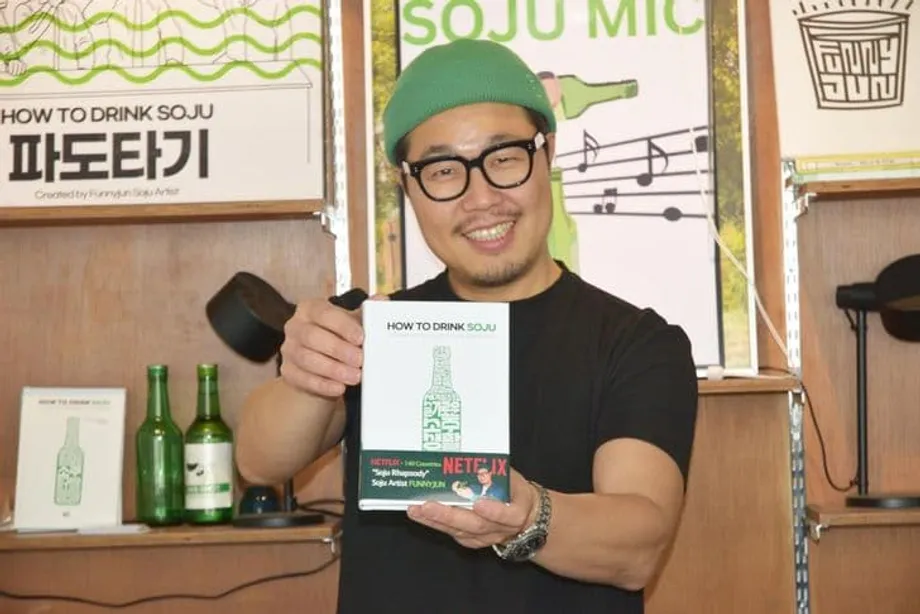
Kim Wan-jun, the 52-year-old artist known as Funnyjun, has released an English edition of How to Drink Soju: A Guide to K-Drinking Culture & Games, turning more than a decade of observation into a 300-page introduction to Korean social customs. Its first English print run comprises 1,000 copies, available through Korean bookstores and directly from the author.
Contents
- Ten Years of Soju Research Reach English Readers
- From Journalism and Public Relations to Bottle Art
- What Happens Between Taking a Seat and Setting Down a Glass?
- A Shared Drink and a Map of Relationships
- Soju on Screens, in Songs and in Drinking Games
- Exhibitions Carry the Green Bottle Abroad
- A Netflix Appearance Changes the Artist's Reach
- Why Foreign Readers Ask Different Questions
- March Events and the Project's Timeline
- More Languages and Further Exhibitions Planned
- The Essentials
The book contains more than 200 hand-drawn illustrations. Kim wrote the text, created the artwork, designed the layout and handled the digital editing himself. The Korean edition sold out rapidly after its publication in 2021. Broader distribution through Amazon is planned in the coming months, although no exact date has been given.
At the centre of the project is a familiar object: the green soju bottle seen on Korean dining tables. Kim, a former public relations executive who also makes art from recycled materials, treats the gestures surrounding that bottle as a way to explain relationships, respect and consideration.
Kim described why he began documenting a drink that was everywhere around him but, in his experience, rarely explained in book form.
Soju is the most popular alcohol in Korea and one of the best-selling liquors in the world," he said. "You can see it everywhere, at every restaurant, every pub, but surprisingly, there were no books about it.
His research began around 2014, when frequent soju drinking prompted questions about the customs surrounding it. Seven years of documentation led to the original Korean publication. The English edition now brings that work to readers who may recognise soju from Korean films, television and music without understanding what happens when people share it at a table.
From Journalism and Public Relations to Bottle Art
Kim's career helps explain the combination of writing, illustration and cultural communication in the book. He graduated from Sungkyunkwan University in Seoul and earned a master's degree in journalism and mass communication at the same institution.
Between 1997 and 2003, he worked as an editor for a Dong-A Ilbo fashion magazine and as a television producer in MBC's entertainment department. He later continued his journalism career at the information technology magazine Webcasting.
From 2004 to 2014, Kim managed public relations at Sungkyunkwan University and Korea National Open University. He then served as executive director of public relations at marketing company Hahm Partners from 2015 to 2023.
During that professional period, he wrote The Laws of University Public Relations and delivered lectures focused on public institutions. He now runs Proudcomm, a public relations company in Seoul, using his corporate work to finance his artistic projects.
Funnyjun's soju project brings those different skills together. The book explains social behaviour through words and pictures, while his exhibitions turn the same subject into something visitors can inspect, discuss and photograph.
What Happens Between Taking a Seat and Setting Down a Glass?
Funnyjun divides a shared soju session into ten steps: taking a seat, grabbing the bottle, opening it, offering a drink, pouring, holding a glass, receiving a drink, clinking glasses, drinking and setting the glass down. Each action becomes a small lesson in how people acknowledge one another.
Using two hands when pouring or receiving a drink signals respect, particularly toward an older companion. During a toast, younger drinkers position the rims of their glasses below those of senior companions. The arrangement makes age and social standing visible at the table.
The book also describes covering the bottle's label with a hand while pouring. Kim explains this as a way to keep the receiver's attention away from the brand or quality of the drink, allowing conversation to proceed without being shaped by price or prestige.
Kim, speaking as the author and artist behind the guide, describes the purpose of these gestures as shared enjoyment grounded in consideration.
process of joyful consideration practiced through mutual respect, so that everyone can enjoy the final glass together.
The ten steps connect drinking etiquette with broader Korean table manners and everyday social behaviour. In Kim's explanation, the way someone offers, receives or finishes a drink provides a compact view of how that person relates to others.
A Shared Drink and a Map of Relationships
Kim presents soju as a kind of social polygraph, a drink through which a person's character becomes visible. A polygraph is associated with detecting truth; here, his comparison concerns the behaviour people reveal while drinking together.
Soju is a clear, affordable distilled spirit, often identified simply by its green bottle. Kim argues that its accessibility helps remove social barriers: it costs less than most alternatives and, in his view, attracts little prejudice about who should drink it.
The same table can therefore show two aspects of Korean social life at once. The shared, inexpensive drink creates common ground, while the position of glasses and the use of two hands acknowledge differences in age and standing. Friendship and respect appear in the same sequence of gestures.
Kim also sees soju as a natural companion to Korean food. He describes it as pairing widely with Korean cuisine and contributing umami to savoury and spicy dishes in ways that wine or whisky cannot replicate. Umami refers to a savoury taste.
For Kim, these rituals reach beyond a meal. He describes shared drinking as a way of building friendships, business relationships and even diplomatic connections. His guide uses the drinking table to explain a social philosophy in which enjoying something together also requires attention to everyone else.
Soju on Screens, in Songs and in Drinking Games
Korean entertainment has given international audiences repeated glimpses of the green bottle. Soju appears prominently in Parasite, whose soundtrack features A Glass of Soju by Im Chang-jung. In Squid Game, protagonist Gi-hun uses the drink in a moment of emotional vulnerability.
More than 70 Korean songs have soju in their titles, and more than 2,000 mention it in their lyrics. Those figures show how often the drink appears in cultural expression, beyond its place at restaurants and pubs.
APT., the hit by Rose and Bruno Mars, has renewed international attention to Korean drinking games often played with soju. Funnyjun includes games alongside manners, showing both the playful and socially ordered sides of a drinking gathering.
His exhibitions feature poster mosaics illustrating the ten etiquette steps and games including APT. and Wi-Fi. In Wi-Fi, participants make toasting gestures at different distances to imitate changes in signal strength. The pictures give visitors a way to follow the action even when the underlying custom is unfamiliar.
Exhibitions Carry the Green Bottle Abroad
Since 2021, Funnyjun has staged more than 20 exhibitions across Korea, Japan, Europe and Southeast Asia. His first exhibition outside Korea took place in Bangkok, Thailand, in 2022. Shows in Vientiane, Laos, and Hanoi, Vietnam, followed in 2023.
In Hanoi, he became the first foreign artist to hold a solo exhibition at Complex01. The venue occupies 4,000 square metres in a renovated factory dating from the 1960s in the Dong Da district.
Phuc Tran, the chief executive of Complex01, explained why the venue welcomed Funnyjun's work and how it fitted a cultural space built around connecting different periods and experiences.
Complex01 is a cultural space regenerated from an abandoned factory with the slogan 'Time Connect'," he said. "Through this work by Funnyjun about K-culture, I thought it represented another connection through time and space and decided to permit this exhibition.
The large poster mosaics serve as cultural explanations and places for visitors to take photographs. Their subject is ordinary behaviour, but for audiences encountering Korean drinking customs for the first time, the gestures become something to study.
Anton and Elisa, Swedish tourists combining work with a holiday while visiting the Hanoi exhibition, described how Korean television had increased interest in the country and why an English book appealed to them.
Interest in Korea has increased tremendously in Sweden due to 'Squid Game'," they said. "The pictures and contents are really interesting and we would buy a book right away if a book came out in English.
Their response illustrates the audience the English edition seeks to reach: people drawn to Korea through entertainment who want a clearer understanding of the everyday behaviour they see on screen.
A Netflix Appearance Changes the Artist's Reach
Funnyjun gained a larger international platform through Soju Rhapsody, a KBS documentary that premiered on Netflix in early 2025. Netflix acquired the programme for ten years of distribution across 140 countries.
During his appearance, Kim introduced his creation called soighball, mixing soju with highball. He wore an outfit entirely in green, including a beanie resembling a soju bottle cap, turning the drink's familiar packaging into part of his presentation.
The documentary also changed how he found exhibition opportunities. Before the Netflix appearance, he sought out venues himself. Afterwards, direct invitations began arriving, making years of independent promotion feel rewarding.
The streaming programme and the illustrated guide offer different ways into the same subject. Television introduces the artist and his visual style to viewers across many countries; the book gives readers a detailed sequence of actions they can revisit at their own pace.
Why Foreign Readers Ask Different Questions
Korean audiences and foreign readers have responded differently to Funnyjun's project. Many Koreans see the customs he describes as ordinary behaviour, making a book about them seem less necessary. Foreign readers have welcomed explanations of situations they had found confusing.
Kim, reflecting on those reactions as the guide's author, said familiarity with a custom does not always come with an explanation of its purpose.
Koreans know how to do these things, but they often don't know why they do them," he said. "Foreign readers responded eagerly. Many said the book answered questions they had long wondered about but felt hesitant to ask.
Drinking straight from a soju bottle is one example. International visitors expressed surprise at rules against it, although the practice can sometimes be seen among tourists in Seoul's Itaewon and Hongdae districts.
Kim compares the gesture with Koreans drinking directly from whisky bottles, which he suggests would make them appear alcoholic to Western observers. His point is about the social meaning attached to an action: the same person may see a bottle as a convenient container while companions see drinking from it as a breach of manners.
The guide aims to help people outside Korea drink more responsibly while understanding the cultural setting. In Kim's account, etiquette allows people to connect without abandoning dignity or consideration for the group.
Commercial partners have also taken an interest. Among his 15 Seoul exhibitions were collaborations with cosmetics company Able C&C's flagship brand Missha at Missha Island in Myeongdong, and with Lotte Chilsung, one of Korea's largest soju producers, for a pop-up store introduction. These partnerships extend the project beyond books and independent art venues.
March Events and the Project's Timeline
The English edition's March release celebration is at Hanstyle Studio in Seoul's Itaewon neighbourhood, combining a Korean drinking session with art, music and soju tastings. The programme includes a book talk by Funnyjun at 5 p.m. and live performances by Xen Sapphire, the Lavelies, Rob Nichols and Jazzphai.
A collaboration with HBC Art Club is scheduled to run from March 19 to April 11. As of March 17, 2026, that exhibition is still ahead, giving the English release another setting in which readers and visitors can encounter the artwork.
The project has developed over several distinct stages, from research to publication, overseas exhibitions and a television appearance:
- Around 2014: Kim begins researching the deeper cultural meanings surrounding soju.
- 2021: The Korean edition is published and sells out rapidly; his exhibition programme begins.
- 2022: Bangkok hosts his first exhibition outside Korea.
- 2023: Exhibitions take place in Vientiane and Hanoi, including the solo show at Complex01.
- Early 2025: Soju Rhapsody premieres on Netflix, bringing his work to a wider international audience.
- By March 17, 2026: The English edition is available through Korean bookstores and the author, with a March celebration at Hanstyle Studio.
- March 19 to April 11, 2026: The exhibition in collaboration with HBC Art Club is scheduled to run.
More Languages and Further Exhibitions Planned
Jean-Pierre Polonovski, You Yeji and Evan Barringer worked on the current English edition's translation team, reviewing the text for accuracy and cultural nuance. Their task involved explaining gestures whose meaning may be immediately familiar to Korean readers but less obvious to others.
Kim has also assembled volunteers from different countries to translate the book into Japanese, Chinese, German, French, Thai and Vietnamese. He intends to make future editions available on Amazon and is planning additional exhibitions in the United States, the United Kingdom and Japan.
Funnyjun explained the broader purpose of documenting small actions such as pouring, receiving a glass and noticing when another person's drink is empty.
What feels completely normal to Koreans may appear unfamiliar to foreigners: how to pour, how to receive a drink, how to subtly check whether someone's drink is empty," he said. "These small actions reflect a deeper philosophy behind Korean social life. This is why understanding K-drinking culture is essential for understanding Korea.
His motto, A Glass of Soju, Bridging the World, connects the book, exhibitions and independent promotion. The project presents everyday rituals as a means of cultural communication, using a familiar green bottle to make centuries of social tradition easier for outsiders to understand.
The English edition's contribution is its attention to what happens around the drink. A reader learns why two hands, a covered label or a lowered glass can matter to the people sharing a table, while the illustrations make those actions visible without requiring prior familiarity with Korean social customs.
The Essentials
- Kim Wan-jun, known as Funnyjun, has released a 300-page English soju guide with more than 200 hand-drawn illustrations.
- The first English print run contains 1,000 copies, following the Korean edition's rapid sellout in 2021.
- The guide explains ten steps of drinking etiquette, including pouring with two hands, covering labels and keeping younger drinkers' glass rims below those of elders.
- Funnyjun has held more than 20 exhibitions since 2021, including shows in Thailand, Laos and Vietnam.
- His appearance in the KBS documentary Soju Rhapsody reached Netflix audiences under a distribution agreement covering 140 countries for ten years.
- The HBC Art Club exhibition is scheduled for March 19 to April 11, 2026.
- Translations into six more languages, wider Amazon distribution and exhibitions in the United States, the United Kingdom and Japan are planned.