A crowded temple where nobody has to speak
Sansa, a virtual Buddhist temple created by a 26-year-old job seeker in South Korea, surpassed 800,000 cumulative visits within three days of its launch, according to a November 1, 2026 account. Its attraction is unusually simple: visitors can sit beside other people without having to say anything.
Contents
- A crowded temple where nobody has to speak
- What visitors actually do inside
- The job seeker behind the quiet
- How a personal project became a crowded hall
- Visitors ask for calm, and practical fixes
- The audience reaches beyond South Korea
- A quieter part of Korea's Buddhist wave
- Why anonymous sacred spaces appeal
- Churches, campsites and the cost of staying open
- What comes next for Sansa
- Key Points
Park Jin-won, an English graduate who develops under the name Metamong, built the website using artificial intelligence. He wanted the comfort of visiting a temple while looking for work, but lacked the time and energy to travel to one. His solution lets people enter a forest temple from a phone or computer, with no application to install.
The rush quickly overwhelmed a space initially designed for just 20 people. By the morning of October 30, its 100 prayer rooms displayed 4,679 people online, with five rooms at their limit of 100 occupants. Visitors looking for a cushion sometimes had to keep walking or stand and wait.
Park had announced 100,000 visits in a single day on October 29. In an October 31 interview, he put the cumulative total at 600,000; the November 1 account placed it above 800,000. Those figures track a rapidly expanding audience, while the October 30 room count captures how many people were present at a particular moment.
The same growth has brought technical failures, requests for more space and a practical question about paying for servers. Visitors have already asked for a way to contribute. A donation feature was introduced, then temporarily interrupted when traffic exceeded its capacity.
Sansa combines two developments in one small project: young people finding comfort in Buddhist settings, and individuals using AI to create shared digital spaces. Its most deliberate choice is the absence of a chat box.
What visitors actually do inside
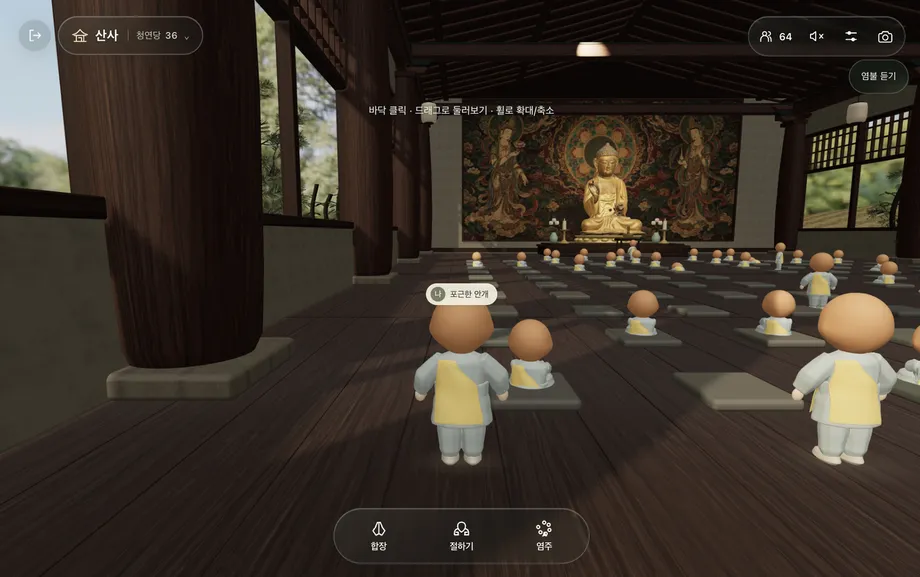
Sansa means mountain temple. On entering, visitors receive a small avatar resembling a young Buddhist monk and a randomly assigned name, such as Leisurely Cloud or Soft Moonlight. A large Buddha statue stands in the main hall, surrounded by cushions where the characters can sit.
Buttons let visitors press their palms together, bow or turn prayer beads. They can listen to a recitation of the Heart Sutra, a Buddhist scripture, or remain still with the sounds of wind and birds. Some describe using their characters to perform 108 bows, a repeated bowing practice associated with Buddhist devotion.
A greeting appears as a notification when another visitor presses their palms together. There are no text conversations or private messages. People can acknowledge one another without beginning an exchange that requires a reply.
The absence of conversation changes the social demands of the room. A visitor can arrive, sit quietly and leave without introducing themselves or explaining why they came. Other avatars provide company, while the controls keep interaction limited.
The job seeker behind the quiet
Park built Sansa through what is commonly called vibe coding: describing desired functions to an AI system, which helps generate the programming code. This allows someone to develop software through ordinary language instructions, although a working public service still needs testing, fixes and enough computing capacity to handle visitors.
Park initially imagined using the temple himself. He is not Buddhist, but remembered visiting temples with his parents as a child and taking part in a temple stay. The young monk characters were inspired by his young nephew.
Park, Sansa's creator, described the response and the need he believed it revealed:
I think temples appeal to people my age because they welcome everyone, even if you're not Buddhist. Seeing so many people respond made me realize that a lot of others are just as tired as I am. Maybe all they really needed was a quiet place to take a break without having to say anything.
How a personal project became a crowded hall
Sansa spread through Threads and Instagram, bringing an audience far beyond Park's initial expectations. About 12,000 visits in its first day caused an outage. Expanding capacity became an urgent part of running the project.
The early growth unfolded across several public updates:
- October 29: Park described an outage after roughly 12,000 visits during the first day, then announced that daily visits had reached 100,000.
- October 30: The main temple's 100 rooms displayed 4,679 people during the morning, and some rooms were still full that afternoon.
- October 31: Park said cumulative visits over the recent three days had reached 600,000.
- November 1: A subsequent account put cumulative visits above 800,000 within three days of launch.
Park increased capacity from 20 places to 100, then 1,200 and finally 10,000, distributed across 100 rooms accommodating 100 people each. The final capacity was 500 times the original 20 places. Even that expansion left some visitors waiting during busy periods.
The room structure helps explain why a particular hall can feel crowded even when the whole temple has space. On October 30, five rooms were full while 4,679 people occupied a network with a stated capacity of 10,000. Visitors choose individual rooms, so demand is not necessarily spread evenly.
Visitors ask for calm, and practical fixes
Users have described entering before work to settle their feelings, keeping the temple open while working, or returning several times during a day. Some identify as having no religion; others say they are Protestant or Catholic and enjoy the peaceful atmosphere.
One visitor described the website as their first temple visit. Another, who identified as strongly introverted, welcomed being able to sit in the front row. Their comments point to a space where participation can be small and private, even with other people nearby.
Complaints have been equally concrete: no cushions available, crowded rooms and difficulty finding somewhere to sit. Park apologised for server problems and said user feedback would guide improvements.
A shared moktak sound was removed after complaints about noise. A moktak is a wooden percussion instrument used to keep rhythm during Buddhist chanting. Park planned an individual version, allowing each visitor to use it without imposing the sound on everyone else. He also blocked two avatars from occupying the same cushion.
The audience reaches beyond South Korea
Park said 50,000 visits arrived from Taiwan overnight, with people also connecting from Vietnam and Thailand. The website's simple entrance makes an overseas visit possible without arranging a trip or downloading a separate program.
A Vietnamese post on Threads, showing a hall packed with young monk avatars, drew 152,000 views and 8,600 likes within seven hours. Its joke about fierce competition for an online temple seat captured the project's central irony: people seeking relief from daily pressure were queueing for a quiet digital cushion.
Sansa's appeal also has a regional parallel. In China, Trip.com recorded a 310% increase in bookings for attractions containing temples in 2023 compared with the previous year. That means bookings were about 4.1 times their earlier level. Roughly half of those visitors were born after 1990.
The Chinese travel figures and Sansa's traffic describe different activities, but both involve younger people choosing temple settings. Sansa removes much of the effort involved in a physical visit: there is no journey to arrange, and someone can stay for a few minutes from home.
A quieter part of Korea's Buddhist wave
South Korea's interest in Buddhist culture has also filled physical venues. The Seoul International Buddhism Expo attracted more than 200,000 visitors in 2025, with over 70% in their 20s and 30s. Attendance reached 250,000 in 2026, the highest figure in the event's 14 years.
Nearly three quarters of the 2026 audience were in their 20s and 30s. Organisers said about half of those young visitors had no religious affiliation. The fair's audience therefore extended well beyond people already attached to a religious community.
Its more exuberant side includes DJ NewJeansNim, a character performed by comedian Yoon Seong-ho, who combines electronic dance music with Buddhist chants. His appearance at the 2024 fair generated enough interest to temporarily overwhelm the event's website.
Merchandise includes shirts depicting the Buddha surfing or skiing, key rings and phone stands with Buddhist themes. Temple stay programs, which let guests spend time at a functioning temple, have also attracted more young Koreans. Sansa takes a much quieter approach than a crowded fair or musical performance, while drawing on the familiarity of the same religious setting.
Why anonymous sacred spaces appeal
Sung Hae-young, a professor of religious studies at Seoul National University, connects young people's interest in Buddhism with uncertainty in their lives. He says Buddhism's acknowledgement of suffering, and its invitation to approach that suffering through personal understanding, can appeal to people struggling with unsettled circumstances.
Sung also explained why a digital setting can be attractive to someone who wants a religious atmosphere without joining a community:
People want to feel a sense of peace and sacredness, like they would at a place of worship, but they don't necessarily want to be tied to a religious community or feel pressured to believe in something unquestioningly. Anonymous online spaces offer exactly that.
Park's circumstances give that explanation a concrete setting. A person looking for work created somewhere to rest because an actual temple visit felt beyond his available time and energy. Visitors describing brief stops before work or quiet company during tasks are fitting the space around daily demands.
Sansa's design accommodates several reasons for entering. Someone can bow and listen to scripture, enjoy the setting without religious belief, or simply sit near other characters. The shared room gives those different activities a common place without requiring people to discuss them.
Churches, campsites and the cost of staying open
Other creators have built related spaces. Chanmi recreates a Catholic church with pews, votive candles and rosaries. Visitors can hear traditional hymns, and its Angelus bells ring at 6 a.m., noon and 6 p.m. Goyottul offers a Protestant church setting with prayer requests and sermons.
Virtual swimming, camping and sauna spaces have also appeared, alongside memorial spaces for pets. These projects extend the idea beyond religion: a shared digital location can be organised around resting, a familiar pastime or remembrance.
Kim Jung-tae, a professor in the game faculty at Dongyang University, expects AI's reduction of the technical barriers to game development to bring more individual creators into the field. Sansa shows both parts of that process: one person can create an inviting space, then suddenly face the operational demands of a large audience.
Park's server costs have already grown. At users' request, he introduced a donation feature framed around gongyangmi, rice offered to a temple. Heavy traffic temporarily interrupted that function too, making the strain visible even in the mechanism intended to help support the service.
What comes next for Sansa
Park plans to add sounds beyond the Heart Sutra, improve the moktak and prayer beads, and expand the temple map. No release dates or detailed financial plan have been announced. His immediate work combines creating more room with keeping the existing experience calm.
The donation feature updates the early picture of a project with no stated way to collect money. Visitors have expressed willingness to support it, while the technical interruption shows how quickly demand has outgrown the original personal experiment.
Buddhist commentary on the wider cultural trend has also warned that treating Buddhism mainly as an attractive image could turn interest into a passing fashion. Sansa's continued appeal will depend in part on whether visitors keep finding value in its modest activities after the initial curiosity fades.
For now, its distinctive experience is concrete: enter a room, find a cushion, hear a chant or the wind, and share a little time with strangers who will not send a message. Park created the place because he needed a break. Hundreds of thousands of visits have made maintaining that quiet a much larger task.
Key Points
- Sansa surpassed 800,000 cumulative visits within three days of launch, according to a November 1, 2026 account.
- Creator Park Jin-won, 26, used AI assisted programming while preparing to find work.
- The browser temple offers bowing, prayer beads, chanting and silent company, with no chat or private messages.
- Capacity expanded from 20 places to 10,000 across 100 rooms.
- Park reported visitors from Taiwan, Vietnam and Thailand, including 50,000 visits from Taiwan overnight.
- A donation feature was introduced at users' request but temporarily interrupted by heavy traffic.
- Planned improvements include more audio, individual percussion controls, better prayer beads and a larger temple map.