The Machine That Bends Time and Gravity
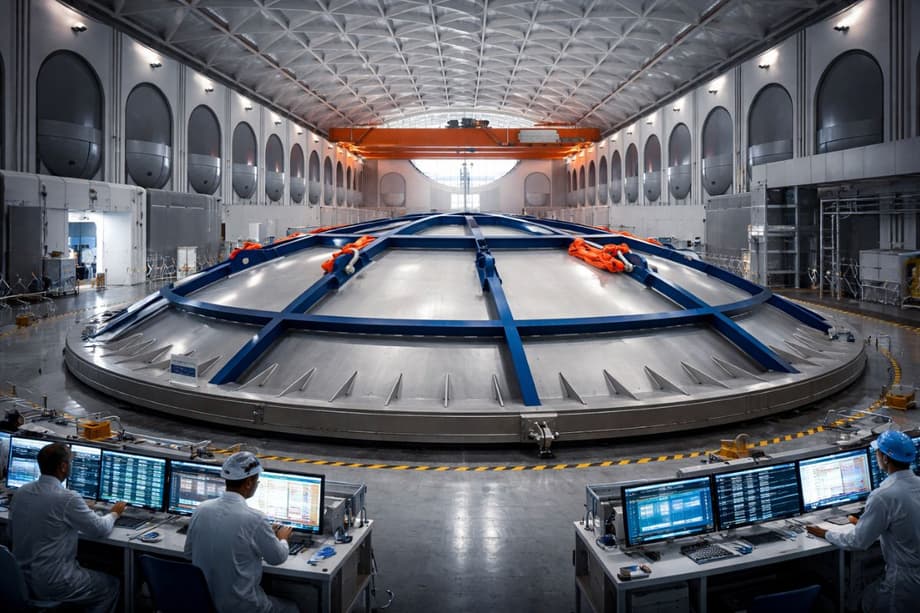
Deep beneath the campus of Zhejiang University in Hangzhou, engineers have completed an installation that redefines the boundaries of experimental physics. Buried 15 meters below ground to isolate it from the vibrations of daily life, the CHIEF1900 centrifuge stands as the most powerful hypergravity machine ever constructed. With a capacity of 1,900 g-tonnes, this facility can apply forces 1,900 times stronger than Earths natural gravity to samples weighing up to one metric ton. To appreciate this achievement, consider that a typical household washing machine generates no more than 2 g-tonnes during its most aggressive spin cycle. The CHIEF1900 operates at nearly one thousand times that intensity, creating an environment where physical processes accelerate dramatically while remaining controlled and observable.
This underground machine, completed in late December 2025, shatters the previous world record of 1,300 g-tonnes set just months earlier by its sister machine, the CHIEF1300. That earlier achievement had already displaced the long-standing record holder operated by the US Army Corps of Engineers in Vicksburg, Mississippi, which offers a capacity of roughly 1,200 g-tonnes. The rapid succession of these breakthroughs signals a significant shift in global research infrastructure, with China now operating the two most powerful hypergravity facilities on Earth.
The essential function of the CHIEF1900 is to compress space and time. By generating extreme centrifugal forces, the machine allows researchers to simulate decades, centuries, or even millennia of geological and structural processes within manageable laboratory timeframes. A three-meter scale model of a dam wall spun at 100 g experiences the same structural stresses as a full-sized 300-meter dam in the real world, allowing scientists to observe crack formation and foundation settlement in hours rather than decades. This capability transforms how engineers approach infrastructure safety, environmental risk assessment, and materials science.
Engineering Marvel Beneath the Campus
The CHIEF1900 was constructed by the Shanghai Electric Nuclear Power Group, a specialized industrial manufacturer with expertise in heavy engineering and nuclear systems. Delivered to Zhejiang University on December 22, 2025, the machine represents the culmination of a project approved in 2021 with a budget of 2 billion yuan, approximately $285 million. This investment establishes the Centrifugal Hypergravity and Interdisciplinary Experiment Facility, known by the acronym CHIEF, as one of only four major dynamic centrifuge complexes worldwide capable of simulating active earthquakes under extreme gravitational conditions.
The decision to install the facility 15 meters underground serves a critical scientific purpose rather than aesthetic preference. At the rotational speeds required to generate 1,900 g-tonnes, even microscopic vibrations from traffic, construction, or natural seismic activity could corrupt experimental data. The subterranean location provides the stability necessary to measure minute deformations under extreme forces, ensuring that readings reflect the tested materials behavior rather than external interference. This stability becomes essential when studying phenomena like soil liquefaction during earthquakes or the micro-fractures that precede structural failure in concrete.
Unlike its predecessor, which came online in September 2025, the CHIEF1900 expands the boundaries of what scientists can model. While the CHIEF1300 demonstrated capabilities such as reproducing seabed pressures at significant depths and simulating the impact of 20-meter tsunamis on ocean floors, the new machine increases capacity by 46 percent. This margin translates into the ability to work with larger scale models, apply harsher loading conditions, and achieve cleaner signal-to-noise ratios during sensitive measurements. The facility now houses multiple centrifuges alongside six specialized testing chambers, each designed for specific research domains ranging from slope stability to deep-sea engineering.
The Science of Extreme Rotation
Hypergravity research relies on a fundamental principle of physics rooted in Einsteins theory of General Relativity: the equivalence between gravitational acceleration and inertial acceleration. When the CHIEF1900s massive arms spin at high velocity, samples attached to the rotor experience an outward force that mimics extremely strong gravity. Scientists measure this capability in g-tonnes, a unit that combines the gravitational acceleration multiplier with the mass of the sample being tested. An object inside the centrifuge does not distinguish between being in a strong gravitational field and being accelerated through rotation, allowing researchers to simulate conditions impossible to find naturally on Earths surface.
The practical applications of this technology transform how researchers approach large-scale civil engineering and environmental studies. By placing a scale model inside the centrifuge and spinning it at high g-forces, scientists can replicate the structural stresses that full-sized infrastructure would experience over decades of service. The hypergravity environment compresses both space and time according to well-established scaling laws, allowing researchers to observe phenomena that would otherwise remain hidden by the slow march of geological processes.
This time compression extends to environmental contamination studies as well. Researchers can track how pollutants migrate through soil layers over geological timescales of thousands of years, observing in days how chemical plumes might move through aquifers and threaten drinking water supplies decades in the future. The facility can also examine how high-speed railway tracks interact with surrounding ground after millions of load cycles, addressing vibration and settlement issues that affect passenger comfort and long-term maintenance schedules. These experiments provide empirical data that would be impossible to gather through conventional field observation, offering insights into long-term risks that computer models alone cannot validate.
Simulating Catastrophe to Prevent It
The CHIEF facility houses six specialized testing chambers designed for distinct research domains: slope and dam engineering, seismic geotechnics, deep-sea engineering, deep-earth environmental studies, geological processes, and materials treatment. Each chamber allows scientists to model catastrophic scenarios that would be dangerous or impossible to study through real-world observation. Engineers can assess how a dam reacts to a major earthquake, how steep slopes fail during extreme rainfall events, or how underground structures respond to seismic waves. This capability transforms potential disasters into controlled trials, producing previously inaccessible data about failure mechanisms and safety margins.
For civil engineers, the centrifuge offers a controlled environment to test infrastructure resilience before construction begins. Models of tunnels, mountain highways, and coastal defenses undergo stress tests that simulate decades of service combined with extreme weather events or seismic activity. The facility can examine how natural gas hydrates behave under deep-sea pressures or how underground caverns might perform as nuclear waste storage facilities over millennia. These applications address critical infrastructure challenges where failure would carry catastrophic human and environmental costs.
The environmental applications prove equally significant. Under hypergravity conditions, the separation of fluids and solids accelerates, allowing scientists to study how buried contaminants spread through different soil types and how remediation strategies might perform over centuries. This capability supports regulatory decisions and cleanup strategies by providing empirical data on contamination plume migration rather than relying solely on theoretical models. For energy research, the facility can evaluate methane hydrate extraction methods and the stability of geological carbon sequestration sites, addressing technologies crucial for energy transition and climate mitigation.
Overcoming Engineering Challenges
Building a machine capable of spinning multi-tonne samples at speeds generating 1,900 g-tonnes presented significant technical challenges requiring custom solutions across multiple disciplines. The project demanded expertise in civil engineering, automation, thermodynamics, and environmental science, with Zhejiang University assembling a specialized team to address the unique demands of extreme rotational systems. Many standard engineering approaches proved insufficient at this scale, requiring novel component designs capable of withstanding high-speed motion and complex operating conditions.
The primary challenge involved thermal management. At maximum operational speeds, friction and air resistance generate substantial heat that could destabilize the system or alter sample properties. Engineers developed a sophisticated vacuum-based temperature control system that combines liquid coolant circulation with forced-air ventilation. This system incorporates the largest flange diameter ever used for such applications, along with specialized glacial refrigerant fluids, to maintain stable operating temperatures during high-speed rotation. Without this cooling capacity, the heat generated would compromise both the mechanical integrity of the centrifuge and the validity of experimental results.
Vibration control required equally innovative solutions. Beyond the underground installation, the centrifuge design incorporates precision balancing mechanisms to ensure that slight asymmetries in samples do not create destructive oscillations. These systems protect both the experimental integrity and the physical safety of the facility, as imbalances at such rotational speeds could generate catastrophic mechanical failures. The multidisciplinary effort was critical to the successful development and launch of the facility, representing a genuine achievement in large-scale precision engineering.
Global Collaboration and Scientific Ambition
Chen Yunmin, chief scientist for the CHIEF project and a professor at Zhejiang University, has articulated an ambitious vision for the facilitys scientific scope. In statements to the media, he described the teams goals in sweeping terms.
We aim to create experimental environments that span milliseconds to tens of thousands of years, and atomic to kilometre scales, under normal or extreme conditions of temperature and pressure. It gives us the chance to discover entirely new phenomena or theories.
The facility operates under an open-access model, inviting researchers from domestic and international universities, research institutes, and industries to conduct experiments. This collaborative approach positions the CHIEF complex as a global hub for hypergravity research, similar to how large telescopes or particle accelerators serve the international physics community. The Chinese team has actively encouraged international collaboration, betting that hypergravity research can rewrite how the global engineering community tests infrastructure and manages risk.
However, the transition from engineering completion to scientific validation remains ongoing. While the machine has been installed and described as operational, peer-reviewed experimental results from the CHIEF1900 have not yet been published. The scientific community awaits empirical data demonstrating that the machine delivers on its theoretical capabilities. There is an important distinction between building an extraordinary machine and proving, through published research, everything it promises to deliver. At this stage, the engineering feat is clear, but the full scientific impact depends on what future experiments will reveal about real-world applications and the accuracy of scale-model predictions.
The Essentials
- The CHIEF1900 centrifuge at Zhejiang University generates 1,900 g-tonnes of force, making it the worlds most powerful hypergravity research machine and surpassing the previous record of 1,300 g-tonnes set by its sister machine earlier in 2025
- Built by Shanghai Electric Nuclear Power Group and buried 15 meters underground to minimize vibration, the facility cost approximately $285 million and took five years to complete after approval in 2021
- The machine can simulate gravitational forces 1,900 times stronger than Earths natural gravity applied to one-tonne samples, compared to roughly 2 g-tonnes in a household washing machine
- Applications include modeling dam failures, earthquake damage, landslides, pollutant migration through soil over millennia, nuclear waste storage behavior, and high-speed rail track resonance
- Six specialized testing chambers cover research domains including slope engineering, seismic geotechnics, deep-sea engineering, and deep-earth environmental studies
- A vacuum-based cooling system using specialized coolant and the largest flange diameter ever built for such applications manages the extreme heat generated during high-speed rotation
- The facility is open to international researchers from universities, research institutes, and industries worldwide, operating as a shared platform similar to major particle accelerators or telescopes
- While construction is complete and the machine is operational, peer-reviewed scientific results from the CHIEF1900 have not yet been published, with validation of its full capabilities awaiting future experiments