A Commercial Reality, Not a Laboratory Concept
In late 2025, Kawasaki Heavy Industries quietly opened the order book for a machine that signals a fundamental shift in how industrial power generation approaches the energy transition. The company began accepting commercial orders for the world’s first large-scale gas engine designed to run on a fuel blend containing 30 percent hydrogen by volume, with the remainder supplied by natural gas. This eight megawatt class unit, built on Kawasaki’s established KG series platform, represents the transition from experimental technology to deployable hardware complete with warranty coverage, service schedules, and defined technical specifications.
The launch follows an eleven-month operational verification campaign conducted at Kawasaki’s Kobe works facility, running from October 2024 through September 2025. During this period, engineers subjected the engine to real-world industrial conditions rather than controlled laboratory parameters, testing how the system behaved under varying loads, temperatures, and operational stresses. The successful completion of these trials allowed Kawasaki to move from demonstration to commercialization, offering the hydrogen co-firing specification as a standard product feature rather than a custom engineering project.
Engineering the 30 Percent Solution
The 30 percent hydrogen threshold represents a carefully calculated compromise between emissions reduction and infrastructure compatibility. Hydrogen molecules are the smallest in existence, capable of escaping through seals that easily contain methane, and they ignite across a significantly wider range of fuel-to-air mixtures than natural gas. These properties create distinct engineering challenges for combustion stability, material integrity, and operational safety.
To address these risks, Kawasaki’s design incorporates specialized hydrogen leak detectors distributed throughout the fuel delivery path, coupled with nitrogen purging systems that can flush fuel lines during startup, shutdown, or fault conditions. The combustion chamber features redesigned cooling channels to manage the higher temperatures hydrogen produces, preventing the metal fatigue and embrittlement that can occur when hydrogen interacts with certain alloys over time. The fuel injection timing and air-to-fuel ratios are precisely controlled through updated digital systems to prevent flashback, a dangerous condition where flames travel backward into the fuel supply.
From an emissions standpoint, the blended fuel approach delivers measurable benefits. Testing data indicates that switching from pure natural gas to the 30 percent hydrogen blend reduces carbon dioxide emissions by approximately ten percent during operation. The system maintains compliance with standard nitrogen oxide emission limits through high-pressure fuel injection and thermal management, addressing concerns that hydrogen’s hotter combustion would increase NOx production.
The Retrofit Advantage
Perhaps the most significant aspect of Kawasaki’s launch lies not in the new orders it might generate, but in the existing equipment it can upgrade. The KG series platform has accumulated more than 240 orders worldwide since its introduction in 2011, with many units currently operating in industrial facilities and distributed power plants. Kawasaki has confirmed that earlier generations of these engines can be retrofitted to accommodate the same hydrogen co-firing specifications, allowing facilities built a decade ago for pure natural gas operation to extend their service life while gradually lowering their carbon intensity.
This retrofit pathway offers a pragmatic solution to the asset utilization problem facing power plant operators. Rather than requiring a complete fleet replacement to access cleaner fuels, the upgrade allows incremental decarbonization as hydrogen availability improves and costs decline. The 30 percent blend level specifically supports this transition strategy because it can move through existing distribution networks and storage tanks with only limited adjustments, avoiding the complete rebuild of pipeline infrastructure that higher hydrogen concentrations would necessitate.
Parallel Progress at Sea
While the stationary power engine entered commercial availability, Kawasaki and its partners achieved a parallel milestone in maritime propulsion. In October 2025, a consortium including Kawasaki, Yanmar Power Solutions, and Japan Engine Corporation completed what they describe as the world’s first land-based operation of marine hydrogen engines. The demonstration utilized a newly developed liquefied hydrogen fuel supply system at Japan Engine’s factory site to validate stable combustion in medium-speed, four-stroke engines at rated output.
The marine initiative extends beyond auxiliary engines. Japan Engine is developing a low-speed, two-stroke hydrogen engine designed for main propulsion on large cargo vessels, with initial trials scheduled for spring 2026. All three engine types incorporate dual-fuel architecture, allowing crews to switch between hydrogen and conventional marine diesel depending on fuel availability at specific ports. This redundancy addresses the practical reality that hydrogen bunkering infrastructure will remain unevenly distributed for years to come.
Liquid hydrogen is a vital key to realising a sustainable energy society, and we have long been committed to building the technological foundation to support it.
Kei Nomura, Executive Central Manager of Kawasaki’s Hydrogen Strategy Division, made this statement in connection with the marine demonstration, capturing the broader corporate strategy that connects the company’s engine development with its simultaneous investments in fuel supply chains.
Building the Fuel Supply Chain
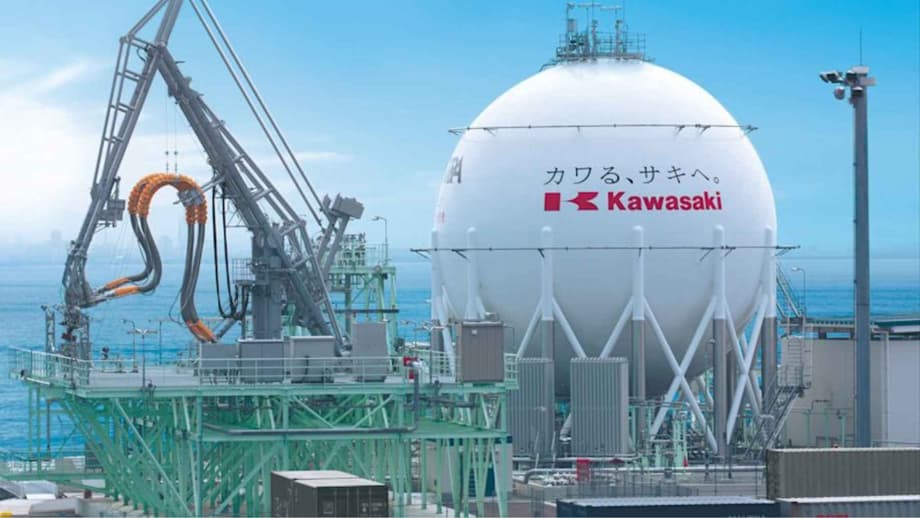
The commercial availability of hydrogen-ready engines creates immediate demand for a fuel supply network that remains under construction. Japan imports nearly all of its primary energy, and large-scale hydrogen logistics are only now materializing. The centerpiece of this effort is the Kawasaki LH2 Terminal rising on Ogishima in Kawasaki City, which broke ground in November 2025.
Scheduled to begin operations around 2030, the terminal represents Japan’s first commercial-scale liquid hydrogen import base. The facility centers on a cryogenic tank capable of holding approximately fifty thousand cubic meters of liquefied hydrogen, described by the partners as the world’s largest, alongside systems for ship handling, regasification, and truck dispatch. The terminal is designed to receive hydrogen produced overseas, addressing Japan’s geographical constraints that limit domestic renewable energy potential.
Complementing the terminal, Kawasaki is working with Japan Suiso Energy on a new liquefied hydrogen carrier with a capacity of roughly forty thousand cubic meters. This vessel represents a thirty-two-fold increase in capacity compared to the earlier Suiso Frontier demonstrator that carried the first test shipment of liquefied hydrogen from Australia to Japan in 2022. Together, the ship and terminal are intended to anchor an international hydrogen supply chain capable of feeding both coastal bunkering facilities and inland power plants.
Public Funding and Market Context
Both the power plant engines and the marine propulsion systems operate within Japan’s broader climate policy framework. Their development receives backing from the New Energy and Industrial Technology Development Organization (NEDO) through the Green Innovation Fund, which the Ministry of Economy, Trade and Industry (METI) has capitalized with approximately two trillion yen (roughly $13 billion) to support the national goal of carbon neutrality by 2050.
This public backing allows companies to tackle technical challenges that resist financing through conventional market channels, including long-term durability testing of hydrogen valves and the development of training protocols for handling cryogenic fuel safely. The funding also provides a buffer for technologies that reduce emissions but may not yet compete on cost with conventional fossil fuels.
The Kawasaki launch enters a growing global market for natural gas engines, which industry analysts project will reach $8.97 billion by 2032, expanding at a compound annual growth rate of 5.9 percent. Asia Pacific currently dominates this market with a 45 percent share, followed by North America at 35.6 percent and Europe at 29 percent. The introduction of hydrogen co-firing capabilities positions Kawasaki to capture demand from operators seeking future-proof equipment that can adapt to evolving fuel supplies rather than becoming obsolete as environmental regulations tighten.
The Reality Check for Early Adopters
For facility managers and fleet operators, the immediate question involves whether these technologies can lower emissions today. The answer depends largely on hydrogen availability. Until the import terminals, carriers, and domestic distribution networks reach scale, early buyers of the KG engine face a choice between securing limited local hydrogen supplies at premium prices, operating exclusively on natural gas while ignoring the hydrogen capability they paid for, or simply waiting for the infrastructure to mature.
When clean hydrogen does become available, the environmental benefits become tangible. A gas plant burning the 30 percent blend produces fewer carbon dioxide emissions per kilowatt-hour than one running pure natural gas, assuming the hydrogen comes from low-carbon production methods. Similarly, hydrogen-capable ship engines offer emission reductions along heavily trafficked maritime routes once bunkering becomes routine. The immediate benefit, however, lies in flexibility. Existing plants and vessels can adapt to cleaner fuels as they arrive, avoiding the asset stranding risk that comes with locking in decades of fossil fuel dependency.
The Essentials
- Kawasaki Heavy Industries launched commercial orders for the world’s first 30% hydrogen co-firing gas engine in late 2025, following eleven months of operational testing at Kobe works
- The eight megawatt class KG series engine can burn fuel blends containing up to 30% hydrogen by volume with natural gas, reducing CO2 emissions by approximately 10% compared to pure natural gas operation
- Over 240 existing KG series engines ordered since 2011 can be retrofitted to accommodate hydrogen co-firing, extending asset life while enabling gradual decarbonization
- Specialized safety systems include distributed hydrogen leak detectors and nitrogen purging mechanisms to manage risks associated with hydrogen’s small molecular size and wide ignition range
- Parallel marine engine development includes successfully tested medium-speed four-stroke hydrogen engines and a planned low-speed two-stroke main propulsion engine for cargo ships scheduled for spring 2026 trials
- The Kawasaki LH2 Terminal in Ogishima, scheduled for 2030 operation, will feature a 50,000 cubic meter liquid hydrogen storage tank to support import infrastructure
- Development funded through Japan’s Green Innovation Fund, capitalized with two trillion yen to support carbon neutrality goals by 2050