A Geopolitical Pivot Two Decades in the Making
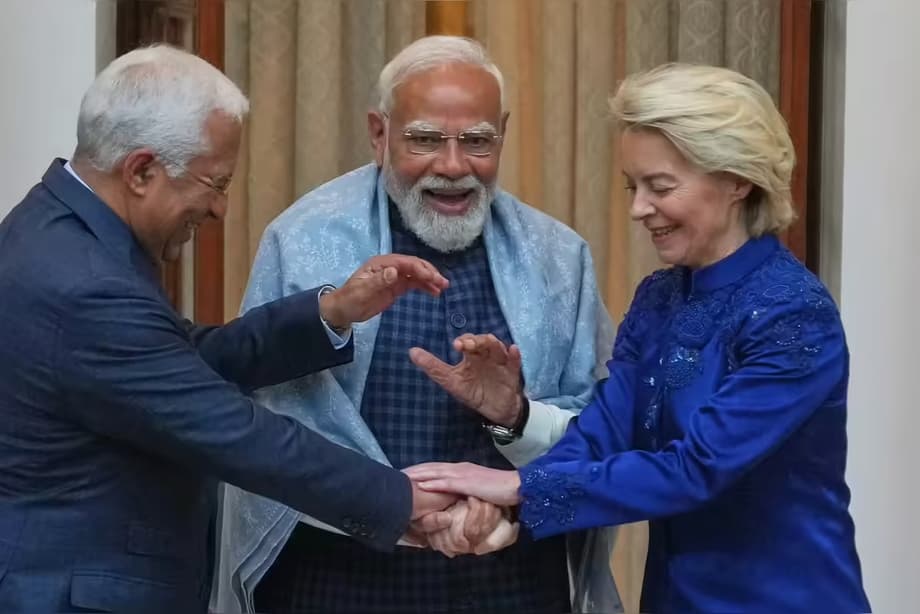
When European Commission President Ursula von der Leyen stood alongside Indian Prime Minister Narendra Modi in New Delhi on January 27, 2026, she proclaimed what negotiators had spent nearly 20 years pursuing: the “mother of all deals.” The EU-India Free Trade Agreement, formally concluded after two decades of fits and starts, creates an economic zone encompassing roughly 2 billion people and approximately 25% of global GDP. More significantly, it represents a fundamental realignment in how major economies approach trade partnerships in an era of mounting protectionism and geopolitical fragmentation.
- A Geopolitical Pivot Two Decades in the Making
- From Suspension to Breakthrough: The Long Road to Agreement
- The Architecture of a Landmark Agreement
- Beyond Tariffs: Services, Digital Trade, and Mobility
- Sustainability as Binding Commitment
- The US Factor: Pressure, Paradox, and Partnership
- Sectoral Winners and Market Reactions
- Challenges Ahead: Ratification and Implementation
- A Template for 21st Century Trade?
- The Bottom Line
The agreement’s timing speaks volumes. With the United States under President Donald Trump imposing aggressive tariffs on allies and adversaries alike, including a 25% levy on selected Indian exports linked to New Delhi’s energy purchases from Russia, both Brussels and New Delhi found compelling reasons to accelerate what had seemed interminable negotiations. The deal transforms a relationship that generated €180 billion in annual trade into something far more integrated, with projections suggesting EU goods exports to India could surge 107.6% by 2032.
Yet the story of this agreement extends far beyond immediate economic calculations. It reflects divergent visions of how major powers should navigate an increasingly contested global order, with Europe choosing commercial integration over coercive pressure while Washington has leaned toward using trade as a geopolitical weapon.
From Suspension to Breakthrough: The Long Road to Agreement
The EU and India first elevated their relationship to a “strategic partnership” in 2004, with formal trade negotiations launching in 2007. Those early talks aimed ambitiously high: comprehensive coverage of goods, services, investment protection, public procurement, intellectual property rights, and regulatory cooperation. By 2013, however, fundamental incompatibilities had brought negotiations to a de facto halt.
Europe pressed aggressively for market access in services, automobiles, wine and spirits, pharmaceuticals, and public procurement, alongside stringent intellectual property and investment protection standards. India, conversely, prioritized what trade negotiators call “Mode 4” access, the movement of skilled professionals across borders, while insisting on preserving policy space for development priorities and regulatory autonomy. The aftershocks of Europe’s financial crisis and shifting political priorities in India after 2014 compounded these divergences.
For nearly a decade, the agreement remained frozen, mirroring broader transformations in global trade politics. The EU increasingly embedded sustainability, labor rights, and environmental standards into its external economic relations. India grew more skeptical of comprehensive trade agreements, emphasizing domestic manufacturing, strategic autonomy, and economic resilience. The relaunch in 2021-2022 adopted a more pragmatic, modular approach that separated trade, investment, and geographical indications into parallel negotiating tracks, finally creating conditions for success.
What ultimately broke the logjam was not diplomatic technique but geopolitical necessity. Supply-chain disruptions during the COVID-19 pandemic, intensifying US-China rivalry, and Europe’s search for dependable economic partners created convergent interests that had previously proved elusive. The Ukraine war, paradoxically, both complicated and catalyzed the relationship, as Western pressure on India over its Russian energy purchases highlighted the costs of strategic dependence on any single partner.
The Architecture of a Landmark Agreement
The final agreement’s scope exceeds any trade pact either party has previously concluded. The EU will eliminate tariffs on over 90% of tariff lines, covering 91% of trade value, while India will eliminate tariffs on 86% of lines, representing 93% of value. When partial liberalization is included, overall trade coverage reaches 99.3% for the EU and 96.6% for India.
For European exporters, the benefits are substantial and immediate. Tariffs on machinery and electrical equipment, which reached as high as 44%, will fall to zero for almost all products. Chemicals facing duties up to 22% and pharmaceuticals at 11% will see similar elimination. The automotive sector, long a European priority, achieves unprecedented access: tariffs on EU-made cars will plunge from 110% to 10% over five years under an annual quota of 250,000 vehicles, with 160,000 internal combustion engines and 90,000 electric vehicles permitted duty-free at full implementation.
Indian exporters secure comparable advantages. The EU will scrap all tariffs on 90% of Indian goods immediately, extending zero tariffs to 93% within seven years. Key Indian exports including marine products, textiles, apparel, leather, footwear, and gems and jewelry see substantial duty reductions. The agreement establishes that 99.5% of bilateral trade will receive some form of tariff concession.
Sensitive sectors on both sides remain protected. India excluded dairy, cereals, and automobiles from full liberalization. The EU maintained tariffs on beef, sugar, rice, poultry, milk powders, bananas, and honey, with calibrated quotas limiting imports of table grapes and cucumbers. A bilateral safeguard mechanism allows either party to take protective action if imports cause serious injury to domestic industry.
Beyond Tariffs: Services, Digital Trade, and Mobility
The agreement’s significance extends well beyond traditional goods trade. Services trade between the parties reached €59.8 billion in 2024, and the FTA introduces substantial improvements to the WTO’s Generalized Agreement on Trade in Services framework. The EU gains access to 144 services sub-sectors, India to 102, including financial services, maritime transport, and telecommunications.
Digital trade provisions create a predictable environment for cross-border data flows while protecting software source code from mandatory disclosure. The agreement incorporates most rules from the WTO Electronic Commerce Joint Initiative, despite India not being a member of that plurilateral arrangement. Consumer protection and anti-spam provisions address practical concerns for businesses and individuals alike.
Perhaps most innovatively, the parties concluded a parallel Comprehensive Framework for Cooperation on Mobility, the first bloc-level agreement of its kind for India. This creates legal templates for EU member states to issue short-term study, research, and seasonal work permits to Indian nationals under fast-tracked procedures, establishes an EU “Legal Gateway Office” in New Delhi, and commits both sides to digitizing Schengen visa processing. While not free movement, it addresses India’s long-standing priority on professional mobility while giving European employers structured access to Indian talent pools.
Intellectual property protection reaches high standards, covering copyright, trademarks, designs, trade secrets, and plant varieties, with comprehensive enforcement mechanisms. Competition provisions ensure independent enforcement against anticompetitive conduct, with possibilities for cooperation between authorities. A dedicated SME chapter requires publication of business information on single digital platforms and establishes contact points to help smaller enterprises navigate opportunities.
Sustainability as Binding Commitment
The agreement embeds sustainability throughout its architecture, reflecting the EU’s evolution toward values-driven trade policy. The Trade and Sustainable Development chapter makes legally binding commitments on environmental protection, climate change, and workers’ rights, enforceable through dedicated consultation mechanisms involving technical experts and political decision-makers.
Both parties commit to implementing the Paris Climate Agreement and relevant multilateral environmental agreements. Specific provisions address forest conservation, biodiversity protection, combating illegal wildlife trade and logging, and preventing illegal, unreported, and unregulated fishing. The agreement promotes cooperation on renewable energy, maritime emissions reduction, and circular economy transition.
Labor provisions incorporate core International Labour Organization principles: freedom of association and collective bargaining, elimination of forced labor, abolition of child labor, non-discrimination, and safe working environments. Gender equality and women’s economic empowerment receive dedicated attention, with commitments to relevant UN and ILO conventions.
Critically, the agreement protects both parties’ right to regulate and prohibits weakening environmental or labor laws to encourage trade or investment. Civil society organizations gain active roles in monitoring implementation, with institutional provisions ensuring their participation in oversight mechanisms.
The US Factor: Pressure, Paradox, and Partnership
American policy choices created powerful incentives for this agreement’s conclusion. The Trump administration’s aggressive tariff policies, including the 25% levy on Indian exports explicitly tied to Russian oil purchases, pushed New Delhi toward alternative partnerships. Washington’s framing of India’s energy security choices as incompatible with a “rules-based international order” struck many Indian officials as hypocritical, given continued Western trade with Russia in sectors from liquefied natural gas to uranium and palladium.
From India’s perspective, energy security is not a discretionary policy choice but a development imperative for a nation of 1.46 billion people. Russian crude imports surged from marginal levels to 35-40% of India’s total crude mix by mid-2025, with bilateral trade exceeding $68 billion in 2024-25. Indian officials noted that the EU maintained approximately €67.5 billion in goods trade with Russia in 2024, alongside record LNG imports of 16.5 million metric tons.
Europe’s response to these tensions differed markedly from Washington’s. While firmly condemning Russia’s Ukraine invasion and maintaining extensive sanctions, European policymakers acknowledged that trade and energy flows remain essential to economic stability. This calibrated approach, accepting the limits of coercive economic diplomacy, created space for renewed engagement with India that Washington’s more confrontational stance foreclosed.
The paradox is striking. The United States originated the “Indo-Pacific” concept as a strategic framework linking the Indian and Pacific oceans through security alliances, supply chains, and governance norms. Yet Europe now appears better positioned to reap its economic dividends. Where Washington has emphasized strategic competition and security alignment, often deploying trade as an instrument of geopolitical signaling, European actors have approached the Indo-Pacific primarily as a space for commerce, connectivity, and economic diversification.
Sectoral Winners and Market Reactions
Corporate responses to the agreement reveal its practical significance. Renault immediately announced that India would become a “top priority,” with Chief Growth Officer Fabrice Cambolive citing the market’s growth potential and new accessibility for European firms. The French automaker is relaunching its Duster SUV in India and developing additional products through 2030, hoping its hybrid technology and Google-powered connectivity will differentiate it in a market dominated by Tata Motors and Mahindra & Mahindra.
German automotive and engineering interests celebrated enthusiastically. The VDMA engineering association called the agreement “much-needed oxygen” for export-oriented mechanical engineering, with Executive Director Thilo Brodtmann declaring that “the EU has delivered” and sent “a clear signal in favour of rules-based trade and against the law of the jungle.”
Beyond autos, multiple sectors stand to benefit. European luxury goods companies, including LVMH, Hermès, and L’Oréal’s Luxe division, gain from reduced effective tax rates on designer handbags, perfumes, and cosmetics. Swiss watchmakers such as Richemont’s Cartier and Van Cleef & Arpels acquire significant pricing advantages over non-European rivals. France’s cognac sector, facing squeezed sales in traditional American and Chinese markets, welcomes tariff reductions from 150% to 40% on spirits.
Aerospace benefits from elimination of 11% tariffs on aircraft and spacecraft. Financial services gain privileged access to Indian markets. Pharmaceuticals, chemicals, and medical equipment see substantial tariff elimination. For Indian exporters, textiles, apparel, engineering goods, leather, footwear, and marine products receive preferential access to the world’s second-largest market.
Challenges Ahead: Ratification and Implementation
Despite the celebratory rhetoric, significant hurdles remain before the agreement takes full effect. The deal requires legal review, translation into 24 EU official languages, and approval by all 27 member states and the European Parliament, a process expected to extend through 2026 with implementation potentially beginning in early 2027.
Recent EU trade history offers cautionary notes. The EU-Mercosur agreement, concluded after 25 years of negotiations just days before the India deal, immediately faced referral to the Court of Justice of the European Union for legal opinion on compatibility with EU policies. France, Poland, Austria, Ireland, and Hungary had voted against that agreement in the European Council, with agricultural sensitivities proving particularly contentious.
The India-EU agreement avoids some of these pitfalls by excluding the most sensitive agricultural products from both sides. Yet ambiguities persist regarding intellectual property, sustainability enforcement, and labor law conventions that could complicate ratification or implementation if not carefully managed. The Atlantic Council’s analysis suggests the deal, while significant, may prove less transformational than headline figures imply, with benefits emerging gradually rather than immediately.
For India, cabinet approval and parliamentary processes must proceed, though the government’s comfortable majority suggests limited domestic political obstacles. The more substantial challenge lies in ensuring that domestic industries can capitalize on new market access and that regulatory systems adapt to meet EU standards for sanitary and phytosanitary measures, technical barriers to trade, and customs facilitation.
A Template for 21st Century Trade?
The EU-India agreement potentially signals broader shifts in global trade architecture. With the World Trade Organization’s multilateral framework increasingly paralyzed, major economies are constructing alternative arrangements that prioritize flexibility over universal rules. The EU-India deal demonstrates that comprehensive agreements between large, diverse economies with distinct development models remain possible when parties accept incremental progress and mutual accommodation.
European officials have framed the agreement as part of a broader “strategic autonomy” agenda, diversifying supply chains and reducing dependence on both China and an increasingly erratic United States. Deals with Japan, Indonesia, Mexico, and South America over the past year, alongside the India agreement, sketch the contours of a commercially grounded European strategy that operates independently of American preferences.
For India, the agreement validates a more pragmatic approach to trade negotiations after years of protectionist skepticism. By accepting modular progress, protecting genuine sensitivities, and securing meaningful concessions on services and mobility, New Delhi has demonstrated that trade agreements can advance national interests without compromising strategic autonomy. The parallel conclusion of investment protection and geographical indications negotiations suggests this model may prove replicable.
The agreement’s ultimate significance may lie less in its immediate economic impact than in the alternative it offers to the zero-sum trade wars increasingly characterizing great power relations. By foregrounding interdependence, human welfare, and mutual benefit alongside political principle, the EU-India deal gestures toward a more nuanced global order, one in which commercial relationships can persist and deepen even amid geopolitical friction.
The Bottom Line
- The EU-India Free Trade Agreement, concluded January 27, 2026, creates the world’s largest free trade zone covering 2 billion people and 25% of global GDP after nearly 20 years of negotiations
- The EU will eliminate tariffs on 90% of lines immediately, with overall liberalization reaching 99.3%; India will eliminate tariffs on 86% of lines, with 96.6% overall coverage
- Key provisions include cutting EU car tariffs from 110% to 10%, eliminating machinery tariffs up to 44%, and creating a 250,000-vehicle annual quota for European automakers
- A parallel Mobility Pact establishes the first bloc-level framework for Indian professional access to EU markets, addressing long-standing Indian priorities
- The agreement includes legally binding sustainability commitments on climate, labor rights, and environmental protection, enforceable through dedicated mechanisms
- US tariff pressure on India, including 25% levies tied to Russian oil purchases, created significant incentives for accelerated EU-India agreement
- Full implementation requires ratification by all 27 EU member states and the European Parliament, with entry into force expected in early 2027
- The deal represents a European alternative to American coercive trade diplomacy, emphasizing commercial integration over geopolitical conditionality