Why drills across Japan’s southwest islands matter now
Japan and the United States are moving quickly to make their alliance ready for a Taiwan crisis, turning years of planning into visible deployments and complex joint exercises across Japan’s far southwest. The most striking sign is Japan’s decision to place air defense missiles on Yonaguni, a small island only about 110 kilometers from Taiwan. That island is the end point of the Ryukyu chain, a string of more than 150 islands that arcs toward the Philippines and borders the sea lanes Chinese forces would likely use in any attempt to coerce or invade Taiwan. US forces have, in parallel, increased supplies, new equipment, and training tempo across the region.
- Why drills across Japan’s southwest islands matter now
- How joint exercises evolved into a real operational blueprint
- Why the Ryukyu chain is central to a Taiwan crisis
- Legal and political shifts in Tokyo
- Logistics, evacuations, and civilian protection
- How Beijing and Taipei are responding
- What a Taiwan contingency could look like under current plans
- At a Glance
Yonaguni already hosts a radar site and an electronic warfare unit designed to monitor and disrupt adversary communications. Japan’s plan to add a medium range surface to air missile unit there would tighten air defense coverage near the Taiwan Strait. The move sits alongside other upgrades, from new Japanese anti ship missile batteries on nearby islands to the first stationing of a US Army Typhon missile battery on Japanese soil. The Typhon system can launch cruise and surface to air missiles and, from Japan’s southwest, can hold distant targets at risk. Intelligence coverage is also growing with the planned arrival of MQ 4C Triton drones on Okinawa to expand long endurance maritime surveillance.
Tokyo’s political signaling has shifted as well. Prime Minister Sanae Takaichi told lawmakers this month that any use of force by China against Taiwan could meet the legal threshold of a survival threatening situation for Japan. That language indicates Japan would consider using force alongside the United States under its collective self defense rules, a change enabled by a 2014 reinterpretation of the constitution. Beijing protested, and the diplomatic dispute that followed underscored how closely any Taiwan emergency is tied to Japan’s own security.
How joint exercises evolved into a real operational blueprint
Recent drills show how the two militaries think a Taiwan scenario could unfold. During the Keen Edge command post exercise in February 2024, US and Japanese staffs simulated a Chinese attack on Taiwan, follow on missile strikes on US bases in Japan, and even a People’s Liberation Army landing on Yonaguni. The Japanese government classified the scenario as a survival threatening situation, opening the way for the Self Defense Forces to fight under collective self defense. In one segment, US commanders asked Tokyo to attack a Chinese amphibious fleet in the Taiwan Strait. Japanese officers debated whether to hit escorts and carriers or the transport ships that carry troops and equipment. They chose the transports, a choice that aligns with the aim of stopping an invasion at sea.
From tabletop to field drills
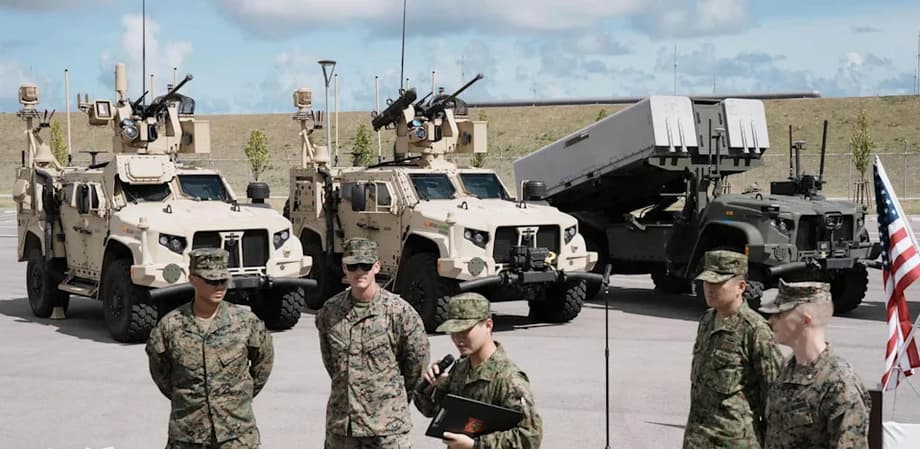
What followed has been a series of large field exercises across Japan’s southwest islands. Keen Sword 2025 involved roughly 45,000 personnel and saw US rocket artillery units stage on Ishigaki, an island closer to Taiwan than to the Japanese mainland. The Iron Fist series shifted to Japan and now focuses on amphibious operations and island defense, with US Marines and Japan’s Amphibious Rapid Deployment Brigade practicing landings and combined fires. Resolute Dragon 2025 placed new US systems in the field, including the Typhon battery at Marine Corps Air Station Iwakuni and the Navy Marine Expeditionary Ship Interdiction System and Marine Air Defense Integrated System on Ishigaki. These drills test the ability to rapidly move units, hide them, fire, and move again, a core requirement for surviving in a missile saturated environment.
Alliance planning has widened beyond Japan. US guidance calls for establishing temporary expeditionary bases on inhabited islands in Japan’s Nansei chain and in the Philippines if a Taiwan contingency becomes imminent. A US Marine Littoral Regiment equipped with mobile rocket artillery would disperse across the islands, while the US Army’s Multi Domain Task Force would deploy long range fires in the Philippines. Japan’s Self Defense Forces would back these units with fuel, ammunition, and transport. Manila already expanded access for US forces to nine sites. The idea is to place precision missiles and sensors along the first island chain to monitor and, if necessary, block Chinese naval movement into the Pacific.
During a news conference on Okinawa, Lt. Gen. Roger Turner, the senior US Marine commander on the island, framed the message the drills were meant to send.
These combined exercises should clearly signal to any potential adversary that any aggression will be met with a swift and decisive response.
That deterrent message rests on the ability to deploy fast, stay hidden, and strike accurately. The drills have moved from abstract planning to real island terrain, giving commanders practice with the geography, weather, and infrastructure they would face in a crisis.
Why the Ryukyu chain is central to a Taiwan crisis
The Ryukyu chain runs from Kyushu toward Taiwan, forming a natural barrier with narrow straits between islands. Ships and aircraft passing from the East China Sea into the Pacific often use the Miyako Strait and passages near Yonaguni. In a Taiwan conflict, Chinese forces would need to move through those chokepoints to maneuver and threaten US and Japanese assets. Japanese islands provide places to base sensors and missiles that can watch and, in wartime, aim at ships and aircraft funneling through those gaps.
History added urgency. When China responded to a high profile visit to Taipei in 2022 with large drills, several ballistic missiles splashed down just south of Yonaguni. That episode showed how close the island chain sits to any clash over Taiwan. Infrastructure is catching up to the strategic logic. Work is accelerating on an airfield on Mageshima, in part to support US Navy carrier landing practice and to add capacity for Japan Air Self Defense Force training. The combination of more runways, island ports, pre positioned supplies, and mobile missile batteries gives the alliance more options to operate under fire.
Missiles and sensors along the chain
Japan has deployed or is building out air defense and anti ship units on remote islands. That includes the Type 03 Chu SAM on Yonaguni, designed to engage air threats at tens of kilometers, and Type 12 anti ship missiles on Ishigaki and other islands. The Type 12 is being upgraded for ranges on the order of a thousand kilometers. Electronic warfare teams already based on Yonaguni add another layer by jamming enemy radars and guidance systems. The United States has brought in mobile systems with different jobs. Marine units demonstrated the ship killing NMESIS launcher and the short range air defense system known as MADIS on Ishigaki. NMESIS fires Naval Strike Missiles with a reach of roughly one hundred miles and can be operated remotely, making it harder to target. The US Army’s Typhon adds a longer reach with cruise and surface to air missiles. The common thread is mobility and signature control, moving in small teams, hiding among civilian infrastructure where permitted, and firing from many locations.
Legal and political shifts in Tokyo
Japan’s legal posture on the use of force has evolved to meet the security environment. In 2014, Tokyo reinterpreted its constitution to allow the limited use of collective self defense, meaning the Self Defense Forces could fight alongside an ally if an armed attack on a friendly state threatened Japan’s existence. Exercises now rehearse the decision steps needed to declare a survival threatening situation and authorize force. That policy is no longer abstract. It is the core of how the government says it would respond if conflict erupts over Taiwan.
Prime Minister Sanae Takaichi went further in public remarks early this month, placing any Chinese use of force against Taiwan inside Japan’s survival calculus. She made the stakes clear for lawmakers and the public before a backlash from Beijing.
Any use of force by mainland China against Taiwan could be a survival threatening situation for Japan.
Institutional changes match the rhetoric. Japan stood up a permanent Joint Operations Command to knit together the ground, maritime, air, space, and cyber arms of the Self Defense Forces and to work more closely with US commanders in Japan. Washington, for its part, is moving to upgrade US Forces Japan into a joint headquarters to pair with Japan’s new command. Both sides are also co operating on production of advanced munitions and spreading ammunition and fuel storage across the archipelago. Political leaders in Tokyo remain cautious about explicit mention of Taiwan in alliance plans, but day to day steps are aimed at making a joint response work under stress.
Logistics, evacuations, and civilian protection
Exercises and staff simulations exposed gaps that planners are trying to close. During Keen Edge, commanders wrestled with how to share runways between airlift, fighter sorties, and emergency repairs while under missile threat. Japan has since established a Maritime Transport Group to coordinate sealift and has accelerated construction and hardening of airfields and ports in the southwest. US units recently practiced moving supplies from Okinawa to Yonaguni to simulate building a forward operating site under pressure. These efforts are about speed, redundancy, and resilience, not just firepower.
Civil defense is rising in priority too. The central government and local authorities have drafted plans to evacuate about 120,000 residents from remote islands in Okinawa Prefecture within about six days if a Taiwan emergency escalates. Drills and surveys on Yonaguni, Ishigaki, and Miyako have focused on routes, temporary shelters, and medical support. Tokyo has also relocated tilt rotor aircraft to better support island contingencies and is adding distributed ammunition depots across multiple prefectures to avoid single points of failure. Every step is being paired with local consultations, since these islands are populated communities as well as strategic terrain.
Intelligence and early warning
Intelligence collection has expanded alongside new missile deployments. Several MQ 4C Triton drones are slated to operate from Kadena on Okinawa, boosting persistent maritime surveillance around Taiwan and the East China Sea. Japanese fighter aircraft already scramble frequently to intercept unidentified drones and surveillance planes in southern airspace, with the number of incidents rising over the past few years. These flights provide early warning and help map patterns of activity by Chinese warships and aircraft that move through nearby straits.
How Beijing and Taipei are responding
China views Taiwan as part of its territory and has warned against any foreign involvement. Its warships and aircraft regularly operate around Japan’s southwest islands and through the Miyako Strait. Chinese coast guard vessels also continue incursions near the disputed Senkaku Islands, backed by a coast guard law that authorizes the use of force in waters China claims. In response to Japanese statements and deployments, Beijing has used sharp diplomacy and, at times, economic signals. A Chinese Foreign Ministry spokeswoman condemned the planned missile deployment on Yonaguni.
Deploying missiles on Yonaguni would be extremely dangerous and a deliberate move that breeds regional tensions.
Taipei has welcomed closer coordination with Tokyo and Washington as a stabilizing factor. Taiwan officials argue that stronger Japanese defenses on nearby islands help keep the Taiwan Strait calm by raising the cost of aggression and giving allies more time to act.
Strengthening military facilities on Yonaguni helps maintain security in the Taiwan Strait and benefits Taiwan’s national interests.
Direct military ties remain limited. Still, contact among coast guard agencies has deepened, and quiet information sharing is more routine. In Southeast Asia, Manila has widened access for US forces and conducted drills with US units that involved systems now present in Japan, extending the same island defense concept down the first island chain.
What a Taiwan contingency could look like under current plans
Alliance planning points to a fast moving crisis with several common features. If warning signs show invasion preparations are underway, small US Marine teams would disperse across islands in Japan’s Nansei chain and in the Philippines. They would bring mobile rocket artillery and anti ship missiles to surveil the ocean approaches and threaten any Chinese naval groups that move beyond the Taiwan Strait. The US Army would position its long reach fires where they can strike from multiple axes. Japanese forces would provide logistics, air defense, and anti ship coverage from their own island batteries, while the Japan Coast Guard manages maritime safety and escorts evacuations.
Chinese planners, if committed to force, would try to neutralize US bases on Okinawa and elsewhere in Japan with missile strikes while pushing amphibious task groups toward Taiwan. That is why drills like Keen Edge have tested decisions about where to focus missile and air strikes. Hitting carriers and escorts can complicate Chinese air defense, but hitting transport ships can stop troops and heavy equipment from reaching beaches. Exercises suggest Japan would prioritize those transports.
None of this removes risk. Dispersed units are harder to target but vulnerable if detected. Evacuations are difficult under fire. Political decisions would need to be made quickly, and alliance coordination would be tested in the first hours. Tokyo has tried to prepare the public for that burden without discarding caution about how it talks about Taiwan. The alliance is moving from telling to showing, putting hardware and people on the very islands that would matter first in a crisis.
At a Glance
- Japan plans to deploy a medium range air defense unit on Yonaguni, about 110 kilometers from Taiwan.
- US and Japanese drills in 2024 and 2025 rehearsed a Taiwan crisis, including attacks on US bases and a landing on Yonaguni.
- New US systems, including Typhon, NMESIS, and MADIS, trained in Japan’s southwest islands.
- Alliance plans envision temporary bases across Japan’s Nansei chain and the Philippines, with Japan providing logistics support.
- Japan created a permanent Joint Operations Command to coordinate responses and work closely with US commanders.
- Evacuation plans target moving roughly 120,000 residents from remote Okinawa islands within about six days if needed.
- China denounced Japan’s missile plan for Yonaguni, while Taiwan welcomed stronger defenses near the strait.
- In exercises, Japanese commanders chose to prioritize strikes on Chinese transport ships over carriers to stop an invasion at sea.