A Doctorate Built for the Yangtze
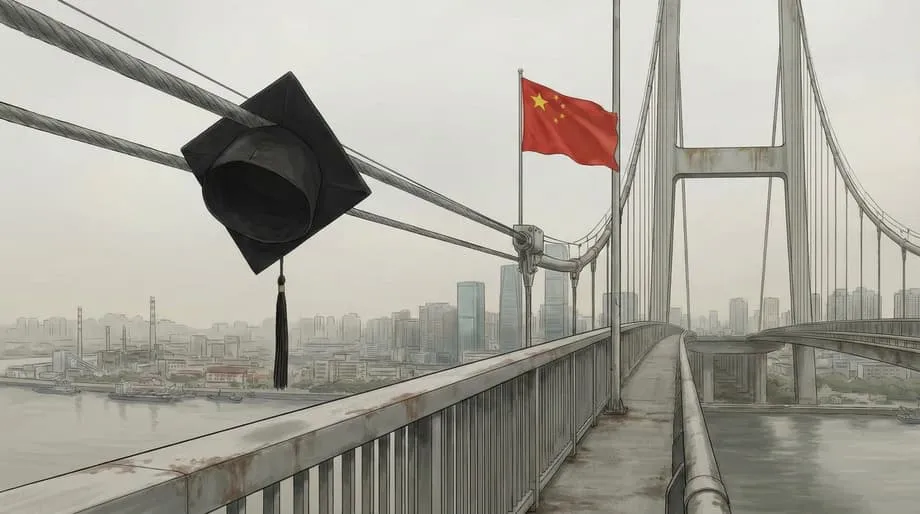
Zheng Hehui defended his doctoral work at Southeast University in Nanjing last month with something more tangible than a conventional dissertation: reinforced steel blocks designed to fit together like Lego pieces and form enormous bridge pylons. The components now support a bridge carrying trains and road traffic across the Yangtze River.
Contents
- A Doctorate Built for the Yangtze
- From a Technician's Problems to a Doctoral Defence
- How the Reform Took Shape
- Why Publication Pressure Matters
- Technology Restrictions Give Training New Urgency
- Two Mentors and a Different Examination
- University Partnerships Reach Into Industry
- Building, Spreading and Using Technology
- The Hard Part Is Judging the Result
- Key Points
The bridge uses cables to help support its deck, with pylons serving as the main towers. Zheng's work therefore connects his academic examination to infrastructure already carrying the demands of a major construction project. His defence focused on an engineered product rather than a thick written thesis destined for a university library.
As of February 11, 2026, at least 11 engineers have earned doctorates through China's new practical route since September. Their work includes Zheng's bridge components, a firefighting system for large seaplanes, and advanced welding equipment for nuclear power applications.
A degree law passed in 2024 allows universities to award engineering doctorates for industrial work such as physical prototypes, new manufacturing techniques and major project installations instead of traditional written dissertations. The first graduates show how that legal change is beginning to affect the work students submit and the achievements universities recognise.
China's objective is to train what officials call "elite engineers": people who can solve difficult industrial problems and turn technical knowledge into functioning equipment. The shift comes as the world's second largest economy faces technological restrictions and an intensifying trade war with the United States. It also challenges a university culture in which publication counts have often carried more weight than practical results.
From a Technician's Problems to a Doctoral Defence
Wei Lianfeng, a researcher at the Nuclear Power Institute of China, became the first graduate under the scheme at the Harbin Institute of Technology in September. His doctoral work involved developing vacuum laser welding processes and manufacturing the equipment needed to use them.
Vacuum laser welding uses a laser to join materials in an environment from which air has been removed. For Wei, the research grew out of specific technical problems encountered during more than a decade of progression from technician to technical expert. His experience supplied the problems; the doctoral project supplied processes and equipment intended to solve them.
Zheng's bridge blocks and Wei's welding systems illustrate the range of work the new route can recognise. One concerns the construction of large infrastructure. The other concerns an industrial manufacturing process used in nuclear power applications. The seaplane firefighting project adds another example of engineering assessed through an operational system.
The change is broader than replacing a bound document with a machine. Universities must decide whether a candidate's contribution deserves a doctorate when its value lies in a design, a process or a working installation. Students must demonstrate that their work functions in practical conditions and can operate at the scale required by industry.
How the Reform Took Shape
The practical doctorate sits within a larger effort to change engineering education. Since 2022, the Ministry of Education has launched pilot programmes in 18 critical fields, including electronics, information technology and semiconductors.
The sequence also places the reform alongside growing concern about research misconduct and the incentives attached to publishing:
- 2022: Ministry of Education pilots began in 18 critical fields. Reports also confirmed that China had overtaken the United States in total scientific research output and studies described as having high impact.
- 2023: More than 10,000 academic papers were retracted globally. Analyses indicated that a substantial portion involved Chinese co-authors.
- Early 2024: A genetics journal retracted 18 papers from China in one action over ethical concerns about DNA collection.
- 2024: China passed the degree law enabling the practical route. The country also graduated more than 97,000 PhD students that year.
- September 2025: Wei became the first graduate under the scheme at the Harbin Institute of Technology. At least 11 engineers have obtained doctorates through the route since September.
- January 2026: Zheng defended his bridge component project at Southeast University in Nanjing.
The National Excellence Engineer Training Program gives the effort a much larger institutional base than the first group of graduates might suggest. It involves 50 newly established graduate colleges for engineers, 20,000 enrolled students, 60 participating universities and more than 100 enterprises.
Why Publication Pressure Matters
China's rise in research output brought international standing, but a heavy reliance on publication volume also created damaging incentives. Cash rewards and professional titles were often tied directly to the number of papers researchers published. Under that pressure, obtaining another journal article could become a career requirement.
Businesses known as paper mills exploited those demands. They sold ghostwritten articles, fabricated data and places on author lists to researchers seeking to meet publication quotas. Investigations found firms operating much like ordinary businesses, charging thousands of dollars to guarantee publication in recognised journals.
The more than 10,000 global retractions in 2023 showed the scale of the problem facing academic publishing. Alongside the genetics journal's withdrawal of 18 papers from China in early 2024, other publishers were forced to close entire special issues overwhelmed by fabricated science. The DNA collection case also exposed ethical problems in how research was conducted.
Critics have used the label "Paper Generals", associated with the Mandarin expression "zhishang tanbing", for researchers with impressive citation records and success in winning grants whose work fails when put into practice. The criticism is aimed at the gap between academic standing and useful technical capability.
New regulations already punish research misconduct. The practical doctorate seeks to change the reward structure itself: an engineer whose graduation depends on a functioning welding system or bridge component has less reason to purchase a paper to satisfy a publication requirement. Its intended contribution to tackling paper mills is to reduce demand for the products they sell.
That ambition helps explain why the reform combines changes in assessment with industrial training. A different graduation route can redirect effort towards building and testing, while universities still face the task of judging whether the result meets doctoral standards.
Technology Restrictions Give Training New Urgency
Chinese officials describe some of the programme's targets as "bottleneck" problems. These are technological choke points where dependence on foreign imports can limit what domestic industries can produce. Electronics, information technology and semiconductor manufacturing are among the fields selected for the pilots.
The pressure intensified when the United States, under the Biden administration, assembled a coalition with the Netherlands, South Korea and Japan to restrict China's access to the most advanced semiconductor manufacturing equipment. Extreme ultraviolet lithography, usually shortened to EUV, became a central focus of those restrictions.
EUV machines help produce the most advanced chips by using light with a wavelength of 13.5 nanometres. Generating that light requires powerful lasers to strike microscopic droplets of tin, creating plasma. Special mirrors built from multiple layers then reflect the light, with manufacturing precision approaching the scale of atoms.
Dutch manufacturer ASML is the only company to have commercialised these systems. Recreating them requires expertise across many disciplines and the ability to make their components work together as an industrial machine.
Once commercial access to EUV systems was closed, China faced a choice between accepting exclusion from the most advanced chip manufacturing processes and trying to reproduce one of the most complex industrial systems ever built. The decision to pursue domestic EUV capability reflected the strategic cost of lacking the technology, rather than confidence that success would come quickly.
China has produced a substantial share of the world's doctorates over the past two decades in disciplines that feed advanced chip manufacturing. Those fields include optics, photonics, materials science, plasma physics and control systems. Yet large numbers of academic qualifications have not automatically supplied the ability to build the required hardware.
Li Jiang, an information scientist at Nanjing University, has described a substantial gap between the theoretical knowledge students learn from books and the practical ability society needs from them. The practical doctorate is designed to address that gap by making an industrial solution the central achievement on which a candidate is assessed.
Two Mentors and a Different Examination
Students in the practical programmes work with two supervisors. One provides academic guidance and theoretical foundations. The other brings experience from industry. This arrangement responds to a weakness in engineering education: many university engineering professors have spent their careers in academia without working in industry.
The two supervisors are expected to connect the reasoning behind a solution with the demands of making it work. A promising laboratory result must survive practical constraints, while industrial experience must be supported by the intellectual rigour expected of doctoral study.
Oral examination panels include scholars and practising engineers. Candidates must show that their prototypes are viable in real applications and at scale, rather than functioning only under laboratory conditions. The assessment therefore asks both how the work was developed and whether it can meet the demands of use.
Zong Yingying, executive vice-dean of the graduate school at the Harbin Institute of Technology, argues that conventional thesis requirements have held innovation back. Some engineering problems fit poorly into the traditional dissertation format, and some work is unsuitable for publication. In certain cases, the solution is contained in the technology itself.
The 2024 degree law provides a framework for recognising such work, including new welding techniques or microchip designs, instead of requiring a conventional written thesis. The Harbin Institute of Technology is also one of the "Seven Sons of National Defence", a group of universities known for military research.
University Partnerships Reach Into Industry
Tsinghua University in Beijing has partnered with 56 companies across 14 key sectors over the past three years. Through the programme, it has recruited 1,430 graduate students who have secured more than 100 patents while working on industrial problems.
Those figures show the scale of cooperation at one university. Companies bring practical problems into graduate education, while students work on designs and technologies that can produce patents as well as academic qualifications.
Northwestern Polytechnical University in Xi'an works with 16 major Chinese groups. They include China North Industries Group, which manufactures weapons and military equipment. Such relationships connect parts of the engineering training effort with national defence as well as commercial industry.
The combination of company partnerships, industrial supervisors and practical examinations gives universities several points of contact with engineering outside campus. It also makes the quality of participating companies and mentors central to the quality of the education students receive.
Building, Spreading and Using Technology
Industry partnerships are already part of doctoral education in Europe and the United States. Students may conduct research with a company or receive commercial sponsorship, but industrial PhD programmes there generally still require a traditional written thesis contributing to scientific knowledge. Published papers often remain part of the expected output.
China's practical route gives the engineering result itself a central place in academic assessment. Its emphasis is on the ability to manufacture, adapt and scale a technology, alongside the knowledge needed to develop it.
The approach highlights a difference between discovery and diffusion. Discovery produces new knowledge or an invention. Diffusion spreads a technology through factories, infrastructure and other parts of the economy, with people learning to use it, modify it and make it reliable.
The historical comparison offered by the United States during the Second Industrial Revolution is instructive. Its industrial strength came from more than being first to invent electricity or power tools. Technical institutes, universities established through land grants, vocational schools and applied engineering programmes helped train millions of people to use, adapt and deploy technologies across the economy.
China's programme follows a similar logic: advanced knowledge has greater economic value when enough engineers can turn it into usable industrial capacity. The bridge blocks and welding equipment make that idea concrete, linking doctoral achievement to the deployment of technology.
Europe's deep technology sector illustrates the concern motivating this approach. The European Union excels in frontier research but has struggled to turn breakthroughs into capability spread across its economy. Education and research systems that reward novelty more than the absorption and deployment of technology can leave a gap between invention and widespread use.
China's experiment places manufacturing, repeated improvement and expansion of production closer to the centre of doctoral training. The strategic argument is that, in a coming technological cycle, the ability to train people to use technology widely may matter as much as being the first to invent it.
The Hard Part Is Judging the Result
Universities face a difficult assessment problem. A dissertation can be judged against familiar academic criteria, but a welding process or a set of bridge components requires different evidence. Examiners must decide how well the product works and whether the candidate's contribution represents a substantial advance for an industry.
A working object makes some achievements visible, yet the value of practical innovation can still be difficult to measure. A design may depend on improvements in manufacturing, reliability or installation that are less easily captured by the usual academic measures.
Industrial supervisors create another quality control challenge. If the experts recruited by universities lack the necessary technical ability or ethical standards, the education and degrees they help deliver will suffer. The model depends heavily on the competence of practising engineers involved in supervision and examination.
The first graduates also remain a very small group beside China's total doctoral output. At least 11 practical doctorates have been awarded since September, while more than 97,000 PhD students graduated nationwide in 2024. The figures cover different periods, but show how limited the new route remains compared with the established system.
Within the pilot programme, 67 students applied for degrees based on designs, proposals and case reports. That is a broader group than the engineers already reported to have graduated, giving universities more submissions through which to develop their assessment methods.
Sun Yutao, a researcher at Dalian University of Technology, believes the route is unlikely to extend to foundational subjects such as theoretical physics or pure mathematics, where theory remains the main form of academic contribution. Other possibilities include fields combining engineering and applied science, such as advanced medical device design and intelligent diagnosis.
Expansion into those areas is a possibility rather than a settled decision, and no timetable has been given. The engineering pilots will provide the first test of whether universities can recognise useful industrial achievements while maintaining demanding doctoral standards.
Key Points
- A degree law passed in 2024 allows engineering doctorates based on practical industrial work instead of traditional written dissertations.
- At least 11 engineers have earned degrees through the route since September, with projects covering bridge components, seaplane firefighting and nuclear welding equipment.
- The wider training programme involves 50 new graduate colleges, 20,000 students, 60 universities and more than 100 enterprises.
- The reform seeks to reduce dependence on publication counts and train engineers to address technological bottlenecks.
- Students have academic and industrial supervisors, and examination panels include scholars and practising engineers.
- Universities must develop reliable ways to judge practical innovation, while the quality of industrial mentors remains a central concern.
- The practical route remains small beside China's more than 97,000 PhD graduates in 2024; expansion beyond engineering has no announced timetable.