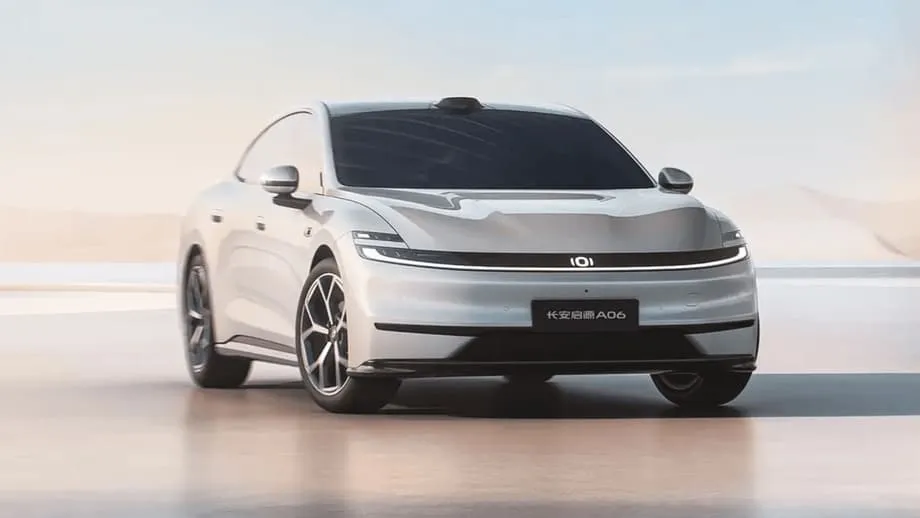
A 45 kWh Battery Takes on the Cold
Changan Automobile and battery maker CATL have unveiled a sodium-ion version of the Nevo A06 sedan, with a 45 kWh Naxtra battery and approximately 400 kilometers of range under China's CLTC testing cycle. Announced at a strategic launch event in Yakeshi, Inner Mongolia, the vehicle is scheduled to enter production and reach the Chinese market around mid 2026.
Contents
- A 45 kWh Battery Takes on the Cold
- Why Sodium Has Taken Decades to Reach Cars
- How the Battery Fits Into the Sedan
- What the Winter Tests Show
- Drilling, Compression and Sawing Tests
- Materials, Mining and Recycling
- Abundant Sodium and the Cost Calculation
- A Large Expansion Is Being Projected
- Why Lithium Remains Part of the Plan
- Changan's Rollout Extends Beyond One Model
- The Schedule From Development to Showrooms
- Key Points
As of February 11, 2026, the companies are presenting the sedan as the first passenger vehicle intended for mass production to use sodium-ion batteries. Its central attraction is winter performance: CATL says the battery retains more than 90 percent of its usable capacity at minus 40 degrees Celsius, can charge at minus 30 degrees Celsius and maintains operational stability down to minus 50 degrees Celsius.
The Nevo A06 brings an alternative to lithium into a vehicle designed for everyday transport. Its range places it alongside lithium iron phosphate batteries already widely used in the entry level electric vehicle market, while its resistance to extreme cold targets places where winter can make electric driving difficult.
Changan and CATL describe the project as a move from laboratory development toward commercial use, rather than an experimental prototype or a limited production showcase. Customer experience will follow the planned market launch; the performance figures announced so far come from development and validation testing.
The partnership also addresses a second concern for manufacturers: dependence on concentrated mineral supply chains. Sodium offers a different raw material base, giving automakers another way to choose batteries according to climate, price and driving requirements.
Why Sodium Has Taken Decades to Reach Cars
Sodium-ion battery research dates back to the 1980s, but early designs struggled to store enough energy for their weight and to withstand repeated charging and discharging. Recent advances in electrode materials and electrolyte formulations have addressed technical barriers that previously limited automotive use.
A sodium-ion battery works on principles similar to a lithium-ion battery. During charging and discharging, ions move between electrodes. Replacing lithium with sodium changes the materials involved and the battery's performance, including how much energy it stores and how it behaves in low temperatures.
CATL's Naxtra cells achieve an energy density of 175 watt-hours per kilogram. Energy density describes how much energy a battery can store for a given weight. The figure is roughly comparable to current lithium iron phosphate technology, although it remains below the density of batteries using chemistries rich in nickel.
The Nevo A06 project follows nearly three years of intensive development since CATL first announced its sodium-ion roadmap. CATL's broader work on the technology stretches back nearly a decade, reflecting the time needed to turn a promising chemistry into something a manufacturer can produce consistently for vehicles.
How the Battery Fits Into the Sedan
The Naxtra battery uses a Cell to Pack architecture, which integrates cells directly into the battery pack instead of first assembling them into separate modules. Conventional modular designs place groups of cells in their own enclosures before those groups are installed in the larger pack.
CATL's approach bonds the cells directly to the structure. Removing intermediate modules reduces structural weight and complexity, improves the use of available space and helps thermal management. Better packaging helps compensate for sodium chemistry's lower energy storage per unit of volume.
The 45 kWh pack installed in the Nevo A06 weighs approximately 257 kilograms. Its capacity and packaging make it suitable for compact vehicles and sedans of moderate size, where drivers may accept a shorter range in exchange for other benefits.
CATL's packaging efficiency helps the sodium system deliver competitive range despite storing fewer watt-hours per kilogram than advanced nickel cobalt aluminum formulations. The engineering choice matters because a vehicle carries the complete pack, including its supporting structure, rather than individual cells alone.
The company has allocated more than 10 billion yuan to sodium-ion research and produced nearly 300,000 test cells during validation. Its specialist team includes more than 300 researchers, among them 20 doctoral specialists, working on the challenges of scaling the chemistry for automotive production.
CATL says that preparation has produced a battery meeting passenger vehicle certification standards, a first for sodium technology. Dedicated production lines and supply chain partnerships are also part of its commitment to commercial deployment.
What the Winter Tests Show
Yakeshi's testing grounds provided temperatures consistently below minus 30 degrees Celsius. The location allowed Changan and CATL to evaluate the Nevo A06 in severe winter conditions, beyond laboratory testing, as part of validation work covering different terrain.
CATL says the Naxtra system can charge at minus 30 degrees Celsius and remains operationally stable at minus 50 degrees Celsius. At minus 40 degrees Celsius, it retains more than 90 percent of its usable capacity, a level described as difficult for conventional lithium iron phosphate cells to achieve.
The battery also delivers nearly three times the discharge power of comparable lithium iron phosphate packs at minus 30 degrees Celsius. Discharge power is the rate at which a battery supplies energy, making it relevant to both the drivetrain and the heating system when the weather is exceptionally cold.
Conventional lithium batteries can lose half their effective range in extreme winter conditions. Drivers in cold regions have consequently adjusted their habits, including reducing cabin heating and limiting highway speeds to conserve charge. CATL's sodium system is intended to reduce those compromises and support normal winter operation.
Regions where winter temperatures regularly fall below minus 20 degrees Celsius are a particular target. CATL identifies northern China, the American Midwest and Nordic countries as suitable markets, linking the technology's cold resistance to places where winter performance has discouraged some potential electric vehicle buyers.
For those drivers, charging capability and usable power can matter as much as a headline range figure. A battery that continues supplying energy to heating and propulsion in severe cold addresses daily usability, especially during prolonged winters.
Drilling, Compression and Sawing Tests
CATL subjected the Naxtra battery to abuse tests exceeding national safety standards. Those included compression from multiple directions, penetration with an electric drill and completely sawing through a fully charged pack.
The company says the battery produced no smoke, fire or thermal runaway during those tests, and continued discharging normally after being physically severed. Thermal runaway is the dangerous overheating process associated with battery fires; resistance to it is a central part of the safety case presented for Naxtra.
Sodium compounds are described as remaining stable under abuse conditions that would compromise lithium systems. The chemistry is presented as reducing thermal runaway risk compared with both nickel manganese cobalt and lithium iron phosphate alternatives, with a potential reduction in fire risk during collisions or when manufacturing defects occur.
CATL's demonstrations support its case for physical durability as well as temperature resilience. The announced testing combines two practical concerns for vehicle owners: whether a battery can keep operating through severe weather and how it responds when damaged.
Materials, Mining and Recycling
Sodium-ion technology also changes the mix of minerals needed for batteries. Some formulations eliminate cobalt and reduce copper requirements, decreasing dependence on minerals associated with problematic mining practices.
CATL has not fully disclosed the proprietary composition of its Naxtra cells. The broader shift toward sodium is nevertheless being presented as a response to concerns about the ethical and environmental effects of lithium extraction in some regions.
Materials used in sodium-ion batteries are described as carrying lower toxicity concerns and requiring less intensive processing for recycling or disposal than lithium chemistries containing heavy metals. Those properties suggest potential environmental benefits across the vehicle's life.
Comprehensive recycling infrastructure for sodium batteries remains under development. The technology's eventual handling at the end of its useful life will therefore require systems capable of collecting and processing the batteries as production expands.
Abundant Sodium and the Cost Calculation
Sodium occurs approximately 1,000 times more abundantly than lithium in the Earth's crust and is distributed across diverse geographic regions. That availability offers a way to reduce exposure to the supply bottlenecks and price swings associated with lithium carbonate.
Lithium carbonate reached 170,000 yuan per ton earlier in 2026, compared with roughly 50,000 yuan in 2021. Such changes affect the raw material economics behind batteries and help explain manufacturers' interest in a chemistry based on a more abundant element.
Early estimates put costs for sodium battery packs of the first generation at approximately $77 per kilowatt-hour, with a possible decline to $40 per kilowatt-hour for the second generation. The comparison given for current lithium iron phosphate packs is an average of around $81 per kilowatt-hour.
Those estimates suggest a relatively small initial cost advantage and a much larger possible reduction as the technology develops. Actual costs of integrating a battery into a vehicle vary considerably by manufacturer, so pack price is only part of the calculation.
CATL says production at scale could lower prices for entry level electric vehicles and make them accessible to more consumers. Sodium's geographic distribution could also allow battery production to expand in regions currently outside the lithium supply chain, potentially reducing shipping costs and the carbon footprint of raw material transport.
For automakers, diversification has a strategic value alongside possible savings. Access to another battery chemistry reduces reliance on a single mineral supply and creates more choices when planning manufacturing capacity.
A Large Expansion Is Being Projected
CATL projects sodium-ion shipments growing from 9 gigawatt-hours in 2025 to more than 1,000 gigawatt-hours within four years. That would represent an exceptionally rapid expansion for an emerging battery technology.
The planned capacity would serve vehicles and stationary energy storage. In stationary systems, batteries stay in one place, so weight and volume are less restrictive than they are in a car. Cost and safety can consequently carry greater weight in the choice of chemistry.
Precedence Research estimates that the global sodium-ion battery market will grow from $1.39 billion in 2025 to $6.83 billion by 2034, with 2026 marking an inflection point for automotive applications. Both that market estimate and CATL's shipment figures are projections of future growth.
CATL also expects future Naxtra versions to support 500 to 600 kilometers of range in vehicles powered entirely by batteries. It says extended range and hybrid configurations could reach 400 kilometers on electric power alone.
Why Lithium Remains Part of the Plan
CATL describes the launch as the beginning of a dual chemistry era, with manufacturers choosing sodium or lithium according to the application. Sodium is being positioned for extreme temperatures, urban commuting, moderate range requirements and market segments where price is a priority.
Lithium remains central to vehicles requiring longer range and rapid charging, particularly through advanced formulations rich in nickel and phosphate variants with high energy density. CATL announced lithium battery advances alongside the sodium project, showing that it is pursuing both technologies.
The lithium development includes a 5C charging pack capable of charging from empty to full in approximately 12 minutes. A 5C rate describes charging fast enough, in theory, to replenish a battery's capacity in one fifth of an hour.
CATL says that lithium system retains 80 percent of its capacity after 3,000 cycles, equating to more than one million miles of service life. Its stated priorities are rapid replenishment and longevity, while Naxtra's central strengths are cold resistance and thermal stability.
The proposed 12 minute recharge could fit into a brief rest stop, addressing another common concern among potential electric vehicle buyers. Offering both systems gives automakers a way to match batteries to actual use patterns, rather than using one specification for every customer.
Changan's Rollout Extends Beyond One Model
Changan plans to introduce sodium-ion options across Avatr, Deepal, Qiyuan and Uni. The Nevo A06, also known as the Qiyuan A06, is the first announced production application in this partnership, but the wider brand plan signals a broader commitment.
The A06 platform previously launched with lithium iron phosphate options offering up to 630 kilometers of range. The sodium version's approximately 400 kilometers under China's CLTC cycle targets a different priority: dependable cold weather performance rather than the platform's maximum range specification.
Changan has also announced expansion of its Choco-Swap battery exchange network to more than 3,000 stations across 140 Chinese cities. The plan places particular attention on northern regions, where winter temperatures affect battery performance, and is intended to support deployment of vehicles equipped with sodium batteries.
The initial vehicle rollout remains focused on China. Changan operates in 117 international markets and sold nearly three million vehicles in 2025, giving it substantial volume to support the tooling needed for sodium-ion manufacturing.
Additional validation programs will examine performance in Southeast Asian humidity and at European alpine altitudes. Those planned tests extend the reliability assessment beyond Yakeshi's cold conditions, with the aim of meeting standards comparable to established lithium systems before vehicles reach customers.
The Schedule From Development to Showrooms
Mid 2026 is the announced window for production and the Chinese market launch. No exact launch date has been given. The transition from validation to volume manufacturing is the next scheduled step for the Nevo A06 sodium variant.
The project's chronology shows how a long period of research is converging with near term commercial plans:
- 1980s: Research into sodium-ion batteries begins, with energy density and cycle life limiting early automotive applications.
- Nearly a decade before the planned launch: CATL begins the broader development effort behind its sodium technology.
- Nearly three years before the planned launch: CATL announces its sodium-ion roadmap, followed by intensive development for the vehicle project.
- 2025: CATL's shipment projection uses 9 gigawatt-hours as its starting point; Changan sells nearly three million vehicles.
- February 11, 2026: The announced Nevo A06 sodium program points toward production and a Chinese launch around mid 2026.
- 2034: Precedence Research projects the global sodium-ion market reaching $6.83 billion.
As sodium technology matures and its supply chains develop, similar vehicles could emerge from Western manufacturers seeking to address winter performance complaints. The immediate commercial test, however, is Changan's planned Chinese launch and whether sodium's combination of cold resistance, safety and potential cost savings finds a place alongside lithium.
Key Points
- Changan and CATL plan to launch the Nevo A06 sodium-ion sedan in China around mid 2026, presenting it as the first passenger car intended for mass production with this chemistry.
- The 45 kWh Naxtra pack provides approximately 400 kilometers of CLTC range; its cells achieve 175 watt-hours per kilogram.
- CATL says the battery retains more than 90 percent usable capacity at minus 40 degrees Celsius and can charge at minus 30 degrees Celsius.
- Compression, drilling and sawing tests produced no smoke, fire or thermal runaway, according to CATL.
- Sodium's abundance offers supply diversification and potential cost reductions, while recycling infrastructure remains under development.
- Changan plans sodium options across Avatr, Deepal, Qiyuan and Uni, alongside expansion of its Choco-Swap network.
- CATL is developing sodium and lithium in parallel, matching cold resistance, range, charging speed and cost to different vehicle needs.