Factories approach full capacity as sales reach $3.19 billion
Semiconductor Manufacturing International Corp. reported revenue of $3.19 billion for the three months ended September 30, 2026, as rising wafer shipments pushed factory utilisation to 97.3%. The Chinese chipmaker's gross margin reached 29.9%, beating its own forecast, although it expects a lower margin in the fourth quarter even as sales keep growing.
Contents
- Factories approach full capacity as sales reach $3.19 billion
- More wafers leave increasingly busy plants
- Industrial and automotive chips gain ground
- China supplies more than nine tenths of revenue
- Why stronger operations produced lower quarterly profit
- Two accounting frameworks produce different headline figures
- Research spending rises while cash generation slows
- Fourth quarter sales may rise as margins retreat
- The dates behind the results
- Key Points
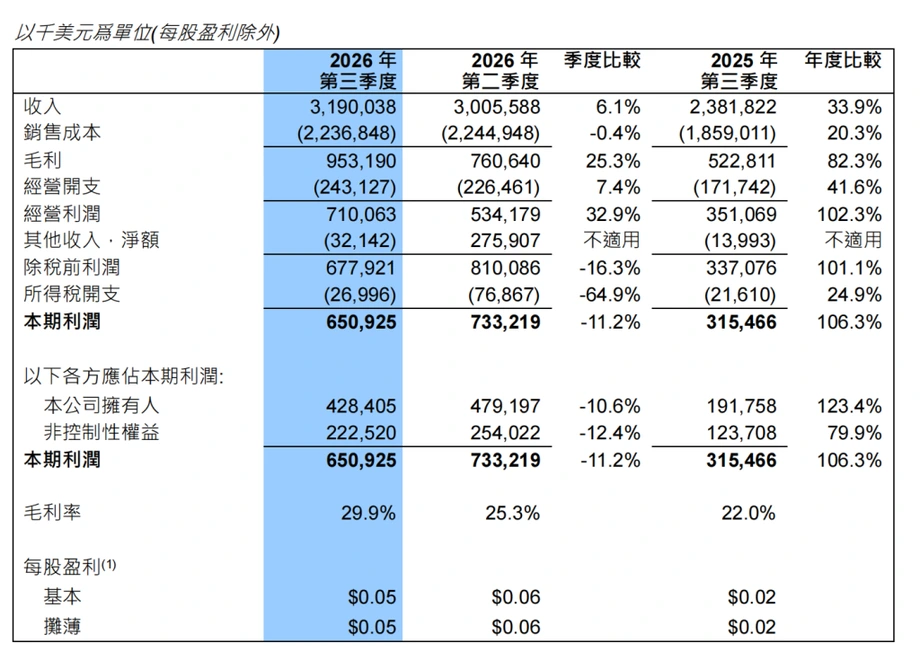
SMIC disclosed the unaudited results on November 12. Revenue rose 33.9% from $2.3818 billion a year earlier and 6.1% from $3.0056 billion in the second quarter. Gross profit increased to $953.2 million, up 82.3% from a year earlier and 25.3% from the preceding quarter.
The results exceeded the company's August guidance for revenue growth of 2% to 4% from the second quarter and a gross margin of 26% to 28%. Revenue also surpassed the $3.09 billion expected by analysts in LSEG data, while profit attributable to shareholders of $428.4 million beat the $418.4 million forecast.
China accounted for 90.8% of revenue, and industrial and automotive customers took a much larger share of wafer sales than a year earlier. Those changes show where the company's expanding business is coming from: increasingly domestic customers, with a greater contribution from applications beyond smartphones.
Shareholder profit more than doubled from a year earlier but fell 10.6% from the second quarter. The contrast between stronger factory earnings and lower quarterly net profit reflects a sharp reversal in income associated with investments, alongside rising research spending.
More wafers leave increasingly busy plants
SMIC shipped 3,033,700 wafers measured as equivalents of standard wafers eight inches across. Shipments rose 5.7% from the second quarter and 21.4% from a year earlier. A wafer is a thin disc on which many chips are manufactured; using an equivalent size lets the company compare output from factories processing different wafer sizes.
Monthly production capacity increased to 1,116,750 equivalent wafers from 1,096,500 in the second quarter. That added 20,250 wafers of monthly capacity, an increase of about 1.8%. Shipments grew faster than capacity, while utilisation rose from 93.7% to 97.3%.
Utilisation measures how intensively a factory's production capacity is being used. SMIC's figure was also above the 95.8% recorded a year earlier. For a business with expensive buildings and machinery, running more production through existing facilities can spread manufacturing costs across more wafers.
SMIC attributed its revenue growth mainly to increased wafer shipments. It linked the improvement in gross margin to higher utilisation and changes in its product mix, meaning the combination of products it manufactures for customers.
The Shanghai company operates factories processing wafers eight and 12 inches across in Shanghai, Beijing, Tianjin and Shenzhen. Wafer manufacturing accounted for 95.9% of quarterly revenue. Services including photomask manufacturing and testing supplied the remaining 4.1%; photomasks carry the patterns used to create chip circuits.
Industrial and automotive chips gain ground
Consumer electronics remained SMIC's largest application category, accounting for 40.6% of wafer revenue in the third quarter. Industrial and automotive applications reached 19.3%, up from 16.5% in the second quarter and 11.9% a year earlier.
The annual increase was 7.4 percentage points. Put simply, industrial and automotive applications generated about $19 of every $100 in wafer revenue, compared with about $12 a year earlier. Their share increased by more than half relative to its earlier level.
Computers and tablets contributed 18.3% of wafer revenue, up from 15.2% a year earlier. Smartphones moved in the opposite direction, falling to 14.3% from 16.9% in the second quarter and 21.5% a year earlier.
Industrial and automotive applications therefore overtook smartphones as a source of wafer revenue. Computers and tablets also contributed more than smartphones. These percentages describe how sales are divided among customer applications; the company attributed the quarter's margin improvement partly to this changing mix without publishing a profit margin for each category.
China supplies more than nine tenths of revenue
China's share of SMIC's total revenue increased to 90.8%, compared with 90.2% in the second quarter and 86.2% a year earlier. Applying that share to quarterly revenue gives approximately $2.90 billion in sales associated with China.
The share from outside China consequently fell to 9.2%, from 13.8% a year earlier. The Americas accounted for 7.8%, down from 10.8% a year earlier. Together, the figures show that SMIC's growing sales have become more concentrated in its domestic market.
For SMIC, the practical result is that decisions by Chinese customers carry increasing weight in factory demand. Management said it would pursue capacity expansion according to customer needs and seek growth through a product mix with higher value.
The geographical and application figures describe different parts of the business. Geography divides total revenue by market, while the consumer electronics, automotive, computer and smartphone categories divide wafer revenue by its intended use.
Why stronger operations produced lower quarterly profit
SMIC's gross margin rose to 29.9% from 25.3% in the second quarter and 22% a year earlier. Gross margin is the share of revenue left after direct manufacturing costs, before expenses such as research and other items further down the income statement.
The annual improvement was 7.9 percentage points. At the third quarter's revenue level, each percentage point of gross margin represents about $31.9 million in gross profit. That helps explain why gross profit grew much faster than sales.
Operating profit reached $710.1 million, increasing 32.9% from the second quarter and 102.3% from a year earlier. Other operating income, driven by government funding recognised during the period, rose to $155 million from $112.6 million.
Further down the accounts, other income swung from a gain of $275.9 million in the second quarter to a net loss of $32.1 million. Results from associates and a joint venture shifted from a gain of $193.8 million to a loss of $23 million, reflecting smaller investment gains.
Total profit for the period was $650.9 million, up 106.3% from a year earlier but down 11.2% from the second quarter. The portion attributable to SMIC's shareholders was $428.4 million, up 123.4% annually but down 10.6% quarterly. Total group profit includes amounts belonging to other shareholders in subsidiaries, which explains why the two profit measures differ.
Two accounting frameworks produce different headline figures
SMIC also published unaudited results prepared under Chinese accounting standards. Those figures put third quarter revenue at 21.983 billion yuan, up 28.1% from a year earlier, and profit attributable to shareholders at 2.847 billion yuan, up 87.6% annually and down 8.35% from the preceding quarter.
The dollar results were prepared under International Financial Reporting Standards. Their annual growth rates were higher: 33.9% for revenue and 123.4% for profit attributable to shareholders. Each set of figures should be followed within its own accounting framework when comparing performance over time. A detailed reconciliation between the two sets of results was not provided.
Under Chinese accounting standards, profit attributable to shareholders after excluding nonrecurring gains and losses was 2.639 billion yuan, an increase of 107.3%. This measure removes items classified as outside ordinary recurring business, giving readers another view of earnings growth.
For the first nine months of 2026, revenue under Chinese accounting standards reached 60.618 billion yuan, up 22.4%. Profit attributable to shareholders was 7.314 billion yuan, up 91.6%. Basic earnings per share were 0.33 yuan for the third quarter and 0.91 yuan for the first nine months.
Research spending rises while cash generation slows
Research and development spending reached $258.4 million, up 23.9% from $208.5 million in the second quarter and 27.2% from a year earlier. Research spending consumed about 8.1% of quarterly revenue.
Capital expenditure, the money spent on assets such as facilities and equipment, fell to $1.0943 billion from $1.8357 billion in the second quarter. That was a decline of about 40.4%, even as the company's monthly production capacity increased.
Cash generated from operations fell to $1.18 billion from $2.52 billion. Operating cash flow tracks money moving through the business rather than accounting profit, making it an important measure of the funds available for investment and other commitments.
Receivables, money customers owe the company, increased to $2.29 billion at the end of September from $1.51 billion at the end of June. Inventories rose to $4.83 billion from $4.36 billion. Those increases placed more money in unpaid customer bills and goods held within the business.
SMIC ended September with $8.3 billion in cash and cash equivalents and $14.9 billion in debt. Its reported net debt measure rose to $1.50 billion from $162.3 million at the end of June. The cash, debt and net debt figures use different financial categories, so the reported net debt measure needs to be considered alongside the broader balance sheet totals.
Fourth quarter sales may rise as margins retreat
SMIC forecast fourth quarter revenue growth of 4% to 6% from the third quarter. Applied to $3.19 billion, that implies sales of approximately $3.318 billion to $3.381 billion.
The company expects gross margin of 26% to 28%, below the third quarter's 29.9%. The forecast therefore points to a business selling more while retaining a smaller share of each sales dollar after direct manufacturing costs.
Combining the revenue and margin ranges gives an illustrative gross profit range of approximately $863 million to $947 million. Even the upper end is slightly below the third quarter's $953.2 million. This calculation uses the endpoints of management's guidance rather than a separate company forecast for gross profit.
Management said it would align expansion with customer demand and build its position through products with higher value. The next quarter will bring that strategy into focus: SMIC is seeking further revenue growth while managing the costs and production mix associated with a larger manufacturing business.
The dates behind the results
SMIC's results cover a quarter that ended more than a month before their publication. The sequence matters because the company exceeded the expectations it had set in August, then issued a more cautious margin forecast for the following quarter.
- Third quarter of 2025: Revenue was $2.3818 billion, gross margin was 22%, and factory utilisation was 95.8%.
- August 2026: SMIC forecast third quarter revenue growth of 2% to 4% from the preceding quarter and gross margin of 26% to 28%.
- September 30, 2026: The third quarter ended with monthly capacity of 1,116,750 equivalent wafers.
- November 12, 2026: SMIC disclosed quarterly results and its fourth quarter outlook.
- November 13, 2026: Management scheduled a results call for 8:30 a.m. Hong Kong time.
On November 12, SMIC's mainland shares closed 2.2% higher at 111.72 yuan, while its Hong Kong shares fell 0.53% to HK$48.74. Those trading sessions preceded the evening results disclosure.
Key Points
- Third quarter revenue reached $3.19 billion, up 33.9% from a year earlier and above company guidance and analyst expectations.
- Gross margin increased to 29.9%, helped by higher utilisation and a changing product mix.
- Factory utilisation reached 97.3%, while wafer shipments increased 21.4% from a year earlier.
- Industrial and automotive applications supplied 19.3% of wafer revenue; China accounted for 90.8% of total revenue.
- Profit attributable to shareholders rose 123.4% annually to $428.4 million but fell 10.6% from the preceding quarter as investment income weakened.
- SMIC expects fourth quarter revenue growth of 4% to 6%, with gross margin easing to 26% to 28%.