Two major banks move closer to a state capital injection
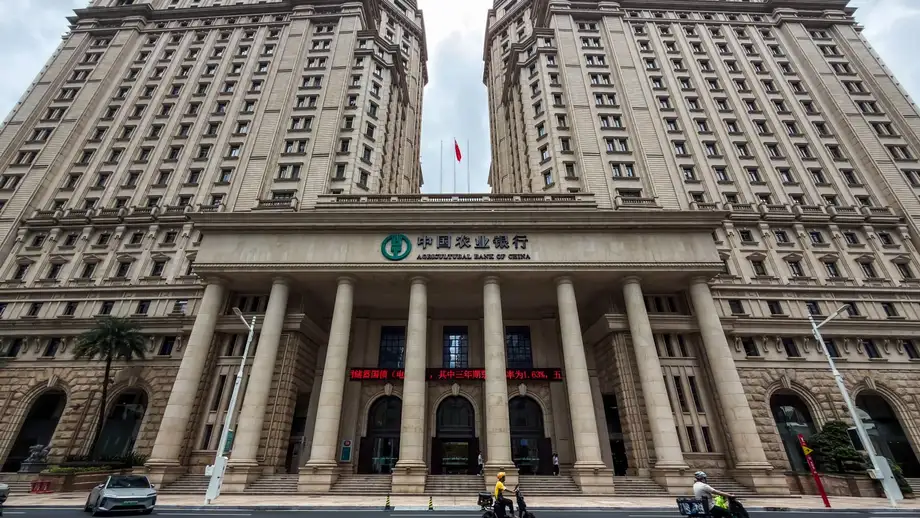
Industrial and Commercial Bank of China and Agricultural Bank of China cleared Shanghai Stock Exchange reviews on November 11, 2026, advancing plans to raise up to 260 billion yuan, about $39 billion, through share sales to the Ministry of Finance and tobacco industry investors.
Contents
- Two major banks move closer to a state capital injection
- Who is buying the new shares?
- How government borrowing funds the plan
- Why ICBC wants a larger buffer
- What Agricultural Bank could gain
- Six other institutions share 100 billion yuan
- How this round compares with 2025
- What changes for existing shareholders?
- More lending capacity meets weak demand
- Key Points
The exchange found that both applications met requirements for share issuance, listing and information disclosure, the banks announced. ICBC plans to raise up to 100 billion yuan and Agricultural Bank up to 160 billion yuan. After issuance expenses, all the proceeds would replenish Common Equity Tier 1 capital, the central financial buffer banks use to absorb losses.
Both banks still need registration approval from the China Securities Regulatory Commission before proceeding. They said the outcome and timing remain uncertain. Analysts expect the money to arrive in the fourth quarter, with November and December identified as likely months.
The two placements are the largest part of a broader 360 billion yuan capital increase covering eight state financial institutions. The Ministry of Finance plans to supply 300 billion yuan, financed through special treasury bonds, while China National Tobacco Corporation and related investors would provide the remaining 60 billion yuan.
The ministry's September capital announcement, published by its news office on September 7, said the eight institutions had stable asset quality and major regulatory indicators within safe and healthy ranges. It described the additional capital as support for prudent operations, stronger protection against risks and financing for the real economy, meaning businesses and households that produce, buy and use goods and services.
Who is buying the new shares?
The Ministry of Finance would contribute 200 billion yuan to the two banks, or about 77% of their combined fundraising target. Tobacco industry investors would supply 60 billion yuan, split equally between ICBC and Agricultural Bank.
ICBC's share issuance circular sets out a proposed 70 billion yuan subscription by the ministry and 10 billion yuan by China National Tobacco Corporation. China Tobacco Shanghai, China Tobacco Yunnan, China Tobacco Hunan and Hunan Tobacco would each subscribe for 5 billion yuan.
Agricultural Bank's proposed allocation is larger: 130 billion yuan from the ministry and 10 billion yuan from China National Tobacco Corporation. Jiangsu Tobacco, Zhejiang Tobacco and Hubei Tobacco would each contribute 5 billion yuan, Beijing Tobacco would invest 3 billion yuan and Shuangwei Investment would supply 2 billion yuan.
The banks would issue A shares, ordinary shares denominated in yuan and listed in mainland China, to these specified investors. This process is called a private placement. The named institutions provide cash directly to the banks in exchange for newly issued shares.
ICBC's subscribers must retain their new shares for five years from the completion of share registration. Its circular also says the Ministry of Finance and Central Huijin Investment would remain its two largest shareholders, with no change in control.
How government borrowing funds the plan
The Ministry of Finance is raising its contribution by selling 300 billion yuan of special treasury bonds. The government borrows from bond investors, then uses the proceeds to acquire capital in the financial institutions.
The first 150 billion yuan tranche was issued on October 8. It is a bond maturing in five years, carries a fixed interest rate and pays interest annually. Interest began accruing on October 9. A second tranche of 150 billion yuan, with a term of seven years, is scheduled for November 18.
The ministry's 300 billion yuan contribution covers the full group of eight institutions. Of that amount, 200 billion yuan is earmarked for ICBC and Agricultural Bank, leaving 100 billion yuan for the other six. Adding the tobacco investors' 60 billion yuan brings the complete package to 360 billion yuan.
The main steps announced so far are:
- September 6: The eight institutions disclosed their planned capital increases, including the two banks' share placements.
- September 7: The Ministry of Finance announced plans to issue 300 billion yuan of special treasury bonds.
- October 8: The first 150 billion yuan bond tranche was issued.
- November 11: ICBC and Agricultural Bank received favourable exchange review opinions.
- November 18: The second 150 billion yuan bond tranche is scheduled for issuance.
Zhou Guannan, cohead of Huachuang Securities Research Institute and its chief fixed income analyst, estimated that the capital injection process typically takes two to three months. The steps include corporate approvals, regulatory review, payment, verification of the new capital and registration of the additional shares.
Why ICBC wants a larger buffer
ICBC reported a Common Equity Tier 1 capital ratio of 13.21% at June 30, 2026. Its Tier 1 capital ratio was 14.43%, and its total capital adequacy ratio was 18.57%. The bank said all three met minimum regulatory requirements.
Common Equity Tier 1, usually shortened to CET1, consists mainly of ordinary shareholder capital and accumulated profits. Its ratio compares that capital with assets adjusted for risk. A loan judged more likely to generate losses generally requires a bank to hold more capital against it.
ICBC's circular identifies two pressures behind its proposed fundraising. Narrower interest margins have slowed its ability to accumulate capital from profits. The bank also faces a higher additional capital requirement after moving into a higher category of global banks whose failure could cause widespread disruption.
ICBC moved from Bucket 2 to Bucket 3 on the Financial Stability Board's 2025 list of global systemically important banks. Banks in the higher category must maintain an additional capital buffer because of their importance to the financial system.
The bank's asset quality figures provide further context. Its ratio of nonperforming loans, loans where borrowers are struggling to meet repayment obligations, was 1.29% at the end of June, down 0.02 percentage points from the end of 2025. Provisions set aside against possible loan losses stood at 217.58% of nonperforming loans, an increase of 3.98 percentage points.
ICBC is therefore seeking additional shareholder capital while its disclosed ratios remain within regulatory requirements. The money would give it more room to absorb losses, meet stricter requirements and support lending as profit growth contributes less to its capital base.
What Agricultural Bank could gain
Agricultural Bank's proposed 160 billion yuan increase is 60 billion yuan larger than ICBC's. A calculation accompanying the plan indicates that its CET1 ratio could rise from 10.8% at June 30 to 11.41% after the transaction, an increase of 0.61 percentage points.
That calculation assumes no issuance expenses and no change in assets adjusted for risk. If the bank expands lending or the risk profile of its assets changes, the final ratio would also change.
The practical benefit is greater capacity to lend within regulatory limits while retaining protection against losses. Capital supports a bank's balance sheet, allowing it to carry loans and other assets whose value may fall.
Lou Feipeng, a researcher at Postal Savings Bank of China, described the potential benefit for savers and borrowers:
Additional bank capital would strengthen their ability to absorb losses, increasing the safety margin for household deposits.
Lou also said stronger capital could improve financing conditions for mortgages, entrepreneurial financing and business loans. The eventual benefit to customers will depend on how banks use the additional capacity and on demand for borrowing.
Six other institutions share 100 billion yuan
The Export-Import Bank of China is due to receive a direct 30 billion yuan injection from the Ministry of Finance. China Life Insurance Group would receive 35 billion yuan, the largest allocation among the other six institutions.
People's Insurance Group of China plans to raise up to 15 billion yuan through an A share placement to the ministry. China Export & Credit Insurance Corporation, known as Sinosure, would receive 10 billion yuan, China Taiping Insurance Group 7 billion yuan and China Reinsurance Group 3 billion yuan.
Those six allocations total 100 billion yuan. Combined with the two large commercial banks, the package reaches institutions involved in ordinary lending, trade finance, insurance and reinsurance. Reinsurance is insurance bought by insurers to help them cover large claims.
The insurance sector has faced pressure from persistently low interest rates, which reduce the returns available on investments used to support future payments to policyholders. Its solvency ratio fell to 180.6% at the end of the second quarter, from 204.5% a year earlier, a decline of 23.9 percentage points. The stated regulatory requirement is 100%.
A solvency ratio measures an insurer's capital against the amount required for the risks it carries. Additional capital gives insurers more capacity to meet policyholder obligations and write insurance. The current package includes four commercial insurance groups, alongside Sinosure and the Export-Import Bank, which serve policy objectives.
How this round compares with 2025
Four other large state banks completed capital increases in 2025. Bank of Communications raised 120 billion yuan, Bank of China 165 billion yuan, Postal Savings Bank of China 130 billion yuan and China Construction Bank 105 billion yuan.
Those placements totalled 520 billion yuan. The Ministry of Finance supplied 500 billion yuan, backed by special treasury bonds, while other investors provided the balance. The distinction between total fundraising and the government's contribution explains the two amounts used to describe that round.
The 2026 placements for ICBC and Agricultural Bank, at up to 260 billion yuan, are half the total raised by the four banks in 2025. The broader 2026 package, including the other six financial institutions, totals 360 billion yuan.
The ministry's planned contribution has fallen from 500 billion yuan in 2025 to 300 billion yuan this year, a reduction of 40%. At the same time, the group of recipients has widened beyond large commercial banks.
The earlier capital increases raised the four banks' CET1 ratios by roughly 0.5 to 1.4 percentage points. Their transactions took less than three months from the coordinated announcements on March 30, 2025, to the arrival of funds. Wang Xianshuang, chief banking analyst at Guolian Minsheng Securities, attributed this year's later timing partly to the complexity of a more varied package and coordination across departments.
What changes for existing shareholders?
ICBC's illustrative ownership table shows total issued shares increasing from about 356.41 billion to 369.19 billion, a rise of approximately 3.6%. The ministry's holding would increase from 31.14% to 32.49% under those assumptions.
Existing investors would own a smaller percentage of the enlarged share base unless they also acquired more shares. Earnings per share can fall when profits are divided among more shares, while return on equity can decline when shareholder capital grows faster than profits.
ICBC's circular warns of possible reductions in earnings per share and return on equity after the placement. Its calculations assume completion by November 30, 2026, as a modelling assumption; the banks' latest announcements leave the actual completion date uncertain.
Share prices fell after the September package was announced. Agricultural Bank's shares listed in Hong Kong dropped 2.7% and ICBC's fell 2.3%, while the Hang Seng Index declined by less than 1%. China Taiping lost almost 4%, and People's Insurance and China Life each fell more than 2%.
The placements offer investors a tradeoff: stronger financial buffers and more room for business growth, alongside a larger number of shares sharing future earnings. The eventual effect will depend on the final issue terms and how productively the new capital is used.
More lending capacity meets weak demand
China's banks have been earning less from the gap between interest received on loans and interest paid on deposits. That gap, known as the net interest margin, is a major source of bank income. Narrower margins leave less profit available to retain as capital.
External investment helps replenish that capital. Borrowers, however, must also be willing and able to take on loans for lending to expand.
Larry Hu, chief China economist at Macquarie, said weak demand for credit was the main constraint on bank lending. He expected the injections to have:
only a very limited short-term impact on the economy
Gary Ng, senior economist at Natixis, said institutions with larger capital buffers might also be asked to commit more resources to capital markets, including purchases of bonds and shares. Stronger capital can therefore support several activities, with new lending being one potential use.
For businesses, households and policyholders, the immediate change is a stronger financial base at major institutions. The next concrete steps are the scheduled November 18 bond sale, the outstanding securities registration decisions and, if approved, payment for and registration of the banks' new shares.
Key Points
- ICBC and Agricultural Bank cleared Shanghai Stock Exchange reviews on November 11 for placements totalling up to 260 billion yuan.
- The Ministry of Finance plans to invest 200 billion yuan in the two banks, with tobacco industry investors contributing 60 billion yuan.
- The placements still require China Securities Regulatory Commission registration approval.
- The wider package totals 360 billion yuan across eight financial institutions, including 300 billion yuan from the ministry.
- A second special treasury bond tranche of 150 billion yuan is scheduled for November 18.
- The new capital would strengthen financial buffers and lending capacity, while additional shares could reduce earnings per share.