A sharp reversal after the Labubu boom
Pop Mart reported a 45% to 50% fall in revenue for the three months ended September 2026, a sharp reversal from growth of about 250% in the same quarter of 2025. The Beijing toy company that turned Labubu into a global fashion accessory is now confronting a difficult combination: less excitement around its biggest character, fuller shop shelves and steep declines across its international markets.
Contents
- A sharp reversal after the Labubu boom
- How a difficult comparison magnifies the fall
- What the first half reveals
- From mystery boxes to crowded shelves
- The slowdown reaches collectors and creators
- Rivals compete for the next purchase
- Can more characters and bigger stores help?
- Investors lower their expectations
- How the boom became an adjustment
- Key Points
The company's preliminary business update put the revenue decline in the Americas at 70% to 75%. The United States was also described as suffering a fall of at least 70%, while the regional breakdown covers the wider Americas. Asia Pacific revenue dropped 65% to 70%, Europe and other regions fell 50% to 55%, and mainland China declined 25% to 30%.
Those figures describe Pop Mart's business across its characters and products, rather than sales of Labubu alone. They nevertheless show the scale of the challenge facing a company whose most famous creation helped push its market value above those of American toy companies Hasbro and Mattel combined.
Pop Mart has called 2026 "a year of adjustment". Its Tuesday business update gave no specific reason for the revenue decline. Collectors describe a more visible change: dolls that once required queues, travel or expensive purchases from resellers are now much easier to find. Some devoted buyers are spending more carefully, while creators who built audiences around opening Labubu boxes are moving to other subjects.
How a difficult comparison magnifies the fall
Pop Mart's latest figures follow an unusually strong period. Revenue growth of about 250% in the third quarter of 2025 meant sales had reached roughly 3.5 times their level a year earlier. Comparing 2026 with that peak makes the reversal especially pronounced.
A simple calculation helps put both movements in perspective. If revenue in the third quarter of 2024 were represented by 100, growth of 250% would take it to about 350 in 2025. A subsequent decline of 45% to 50% would leave it at roughly 175 to 193 in 2026. Sales would still be well above the starting point, even after losing around half their value from the boom quarter.
The important change for Pop Mart is the direction of travel. A business that had been expanding at extraordinary speed must now manage stores, product releases and investor expectations while revenue contracts. The much steeper falls overseas also show that the adjustment is uneven: mainland China has held up better than the markets that helped turn Labubu into an international phenomenon.
What the first half reveals
Pop Mart entered the third quarter after a stronger first half. Revenue for the six months ended June reached 17.2 billion yuan, up 23.8%, while profit rose 10% to 5.04 billion yuan. Its gross margin was close to 70%, meaning that roughly 70 yuan remained from each 100 yuan of sales after the direct cost of the products, before other business expenses.
The Monsters, the character family that includes Labubu, contributed 4.45 billion yuan, or about 26% of first half revenue. Its share had been 38% in the full 2025 financial year. That is a decline of 12 percentage points in its contribution to the business, although the comparison uses a half year and a full year.
The figures show that Pop Mart was already becoming less dependent on its flagship character family as a share of sales. They also reveal a sharp change within 2026: growth in the first six months gave way to a substantial contraction in the third quarter.
Mainland China's sales channels moved at different speeds. Revenue from physical shops fell 5% to 10% in the third quarter, compared with a 45% to 50% decline online. Stores therefore held up much better than internet sales, even as both weakened.
From mystery boxes to crowded shelves
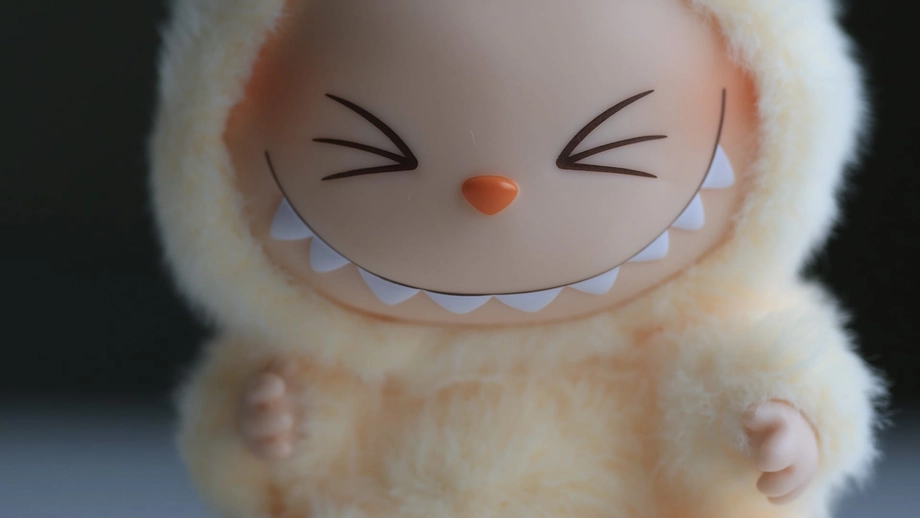
Labubu became Pop Mart's most successful toy line after its launch in 2019. Its furry appearance and jagged teeth helped it stand out, while celebrities including Kim Kardashian and Blackpink member Lisa brought the character into fashion and entertainment circles.
The blind box format added another attraction. Buyers paid for sealed packages without knowing exactly which version they would receive. Collectors seeking a particular design could buy repeatedly or turn to resellers, where sought after dolls commanded higher prices. Ordinary boxes often cost $15 or more.
At the height of demand, queues formed outside shops, Pop Mart temporarily removed Labubu products from British stores after reports of customers fighting, and one buyer paid more than $150,000 for a doll the size of a person. Scarcity became part of the experience.
Samer El Hajjar, a marketing lecturer at the National University of Singapore, identifies the difficulty of finding particular dolls as an important part of their appeal. Ashley Dudarenok, founder of China research company ChoZan, says that feeling of exclusivity faded as Pop Mart increased production to meet demand.
Ensito, a collector and content creator in North Carolina, describes the difference in practical terms. After spending more than $50,000 on over 400 Labubus, he now encounters entire series readily available in stores.
"Now it doesn't feel that way. I walk into a Pop Mart and there's a whole series of Labubus sitting there," he says.
The slowdown reaches collectors and creators
Ensito left his technology job in 2024 to make Labubu content full time. His search for releases took him as far as Italy and Spain, and his enthusiasm extended to having a dentist make custom teeth resembling the character's jagged grin for events.
His audience has become harder to reach. Ensito says videos that once quickly attracted 10,000 views now struggle to reach that level. He has shifted some attention to Hello Kitty and squishies, reflecting how a change in buying habits can also affect people whose work depends on the surrounding excitement.
Melbourne content creator Lawrence Yu has roughly 50 Labubus. His shopping and unboxing videos once attracted as many as a million views, but he now rarely makes videos about them. After two years of chasing releases, he expects to be more selective about adding to his collection.
Canadian collector Clara Barbero is also moving away from buying each new series. She describes Labubu as a "dead trend", yet continues watching for designs she genuinely likes. Barbero explains her new approach this way:
I'm curating my collection more and only buying what I see myself liking for the next few years, and not just buying the newest series that's out.
For Pop Mart, that change means competing for individual purchases rather than relying on collectors to follow every launch. A customer can remain attached to an existing collection while buying fewer new dolls.
Rivals compete for the next purchase
Sonny Angel and Smiski are attracting buyers as the Labubu frenzy cools. Sonny Angel offers tiny figures resembling cherubs, while Smiski's miniature figures glow in the dark. My Little Pony and KPop Demon Hunters characters are also appearing in blind boxes, giving collectors more alternatives within the same mystery packaging format.
Miniso, founded in Guangzhou, sells blind boxes featuring Disney and Marvel characters through more than 8,000 shops globally. Pop Mart has about 500 shops in more than 30 countries, alongside roughly 2,000 vending machines. Miniso's shop network is therefore more than 16 times as large, although its stores sell a broader range of goods.
Vincent Huang, a Miniso executive, says shoppers put the experience and the product ahead of a brand's country of origin. He described their priorities earlier in the year:
Consumers aren't particularly concerned about where the brand comes from. They're more focused on the shopping experience - the designs, value for money, and enjoyment.
Sanrio, the company behind Hello Kitty, posted record earnings in the year to March. Its success offers a useful comparison for Pop Mart: a character can continue attracting spending long after its initial moment of popularity. Pop Mart is trying to build that kind of lasting attachment while competitors pursue the same collectors.
Can more characters and bigger stores help?
Pop Mart is continuing to expand its physical presence. In September, it opened a flagship spanning three storeys near West Lake in Hangzhou and a European flagship on Boulevard Haussmann in Paris. Its expansion strategy also places greater weight on flagship locations in New York, Milan and Paris.
Other characters are taking a larger role. SKULLPANDA, Hirono and Twinkle Twinkle are gaining traction overseas, according to Jefferies, while third quarter releases included products featuring Twinkle Twinkle and Dimoo. A wider selection gives shoppers reasons to return even when Labubu is no longer their first choice.
Pop Mart has also invested in a theme park in Beijing and announced a Labubu film. Those projects aim to give its characters a life beyond shop shelves, following a business model in which stories, entertainment and merchandise support one another.
Dudarenok says Pop Mart faces a different starting point from Disney: Disney sells a story before selling a toy, whereas Pop Mart is building outward from toys that are already popular. The commercial task is to turn recognition into affection that survives changes in celebrity attention.
Dudarenok, whose company studies the Chinese market, framed the test directly:
The real test for next year is whether Pop Mart can make people love a character without a celebrity holding it.
Investors lower their expectations
Pop Mart's shares initially fell more than 6% in Wednesday trading after the update before recovering some ground to trade less than 2% lower. The stock had already lost more than 30% during the year and had finished lower in nine of the previous 12 trading sessions.
The shares were trading near HK$130, compared with an August peak around HK$340. Those prices represent a decline of about 62%. The company's market value remained close to $24 billion, leaving it among the world's most valuable toy businesses despite the retreat.
Jefferies had estimated a third quarter revenue decline of 30%, making the reported 45% to 50% fall worse than its forecast, although broadly consistent with expectations among investment firms buying and holding shares. The brokerage cut its earnings estimates for 2027 and 2028 by 9% to 12%, citing weaker overseas sales and pressure on profitability.
HSBC also reduced its expectations. It lowered its 2026 revenue estimate from 34.6 billion yuan to 33.2 billion yuan, a reduction of 1.4 billion yuan, or about 4%. Its forecasts for 2027 and 2028 revenue fell by 8% and 9%, respectively, as it anticipated a longer period before sales stabilise.
Jefferies expects fourth quarter revenue to rise 3% from the third quarter but remain 34% below the same period a year earlier. That forecast describes a modest improvement from the latest quarter alongside a continuing substantial annual decline.
How the boom became an adjustment
Pop Mart's recent history shows how quickly a collectible can move from rapid expansion to a test of customer loyalty. The company now has a much larger international presence than when Labubu launched, but that reach also exposes it to changes in demand across several regions at once.
- 2019: Labubu launched and went on to become Pop Mart's most successful toy line.
- 2020: Pop Mart listed its shares in Hong Kong.
- 2024: Ensito left his technology job to create Labubu content full time.
- Third quarter of 2025: Pop Mart recorded revenue growth of about 250%.
- First half of 2026: Revenue rose 23.8% to 17.2 billion yuan.
- September 2026: Pop Mart opened major stores in Hangzhou and Paris.
- Third quarter of 2026: Revenue fell 45% to 50%, with the steepest regional decline in the Americas.
Some collectors still provide a base of support. Liverpool collector Hedy Khaled owns 70 Pop Mart figurines and distinguishes people following trends from fans with a lasting attachment. Marketing professional Katelynn Carlson, who owns 36 Labubus, says blind boxes recall the excitement of opening gifts as a child. A rare doll in one of her early purchases made the experience especially memorable.
Carlson continues to enjoy new releases, including a recent series featuring cat designs. Her reason for collecting centres on the pleasure the figures bring:
I think there's something special about embracing our inner child and enjoying things simply because they make us happy.
Pop Mart's challenge is to turn that affection into repeat purchases across a broader range of characters. Fuller shelves make products easier to buy; more selective customers make each purchase harder to win.
Key Points
- Pop Mart's third quarter revenue fell 45% to 50% in 2026 after growth of about 250% a year earlier.
- Revenue dropped 70% to 75% in the Americas, compared with 25% to 30% in mainland China.
- First half revenue and profit had grown, showing a sharp reversal during the year.
- Collectors describe easier availability, less online excitement and more selective buying.
- Pop Mart is expanding flagship stores and promoting characters beyond Labubu while pursuing entertainment projects.
- Jefferies forecasts a small quarterly sales recovery in the fourth quarter, with revenue still below the previous year's level.