Higher earnings beneath the panels, less freedom beyond them
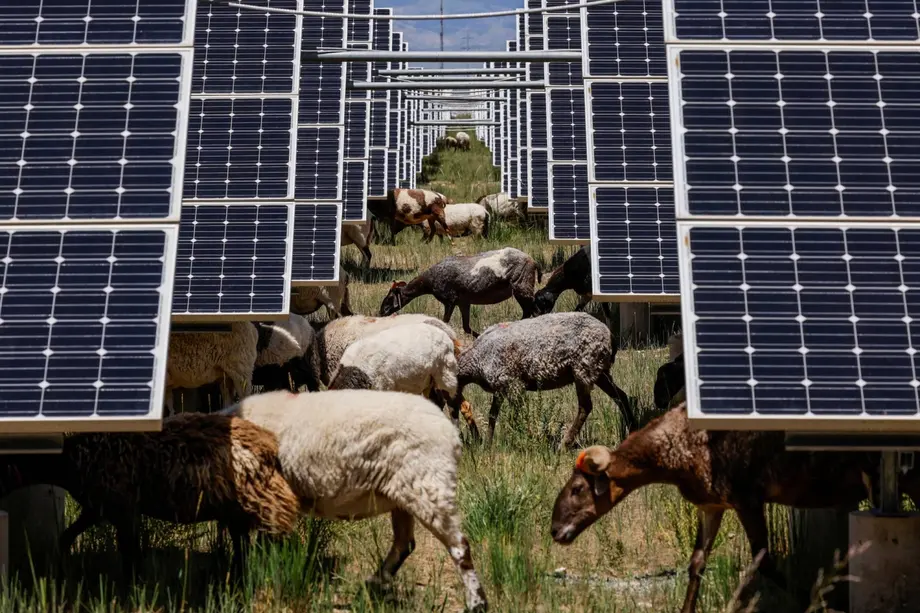
In Gonghe County, Qinghai province, shepherd Li Yonglin estimates that grazing sheep inside a fenced solar park has lifted his annual earnings from 10,000 to 20,000 yuan to between 50,000 and 60,000 yuan. The panels provide shelter for grass, the sheep keep vegetation short, and Li spends less time following his flock across the plateau.
Contents
- Higher earnings beneath the panels, less freedom beyond them
- How a desert energy base became a grazing site
- Why grass grows under the arrays
- Sheep replace an expensive mowing job
- Families combine livestock sales with solar wages
- How many households receive grazing access?
- Why some herders and researchers are concerned
- Noise and an earlier grassland complaint
- Local pastures support electricity sent far away
- At a Glance
Across Hainan Tibetan Autonomous Prefecture, the arrangement has grown into a network of 32 photovoltaic ecological pastures and 56 concentrated grazing sites. A May 29, 2026, account published by China's Yellow River Conservancy Commission said more than 2,300 households around Talatan Solar Park benefited, with an average annual income increase exceeding 40,000 yuan per household.
Those gains sit alongside a harder change in pastoral life. Solar installations divide previously open grazing areas, access depends on permission, and researchers and advocates say the arrangements generally favor sheep over goats and yaks. For families accustomed to moving livestock across extensive pastures, a fenced solar park offers a different kind of livelihood.
Li, 25, described the practical benefit of that enclosure:
In the morning, we simply open the gate to the sheep pen and don't really need to look after them. They come back on their own in the evening, and we just pen them up.
Gonghe's experience brings together three changes on the same ground: electricity production, the recovery of vegetation in some degraded areas, and a shift toward grazing managed around energy infrastructure. The financial rewards can be substantial for participating households. Who receives access, which animals can enter and how pasture decisions are made determine how widely those rewards spread.
How a desert energy base became a grazing site
Talatan lies in Gonghe County within Hainan Tibetan Autonomous Prefecture, a culturally Tibetan area of Qinghai. Photovoltaic panels, which turn sunlight directly into electricity, have spread across land described in local development accounts as severely desertified before construction.
The Yellow River Conservancy Commission's May 2026 account, based on a May 25 visit, dates the beginning of Talatan's solar industry to 2011. Construction of the local new energy base began in 2012. The commission put the park's installed solar capacity above 10 million kilowatts, equivalent to more than 10 gigawatts.
Several milestones show how grazing became part of that expansion:
- 2011: Talatan's solar industry began developing, according to the commission.
- 2012: Construction of the new energy base started.
- From 2022: Gonghe developed 32 photovoltaic ecological pastures with support from solar companies.
- 2024: Gonghe's government said sheep belonging to 16 households were permitted to graze in a solar park for part of the year.
- May 2026: The commission described 32 ecological pastures, 56 grazing sites and more than 20,000 sheep raised annually through the arrangement across Hainan prefecture.
The expansion followed the return of vegetation beneath Qinghai's solar arrays, where shade and slower winds changed conditions close to the ground. By March 2026, income from solar pastures was already supporting some households through larger flocks and work at the installations.
Why grass grows under the arrays
Talatan's main environmental difficulty is keeping moisture in the ground. Strong winds and evaporation can dry soil before plants establish themselves. Panels interrupt the wind and shade parts of the surface, helping water remain available for longer.
The commission cited operating observations indicating that wind speeds inside the park had fallen by 50%, soil moisture evaporation had declined by 30%, and vegetation coverage had reached 80%. It also reported that nearly 600,000 mu of land had received treatment to control desertification, equivalent to about 40,000 hectares.
Water from panel cleaning and condensation also reaches the soil. Grass planting and fertilization have accompanied construction in partly degraded grassland and desertified areas, meaning the recovery includes deliberate land management as well as changes created by the panels.
Other local measurements describe vegetation coverage inside completed solar arrays as more than 30% higher than in areas without installations, with the average amount of plant material above ground 65% higher. An increase in vegetation coverage of 15% over more than a decade was also reported for the park. These measurements describe different comparisons: change over time and differences between locations.
For herders, the practical result is more forage in participating areas. For electricity operators, that same grass becomes a maintenance task when it grows high enough to shade panels or dries into a fire risk.
Sheep replace an expensive mowing job
A single solar station can spend nearly 2 million yuan a year on manual grass cutting, according to project accounts cited by the commission. Letting sheep eat the vegetation reduces that expense while saving herders money on feed.
Cao Jun, a safety supervisor for a State Power Investment Corporation project in Hainan, described the arrangement as a:
win-win situation
The developer's Huanghe company invited an initial group of 16 herding households into the park and reached an agreement with Tiegai township for free use of nearly 100,000 mu of pasture, about 6,667 hectares. The commission says free grazing runs from June through October each year.
Engineers have also changed the layout to accommodate livestock. Local descriptions say spacing between panels increased from 3 meters to 5 meters. One account describes support heights rising from 0.5 meters to 1.2 meters; the commission's May account gives a clearance of 1.8 meters after an increase from 0.5 meters.
Wider passages and higher panels give sheep more room to move. Their manure returns nutrients to the soil, while shorter grass helps keep the equipment clear. For households using these pastures, the seasonal opening provides several months of forage alongside the electricity operation.
Families combine livestock sales with solar wages
Li's income estimate is one example of the gains reported by participating shepherds. Wen Yujun, 43, says he can now manage 700 to 800 sheep largely by himself and estimates annual earnings of about 80,000 yuan, eight times his previous income.
Wen described the scale of the change in his own life:
Life has changed tremendously.
Yeduo, a herder from Xiahelesi village in Tiegai township, combines sheep raising with cleaning and maintaining solar panels. The commission's May account describes a flock of more than 300 sheep, annual income approaching 100,000 yuan from sheep raising, and additional monthly wages exceeding 4,000 yuan.
Badu, another local herder named in the commission's account, reported household net income above 80,000 yuan in 2025. His family receives income through land leasing, work inside the park and livestock sales. His son returned from work elsewhere to take a job operating and maintaining a solar station.
These households illustrate how the change extends beyond free grass. A family may receive money from livestock, wages or land arrangements, with each stream affecting its finances differently. Badu's figure is household net income, while Yeduo's account lists sheep income and wages separately.
How many households receive grazing access?
By July 2026, 6,330 households in five townships were described as benefiting from Hainan's 56 grazing sites. The commission's May figure was more than 2,300 beneficiary households around Talatan Solar Park. The July total covers a wider area, but the number of households actually permitted to graze animals was not disclosed.
The commission also said the program supported 18 village collective economic cooperatives. These are village organizations through which residents can take part in shared business activities and receive income.
Daily and annual animal counts offer another view of the operation. A project account describes about 11,000 sheep grazing in the solar park each day, while the commission gives a prefecture total exceeding 20,000 sheep raised annually through solar grazing.
Gonghe is trying to connect this production to a broader meat business, linking solar companies, ecological pastures, cooperatives, herding households and sales arranged in advance. Plans include slaughtering facilities, refrigerated transport, processing and shops. Ear tags carrying information on an animal's age, vaccinations and owner help buyers trace where the meat came from.
Why some herders and researchers are concerned
Solar fences create a different working landscape from open pasture. An unnamed researcher studying conservation and energy infrastructure on the plateau said residents had little say in pasture conversion and that installations fragmented grazing space, making it harder to watch livestock across the wider area.
Tsewang Dorji, a researcher at the Tibet Policy Institute in Dharamsala, India, questioned whether space among the panels could sustain nomadic livelihoods:
You can find some places (to graze) around the solar panels, but these are not suitable for nomads and shepherds to hold their livelihood.
Mandie McKeown, advocacy director at the British environmental charity Foundation for Gaia, said goats and yaks were generally excluded and that only a small number of nomads were employed to graze sheep.
The difference matters because traditional pastoralism involves moving animals across a larger landscape as forage and conditions change. A seasonal place inside an energy installation gives participating families a defined resource, while access rules and infrastructure determine where they can go and which livestock they can keep there.
Gonghe's changes also follow earlier disruption on the plateau. Thousands of Tibetan nomads were resettled into rural townships in the early 2000s under government efforts to reverse ecological degradation. Solar development adds another layer of decisions about land use to that history.
Noise and an earlier grassland complaint
Sanggay Tashi, an anthropology researcher at the University of Colorado Boulder, described another concern in a June article: wind moving through solar posts and wires produced persistent sounds that unsettled people and animals, according to residents in Qinghai.
Government records published online in 2017 also recorded an undated complaint alleging that Gonghe's photovoltaic stations had damaged grasslands and left cattle and sheep with little to eat. The official investigation found no evidence supporting the allegation and stated that grazing was prohibited in the area concerned.
Those records show that grazing rules have varied across locations and periods. Today's designated ecological pastures operate through explicit permission, including seasonal entry. Qinghai authorities did not respond to requests for comment on concerns about the wider effects of solar development.
Local pastures support electricity sent far away
The grass and livestock story sits inside a much larger electricity project. A local development account puts Talatan's solar park at 609 square kilometers, with more than 60 companies and annual electricity deliveries of roughly 10 billion kilowatt hours to places including Jiangsu and Henan. Cao described electricity from the Hainan project reaching cities including Beijing and Shanghai.
Installed capacity measures the maximum rated output of generating equipment. Electricity delivered over a year measures how much energy it actually supplies. Sunshine, operating conditions and the electricity network affect that annual total.
Solar overtook coal as China's largest source of installed generating capacity in July 2026. Authorities also plan a further 53% increase in wind and solar generation over five years. The Qinghai Tibet Plateau is a major focus because a study estimates that it holds almost half of China's solar energy potential.
For Gonghe's participating families, that national expansion can mean cheaper feed, larger flocks and nearby jobs. For herders outside the arrangements, pasture conversion and fencing can mean a more restricted landscape. Talatan's growing network of grazing sites makes the terms of participation as consequential locally as the panels' electricity output is nationally.
At a Glance
- Hainan prefecture has 32 photovoltaic ecological pastures and 56 concentrated grazing sites.
- Li Yonglin estimates his annual earnings rose to 50,000 to 60,000 yuan after gaining access to a solar pasture.
- The Yellow River Conservancy Commission says free seasonal grazing runs from June through October.
- The commission reports lower wind speeds, reduced evaporation and vegetation coverage reaching 80% at Talatan.
- More than 2,300 households around Talatan were described as benefiting in May; a wider July total covered 6,330 households in five townships.
- Researchers and advocates raise concerns about fragmented pasture, limited local influence and restrictions on goats and yaks.