A decade of celebrations ends beneath Mount Fuji
Fujiyoshida has cancelled its 2026 cherry blossom festival at Arakurayama Sengen Park after crowds reaching 10,000 visitors a day during peak season brought growing disruption to surrounding neighbourhoods. In February 2026, Mayor Shigeru Horiuchi announced the end of the festival, citing a "strong sense of crisis" about conditions in the city west of Tokyo.
Contents
- A decade of celebrations ends beneath Mount Fuji
- Residents describe pressure beyond crowded paths
- Why cherry blossoms carry such cultural weight
- How flower viewing became a public tradition
- Ancient trees make the heritage tangible
- A flower associated with sacrifice and renewal
- Washington's blossoms began with a gift
- Korea's cherry trees became a disputed legacy
- Blossom branches now travel through global trade
- Other destinations are setting limits too
- Tourism income and local costs fall unevenly
- Japan is trying barriers, dispersal and crowd controls
- The 2026 season will continue beyond the cancelled festival
- Key Points
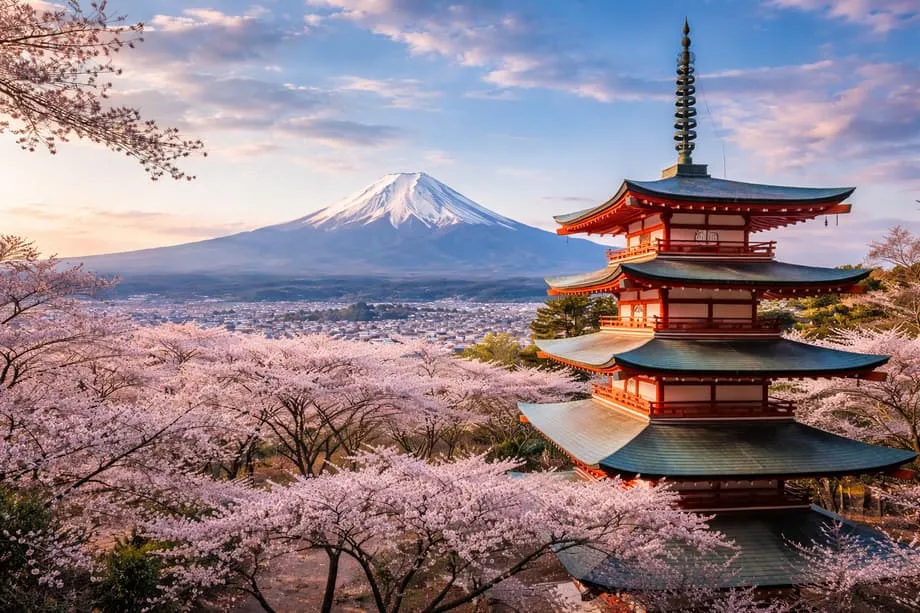
The festival had run for a decade at a location famous for its view of Mount Fuji, a pagoda with five stories and pink cherry blossoms. Photographs of the snow capped mountain framed by the pagoda and flowers spread through millions of social media posts, turning the park into a destination sought by visitors from around the world.
Horiuchi, the mayor responsible for the city's response, put residents' welfare at the centre of the cancellation announcement:
To protect the dignity and living environment of our citizens, we have decided to bring the curtain down on the 10-year-old festival.
The park will remain open. The organised festival, with its associated infrastructure and support, will not proceed, although officials plan additional security, temporary parking facilities and portable toilets to manage visitors who continue to arrive.
Japan received a record 42.7 million tourists in 2025, surpassing the previous record of 37 million in 2024. The increase of 5.7 million visitors, about 15%, provides the national setting for Fujiyoshida's decision. A weak yen made travel in Japan cheaper for many overseas visitors, while social media directed large numbers towards particular viewpoints.
For Fujiyoshida, the immediate problem was how to accommodate that attention without allowing daily life around the park to deteriorate. The cancellation places the protection of residents and a culturally important setting ahead of the benefits associated with staging another festival.
Residents describe pressure beyond crowded paths
City reports documented visitors entering private homes without permission to use toilets, defecating in residential yards and becoming confrontational when property owners challenged them. These complaints placed sanitation and personal safety alongside the more familiar problems of congestion.
Parents complained that children were pushed aside on narrow pavements used on the journey to school as visitors pursued photographs. Cigarette butts littered sacred grounds, while persistent traffic jams disrupted movement through the small city.
Arakurayama Sengen Park's popularity concentrated the pressure in a residential setting. The Mount Fuji, pagoda and blossom composition became a repeatedly shared destination for influencers and travel bloggers. Digital recommendations brought more visitors than local infrastructure could comfortably accommodate.
The decision therefore concerns more than the number of people admiring flowers. Residents described losing access to ordinary necessities: a clear pavement, a usable road and privacy at home. Officials will still need to manage those pressures because cancelling the festival leaves the park accessible.
Why cherry blossoms carry such cultural weight
Sakura, the Japanese word for cherry blossoms, connects the flowers with agricultural belief as well as seasonal beauty. In the traditional explanation of the name, "sa" refers to the rice paddy god and "kura" means a seat or vessel. Together, they convey the idea of a seat for the rice god.
That explanation reflects a belief that cherry trees house mountain deities who become agricultural gods during the planting season. Farmers travelled to mountain groves in spring to worship beneath the branches and pray for abundant harvests.
Some ancient trees remain encircled by shimenawa, thick twisted ropes marking sacred places. Trees understood to contain spirits are known as kodama, while kami refers to gods or spirits. Folklore warns of misfortune for anyone who damages sacred cherry trees.
Two legends connect flowering with personal sacrifice. The Uba-zakura, or Milk Nurse Cherry Tree, is said to bloom on the anniversary of a wet nurse's death after she gave her life to save a child. Another tree in Wakegori is said to bloom every January 16, commemorating an elderly samurai who died by ritual suicide after his beloved tree died, with his spirit entering the wood.
The Japan National Tourism Organization describes cherry blossoms as "perhaps the most recognizable symbol of the country and its culture." Their place in literature, art and philosophy developed over twelve centuries.
Sakura express mono no aware, an appreciation of beauty accompanied by sadness that it cannot last. This aesthetic, informed by Buddhist ideas about impermanence, finds a visible expression in petals falling at peak bloom rather than remaining until they wilt. The resulting image of pink snow has inspired poetry from the Manyoshu anthology to Matsuo Basho.
How flower viewing became a public tradition
Hanami means flower viewing, but its earliest focus was plum blossom rather than cherry blossom. During the Nara period, from 710 to 794 CE, Chinese cultural influence helped make plum flowers the prestigious choice among aristocrats.
The focus shifted towards sakura during the Heian period, from 794 to 1185, as distinct Japanese cultural practices flourished. The imperial court developed elaborate blossom viewing rituals that remained privileges of the nobility for centuries.
The Edo period, from 1603 to 1868, brought flower viewing into public life. Commoners gathered beneath blossoms for picnics with sake and seasonal food by the 17th century. In 1720, Tokugawa Yoshimune, the eighth shogun, ordered cherry trees planted at Asukayama Park for public enjoyment, creating one of the early public hanami spaces.
The main stages in that transformation span more than a millennium:
- 710 to 794 CE: Plum blossom viewing held prestige in the Nara period.
- 794 to 1185: Cherry blossom viewing became established at the Heian imperial court.
- 1603 to 1868: Hanami spread among ordinary people during the Edo period.
- 1720: Tokugawa Yoshimune ordered public cherry tree planting at Asukayama Park.
- By the Meiji era: Somei Yoshino trees had spread nationwide and become central to modern hanami.
- February 2026: Fujiyoshida cancelled its festival after a decade of celebrations.
The Edo period also saw the creation of Somei Yoshino through crossing Edohigan and Oshima cherry species. Its abundant flowers helped it become the dominant variety in Japanese landscapes. The picnic tradition continues, including companies sending junior employees out at dawn to reserve desirable spaces with tarpaulins.
Ukiyo-e, meaning "pictures of the floating world," recorded these celebrations in woodblock prints. Artists including Hiroshige and Kiyonaga depicted courtesans, samurai and commoners beneath the blossoms. Library of Congress exhibitions describe the images as helping establish sakura as "a particularly Japanese cultural hallmark" recognised internationally by the 19th century.
Ancient trees make the heritage tangible
Japan's cherry blossom heritage includes individual trees whose estimated ages stretch across centuries or millennia. Jindai-Zakura in Hokuto City, Yamanashi Prefecture, is one of Japan's Three Great Cherry Trees and is estimated to be between 1,800 and 2,000 years old.
Its trunk measures 11.8 metres in circumference. During the Taisho era, it became the first tree designated a national natural monument. Tradition says the Buddhist priest Nichiren prayed for it when it was dying, bringing about its recovery and the name myoho-zakura, or "Saddharma cherry blossom."
Miharu Takizakura in Fukushima is estimated to be more than 1,000 years old. Its name means "waterfall cherry tree," describing branches that create the appearance of a pink cascade when flowering in late April. The tree stands more than 12 metres tall and spreads 20 metres from east to west and 18 metres from north to south.
Thousands of visitors come to see Miharu Takizakura, with strictly regulated traffic flows helping manage access. Along with trees such as Jindai-Zakura, it is protected as a national natural monument.
Usuzumi Zakura in Gifu Prefecture is more than 1,500 years old and changes colour as its flowers develop. Pale pink buds open into white blossoms, which become pale grey shortly before falling.
Ishiwari-zakura in Morioka took root in a crack in a boulder about four centuries ago and grew until it split the stone. Such trees serve as living shrines, linking present day visitors with older religious traditions and local history. Washington DC, by comparison, has 3,700 cherry trees around the Tidal Basin and attracts 1.5 million visitors annually.
A flower associated with sacrifice and renewal
Samurai adopted cherry blossoms as an emblem during the feudal era. A brief, brilliant flowering offered a comparison with a warrior's life, which the bushido code expected to be lived honourably and surrendered without fear.
Falling petals became a metaphor for samurai dying young in battle, with their glory preserved at the moment of death rather than diminishing through old age. That symbolism gave the flowers associations with violence as well as beauty.
During World War II, kamikaze pilots painted cherry blossoms on aircraft and called themselves cherry blossoms before suicide missions. Aircraft were also named Ohka, another word for cherry blossom, and young cadets wore the flower on their uniforms.
The image of dying "like beautiful falling cherry petals for the emperor" turned an appreciation of life's brevity into a message encouraging military sacrifice. This history forms part of the flower's cultural meaning alongside its more familiar associations with celebration.
April also begins Japan's school year and fiscal calendar, giving blossom season a connection with new beginnings. Families gather beneath flowering branches to celebrate renewal and hope. Annual sakura forecasts issued by the Japanese Meteorological Agency are followed closely as people plan visits to particular parks and trees.
Washington's blossoms began with a gift
Tokyo Mayor Yukio Ozaki gave Washington DC 3,020 cherry trees in 1912 as a gesture of friendship. First Lady Helen Taft planted the first two on March 27 that year.
The gift fulfilled a campaign begun in 1885 by Eliza Scidmore, the first woman on the National Geographic Society board. She had sought to beautify the reclaimed banks of the Potomac River with cherry trees.
Washington's National Cherry Blossom Festival now draws more than 1.5 million visitors annually. The Tidal Basin trees, with the Jefferson Memorial as a backdrop, made blossom viewing a prominent celebration outside Japan.
The Washington story demonstrates how the flowers became part of cultural diplomacy. A gift intended to express friendship developed into an annual public gathering whose scale now invites comparison with crowded blossom destinations in Japan.
Korea's cherry trees became a disputed legacy
Yoshino cherry trees were introduced to the Korean peninsula during Japanese colonial rule from 1910 to 1945. After liberation and the Korean War, hostility towards Japan led to large numbers being cut down.
South Korean ecologists, including Shin Joon Hwan, have campaigned to replace Yoshino varieties with the king cherry, claiming Korean origin for that species. The debate connects botanical identity with the legacy of colonial rule.
In 2018, South Korea's National Arboretum genetically analysed Somei Yoshino trees and removed them from the native plant list, confirming their Japanese origin.
Author Che Sukyoung has observed that, although cherry trees existed in Korea for centuries, they appear in no classical Korean literature or poetry. Che presents that absence as an indication that a culture of cherry blossom appreciation did not develop there in the same way as in Japan.
Blossom branches now travel through global trade
Cherry blossoms also reach international audiences through commercial exports. JA Shonai Midori, an agricultural cooperative in Yamagata Prefecture, ships flowering branches to Hong Kong, Vietnam, Singapore and the Netherlands.
The branches appear in Lunar New Year celebrations and spring festivals. Export arrangements extend the flowers' reach beyond the period when visitors can see them growing in Japan.
Aucnet, which handles these exports, coordinates with growers to adjust the stage of the buds for different destination climates. It sent 170,000 stems overseas in 2025.
Varieties selected for beauty and their ability to withstand transport circulate as another expression of Japanese aesthetics. This trade offers a different route for sharing blossom culture from bringing large crowds to a single park.
Other destinations are setting limits too
Fujiyoshida's decision belongs to a wider pattern of destinations responding to excessive visitor pressure. Overtourism describes a situation in which crowds disrupt residents' lives, strain infrastructure or damage the places people have travelled to enjoy.
Venice receives 25 million to 30 million visitors annually. It charges visitors making day trips 5 euros for entry during peak periods, limits tour groups to 25 people and bans large cruise ships.
Machu Picchu caps visitors at 5,600 a day, using timed entry slots and mandatory routes through the site. Those measures organise where visitors go as well as how many can enter.
Barcelona has restricted rentals for short stays, while Rome charges 2 euros to enter the Trevi Fountain viewing area. The measures range from accommodation controls to direct management of access at individual attractions.
Fujiyoshida has chosen to stop an organised event while keeping its park open. Other destinations use fees, visitor caps or route restrictions. Each approach addresses a different part of the pressure created when large numbers converge on limited space.
Tourism income and local costs fall unevenly
Japan's hanami season generated approximately $9 billion in 2025, compared with $7.7 billion in 2024. The increase of about $1.3 billion illustrates the commercial value of blossom tourism.
Those gains can concentrate in airlines and major hotel chains, while residents bear infrastructure costs and everyday disruption. Fujiyoshida's complaints show why rising visitor spending and worsening local conditions can occur together.
India provides other examples of pressure on destinations. A report on the 2013 Uttarakhand disaster highlighted how tourism related construction on fragile hillsides increased vulnerability to catastrophe.
Goa receives 10 million domestic tourists against a resident population of 1.6 million, equivalent to more than six tourist visits for every resident. Tourism contributes 16.43% of the state's gross domestic product, yet sewage problems and traffic congestion accompany that activity. Gross domestic product measures the value of goods and services produced in an economy.
Japan also received 315,100 Indian tourists in 2025, an increase of 80% over 2019. Direct flights and favourable exchange rates contributed to the rise, adding to the wider growth in international arrivals.
The financial issue for destinations is therefore how to distribute tourism's benefits while paying for the services visitors use. Fujiyoshida's cancellation gives priority to residents' dignity and living conditions despite the commercial appeal of a famous spring event.
Japan is trying barriers, dispersal and crowd controls
Fujikawaguchiko erected large black barriers at popular Mount Fuji photography spots in 2024 after complaints about blocked pavements and illegal parking. The barriers were intended to discourage disruptive behaviour around places that had become popular for photographs.
The Japan Tourism Agency promotes directing visitors towards less familiar destinations. For blossom viewing, that includes encouraging trips to Tohoku or Hokkaido instead of concentrating attention on Kyoto and Tokyo.
Other crowd management approaches include digital ticketing that updates in real time, mobile applications showing crowd density and strict enforcement of behaviour guidelines. These measures can help organise arrivals and movement around busy attractions.
India's Swadesh Darshan 2.0 initiative offers a model Japan may consider. Its focus is sustainable destination development rather than scattered infrastructure projects, treating the needs of a destination together instead of addressing individual facilities in isolation.
Entry fees at previously free natural sites have also been proposed as a way to reduce demand and fund conservation. The specific response announced for Arakurayama Sengen Park centres on cancellation, additional security, temporary parking and portable toilets.
Fujiyoshida's challenge is to share a cultural attraction while protecting the neighbourhood and sacred setting around it. Social media can direct attention towards a single view much faster than roads, toilets and local services can expand.
The 2026 season will continue beyond the cancelled festival
As of February 7, forecasts pointed to early cherry blossoms in Tokyo around March 19 to 20. The Fujiyoshida cancellation affects one organised festival, while blossom viewing opportunities remain across Japan.
Shinjuku Gyoen in Tokyo, the Philosopher's Path in Kyoto, Hirosaki Castle and Matsumae Park in Hokkaido are among the places where visitors can enjoy the season. Their presence also supports the effort to spread trips beyond a small number of heavily photographed destinations.
Cherry blossoms bring together agricultural belief, public recreation, ancient trees, artistic traditions and memories of war and diplomacy. At Arakurayama Sengen Park, those cultural associations meet the practical needs of people living beside a world famous view.
The cancellation places limits on the organised celebration to protect residents and the setting that made it popular. The flowers will still draw visitors, leaving crowd management central to the city's preparations for spring.
Key Points
- Fujiyoshida cancelled the 2026 Arakurayama Sengen Park cherry blossom festival after a decade, citing a crisis affecting residents' dignity and living conditions.
- The park remains open, with additional security, temporary parking and portable toilets planned.
- Peak crowds reached 10,000 visitors daily, with complaints including trespassing, sanitation violations, obstructed school routes, litter and traffic jams.
- Japan received 42.7 million tourists in 2025, compared with 37 million in 2024.
- Sakura traditions connect agricultural worship, imperial flower viewing, public hanami, ancient sacred trees and ideas about life's brevity.
- Japan's hanami season generated approximately $9 billion in 2025, up from $7.7 billion in 2024.
- Other destinations use fees, visitor caps, route controls and accommodation restrictions to manage tourism pressure.
- Tokyo's early blossom forecasts pointed to March 19 to 20, with flower viewing continuing at destinations across Japan.