Dense Ship Formations Raise the Stakes in the East China Sea
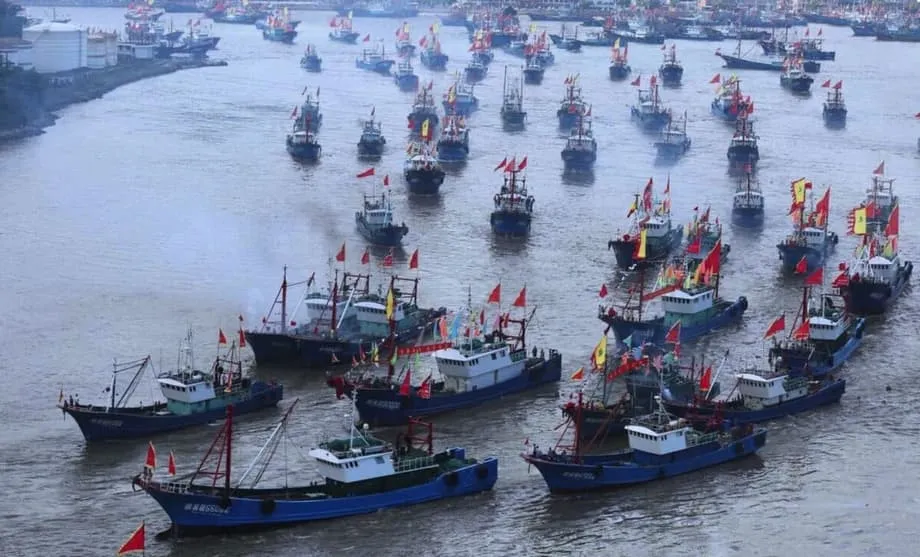
Thousands of vessels flying Chinese flags appeared in dense grid formations across the East China Sea in satellite imagery captured on February 12, 2026. The deployment, described as unprecedented, placed concentrated groups of ships near waters administered by Japan as a dispute over maritime territory and Taiwan sharpened relations between Tokyo and Beijing.
Contents
- Dense Ship Formations Raise the Stakes in the East China Sea
- Why the Islands Matter to Both Countries
- Japan Recorded Another Year of Heavy Chinese Activity
- How Earlier Crises Changed Maritime Behaviour
- Taiwan Remarks Triggered a Wider Diplomatic Dispute
- Two Governments Gave Opposing Accounts of December's Encounter
- Why the Grid Formations Attracted Attention
- Japan Moved From Monitoring to Enforcement
- Domestic Support and Economic Adjustments Shape Tokyo's Response
- Key Points
Commercial satellite passes conducted in late January and early February documented tightly packed clusters of hulls holding stationary positions over several days. Maritime analysts described those arrangements as inconsistent with ordinary commercial fishing, which usually requires vessels to move in response to currents, water depth and the location of fish.
Within 24 hours of the imagery's publication, Japanese authorities seized a Chinese fishing vessel suspected of violating domestic fisheries law after it entered territorial waters off Nagasaki prefecture. The Japan Coast Guard arrested its captain at around 12:23 p.m. on February 12. It was the first such detention of a Chinese fishing boat since 2022.
The Fisheries Agency said the vessel had attempted to flee to avoid inspection before authorities boarded it. The arrest brought an immediate enforcement dimension to a wider confrontation involving fishing fleets, coast guard ships, disputed islands and competing claims about regional security.
As of February 27, the captain remained in custody pending investigation. Japanese officials had described the vessel concentrations as large in scale but had not publicly attributed them to a formal directive from Beijing. The formations and the arrest took place against months of worsening diplomatic relations, with both countries increasingly connecting events around Taiwan to their positions in the East China Sea.
Why the Islands Matter to Both Countries
The maritime dispute centres on the Senkaku Islands, an uninhabited chain administered by Japan and claimed by China, which calls them the Diaoyu Islands. They lie approximately 105 miles east of Taiwan and 254 miles west of Okinawa.
The rocky islands have been a persistent source of friction between Asia's two largest economies for more than a decade. Potential oil and gas reserves nearby add economic stakes to the argument over sovereignty, or which country has authority over the territory.
Japan maintains that the Senkakus are indisputably Japanese territory under international law and historical fact. China asserts its own sovereignty over the islands and surrounding waters. Those competing positions mean that an encounter involving a fishing boat can quickly become a dispute between governments.
The territorial sea extends 12 nautical miles from the relevant coastal baseline. The contiguous zone reaches 24 nautical miles from that baseline and allows a country to exercise limited control under international law. The two areas carry different legal powers, which helps explain why Japan separately records Chinese government ships appearing in the contiguous zone and entering territorial waters.
Japan Recorded Another Year of Heavy Chinese Activity
The Japan Coast Guard recorded Chinese government vessels entering the contiguous zone around the Senkakus 357 times in 2025. The figure set a record for the fourth consecutive year, extending a pattern of sustained Chinese activity around the islands.
Chinese ships also entered the territorial waters themselves 27 times during the year. Eight instances involved the pursuit of Japanese fishing vessels past the territorial limit. For Japanese authorities, those encounters added a direct concern about fishing crews to the wider challenge of monitoring government ships.
Seishiro Sakamoto, commander of Japan's 11th Regional Coast Guard, described the conditions around the islands in a statement issued in early 2026:
The situation surrounding the Senkaku Islands is becoming increasingly severe, and the situation remains unpredictable. We will continue to conduct surveillance and vigilance activities with a high sense of urgency so as not to miss even the slightest change and will take all possible measures to protect our territorial waters.
Sakamoto's statement placed close observation at the centre of Japan's response. The concern was that small changes in ship movements, numbers or behaviour could develop into a more serious encounter before patrol crews had time to react.
How Earlier Crises Changed Maritime Behaviour
September 2010 brought a major confrontation when a Chinese fishing trawler collided with Japanese Coast Guard patrol vessels near the islands. The collision triggered a diplomatic freeze and Chinese restrictions on rare earth exports. Rare earths are materials used in manufacturing, making access to them an economic concern as well as a trade issue.
Tokyo's decision in 2012 to nationalize three islands previously held in private ownership prompted China to establish regular coast guard patrols in the surrounding waters. Buying those islands placed them under Japanese state ownership, while China's response changed the pattern of government activity at sea.
Beijing subsequently began routinely deploying vessels inside the territorial waters. In November 2013, China established an air defense identification zone over parts of the East China Sea, adding an aviation dimension to the maritime dispute.
August 2016 provided a precedent for a large coordinated gathering. More than 200 Chinese fishing vessels and seven China Coast Guard ships assembled near the Senkakus, repeatedly entering the contiguous zone and territorial waters despite Japanese warnings.
During that episode, more Chinese government ships entered the area in five days than in any full month over the preceding three years. The comparison illustrates why a concentrated deployment can matter even when the waters already see frequent patrols: it changes the number of ships Japanese authorities must watch and respond to at once.
The recurring pattern has been one of crises followed by new levels of activity that do not fully return to earlier norms. Security analysts see that history as relevant to the latest concentrations, because a temporary confrontation can become a lasting change in how the waters are used.
Taiwan Remarks Triggered a Wider Diplomatic Dispute
Prime Minister Sanae Takaichi's remarks in Japan's parliament on November 7, 2025, preceded the current crisis. Asked about regional security scenarios, she suggested that a hypothetical Chinese military attack on Taiwan could create a situation threatening Japan's survival.
Under Japan's security framework, such a situation could trigger collective self-defense measures. In simple terms, the discussion concerned circumstances in which Japan might use force in response to an attack involving another party because Japan's own security was threatened.
Beijing views self-governed Taiwan as part of its territory and has not excluded using force to achieve reunification. Chinese Foreign Minister Wang Yi described Takaichi's statement as shocking and accused Japan of crossing a red line.
China launched a global diplomatic campaign against Tokyo, including letters to the United Nations criticizing Japanese policy and coordinated statements from several government ministries. Chinese officials also portrayed Takaichi's government as promoting militarism.
Beijing reinstated a de facto ban on Japanese seafood imports and urged Chinese citizens to reconsider travel to Japan. It stopped short of introducing the rare earth export restrictions used during the 2010 crisis, leaving a difference between the economic responses to the two disputes.
Chinese officials also referred to clauses in the United Nations Charter dating from the World War II era in ambiguous threats about possible military action. Those statements added to the diplomatic pressure while Japan continued to defend its sovereignty position over the Senkakus.
Two Governments Gave Opposing Accounts of December's Encounter
Chinese and Japanese coast guard vessels confronted one another near the Senkakus on December 2, 2025. Beijing said its vessels had expelled a Japanese fishing boat from Chinese territorial waters.
Tokyo gave a different account of the same encounter, saying it intercepted and drove away two Chinese coast guard ships that had approached a Japanese fishing vessel. The disagreement concerned both what the ships had done and which government had authority in those waters.
Chinese spokesperson Liu Dejun said Chinese vessels took necessary control measures. The Japan Coast Guard said the Chinese ships violated international law by asserting claims in Japanese territory.
The main events leading to the February deployment unfolded over several months:
- November 7, 2025: Takaichi told parliament that a hypothetical Chinese attack on Taiwan could threaten Japan's survival and potentially trigger collective self-defense measures.
- December 2, 2025: Chinese and Japanese coast guard vessels confronted one another near the Senkakus, with each government describing its actions as enforcement against the other side.
- Late January and early February 2026: Commercial satellite passes documented dense vessel clusters maintaining positions over multiple days.
- February 12, 2026: Satellite imagery captured the maritime deployment, and Japanese authorities arrested a Chinese fishing captain at around 12:23 p.m. after an incident off Nagasaki prefecture.
Why the Grid Formations Attracted Attention
Analyses of the latest concentrations described flotillas of up to 2,000 vessels arranged in coordinated groups. Their configuration differed from the loose, moving arcs normally associated with trawling operations, when boats tow fishing equipment through the water.
Sequential commercial satellite passes allowed analysts to compare positions over time. The fleets remained clustered across multiple days instead of drifting, fishing or dispersing with changing weather conditions. The combination of scale and apparent persistence distinguished the episode from a seasonal increase in fishing activity.
Fishing fleets in the East China Sea typically spread out to find marine stocks. Currents, depth and the movement of fish help determine where boats operate. Stationary grids create a different operational pattern, particularly when large numbers of vessels maintain tightly spaced positions.
Maritime tracking data showed that many vessels transmitted civilian Automatic Identification System signals. Known as AIS, the system allows ships to identify themselves and helps crews and authorities avoid collisions.
AIS provides information about a vessel's identity and movements; determining why many ships are acting together requires additional assessment. Japanese officials had not publicly identified a formal Chinese state order behind the formations. Chinese foreign ministry briefings repeated longstanding sovereignty claims without directly addressing the specific satellite imagery.
Japan Moved From Monitoring to Enforcement
The February 12 seizure marked a shift from watching maritime activity to taking action against an individual vessel. Japanese law permits authorities to detain foreign vessels operating without authorization inside territorial waters.
Such detentions have occurred intermittently over the past decade and have usually involved smaller numbers of boats. The Nagasaki incident was the first detention of a Chinese fishing boat since 2022, making it a distinct enforcement event within a much larger maritime confrontation.
Japanese authorities were collecting evidence through inspection and questioning to determine whether to refer the captain's case to prosecutors. That decision was part of the continuing investigation as of February 27.
The Japan Coast Guard increased patrols following the satellite confirmations, deploying ships and aircraft to monitor the clusters. Patrol crews also issued radio warnings when vessels approached territorial waters.
Tokyo's foreign ministry lodged protests after reported incursions. Diplomatic channels between the capitals remained technically open, although relations had deteriorated to their lowest point in more than a decade.
Domestic Support and Economic Adjustments Shape Tokyo's Response
Takaichi maintained approval ratings of around 75 percent despite Chinese pressure. Polls also indicated that a majority of Japanese citizens supported the government's firm position on regional security, giving the prime minister domestic backing during the confrontation.
Japan has been diversifying economic ties and reducing its dependence on Chinese supply chains. Its dependence on China for rare earths fell from approximately 90 percent in 2010 to about 60 percent in 2023, a decline of roughly 30 percentage points.
That change provides a concrete comparison with the earlier crisis, when Beijing's export restrictions placed rare earth supplies at the centre of the dispute. Further diversification was considered likely following the latest tensions.
Tokyo has also strengthened security relationships with the United States, Australia and other regional partners. Alongside those partnerships, Japan has increased defense spending and developed capabilities to monitor and respond to maritime incursions.
Security analysts suggest that the current escalation may produce lasting changes in relations and operations in the East China Sea. The experience of 2010 and 2012 gives that concern a specific basis: each crisis was followed by Chinese activity that established a new regular presence.
The risk of further escalation remained substantial as both governments linked concerns about Taiwan to their territorial positions in the East China Sea. Japan's patrols, China's repeated sovereignty claims and the dense fishing vessel formations were all unfolding within that wider dispute.
Key Points
- February 12 satellite imagery showed thousands of Chinese vessels in dense formations near waters administered by Japan; analyses described flotillas of up to 2,000 ships.
- Commercial satellite passes in late January and early February showed clusters holding positions over several days.
- Japanese authorities arrested a Chinese fishing captain off Nagasaki on February 12, the first such detention since 2022.
- The Senkaku Islands are administered by Japan and claimed by China as the Diaoyu Islands.
- Japan recorded 357 Chinese government vessel entries into the contiguous zone and 27 entries into territorial waters in 2025.
- Takaichi's November 7 remarks about a possible Chinese attack on Taiwan preceded diplomatic pressure and the December maritime confrontation.
- As of February 27, the captain remained under investigation, and Japan had not publicly attributed the vessel formations to a formal directive from Beijing.