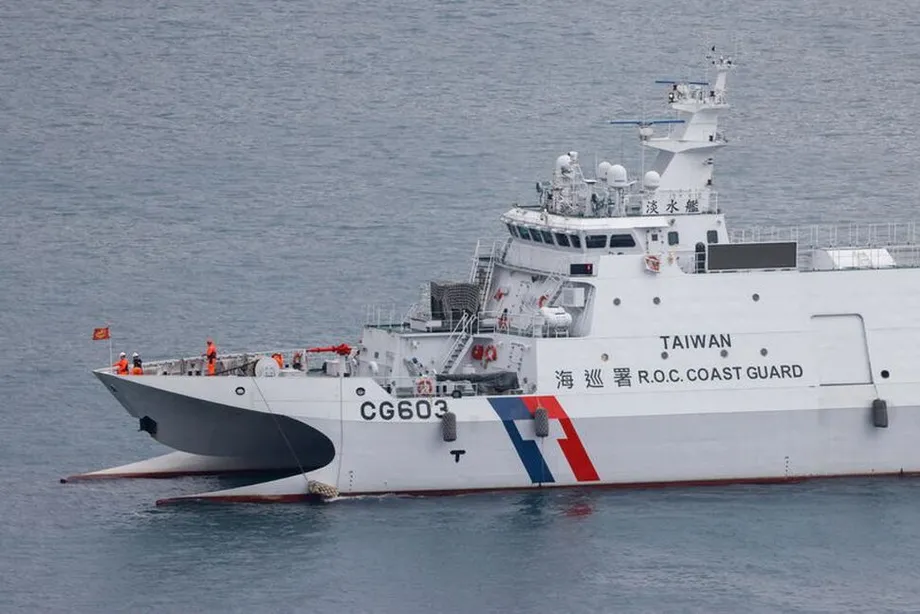
Three vessels off Taiwan's east coast sharpen security concerns
A Chinese fishing boat suspected of maritime militia activity approached within about 2.7 nautical miles of Taiwan's restricted waters on August 16 while operating alongside a coast guard ship and a research vessel, according to Taiwan's Coast Guard. Taiwan dispatched a patrol boat to drive it away and placed the fishing vessel, Minfudingyu 07902, on a priority watchlist.
Contents
- Three vessels off Taiwan's east coast sharpen security concerns
- What the surveillance recorded
- A rise in activity beyond the warship count
- How the pressure developed
- Why fishing boats matter in a security confrontation
- The eastern coast's importance for supplies
- Competing claims in overlapping economic waters
- Security proposals focus on keeping routes open
- Earlier encounters and vulnerable infrastructure
- Key Points
The accompanying ships were identified as China Coast Guard vessel 2502 and the research vessel Xiang Yang Hong 3. Their appearance off Taiwan's Pacific coast has drawn attention to how Beijing can combine fishing boats, government vessels and scientific platforms to maintain a presence in strategically important waters without deploying warships.
In an October 23 account of its response, Taiwan's Coast Guard warned that these coordinated operations could support Chinese preparations for military action while increasing the surveillance and response burden on Taiwan, Japan and the Philippines. Taiwan's eastern coastline provides access to the wider Pacific and carries maritime traffic and supplies.
The coast guard said the vessels remained outside Taiwan's restricted waters. Its assessment of Minfudingyu 07902 was that the boat displayed characteristics associated with maritime militia activity. The vessel's precise assignment remains unknown.
China says its activities east of Taiwan are legitimate exercises of its maritime rights. Taiwan rejects Beijing's jurisdictional claims and views the growing presence as pressure on its ability to manage surrounding waters and keep supply routes open.
What the surveillance recorded
Apex Aviation, a Taiwanese aviation company, documented the cluster during a reconnaissance flight. Its surveillance material combined radar screenshots, infrared imagery and automatic identification system data. That system, commonly called AIS, broadcasts information such as a vessel's identity and position.
The three types of observation provided different views of the encounter: radar tracked objects at sea, infrared imagery recorded heat signatures, and AIS supplied identifying and positional information. Together, they helped document which ships were operating near one another.
The formation was described as being more than 30 nautical miles off Hualien, on Taiwan's eastern coast, near the area beyond the 24 nautical mile contiguous zone. The coast guard separately gave the fishing boat's closest approach as about 2.7 nautical miles outside restricted waters. These measurements use different reference points, with one describing distance from the coast and the other distance from a maritime boundary.
Earlier public statements from the coast guard confirmed that the ships were being monitored and remained outside restricted waters, without publicly identifying the fishing boat as militia. Its later response named Minfudingyu 07902, described its suspected characteristics and confirmed the patrol response.
A rise in activity beyond the warship count
Taiwanese figures show a sharp increase in Chinese coast guard, research and other vessel activity around the main island. Authorities recorded 244 vessels in July, compared with 55 in June and 30 in May. The previous July's figure was 58.
July's total was therefore more than four times both the June figure and the figure for the same month a year earlier. These counts excluded Chinese warships, showing how much maritime pressure can come from vessels outside the navy.
Another 152 vessels were detected during the first 21 days of August. About 60 percent of the vessels in the reported activity were coast guard ships, with research and other government vessels accounting for the rest.
Taiwan's Coast Guard also described an operation in which it drove away 16 Chinese coast guard, research and fishing vessels, including four fishing boats. The activity took place off Taiwan's eastern, southern and southwestern coasts and around the Taiwan controlled Pratas Islands. Some vessels in those operations entered restricted waters, unlike the three ships monitored off the eastern coast in August.
How the pressure developed
The August encounter followed an expansion of Chinese government vessel activity east of Taiwan. Taiwan's Coast Guard linked the increase since June to announcements by Japan and the Philippines that they would discuss the boundaries of their exclusive economic zones.
The reported sequence shows pressure building through several kinds of deployment and response:
- May: Taiwan recorded 30 Chinese coast guard, research and other vessels around its main island.
- Late May and June: China announced maritime traffic enforcement activity in waters east of Taiwan as Japan and the Philippines pursued maritime boundary discussions.
- June: Taiwan's vessel count rose to 55.
- July: The count reached 244, compared with 58 in July the previous year.
- August 16: Minfudingyu 07902 approached about 2.7 nautical miles outside Taiwan's restricted waters.
- October 1: Taiwan used a water cannon against a Chinese recreational fishing vessel near Pratas.
- October 20: A Taipei security forum discussed the risks of continuing Chinese coast guard patrols east of Taiwan.
- October 23: Taiwan's Coast Guard detailed its response to the suspected militia boat and warned about preparations for military operations.
Taiwan's Defence Minister Wellington Koo said the coast guard would take the lead in enforcement and expulsion if Chinese militia or coast guard vessels crossed relevant boundaries. The navy would assist under an existing support arrangement.
Why fishing boats matter in a security confrontation
China's maritime militia dates to the 1950s. It uses fishing vessels with trained crews and state support to carry out maritime tasks, sometimes alongside coast guard ships. A boat can retain its civilian appearance while helping a government monitor activity or maintain a presence in contested waters.
Research by Taiwan's Institute for National Defense and Security Research divides the force into two broad groups: vessels built or adapted for specialist militia tasks, and fishing boats mobilised through government subsidies for particular operations.
Chieh Chung, a research fellow at the institute, has described features that can attract attention, including activity during official fishing moratoriums and more communications antennas than would normally be expected on a fishing boat. He said such vessels can undertake surveillance, intelligence collection and underwater detection tasks.
Taiwanese officials say the scale extends well beyond the single boat off Hualien. Coast Guard Director General Chang Chung-lung said more than 100 Chinese vessels assessed as having militia backgrounds had appeared around Taiwan since 2023 and had been listed for monitoring. National Security Bureau Director General Tsai Ming-yen put China's broader militia fleet at several thousand vessels.
The Asia Maritime Transparency Initiative estimated an average daily deployment of 241 Chinese maritime militia vessels in the South China Sea during 2025, a record in its assessment. Activity was concentrated around contested features including Mischief Reef and Whitsun Reef. That figure describes deployments in the South China Sea, while Taiwan's count concerns vessels tracked around Taiwan over several years.
The eastern coast's importance for supplies
Taiwan's eastern coast opens onto the Pacific, making it an important route for shipping and supplies. Persistent Chinese activity there could put additional pressure on routes that Taiwanese officials would need to keep functioning during a crisis.
Taiwan's Coast Guard said coordinated civilian, scientific and law enforcement operations could assist Chinese preparations for military action. Officials in Taiwan believe Beijing is practising how military, paramilitary and civilian vessels could work together in a possible maritime blockade.
A blockade seeks to restrict movement into and out of a place. Around Taiwan, that could mean interfering with ships carrying fuel, food, industrial materials or other essential goods. Monitoring shipping movements and observing patrol responses would be useful to a force considering such an operation.
For Taiwan's coast guard, a mixed group of ships creates several decisions at once: which vessel needs close observation, whether any activity warrants enforcement, and how to respond if a Chinese coast guard ship intervenes on behalf of a fishing boat. Keeping patrols and surveillance assets available across several locations also stretches personnel and equipment.
The practical pressure therefore starts before a military confrontation. Each deployment requires authorities to identify vessels, follow their movements and decide whether to send ships to the area.
Competing claims in overlapping economic waters
Exclusive economic zones, or EEZs, can extend up to 200 nautical miles from a coast. They give coastal authorities rights over resources such as fisheries and seabed deposits, along with certain responsibilities and jurisdiction. Ships from other countries retain navigation rights, so resource rights and the right to sail through an area are separate matters.
Where coastlines are close enough for claimed zones to overlap, governments may negotiate a boundary. Japan and the Philippines have been discussing that process. Taiwan's Coast Guard says increased Chinese activity in the overlapping waters adds pressure to all three administrations.
Chinese Foreign Ministry spokesperson Mao Ning has said China possesses an EEZ and continental shelf east of Taiwan and regards its activities there as legitimate exercises of sovereign rights and jurisdiction. Beijing claims Taiwan as its territory and has not ruled out using force to take control.
Taiwan's government rejects that claim and says the island's people should decide their future. National Security Council Secretary General Joseph Wu told the October 20 Taipei forum that China had no legal claim to waters off Taiwan's eastern coast. Taiwan also says China has no authority to conduct enforcement against vessels navigating lawfully within Taiwan's EEZ.
Patrols have a political purpose alongside their practical role. A government ship repeatedly carrying out enforcement can project the message that its government controls an area. That is why Taipei objects to the presence even when the ships remain outside restricted waters.
Security proposals focus on keeping routes open
Randall Schriver, chair of the U.S.-China Economic and Security Review Commission and the Institute for Indo-Pacific Security, addressed the risks at the October 20 forum. He described continued Chinese coast guard patrols as a way to press sovereignty claims through vessels presented as law enforcement rather than naval forces.
Schriver warned about Beijing putting that claimed enforcement role into practice:
This is highly destabilizing if they continue to operationalize this law enforcement role.
Schriver suggested exploring exercises between Taiwan and Japan to practise countering a blockade, including a possible maritime corridor between Keelung in northern Taiwan and Japan's Yonaguni Island. He presented these as proposals for preparation, rather than announced joint operations.
He also called for layered defences against ballistic missiles, cruise missiles and drones. His argument connected maritime access with protection from attacks above the sea: keeping a route open requires ships to move safely and the infrastructure supporting them to keep working.
Schriver cautioned that the American concept of using large numbers of unmanned systems to impede an invasion still required development. His remarks placed operational planning alongside equipment purchases as a priority.
Earlier encounters and vulnerable infrastructure
Suspected militia activity near Taiwan's eastern approaches has precedents. Chieh pointed to July 30, 2021, when Taiwan drove away two large Chinese fishing vessels, Qiong Sanya Yu 72107 and Qiong Sanya Yu 72108, near Orchid Island, about 10 nautical miles from shore.
Chieh suspected an intelligence collection role because the boats were far from their home ports during a Chinese fishing moratorium and carried numerous satellite communications antennas. Weapons tests were taking place around Taiwan's Jiupeng area at the time. The August sighting has brought renewed attention to this earlier encounter and to the difficulty of identifying a fishing vessel's purpose from its appearance.
Taiwan's concerns also extend to infrastructure beneath the sea. A National Security Bureau report said surrounding submarine cables had suffered an average of about seven to eight breaks annually over the preceding three years, with the share attributed to human activity increasing.
In a case arising from damage to the Taiwan-Penghu No. 3 cable in February 2025, the Chinese captain of Hong Tai 58 was sentenced to three years in prison under Taiwan's Telecommunications Management Act. Protecting cables adds another task to the surveillance of shipping, alongside watching supply routes and responding to incursions.
Taiwan's immediate response to Minfudingyu 07902 is continued tracking through its priority watchlist. China's defence ministry and the Philippine defence and foreign ministries did not immediately respond to requests for comment on the October 23 warning. Japan's coast guard declined immediate comment.
Key Points
- Taiwan identified Minfudingyu 07902 as a suspected militia fishing boat operating with a Chinese coast guard ship and a research vessel off its eastern coast.
- The boat approached about 2.7 nautical miles outside restricted waters on August 16. Taiwan sent a patrol vessel and added it to a priority watchlist.
- Taiwan recorded 244 Chinese coast guard, research and other vessels in July, up from 55 in June. The figures excluded warships.
- Taiwan warns that coordinated deployments could support preparations for military action and increase pressure on Pacific supply routes.
- China claims maritime rights east of Taiwan. Taipei rejects Beijing's authority to conduct enforcement there.
- Proposals discussed at an October 20 Taipei forum included exercises with Japan to prepare for keeping maritime routes open during a blockade.