Security and investment meet in Dushanbe
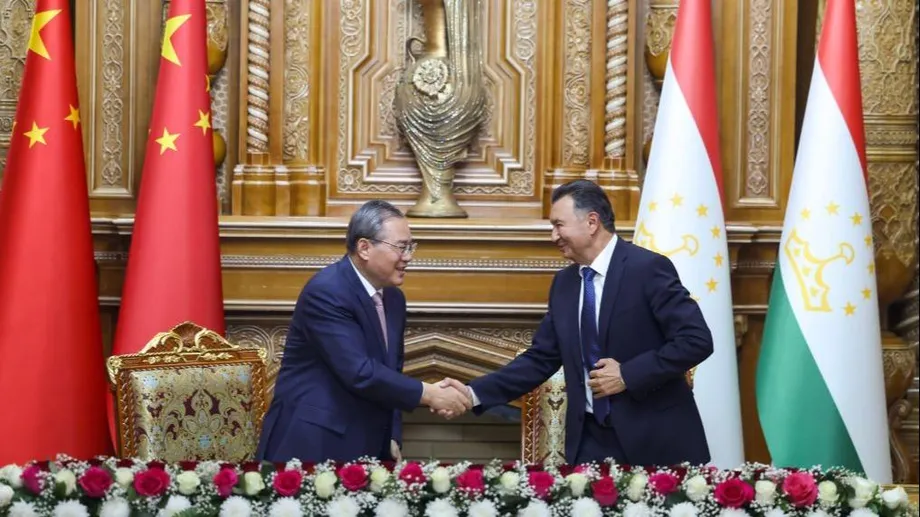
Chinese Premier Li Qiang called for stronger intelligence sharing with Tajikistan during talks with President Emomali Rahmon in Dushanbe on October 19, 2026, linking closer security cooperation with the protection of Chinese citizens and businesses. The appeal follows attacks late last year that killed five Chinese nationals in Tajikistan, which Tajik authorities said were launched from neighbouring Afghanistan.
Contents
- Security and investment meet in Dushanbe
- What Li asked Tajikistan to do
- Why the Afghan frontier matters
- The language of security and the rights dispute
- Trade, minerals and artificial intelligence
- What the signed documents cover
- A regional meeting broadens the agenda
- How the meetings fit together
- What changes for people and projects
- Key Points
China's official meeting statement said Li urged the two countries to deepen cooperation in law enforcement and security, exchange intelligence and jointly combat terrorism, separatism and extremism. He also proposed expanding trade and cooperation in infrastructure, green minerals, connectivity, the digital economy and artificial intelligence.
The talks brought together two closely connected priorities: keeping Chinese people and projects safe, and expanding China's economic presence in a country of around 11 million people. China is already a major investor in Tajikistan, whose remote, mountainous border with China gives the relationship a direct geographic importance.
Li met Rahmon a day after holding talks with Tajik Prime Minister Kokhir Rasulzoda. Those discussions produced documents covering infrastructure construction, education, efforts against corruption and standardization, giving the visit a practical economic agenda alongside its security message.
What Li asked Tajikistan to do
Li's request went beyond a general pledge of friendship. He called for greater intelligence exchange and sharing, meaning that the authorities would pass information about suspected threats to each other so they could identify risks and coordinate responses.
The Chinese readout of the October 19 morning meeting recorded Li's security proposal in these terms:
The two sides should deepen law-enforcement and security cooperation, strengthen intelligence exchanges and sharing, jointly combat the 'three forces,' and safeguard lasting peace and stability in the region.
Li, China's premier, made the protection of Chinese citizens and companies an explicit part of that agenda. The Chinese government statement recorded his request in these terms:
It is hoped that Tajikistan will continue to take strong measures to ensure the safety of Chinese individuals and enterprises in Tajikistan.
Chinese workers and businesses are therefore central to the security discussions. For companies operating in Tajikistan, protection affects whether staff can travel, work at project sites and maintain operations. Li also raised security in his talks with Rasulzoda, connecting it to a stable environment for exchanges between people from both countries.
In the official account of the October 18 afternoon talks, Li said the two sides should "continue to deepen law-enforcement and security cooperation, creating a stable and peaceful environment for exchanges between people from both sides."
The announcements did not specify new intelligence procedures, additional deployments, funding or a timetable for security measures. The concrete public commitments were to deepen cooperation and improve protection, while the details of implementation remained unstated.
Why the Afghan frontier matters
Tajik authorities attributed the attacks that killed five Chinese nationals late last year to assailants operating from Afghanistan. Those deaths give Li's appeal an immediate human and economic context: Chinese citizens working abroad have already been killed in violence reaching across Tajikistan's southern frontier.
Tajikistan has tense relations with the Taliban authorities in Afghanistan. It has also previously warned about drug smugglers and illicit gold miners operating along the border. These concerns put pressure on the same frontier through different kinds of activity, from armed attacks to illegal trade and extraction.
China's concern extends to its own territory. Beijing has long feared that violence in Central Asia could spread into Xinjiang, its far western region, which is home to the mostly Muslim Uyghur people. Chinese authorities have blamed Uyghur militants for a series of past attacks there.
Tajikistan's position between China and Afghanistan helps explain why intelligence exchange features prominently in the talks. Information collected on one side of a border can matter to authorities on the other, particularly when suspected attackers or smugglers move through remote areas.
The language of security and the rights dispute
Li called for a joint fight against terrorism, separatism and extremism, categories that Beijing often groups under the term "three evil forces." Separatism refers to efforts to break a territory away from a state. In China's security policy, the term is closely connected to its concerns about territorial control, including in Xinjiang.
Human rights groups say China has severely repressed Uyghurs and restricted their religious, cultural and linguistic rights. China denies that abuses have taken place. That dispute is part of the context for Beijing's efforts to build international cooperation around its security priorities.
Rahmon reaffirmed Tajikistan's support for China's core interests during the meeting. His government also restated its commitment to the one-China principle, Beijing's position that there is one China and that Taiwan is part of it.
Political support and operational security cooperation appeared together in the discussions. Li sought closer coordination against perceived threats, while Rahmon offered backing on issues Beijing places at the centre of its relations with other governments.
Trade, minerals and artificial intelligence
Li proposed expanding bilateral trade and cooperation in infrastructure, green minerals and transport connectivity. He also named the digital economy and artificial intelligence as areas for growth. The digital economy includes business activity built around digital services and data, while artificial intelligence involves computer systems performing tasks such as identifying patterns or generating information.
The October 19 readout gave his economic proposal as follows:
China is willing to work with Tajikistan to expand the scale of bilateral trade, strengthen cooperation in infrastructure, green minerals, connectivity and other fields, expand cooperation in emerging industries such as the digital economy and artificial intelligence, and jointly strengthen the drivers of economic growth.
China also expressed an intention to import more goods from Tajikistan and encourage Chinese businesses to invest and establish operations there. During his talks with Rasulzoda, Li asked Tajikistan to continue providing a favourable business environment for those companies.
The October 18 account specified that China was willing to import more high-quality Tajik goods. Li proposed deeper cooperation in trade and investment, green minerals, connectivity, clean energy and artificial intelligence to achieve mutual benefit.
Rahmon's economic priorities substantially overlapped with Li's. He listed trade, industry, agriculture, energy, minerals, transport connections and artificial intelligence as fields where Tajikistan was ready to deepen cooperation. Rasulzoda likewise called for more activity in investment, agriculture, logistics, energy and minerals, alongside the green and digital economies.
Rasulzoda described China as Tajikistan's most important trade and investment partner and thanked it for its longstanding support for Tajik economic development. He called for making greater use of the intergovernmental economic and trade cooperation committee to advance cooperation.
The breadth of that agenda matters for Tajikistan. The proposed relationship covers the movement of goods, the construction of infrastructure, the extraction of resources and the development of new services. Security cooperation sits alongside those plans because each depends on people and companies being able to operate safely.
What the signed documents cover
Li and Rasulzoda witnessed the signing of documents covering infrastructure construction, education, efforts against corruption and standardization after their October 18 talks. Standardization means establishing common technical rules or requirements, which can help products, equipment and services work across borders.
The official account published on October 18 did not list the documents' specific titles or provide their texts.
Education and cultural exchanges were also part of the visit's agenda. Li proposed broader cooperation in culture, education, health, sports and contacts between local communities. Rasulzoda supported closer cultural and humanitarian exchanges, along with the economic programme.
Rahmon also called for promoting people-to-people exchanges during his meeting with Li.
Li placed the economic proposals within the Belt and Road Initiative, China's programme for international infrastructure and trade connections. He called for closer alignment between the two countries' development strategies, including cooperation in clean energy, minerals, connectivity and artificial intelligence.
The combination gives the visit two levels of activity: signed documents in several defined fields, and a wider political commitment to expand investment and cooperation. For businesses, the documents on infrastructure and standards are among the most directly relevant elements; for students and institutions, the education component provides another channel of contact.
On the afternoon of October 18, Li also laid a wreath at Tajikistan's monument to national reconciliation and revival. Wu Zhenglong attended the talks and the wreath-laying, as well as the meeting with Rahmon the following morning.
A regional meeting broadens the agenda
Li travelled to Dushanbe for an official visit and the 25th meeting of the Council of Heads of Government of the Shanghai Cooperation Organization, or SCO. The council brings together heads of government within the regional organization, providing a setting for discussions beyond the bilateral meetings.
China offered full support for Tajikistan's hosting of the gathering. Li also called for stronger coordination through the United Nations and the China-Central Asia mechanism, while his talks with Rasulzoda included proposed coordination through the World Artificial Intelligence Cooperation Organization.
In his meeting with Rahmon, Li said China was willing to work with all parties to promote higher-quality development of the SCO. He also called for actively putting Xi's four global initiatives into practice and working together to build a community with a shared future for humanity.
During the talks with Rasulzoda, Li said China and Tajikistan, as important members of the Global South, should unite and cooperate more closely amid continuing complex changes in the international situation, safeguard their common interests and uphold international fairness and justice. He called for coordination through the UN, the SCO, the China-Central Asia mechanism and the World Artificial Intelligence Cooperation Organization to help build a fairer and more reasonable global governance system.
Rahmon backed closer cooperation through the UN, the SCO and the China-Central Asia mechanism. He also expressed support for four global initiatives put forward by Chinese President Xi Jinping, aligning Tajikistan with a broader set of Chinese diplomatic priorities.
Rahmon said this cooperation should take the comprehensive strategic partnership in the new era to new heights and advance a community with a shared future between the two countries. Rasulzoda also called for close coordination through the SCO and China-Central Asia mechanism to achieve further results in bilateral relations.
The visit took place during a busy period of diplomacy in Central Asia. Li had been in Uzbekistan before travelling to Tajikistan, while US Secretary of State Marco Rubio travelled to Uzbekistan on Sunday. Tajikistan also remains closely aligned with Russia, which maintains a military base in the country. Its expanding ties with China sit alongside that established Russian security relationship.
How the meetings fit together
Li and Rahmon both referred to Rahmon's visit to China in May and his meeting with Xi. The October discussions followed that earlier effort to set the direction of the relationship, moving through talks between prime ministers before the meeting with Tajikistan's president.
Li told Rahmon that the two countries were working to build a community with a shared future and that the May meeting had further mapped out bilateral relations. He said China cherished its deep friendship with Tajikistan, would always view the relationship from a strategic and long-term perspective, and wanted to consolidate political trust, firmly support each other's core interests, improve the quality and effectiveness of cooperation, and continue advancing together towards modernization. Rahmon said Tajikistan had always attached great importance to and deeply valued its partnership with China, and that the important understandings reached in May had set the direction for its development.
- May 2026: Rahmon visited China and met Xi, reaching understandings on the development of bilateral relations.
- October 18, 2026: Li arrived in Dushanbe and held talks with Rasulzoda. The two sides witnessed the signing of cooperation documents.
- October 19, 2026: Li met Rahmon and called for stronger intelligence sharing, security cooperation and protection for Chinese citizens and enterprises.
- 2027: China and Tajikistan will mark the 35th anniversary of diplomatic relations, an occasion both sides identified as a reference point for closer ties.
Rasulzoda described bilateral relations as being at their highest level historically. Li presented the coming anniversary as an opportunity to deepen political trust and align development plans more closely.
In the October 18 talks, Li said the two peoples had always held friendly feelings towards each other and that relations had maintained a high level of development under Xi and Rahmon's strategic guidance, with cooperation deepening across all fields. He called for deeper strategic trust, firm mutual support and further practical results from all-round cooperation to benefit both peoples. Rasulzoda said Rahmon's successful visit to China in May had brought relations into a new stage of development.
What changes for people and projects
Chinese personnel in Tajikistan are the most immediate focus of Li's security request. The deaths of five nationals placed the protection of workers and enterprises directly within the talks between national leaders, alongside discussions about expanding the business presence that brings those workers into the country.
Tajikistan's government is seeking broader trade, investment and cooperation across established sectors such as agriculture and energy, as well as newer fields such as artificial intelligence. China's promise to encourage investment and import more Tajik goods addresses both sides of that economic relationship: attracting capital and finding buyers.
Rahmon, who rose to power during Tajikistan's civil war in the 1990s, leads a secular state facing security pressures along its Afghan frontier. His discussions with Li connect those domestic concerns with a wider diplomatic strategy involving China, Russia and regional organizations.
The central development is the decision to pursue economic expansion and closer security coordination together. China wants more opportunities for trade and investment, coupled with stronger protection for its people. Tajikistan is offering political support and seeking deeper cooperation across much of its economy.
Key Points
- Li Qiang met Emomali Rahmon in Dushanbe on October 19, 2026, and called for stronger intelligence sharing and security cooperation.
- Li sought continued protection for Chinese citizens and companies after attacks killed five Chinese nationals late last year.
- Tajik authorities said those attacks were launched from neighbouring Afghanistan.
- China proposed more trade, investment and cooperation in infrastructure, green minerals, connectivity, clean energy, the digital economy and artificial intelligence.
- Talks with Prime Minister Kokhir Rasulzoda produced documents on infrastructure, education, efforts against corruption and standardization; the official account did not give their specific titles or texts.
- Rahmon reaffirmed support for the one-China principle and closer coordination with Beijing in international organizations.
- The countries will mark 35 years of diplomatic relations in 2027.