A target set for 2015 is finally reached
Cambodia exported 1,014,442 tonnes of milled rice by October 19, 2026, passing a national target that the government originally hoped to reach in 2015. The milestone follows a sharp rise in shipments to the Philippines, continued demand from China and Europe, and new transport arrangements intended to make Cambodian rice cheaper to deliver.
Contents
- A target set for 2015 is finally reached
- How exports moved beyond a decade of slower growth
- The Philippines becomes a major buyer
- Direct shipping changes the cost of delivery
- China, Europe and ASEAN fill different roles
- The kind of rice matters as much as the quantity
- Paddy exports follow a different course
- Farm costs remain a pressure on the export industry
- What comes next after the record
- Key Points
The Ministry of Agriculture, Forestry and Fisheries recorded the total in its National Phytosanitary Database. The figure was published in the Cambodian government news agency Agence Kampuchea Presse's October 20 announcement. Prime Minister Hun Manet congratulated the achievement in a social media message that morning.
Ministry spokesperson Khim Finan announced the record on October 19, describing it as an achievement for the country and its agricultural sector.
We have officially broken the historical record for rice exports today," he said. "This is a remarkable triumph for the nation and the agriculture sector as a whole.
The new total is 14,442 tonnes above the million tonne target. It also exceeds the Cambodia Rice Federation's figure of 940,321 tonnes for all of 2025 by 74,121 tonnes, or about 7.9%, with more than two months of 2026 still to run.
For Cambodia, the breakthrough combines two changes: selling more rice abroad and processing more of it before export. Milled rice has had its outer husk removed and is prepared for further processing or consumption. Paddy rice is the harvested grain with the husk still attached. Cambodia exports both, through markets that are developing at different speeds.
How exports moved beyond a decade of slower growth
Cambodia's government set its million tonne ambition in the early 2010s. Exports reached about 538,000 tonnes in 2015, leaving the country well short of the original deadline.
Ministry figures show that annual shipments then remained between roughly 542,000 and 691,000 tonnes from 2016 through 2024. Exports rose and fell within that range rather than moving steadily toward the target. The 2024 total was about 646,000 tonnes.
The Cambodia Rice Federation puts 2025 exports at 940,321 tonnes, earning approximately $602.41 million and growing 45.59% from 2024. A figure of 950,321 tonnes was also cited alongside the August 2026 trade update; the federation total carried in the government's October announcement is 940,321 tonnes.
Lay Chhun Huor, president of the Cambodia Rice Federation, attributed the stronger performance to joint efforts by government leaders and businesses to promote Cambodian rice, expand production and develop export markets. The acceleration became visible well before the October milestone.
- 2015: Cambodia exported about 538,000 tonnes, missing the original million tonne deadline.
- 2025: Milled rice exports reached 940,321 tonnes, according to the Cambodia Rice Federation.
- January to May 2026: Shipments reached 568,912 tonnes across 63 destinations.
- January to August 2026: Exports reached 792,212 tonnes, including 122,102 tonnes sent to the Philippines.
- October 19, 2026: The agriculture ministry recorded 1,014,442 tonnes, passing the national target.
The Philippines becomes a major buyer
The Philippines has supplied one of the clearest sources of new demand. Cambodia shipped 122,102 tonnes there during the first eight months of 2026, equivalent to 15.4% of its 792,212 tonnes of rice exports during that period.
Finan said those shipments were more than 34 times the amount exported to the Philippines during the whole of 2025. He linked the expansion to Cambodian rice quality and Philippine efforts to secure food supplies, as well as cooperation between Cambodian Agriculture Minister Dith Tina and Philippine Agriculture Secretary Francisco P. Tiu Laurel Jr.
The Cambodia Rice Federation said another 87,344 tonnes had been contracted for delivery from September through December. Added to the first eight months, those contracts would bring shipments to 209,446 tonnes for 2026. That projected total would make the Philippines a buyer of roughly one fifth of Cambodia's expected annual rice exports.
Signature Rice general manager Chan Pech said his company would export 60,000 tonnes to the Philippines by the end of 2026. He credited promotion, quality, taste and improved transport infrastructure with helping Cambodian rice compete and attract international orders.
Direct shipping changes the cost of delivery
A shipment of 10,000 tonnes aboard a bulk carrier introduced another way to move Cambodian rice directly to the Philippines. The arrangement is expected to reduce transport costs and delivery times, both important considerations for buyers placing large orders.
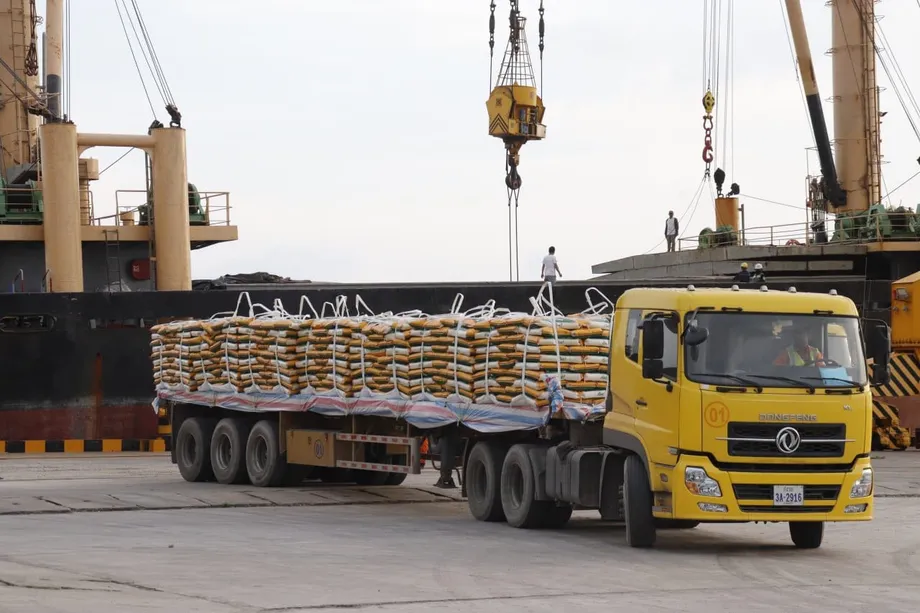
A bulk carrier carries cargo in large holds rather than relying on individual shipping containers. For this rice shipment, bags of grain were bundled and loaded into the vessel's holds using cargo handling equipment.
The approach can reduce spending on container rental, labour used to load containers, and the handling and upkeep of empty containers. Lower delivery costs give exporters more room to compete on price while meeting the buyer's required standard.
Pe ch's assessment of stronger transport links fits the broader shift toward larger Philippine orders. Mills need to prepare consistent quantities, exporters need dependable delivery schedules, and buyers need confidence that repeat shipments will arrive as agreed. Direct shipping provides another option for connecting those steps.
China, Europe and ASEAN fill different roles
The European Union remained Cambodia's largest market in the federation figures described in the October government announcement, followed by China and its autonomous regions and five members of the Association of Southeast Asian Nations (ASEAN). Cambodia also supplied 25 other markets, including countries in Africa and the Middle East.
A more detailed picture of early 2026 appears in the government's June trade announcement, which draws on a Cambodia Rice Federation report released June 5. During January through May, five ASEAN countries bought 208,593 tonnes, China and its autonomous regions bought 162,125 tonnes, and 31 European countries bought 154,254 tonnes. Another 43,940 tonnes went to 24 other markets.
Those figures put the five ASEAN buyers at about 36.7% of the first five months' volume, compared with 28.5% for China and its autonomous regions and 27.1% for the 31 European countries. The European grouping in that breakdown includes countries beyond the EU.
China also expanded the room available for Cambodian shipments. A 2025 agreement raised Cambodia's milled rice export quota from 400,000 to 500,000 tonnes, an increase of 25%. The larger quota gives exporters additional access to an established market while Philippine demand grows.
The kind of rice matters as much as the quantity
Fragrant rice accounted for 59.20% of Cambodia's milled rice exports during the first five months of 2026. White rice followed at 22.28%, while broken rice made up 15.58%. Smaller shares came from parboiled rice, organic rice and other varieties.
The US Department of Agriculture's Foreign Agricultural Service explained the different markets in its Grain and Feed Annual, report CB2026-0003, dated June 18, 2026. Its Phnom Penh staff described strong European demand for premium fragrant rice, while competitively priced white rice attracted buyers in China and the Philippines.
France was the leading European destination in the report's figures, importing approximately 37,000 tonnes. The Netherlands followed at around 15,000 tonnes and the United Kingdom at approximately 13,000 tonnes. Broken rice, meaning grains that break during processing, also supplies processing mills and commercial feed manufacturers through trade with Vietnam.
Revenue figures show how much the export mix can vary. During the first five months, shipments to the 31 European countries earned more than $105 million from 154,254 tonnes. The five ASEAN countries bought a larger quantity, 208,593 tonnes, worth $87.32 million.
That works out to more than $680 per tonne for the European group and about $419 per tonne for the ASEAN group. These are averages across different products and orders. They show why selling more premium rice and selling larger volumes of other rice can contribute differently to export earnings.
Paddy exports follow a different course
Cambodia's rice trade extends far beyond the processed grain counted in the million tonne milestone. In the first five months of 2026, the country also exported more than 2.75 million tonnes of paddy rice, with estimated revenue of $591.41 million. Milled rice shipments during the same period earned $327.43 million.
The federation recorded growth in both categories in 2025: milled rice exports increased 45.59%, while paddy exports rose 32.43%. Early 2026 brought a change in direction for the paddy trade with Vietnam.
USDA staff reported that paddy exports to Vietnam fell 13% during the first four months of the 2025/26 marketing year, which began in January 2026. They linked the decline to weaker Vietnamese demand as Vietnam's own rice exports softened. Cambodian milled rice exports, meanwhile, reached nearly 470,000 tonnes in January through April, rising approximately 70% from a year earlier.
USDA's broader rice export forecast includes paddy shipments converted into the equivalent weight of milled rice, alongside exports of rice already milled in Cambodia. On that basis, its Phnom Penh staff forecast 4.1 million tonnes of exports for the 2026/27 marketing year. Processing paddy inside Cambodia keeps milling, grading and related work within the domestic rice industry.
Farm costs remain a pressure on the export industry
Cambodia reached the export milestone after a difficult production period. USDA staff estimated that milled rice production fell about 5% to 8.1 million tonnes in the 2025/26 marketing year, as harvested area and yields declined.
Farmers reported fertilizer and fuel price increases of 20% to 30%. Higher costs led some to reduce fertilizer use and others to leave land out of rice production. The Cambodia–Thailand border conflict disrupted access to Thai fertilizer and seed, pushing farmers toward Vietnamese and Chinese suppliers that could be more expensive or harder to reach.
Transport costs also increased between farms, mills and ports. Those expenses matter at each stage: farmers must move harvested grain, mills must secure supplies, and exporters must get finished rice to ships at a competitive cost.
USDA staff forecast production recovering to 8.8 million tonnes of milled rice in 2026/27, equivalent to about 14.4 million tonnes of paddy. Their forecast assumes harvested area expands to 3.85 million hectares and yields recover to approximately 3.74 tonnes of paddy per hectare as farmers restore fertilizer use.
The government has directed the agriculture ministry to negotiate fertilizer imports and speed up domestic fertilizer production. At a May 28 meeting in New York, China pledged support for Cambodia's supply of oil, gas and fertilizers. More reliable access to those supplies would help farmers meet the needs of a growing export industry.
What comes next after the record
The next concrete delivery period is September through December, when the federation said 87,344 tonnes were contracted for the Philippines. Signature Rice's stated plan to ship 60,000 tonnes to that market also runs through the end of 2026.
Cambodia's final export volume and earnings for 2026 are not yet known. The October milestone measures tonnage, while the January through May figures provide the latest revenue breakdown detailed here.
The country's immediate task is to turn a larger order book into completed deliveries while maintaining quality and managing farm and transport costs. Europe remains an important market for premium rice, China has increased its quota, and the Philippines has rapidly become a substantial buyer. Together, those developments explain how Cambodia finally moved beyond a target that had stood for more than a decade.
Key Points
- Cambodia exported 1,014,442 tonnes of milled rice by October 19, 2026, passing its longstanding million tonne target.
- The Cambodia Rice Federation recorded 940,321 tonnes of milled rice exports worth approximately $602.41 million in 2025.
- The Philippines bought 122,102 tonnes in the first eight months of 2026, with further contracts lifting projected annual shipments to 209,446 tonnes.
- A direct shipment of 10,000 tonnes by bulk carrier introduced another transport option expected to reduce delivery costs.
- Fragrant rice made up 59.20% of milled rice exports during the first five months of 2026.
- Higher farm costs and disrupted access to fertilizer remain pressures as exporters work to complete orders through December.