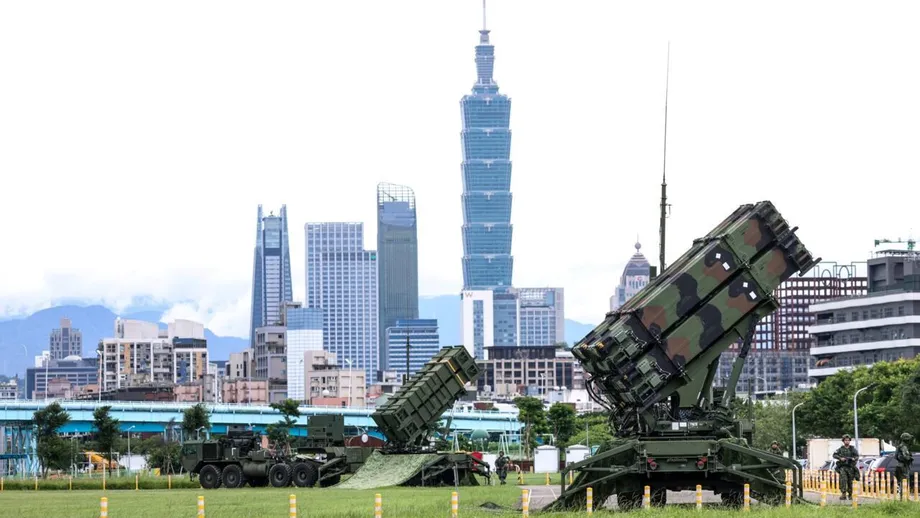
A weapons decision with consequences beyond Taiwan
Taiwan is waiting for US President Donald Trump to approve a proposed $14 billion arms sale that would supply key parts of its planned T-Dome air defence system, including Patriot missiles, an automated command and control system and radar covering all directions.
Contents
- A weapons decision with consequences beyond Taiwan
- What Taiwan wants for the T-Dome
- Taipei has approved money, but Washington controls the sale
- Trade talks put Taiwan at the centre of diplomacy
- American weapons stocks are another constraint
- A single package could become several sales
- Why Taipei sees a political signal in the weapons
- The waiting period extends beyond presidential approval
- Key Points
The proposal has been pending for months while Washington weighs relations with Beijing and the availability of American weapons for operations in Iran. Secretary of State Marco Rubio said in June that the package was under review. No date has been announced for a decision, and the sale could be divided into smaller packages.
For Taipei, the stakes involve both military equipment and political support. Taiwan wants weapons to discourage a Chinese attack and strengthen its ability to defend itself. Beijing claims Taiwan as its territory, opposes American arms sales to the island and has threatened to seize it by force.
The proposed purchase is larger than the record $11.1 billion package Washington approved in December. At $14 billion, it would be $2.9 billion bigger, an increase of about 26%. Its size also makes the decision particularly sensitive as Trump and Chinese President Xi Jinping seek to ease trade tensions.
What Taiwan wants for the T-Dome
Taiwan is developing the T-Dome as an air defence network with several layers. The aim is to bring different defensive systems together so they can detect threats, coordinate a response and intercept incoming attacks.
The three identified elements of the proposed American package serve different purposes. Radar helps detect and track approaching threats. An automated command and control system helps turn that information into a coordinated response. Patriot missiles provide a means of interception. A radar with coverage of 360 degrees can watch in every direction around its position.
The package includes Patriot PAC-3 interceptors and advanced surface-to-air missile systems.
Su Tzu-yun, a military expert at the Institute for National Defense and Security Research in Taipei, described the value of combining those components:
Together these systems can strengthen the resilience of Taiwan's strategic air defences.
Resilience means being able to keep functioning under pressure or recover after disruption. For Taiwan, the objective is an air defence network whose components work together during an attack. Buying the equipment is one stage; connecting it and preparing personnel to operate it are also necessary before it can become effective.
Taipei has approved money, but Washington controls the sale
Taiwan's parliament passed a $25 billion defence spending bill in May after months of political disputes. Funding for the proposed American weapons is expected to come from that measure.
The $14 billion package would equal 56% of the bill's value if the entire purchase were financed from it. That comparison shows the scale of the proposed acquisition within Taiwan's spending plans, although the final package and its financing arrangements have yet to be settled.
Taiwan is also upgrading its armed forces and expanding domestic weapons production. Those efforts accompany its purchases from the United States, which remains its most important security backer.
The parliamentary vote settled a major funding dispute inside Taiwan. The next decision rests in Washington, where Trump has resisted pressure to approve the package, including from members of his own Republican Party. Taipei's willingness to pay and Washington's willingness to authorise the sale are separate steps in getting the weapons into service.
Trade talks put Taiwan at the centre of diplomacy
Trump and Xi met in Beijing in May as they sought to reduce trade tensions between the world's two largest economies. The summit was the first of four meetings expected between the leaders in 2026.
Xi warned Trump that missteps over Taiwan could push China and the United States into conflict. A $14 billion arms approval would therefore arrive at a sensitive moment in their efforts to maintain a trade truce.
Trump said in May that arms sales to Taiwan could be used as a bargaining chip with China. That possibility alarmed Taipei, which has reminded Washington of its commitments to help provide for Taiwan's defence.
Trump, who has also praised his friendship with Xi, left his decision open when asked about arms sales after the Beijing summit:
I'm going to make a determination. I'm going to see.
The president's comments place the proposed sale within a wider negotiation involving trade and the relationship between Washington and Beijing. Taiwan's immediate concern is more concrete: when approval might come, which weapons it would cover and how soon those systems could become usable.
American weapons stocks are another constraint
US officials said in May that they were assessing whether American weapons stockpiles were sufficient for operations in Iran. That review adds a military supply concern to the diplomatic calculations surrounding the Taiwan package.
A stockpile is the supply of weapons a military holds for use. Washington must consider its own operational requirements while deciding what equipment it can make available to a security partner. Approval, production and delivery each affect how quickly a purchase can proceed.
Rubio's statement in June that the package remained under review followed those assessments. No detailed allocation of weapons between American requirements and Taiwan's proposed purchase has been announced.
Explaining the review, Rubio told reporters in New York that foreign arms sales must be weighed against American military industrial capacity:
This is not about Taiwan in specific, but when we sell something, that means we don't have it anymore," he said. "We can get it in the future, but we don't have it now.
He said the $14 billion package was undergoing a review balancing American needs in different parts of the world and "whether we can afford to sell something, because we may need it for ourselves."
For Taiwan, this creates uncertainty beyond Trump's talks with Xi. Even a political decision to support a sale must be followed by arrangements for producing, supplying and delivering the equipment. The timetable matters because Taiwan is trying to build a functioning defence network rather than simply secure permission to buy individual weapons.
A single package could become several sales
A US official said the likelihood of dividing the proposal into smaller sales had increased. Such an approach would change the form of the approval process, allowing the weapons to be considered in separate packages instead of one $14 billion transaction.
Some Taiwanese officials have said they are willing to accept either arrangement. Their priority is obtaining the equipment, whether Washington approves it together or through several decisions.
The practical issue would then become the content and timing of each sale. Taiwan wants radar, command systems and missiles that can support its wider air defence plan. Separate approvals would leave Taipei watching which components move first and when the rest follow.
Washington has not announced a final structure for the proposal. Splitting it remains a possibility while the administration considers the package, its military supply requirements and relations with China.
Why Taipei sees a political signal in the weapons
The United States switched diplomatic recognition from Taipei to Beijing in 1979. Since then, the Taiwan Relations Act has provided the framework for American commitments to supply Taiwan with weapons for its defence.
Section 2 of the Taiwan Relations Act states that American policy is "to provide Taiwan with arms of a defensive character". Section 3 says the United States will make available defence articles and services in quantities necessary for Taiwan to maintain a sufficient self-defence capability. The president and Congress determine the nature and quantity of that support based solely on their judgement of Taiwan's needs, with review by American military authorities.
Taipei has pointed to those commitments as it presses for the new sale. Rubio and other US officials have said American policy on Taiwan has not changed, even as Trump's comments about bargaining with Beijing have created concern.
Wang Ting-yu, a senior lawmaker in President Lai Ching-te's Democratic Progressive Party, said approval would signal American support and tell Beijing that an attack would leave it facing more than Taiwan alone.
Wang's argument concerns deterrence: discouraging an attack by increasing its expected difficulty and cost. The proposed weapons would contribute military capability, while approval would also communicate Washington's willingness to continue supporting Taiwan's defence. Taipei wants both effects as China maintains its claim over the island.
The waiting period extends beyond presidential approval
Taiwan's procurement effort now stretches across several decisions, from the previous American package to its own spending legislation and the continuing review in Washington:
- December: Washington approved a record $11.1 billion arms package for Taiwan.
- May 2026: Taiwan's parliament passed a $25 billion defence spending bill after months of political disputes.
- May 2026: Trump and Xi met in Beijing, while US officials assessed weapons stockpiles for operations in Iran.
- June 2026: Rubio said the proposed $14 billion package remained under review.
- During 2026: Four Trump-Xi meetings were expected, beginning with the May summit.
Su, the defence researcher in Taipei, warned that the time needed to turn an approved purchase into an operational system makes the delay consequential. He described the steps that follow an order:
Acquiring weapons is not like ordering at a drive-through. Production, delivery and training all take time before the systems can enter service and become effective.
Taiwan has moved ahead with funding and domestic production while seeking American systems for its T-Dome. Its immediate priority is a decision that allows procurement to advance. After that, factories, delivery schedules and training will determine when the proposed equipment can contribute to the island's defence.
Key Points
- Trump has yet to approve a proposed $14 billion weapons sale to Taiwan.
- The package includes Patriot missiles, automated command and control equipment, and radar for the planned T-Dome air defence network.
- Taiwan expects funding to come from a $25 billion defence spending bill passed in May.
- Washington is weighing relations with China and American weapons requirements for operations in Iran.
- The proposal could be divided into smaller sales; no decision date has been announced.
- Production, delivery and training would still be needed after approval.