A 200 vehicle test planned for Can Gio
VinFast plans to test 200 Level 4 autonomous taxis at Vinhomes Green Paradise in Can Gio, Ho Chi Minh City, toward the end of 2027, bringing its partnership with NVIDIA and Autobrains toward a specific deployment in Vietnam. The trial is being prepared and requires approval from the relevant authorities.
Contents
- A 200 vehicle test planned for Can Gio
- What Level 4 means for a taxi passenger
- How the partnerships developed
- What NVIDIA and Autobrains contribute
- Why Southeast Asian traffic shapes the design
- What VinFast says its prototypes can do better
- A small fleet beside larger robotaxi ambitions
- How the trial fits Vietnam's electric transport expansion
- Key Points
The proposed fleet would test technology designed to handle driving without continuous human supervision within a defined operating area and set of conditions. For passengers, the intended change is straightforward: a taxi whose driving system, rather than a person behind the wheel, takes responsibility for the journey within those limits.
VinFast announced the three company partnership on June 1, 2026, at NVIDIA GTC Taipei during COMPUTEX 2026 in Taiwan. The program combines VinFast's vehicle integration work, NVIDIA DRIVE Hyperion 10 computing technology and Autobrains' Agentic AI software, with Southeast Asia as its target market.
The 200 vehicle figure appears in VinFast management's prepared earnings remarks, although a summary of the question and answer session also refers to about 20 vehicles the following year. The relationship between those two fleet sizes was not explained. Management's detailed statement identifies the planned deployment as 200 robotaxis in Can Gio in late 2027.
What Level 4 means for a taxi passenger
Level 4 describes a vehicle that can perform the driving task within specified conditions without requiring a person to supervise continuously. Those conditions can define where the vehicle operates and the circumstances in which it is allowed to drive. If the system reaches its limits, it must be able to bring the vehicle to a safe state.
A robotaxi can therefore serve a limited area before attempting a wider network. VinFast's choice of a named development gives the proposed trial a geographic focus, while the operating rules will determine the actual boundaries of the service.
Level 5 is the broader ambition of automation across all driving conditions. VinFast is pursuing Level 4, making the ability to operate reliably inside an agreed boundary the immediate engineering task.
VinFast's earlier L2++ program concerns advanced driver assistance, where a human remains responsible for driving. Moving from assistance to Level 4 changes the responsibility placed on the technology: the system must manage the driving task and respond safely when it cannot continue within its operating limits.
How the partnerships developed
VinFast's robotaxi plan follows an earlier agreement with Autobrains covering assistance systems for passenger cars. The progression connects work on existing electric SUVs with a more demanding autonomous taxi platform.
- January 27, 2026: VinFast announced cooperation with Autobrains on L2++ driver assistance and a Robo-Car architecture, with testing planned on the VF 8 and VF 9 electric SUVs.
- June 1, 2026: VinFast, NVIDIA and Autobrains announced their Level 4 robotaxi partnership in Taipei, targeting Southeast Asia.
- During its Q2 2026 earnings discussion: VinFast management described prototype improvements and work with authorities on rules, safety standards and training.
- Late 2027: VinFast aims to conduct the 200 vehicle trial at Vinhomes Green Paradise, subject to permission.
The January program explored standard cameras paired with powerful processing chips, seeking to reduce dependence on expensive hardware such as LiDAR. LiDAR uses laser light to measure distances and help build a picture of a vehicle's surroundings.
The Level 4 platform described by management uses camera vision, LiDAR and radar. The development program therefore includes both research into reducing sensor costs and a robotaxi approach that combines several ways of observing the road.
What NVIDIA and Autobrains contribute
NVIDIA supplies the computing foundation and development hardware and software, while Autobrains develops the artificial intelligence supporting autonomous driving. VinFast brings those components together in the vehicle. The companies describe their architecture as open and modular, meaning its main parts can be integrated and developed as distinct components.
DRIVE Hyperion provides a development platform that includes computing, software and sensor support. VinFast says using a validated hardware and software foundation can reduce integration work that would otherwise add years to an autonomous vehicle program.
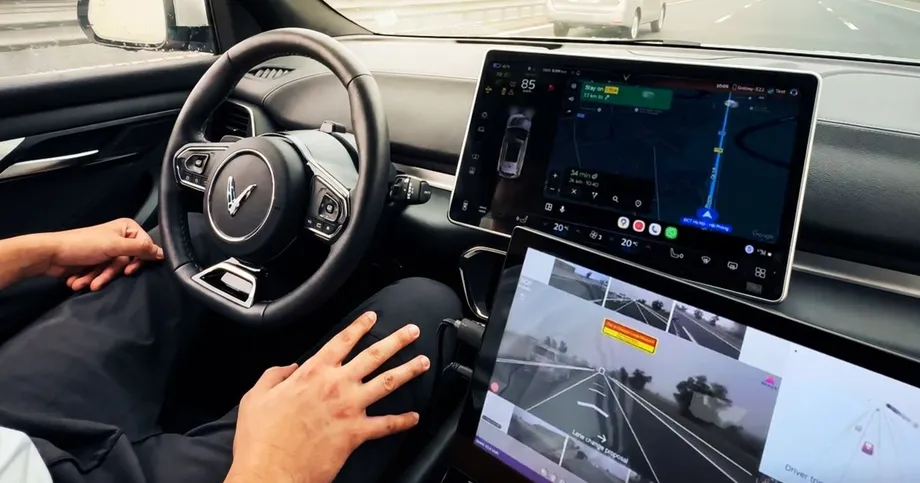
Descriptions of the proposed platform list support for 12 cameras with high resolution, nine radar units, 12 ultrasonic sensors and a LiDAR unit facing forward, with the option of three additional LiDAR units along the sides. Cameras capture visual information, radar measures objects using radio waves, and ultrasonic sensors help detect nearby obstacles.
Autobrains, an Israeli AI company with more than 300 patents related to driver assistance and autonomous vehicles, supplies a different part of the system: software intended to interpret situations and support driving decisions. Its Agentic AI uses specialized software agents, each assigned particular tasks.
An agent can be activated when a driving situation needs its capabilities, rather than keeping every part of the AI working at full intensity throughout a trip. The companies aim to reduce computing demand while improving responses to changing traffic. Those are development goals that the vehicle testing program will need to assess.
Why Southeast Asian traffic shapes the design
VinFast identifies dense traffic, varied road user behavior and complex urban conditions as central challenges for the program. A vehicle must continually interpret the movement of nearby traffic and choose an appropriate response as the scene changes.
The partners are targeting three practical difficulties: complicated systems, expensive computing requirements and unreliable performance outside controlled environments. Their proposed solution combines an established computing platform with software that activates specialized capabilities as needed.
Nguyen Van Duong, VinFast Global's deputy chief executive responsible for advanced driver assistance, described affordability as a central aim of the partnership:
Advanced mobility shouldn't be a luxury. VinFast is committed to building scalable and accessible autonomous driving solutions through collaboration with global technology leaders. Together with Autobrains and NVIDIA, we are exploring a practical and cost-efficient path toward Level-4 mobility for Southeast Asia's highly dynamic real-world traffic environments.
NVIDIA's vice president of automotive, Rishi Dhall, said the combination of DRIVE Hyperion and Autobrains' software is intended to accelerate the development of safe, reliable autonomous vehicles that perform in complex traffic and improve over time.
What VinFast says its prototypes can do better
VinFast management representative Chien Nguyen said the company had shown its latest robotaxi prototypes during the Vingroup investor tour in 2026. The improvements he described concerned everyday aspects of a ride: acceleration, braking, cornering and following another vehicle.
Nguyen described the changes during the earnings discussion:
Recent improvements included smoother acceleration and braking, more natural cornering and vehicle-following behavior and an overall more refined driving experience.
Passenger comfort matters alongside the ability to complete a route. Sudden braking or awkward turns can make a technically completed journey unpleasant. VinFast says it is continuing to improve navigation on autopilot, focusing on driving quality, predictability and comfort.
The company is also working with authorities on a regulatory framework, safety standards and training protocols. That work connects the vehicle engineering program with the rules and preparation needed to put a fleet into operation.
A small fleet beside larger robotaxi ambitions
VinFast is entering a sector where Level 4 services already operate in several markets. Waymo runs autonomous taxi services in the United States, while Baidu's Apollo Go has operated vehicles without drivers in Wuhan, Beijing and Shenzhen.
Pony.ai has set a target of more than 3,500 vehicles during 2026. VinFast's planned 200 vehicle trial would be less than 6% of that target, illustrating the difference between a proposed local validation fleet and the expansion plans of an established robotaxi developer.
Autobrains has also announced a robotaxi program with Uber in Munich using NVIDIA DRIVE Hyperion. That gives VinFast's software partner another announced deployment effort using the same platform family, alongside the proposed Southeast Asian program.
VinFast's immediate task is to validate its own integrated vehicle and software system in the conditions chosen for Can Gio. Its late 2027 target places the project at a different stage from services already carrying passengers elsewhere.
How the trial fits Vietnam's electric transport expansion
VinFast's autonomous taxi project builds on an expanding domestic electric vehicle market. Vietnam became Southeast Asia's largest electric car market in 2025, when electric models accounted for nearly 40% of new car sales, as detailed in the country's electric car sales expansion.
The company's cars have also become familiar through passenger services. VinFast delivered 67,569 electric vehicles in Vietnam during the first half of 2025, taking about 30% of the automobile market, during its Ho Chi Minh City expansion. Taxi use helped bring electric cars into everyday travel for people who did not own one.
A robotaxi trial would add a new technical and operational task to that electric transport base. Charging and maintaining the vehicles would remain necessary, while the autonomous system would take on the driving responsibility inside its approved operating conditions.
For Can Gio, the proposed fleet offers a specific place and scale for testing that transition. VinFast's next stated deployment target is late 2027, with technology development and work on regulatory approval continuing before then.
Key Points
- VinFast plans a trial of 200 Level 4 robotaxis at Vinhomes Green Paradise in Can Gio toward the end of 2027, subject to approval.
- The program combines VinFast vehicle integration, NVIDIA DRIVE Hyperion 10 and Autobrains' Agentic AI software.
- Level 4 allows autonomous driving within defined operating conditions without continuous human supervision.
- Management says prototypes have improved acceleration, braking, cornering and vehicle following.
- VinFast is working with authorities on a regulatory framework, safety standards and training protocols.
- An earnings discussion summary also mentioned about 20 vehicles, without explaining how that figure relates to the planned fleet of 200.