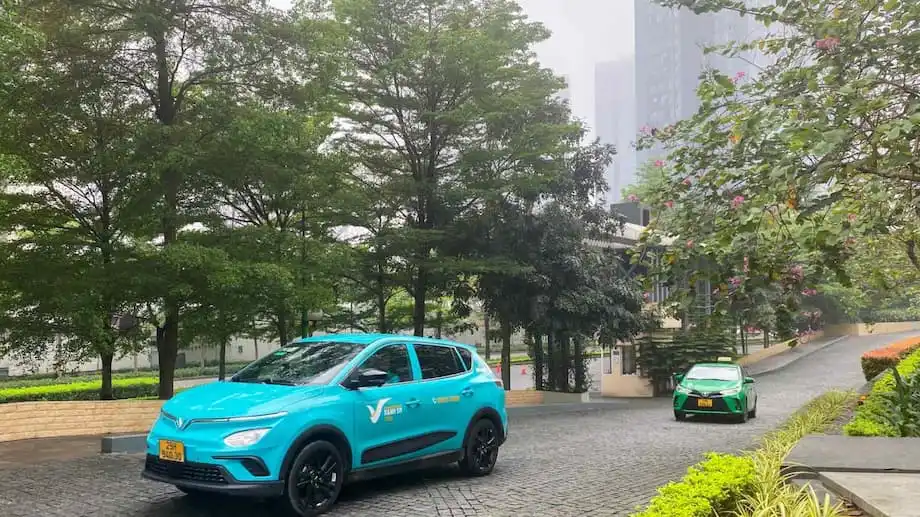
Turquoise Cars Mark a Change in City Traffic
VinFast delivered 67,569 electric vehicles in Vietnam in the first half of 2025, taking about 30% of the automobile market as the country's shift toward electric transport gathered speed. In Ho Chi Minh City, the change is visible in the turquoise cars carrying passengers through streets long dominated by gasoline cars and motorbikes.
Contents
- Turquoise Cars Mark a Change in City Traffic
- How VinFast Became So Visible
- Government Incentives Reduce the Cost of Switching
- Xanh SM Connects Manufacturing With Everyday Travel
- A Growing Market Attracts More Competitors
- Charging Access Shapes Who Can Join the Transition
- Why Consumers Are Considering Electric Vehicles
- Safety and Quality Remain Practical Concerns
- International Ambitions Bring Financial Pressure
- What the Change Means for Ho Chi Minh City
- Key Points
By July 22, 2025, VinFast's growing presence had become a striking feature of the city. A returning visitor described seeing two or three VinFast vehicles among every six cars at some traffic lights. That street observation captures how familiar the brand has become, while the national sales figures show the scale of its expansion.
VinFast's rise brings together several developments: government incentives that reduce purchase costs, a large charging network, and demand from the Xanh SM taxi and ride service. Electric cars are becoming part of everyday travel, including for passengers who have never bought or driven one.
The transition also carries practical difficulties. Charging remains inconvenient in some neighborhoods, competing brands have limited access to public infrastructure, and VinFast faces financial losses, questions about vehicle quality and strong international competition.
Ho Chi Minh City's changing traffic therefore tells a larger story about Vietnam's attempt to build a domestic automotive industry while reducing transport emissions. The speed of adoption is striking, but the next stage depends on making electric transport affordable, convenient and reliable beyond the fleets already filling the roads.
How VinFast Became So Visible
VinFast was founded in 2017 as a subsidiary of Vingroup, Vietnam's largest private conglomerate, with the goal of creating a homegrown automotive industry. It initially produced gasoline vehicles before shifting rapidly toward electric cars, buses and scooters.
Billions in investment and strong government support have helped that expansion. VinFast is now Vietnam's leading electric vehicle brand and a central company in the country's push toward cleaner transport.
A recent visitor and electric vehicle enthusiast described the speed of the change in Ho Chi Minh City:
From totally non-existent the last time I was here a few years back, to easily a top three brand on the streets of Ho Chi Minh now. They're everywhere. Ubiquitous.
The same visitor described how much of that presence came from passenger services, identifying the models being used across different service tiers:
Most of these cars are cabs on VF's own Xanh SM rideshare network — VinFast operates at least two major tiers of car service, the regular bright blue VF e34 and VF5 units, as well as the Xanh Luxury VF6 and VF8 cars. Surprisingly, the luxury service seems quite popular — I've seen almost as many VF8s as I have VF5s, although the VF e34 is king.
Those observations show why the brand can appear especially prominent in city traffic. Cars working as taxis spend their days carrying passengers, making electric vehicles a familiar sight and giving residents a direct experience of the technology.
Government Incentives Reduce the Cost of Switching
Vietnam's government has supported adoption through a 100% exemption from registration fees for battery electric vehicles until at least February 2027. Battery electric vehicles, often shortened to BEVs, run on electricity stored in a battery rather than gasoline.
Registration fees can amount to 10% to 12% of a vehicle's value, making them a substantial part of the initial purchase cost. Removing that charge narrows the price gap between an electric car and a gasoline alternative. Buyers still face the vehicle's purchase price, but one major expense is waived.
Decision 876 also mandates that all taxis in urban areas run on electricity or clean energy by 2030. That requirement gives taxi companies and drivers a reason to prepare for a change in their fleets, with Xanh SM already leading the shift toward electric services.
The main dates shaping the transition are:
- 2017: VinFast was founded to help establish a Vietnamese automotive industry.
- First half of 2025: VinFast delivered 67,569 electric vehicles in Vietnam.
- At least February 2027: The registration fee exemption for battery electric vehicles remains in place.
- 2030: Urban taxis must run on electricity or clean energy under Decision 876.
The government's stated direction is to reduce greenhouse gas emissions, improve air quality and position Vietnam as a leader in sustainable transport in Southeast Asia. For vehicle buyers and fleet operators, those goals are being translated into immediate financial incentives and a deadline for changing urban taxis.
Xanh SM Connects Manufacturing With Everyday Travel
VinFast's strategy extends beyond manufacturing vehicles. It supplies cars to the Xanh SM taxi and ride service, connecting vehicle production with a business that puts those cars to work on city streets.
This approach provides a steady source of demand for VinFast vehicles and helps the company expand its presence quickly in major cities. It is an example of vertical integration: connected activities, such as making cars and providing transport services, operate within the same business network.
Xanh SM has become Vietnam's second most popular ride service, operating 20,000 cars and 22,000 motorbikes across nearly half the country. Its expansion has brought it into competition with established services such as Grab.
The regular service uses bright blue VF e34 and VF5 vehicles, while Xanh Luxury includes VF6 and VF8 cars. That range places VinFast vehicles in different parts of the passenger market, from routine journeys to more expensive services.
Passengers can experience electric transport without taking on the cost of buying a car or arranging charging. VinFast also produces electric buses and works with local authorities to modernize public transport fleets. Together, taxis, ride services and buses make the technology part of daily life while supporting efforts to reduce emissions.
A Growing Market Attracts More Competitors
Figures attributed to the Vietnam Automobile Manufacturers Association put total vehicle sales in the first half of 2025 at 226,500 units, up 70% from the same period a year earlier. VinFast's 67,569 electric vehicle deliveries represented about 30% of that total, or roughly three vehicles in every ten sold.
Vietnam's electric vehicle market is projected to reach a value of $5 billion to $7 billion within the next five years. An estimated 250,000 to 300,000 electric vehicles are already on the country's roads.
BYD, Hyundai, Wuling, Mercedes-Benz and Audi have entered the Vietnamese market, with competition also developing in the luxury segment. Their presence gives buyers more alternatives as electric vehicle adoption grows.
VinFast's domestic identity and charging network remain important advantages. Foreign brands face the task of persuading consumers to buy their vehicles while also ensuring those buyers can charge conveniently.
BYD, described as the world's top electric vehicle maker, faces particular difficulties from VinFast's near monopoly on charging points and lingering sentiment against China among Vietnamese consumers. Price and vehicle specifications are therefore only part of the competition. Access to charging and attitudes toward a brand's country of origin also affect its appeal.
Charging Access Shapes Who Can Join the Transition
VinFast has invested in a nationwide network of more than 150,000 charging ports at shopping malls, apartment complexes and public spaces. A charging port is a connection through which a vehicle receives electricity, making access to one a basic requirement for regular use.
The network is largely exclusive to VinFast vehicles. That gives the company a substantial advantage over competitors such as BYD and Wuling, whose customers often struggle to find convenient charging options.
Public chargers are concentrated in newer urban areas, shopping malls and service points operated by manufacturers. Residents of older neighborhoods and apartment buildings can face more difficulty finding a suitable place to charge.
The warning accompanying this growth puts the infrastructure problem in plain terms:
Vietnam is experiencing rapid growth in electric car and motorbike adoption, signaling a major shift in transportation. However, experts warn that this momentum could be hindered without a swift expansion of charging infrastructure.
A broader network shared by different brands would give more drivers convenient charging choices. Without that access, buyers of vehicles outside VinFast's network face an extra practical concern, and the pace of wider adoption could slow.
VinFast has introduced franchise charging stations and partnerships with gas station operators to expand coverage. These arrangements create more potential locations, but expansion still requires attention to fire safety regulations, electricity grid capacity and coordination by government bodies.
The issue reaches beyond installing equipment. A charger must be in a useful location, have a suitable electricity supply and meet safety requirements. For residents deciding whether to replace a gasoline vehicle, those practical details can determine whether an electric car fits their daily routine.
Why Consumers Are Considering Electric Vehicles
Urban pollution and climate change have become pressing concerns in Ho Chi Minh City and Hanoi. Environmental protection is increasingly part of vehicle purchasing decisions, alongside price, convenience and the appeal of newer technology.
Electric vehicles offer lower operating costs than gasoline vehicles, particularly as fuel prices rise. Government incentives further reduce the total cost of ownership, meaning the combined expense of buying and using a vehicle rather than its purchase price alone.
Vietnam's growing middle class and young population are also more open to new technologies and sustainable lifestyles. Smart city initiatives, which seek to make urban services more modern and connected, fit with the adoption of electric transport.
VinFast serves different budgets through models ranging from the more affordable VF3 to the luxury VF8 and VF9. It also offers free charging at V-Green stations for new buyers and a program allowing motorists to exchange gasoline vehicles for electric ones.
These measures address different parts of the purchase decision. A less expensive model lowers the entry price, free charging reduces an operating expense, and an exchange program provides a route for an existing owner to move away from gasoline.
Safety and Quality Remain Practical Concerns
A recent incident in Ho Chi Minh City, where a VinFast VF 3 caught fire after being fitted with aftermarket headlights, has brought attention to vehicle modifications. Concerns also surround nonstandard chargers and changes made outside a vehicle's original equipment.
Charging expansion must therefore develop alongside safety rules and suitable electrical infrastructure. Fire safety requirements can affect where equipment is installed, while grid capacity affects how much electricity a location can supply.
Some consumers and experts have raised concerns about VinFast's quality and pricing, particularly compared with cheaper Chinese alternatives. As competition grows, the company will need to maintain its position through innovation, pricing and customer service.
For buyers, the decision involves more than choosing an electric motor over a gasoline engine. Vehicle quality, charging convenience, running costs and service support all shape whether the switch works in everyday use.
International Ambitions Bring Financial Pressure
VinFast's plans reach well beyond Vietnam. The company has appeared at major international events, including the LA Auto Show in the United States, and has announced plans to export vehicles to North America and Europe.
Its expansion in the United States includes a California headquarters and plans for a manufacturing plant. Those efforts have faced delays and financial challenges, while the company has reported substantial losses as it spends heavily on production capacity and infrastructure.
At home, VinFast's investment in factories, supply chains and charging infrastructure has created jobs and attracted foreign investment. Its growth is viewed as a potential driver of wider economic development, extending beyond the vehicles sold under its own brand.
Vietnam's participation in trade agreements, including the EU-Vietnam FTA, supports its potential role as a regional center for electric vehicle and battery production. Manufacturing vehicles and batteries domestically would connect the transport transition with the country's industrial ambitions.
VinFast must pursue those ambitions while competing against global manufacturers expanding in Vietnam and Southeast Asia. Its domestic charging advantage and visibility through Xanh SM support its position at home, while international expansion adds demands on spending, production and service.
What the Change Means for Ho Chi Minh City
Ho Chi Minh City's growing number of electric taxis gives residents a visible example of Vietnam's transport transition. Government incentives, a young population receptive to technology and investment by VinFast are helping electric vehicles move into ordinary urban travel.
More charging locations would make ownership practical for a wider range of households. Electrifying taxis and buses could also reduce exhaust emissions from vehicles that operate throughout the city each day.
Vietnam's transition is still at an early stage. Continued investment, clear regulation, attention to safety and dependable vehicle quality will shape how widely its benefits spread. The country's experience offers lessons for other emerging economies seeking to combine industrial growth with environmental responsibility.
Key Points
- VinFast delivered 67,569 electric vehicles in Vietnam in the first half of 2025, about 30% of total automobile sales.
- Battery electric vehicles receive a 100% registration fee exemption until at least February 2027.
- Decision 876 requires urban taxis to run on electricity or clean energy by 2030.
- Xanh SM operates 20,000 cars and 22,000 motorbikes across nearly half the country.
- VinFast's network includes more than 150,000 charging ports, largely reserved for its vehicles.
- Charging gaps, safety concerns, financial losses and growing competition remain major challenges.