Nearly VND 2 trillion system arrives in Ho Chi Minh City
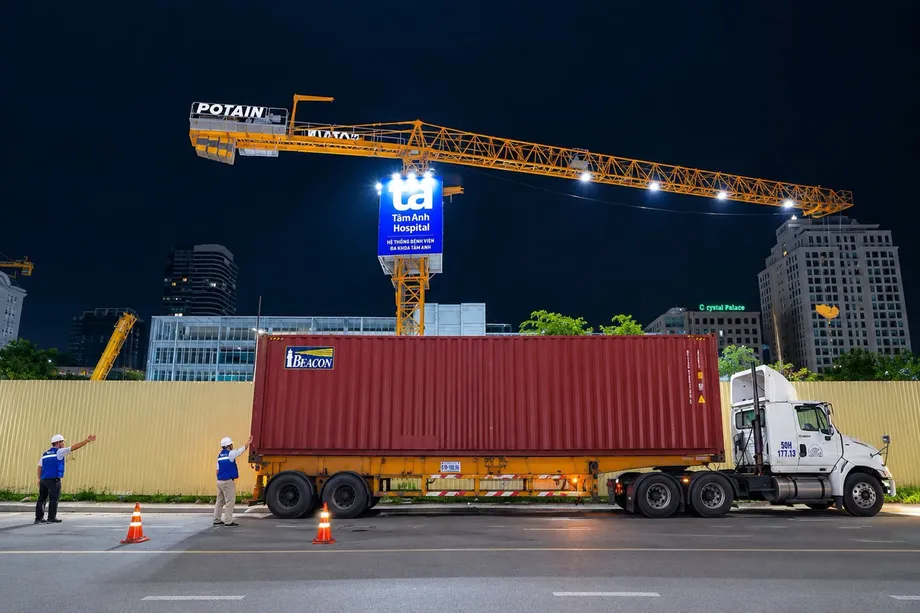
The first components of a proton therapy system valued at nearly VND 2 trillion reached Tam Anh's hospital construction site in Phu My Hung, Ho Chi Minh City, late on October 20, 2026. The delivery brings Vietnam closer to offering a form of cancer radiotherapy designed to concentrate radiation in a tumour while reducing exposure to healthy tissue beyond it.
Contents
- Nearly VND 2 trillion system arrives in Ho Chi Minh City
- Two signing dates and a delivery timeline
- How protons deliver radiation differently
- Why patients will sit instead of lie down
- A smaller footprint, with specialised construction still required
- What the planning software and beam controls do
- Why childhood cancers receive particular attention
- Training doctors and physicists before opening
- What domestic treatment could change for families
- Key Points
The American MEVION S250-FIT system will use a fixed proton beam and equipment that positions and rotates patients while they sit upright. Tam Anh is completing a dedicated radiation bunker before installing the system's supporting frame and base.
The hospital plans installation from early 2027, followed by testing and clinical operation from the middle of that year, alongside the opening of its new general and oncology hospital. Manufacturer Mevion gives a later target: its May 26, 2026 announcement says the system could become operational as early as late 2027. A single opening date has yet to be confirmed.
Mevion describes the project as Vietnam's first proton therapy system. For patients selected for this treatment, a domestic service would offer an alternative to travelling abroad, although treatment prices and detailed insurance arrangements have not been announced.
Radiotherapy department head Dr Nguyen The Hien and chief medical physicist Tran Anh Duong were present to oversee the initial delivery. The components begin a process that also requires specialised construction, equipment installation, technical checks and staff preparation before patients can receive treatment.
Two signing dates and a delivery timeline
Tam Anh's contract signing announcement records a purchase and technology transfer agreement signed in Washington, DC, on February 18, 2026, witnessed by Vietnamese Communist Party General Secretary To Lam. US officials David Fogel and Michael G. DeSombre also attended. Mevion dates its definitive purchase agreement to May 26, 2026; neither institution explains the relationship between those two contractual milestones.
The main steps described by the hospital and manufacturer are:
- February 18, 2026: Tam Anh announces the purchase and technology transfer signing in Washington, DC.
- April 2026: Stanford Medicine begins using the system, according to Tam Anh.
- May 26, 2026: Mevion announces a definitive purchase agreement with Tam Anh.
- Late September 2026: Tam Anh doctors and specialists visit Mevion's US factory to prepare for the transfer.
- October 20, 2026: The first components arrive at the Phu My Hung construction site.
- Early 2027: Tam Anh plans to begin installation.
- During 2027: Tam Anh targets operation from the middle of the year, while Mevion identifies late 2027 as the earliest expected opening.
The hospital says it was the second institution worldwide and the first in Asia to order this model, following Stanford. Its February announcement also describes Vietnam as the second country outside the United States able to purchase it. Those rankings use different categories, institutions and countries, while the central local milestone is the planned introduction of proton therapy in Vietnam.
How protons deliver radiation differently
Proton therapy uses positively charged particles found in the centre of atoms. A machine accelerates them into a beam, and the treatment team selects their energy so that most of the radiation dose is deposited at the depth of the tumour.
Conventional radiotherapy uses photons, usually X-rays, which deliver radiation along their path through the body, including beyond the tumour. Protons can sharply reduce that dose beyond the target. Healthy tissue along the beam's entry path still needs careful protection through treatment planning.
Mevion's purchase agreement announcement says this difference can reduce radiation exposure to healthy tissue and lessen side effects in selected clinical situations, particularly childhood cancers and complex tumours. The benefit depends on the tumour's location and the treatment plan for the individual patient.
Tina Yu, Mevion's chief executive officer and president, described the company's purpose in bringing the system to Vietnam:
Our partnership with Tam Anh General Hospital marks an important step in Mevion's mission to make the most advanced cancer care accessible to patients worldwide,
Why patients will sit instead of lie down
Dr Hien explains that many conventional radiotherapy systems rotate a large machine around a patient lying on a treatment couch. The S250-FIT instead keeps the proton source fixed and uses precise positioning equipment to turn and align the patient for the required treatment angles.
Mevion says the Tam Anh installation will include an upright positioning system supplied by Leo Cancer Care. Moving the patient rather than a large rotating assembly helps reduce the space and structural demands of the treatment room.
Tam Anh expects the seated position to offer practical advantages for some people who struggle to lie flat for long periods, including older patients and people with spinal pain, breathing difficulties or obesity. The hospital also says sitting upright may allow more natural lung expansion and improve breathing comfort.
Breathing moves the diaphragm and can shift organs in the chest and abdomen. If upright positioning makes that movement smaller or more predictable for a patient, the treatment team may be able to reduce the safety margin around the tumour. That margin is an extra area included in the radiation plan to allow for movement and small positioning differences.
Accurate positioning must be repeated at every session. Imaging in the treatment position therefore forms an important part of the proposed system, helping staff check where the tumour and nearby organs are before radiation is delivered.
A smaller footprint, with specialised construction still required
Tam Anh puts the system's installation footprint at about 111.5 square metres. Its installation and operation plan contrasts that with earlier proton centres, particularly facilities with several treatment rooms, which can occupy thousands of square metres.
Traditional layouts may require a separate accelerator, extensive beam transport equipment and rotating structures weighing hundreds of tonnes. The compact design integrates the accelerator and removes the need to rotate such a large structure around the patient.
Mevion describes the S250-FIT as a system cleared by the US Food and Drug Administration for installation in an existing conventional radiation therapy vault. At Phu My Hung, however, Tam Anh is preparing a dedicated bunker within a new hospital. Its foundations, reinforced steel and shielding are being designed for the installation and radiation safety requirements.
Proton therapy's long development helps explain the focus on size. Tam Anh dates the original treatment concept to 1946, the first patient treatment to 1954 and the first proton centre designed for clinical use at hospital scale to 1990. The present project aims to bring that technology into a more compact hospital setting, while retaining the specialised infrastructure needed to operate it.
What the planning software and beam controls do
Tam Anh's system technology description presents the S250-FIT as an integrated platform combining an accelerator, CT imaging, beam delivery and treatment planning assisted by artificial intelligence. CT scans provide a three dimensional picture that helps staff map the tumour and nearby organs.
Mevion identifies RaySearch Laboratories as the supplier of the RayStation planning software, with HYPERSCAN and DirectARC planning features. Tam Anh also names SmartARC, imaging using two X-ray energy levels and a CT scanner with a large opening. The descriptions cover several planning and delivery tools; the equipment and software installed will need to work together for clinical treatment.
HYPERSCAN directs a narrow proton beam across the target. Tam Anh claims scanning and changes between treatment layers can be up to 20 times faster than conventional approaches, while its Adaptive Aperture beam shaping technology can produce beam edges three times sharper. The hospital does not identify the comparison systems in those descriptions.
Tam Anh also describes a superconducting magnet with a field strength of 10 tesla. Tesla measures magnetic field strength. Strong magnets help make the accelerator compact while it produces the proton beam needed for treatment.
Artificial intelligence is described as supporting planning and adjustments when a patient's anatomy changes, for example through weight loss or tumour shrinkage. These changes matter because the beam must continue to reach the intended target while keeping doses to nearby organs within the treatment plan.
Why childhood cancers receive particular attention
Stanford Medicine began operating the system in April 2026, according to Tam Anh, which says the installation followed US regulatory clearance and European CE approval. Tam Anh's February announcement dates FDA clearance for the new version to October 2025. Mevion says both the S250-FIT and its S250i system have received regulatory approval in Vietnam.
The first child treated with the system at Stanford was Stephen De La Torre, aged seven, who had a rare malignant brain tumour, according to Tam Anh's account. He underwent surgery to remove the tumour before receiving additional radiation treatment.
Dr Susan Hiniker, a paediatric radiation oncology specialist at Stanford Medicine, highlighted the potential to reduce lasting side effects in children. Growing organs and tissues are especially sensitive to radiation, making the amount delivered outside the treatment target an important consideration.
Tam Anh identifies brain, head and neck, spinal cord, lung, liver and digestive system tumours among the complex locations the system could help treat. Whether proton therapy is suitable will depend on each patient's diagnosis and the clinical assessment of the treating team.
The hospital also cites technical findings presented at ESTRO 2026, including beam accuracy below one millimetre and quality check results ranging from 97% to 99.8%. These figures describe equipment precision and quality testing. Patient outcomes, including tumour control and side effects, are assessed through clinical follow up.
Training doctors and physicists before opening
Dr Pham Xuan Dung, director of Tam Anh's Oncology Centre in Ho Chi Minh City, identified three priorities for the hospital's visit to Mevion's factory in late September 2026: agreeing the installation schedule, preparing staff and expanding international cooperation.
Mevion committed to specialised training for doctors and medical physicists. Medical physicists help calculate and check radiation doses, test equipment performance and ensure that the treatment delivered matches the approved plan.
Tam Anh also wants to exchange experience with institutions such as Stanford and eventually become a proton therapy training centre for Vietnam and the region. That goal extends the project beyond purchasing equipment to building a workforce able to operate and teach the technique.
TD Tech Company, identified by Mevion as its Vietnamese distributor, is involved in bringing the system to the country. The transfer brings together the hospital, equipment manufacturer, positioning supplier and planning software provider, alongside the local construction and clinical teams.
What domestic treatment could change for families
Tam Anh's immediate promise is geographical: suitable patients could receive proton therapy in Ho Chi Minh City rather than arranging treatment abroad. For families, that could reduce international travel, accommodation needs and time spent away from relatives during a course of treatment.
The financial benefit for an individual patient will depend on the eventual charges and insurance support. Tam Anh says costs will vary with the cancer type, disease stage, treatment duration and applicable insurance reductions. It has not published a standard treatment price or a fixed course length.
The nearly VND 2 trillion investment describes the system purchase, while patients will need information about the cost of their own care. The hospital's proposed opening in 2027 therefore has two practical milestones: making the equipment ready for clinical use and establishing how patients can access treatment.
Tam Anh Group chairman Ngo Chi Dung has presented the purchase as part of a broader investment in cancer diagnosis and treatment. For the Phu My Hung project, the next concrete steps are completing the bunker, installing the system from early 2027 and carrying out testing and staff preparation before clinical operation.
Key Points
- The first MEVION S250-FIT components arrived at Tam Anh's Phu My Hung site on October 20, 2026.
- The system is valued at nearly VND 2 trillion and is intended to introduce proton therapy in Vietnam.
- Tam Anh plans installation from early 2027 and operation from the middle of the year; Mevion gives late 2027 as the earliest expected opening.
- The compact system uses a fixed proton beam, upright patient positioning, CT imaging and computerised treatment planning.
- Proton therapy can reduce radiation beyond a tumour, with potential benefits for selected patients, particularly children and people with complex tumours.
- Specialist training is planned, while treatment prices and detailed insurance arrangements have not been announced.